Tag Archives: 5-25

Steiner, M5X, desert tech, HTI, 50bmg,

Steiner MX5i 5-25×56

Preface

Steiner Optics has a long and distinguished history of making professional grade shooting tools. I have always been a fan of the brand and I’ve reviewed several products here. Today we are looking at another one of Steiner’s popular rifle scopes, the Steiner MX5i 5-25×56. The MX5i has been a popular riflescope for law enforcement and military use during the last decade or so. Today I wanted to see how this popular scope stands up to the other scopes I have used.

The Mx5i Riflescope

The Steiner MX5i is a purpose built tactical scope made with precision shooters in mind. It has all the features a long-range precision rifle would need. The large 34mm tube allow for a full 26 MRAD of elevation adjustment, and houses the large erector housing with fully adjustable turrets. The Duoscale elevation turret has 15 MRAD per rotation, and allows you to reset at zero easily.

Steiner, M5X, desert tech, HTI, 50bmg,
the Steiner MX5i mounted in a Contessa 34mm Scope Mount

Inside the MX5i you’ll find the MSR2 illuminated reticle, which I have used in several scopes with success. The FFP reticle is very useful without being too obtrusive, and the ability to illuminate it in low light conditions is also quite helpful.

Included with the scope are some nice flip-open caps to protect the lenses, as well as the typical accessories. As well as the Steiner Heritage Warranty to give you peace of mind. Steiner has moved some of their production to the US which is comforting. In my opinion, the second best place to have a scope built is Germany, and that is where the MX5i comes from.

Steiner, M5X, desert tech, HTI, 50bmg,
the MX5i made a perfect companion for the Desert Tech HTI 50 BMG

Specifications

Steiner Optics MX5i Riflescope
Magnification5-25X
Reticle MSR2
FinishMatte Black
Objective Diameter56MM
Reticle Focal PlaneFirst
Tube Diameter34 MM
Field of View4.6 – 23.6 ft at 100 yds
Eye Relief3.5 – 4.3 in
Exit Pupil2.2 – 9.8 mm
Length16.6 Inches
Weight36.3 Ounces
IlluminationRotary Rheostat with off settings between
Turret DesignDuoscale with resettable zero
Turret Values0.1 MRAD per click
Elevation Range26 MRAD
Parallax FocusSide focus adjust
BatteryCR2450
MSRP $3679.99

Shooting the Steiner MX5i

I’ve had the good luck to use this scope quite a bit, which is not always the case when reviewing some products. Having been able to travel the world a bit with the scope has given me some additional insight into its durability. From shooting 50 BMG rifles in the arid deserts of the west, to sub-freezing temps shooting down abandoned Soviet airstrips.

My first experience shooting the scope was on my Desert Tech SRS M2 chambered in 338 lapua magnum. A strong rifle that would show failures in a scope that isn’t up to the task. Zeroing the rifle was easy using the MX5’s turrets. With a simple slip of the turrets I zeroed the elevation and windage.

First Shots

On the first trip out, we stretched the rifle all the way out to 1600 yards. I must say that I was impressed with both the repeatability of the scope, and the optical sharpness. As it happens, after picking out a target at 1600, every shooters dream occured…

Steiner, M5X, desert tech, SRS, srs m2, 338lm,

A lone coyote wandered out of the cedar trees just behind my target zone just as I settled in for a shot. I watched him as he picked his way between the trees hoping for him to pause. After he seemed to show no sign of stopping, I decide to lead him. Having made a dozen or so shots all ready at that distance, I had a pretty good idea of the flight time anticipated. With my lead held I pressed the trigger, sending the 250 grain Swiss P bullet on its way.

My luck with coyotes held true that day, as just after I pulled the trigger he must have sensed a disturbance in his aura or something and he stopped. A moment later and just a foot or two ahead of him, my shot landed right where he should have been. It would have been an amazing shot.

Shooting Abroad

A few weeks later I found myself laying in deep snow looking down a cut in a sea of coniferous forest in northern Europe. My breath would condense and freeze to the side of my rifle, making it somewhat challenging to focus. But looking through the MX5 I could clearly see my targets downrange a kilometer away. The target hangers contrasted clearly against the white blanket of snow.

Steiner, M5X, desert tech, SRS, srs m2, 338lm,

Over the course of several days we shot targets in the icy breeze, with and without snow falling. It was a great test of the clarity of this scope, never fogging up. It also required me to rely on its accurate tracking, as I was shooting soft targets through falling snow. It was impossible to see impacts.

Steiner, M5X, desert tech, HTI, 50bmg,
Loosening turret screws to zero the turret

In Tandem

I also shot the MX5i in tandem with the Andres Industries TigIR thermal sight. This brought another level of perception, looking through both optics together I was able to see my bullet holes appear in the snow even 600 meters away.

Steiner, M5X, desert tech, SRS, srs m2, 338lm, Andres Industries, TigIR, thermal,

You can read more about the Thermal here, but I must say that the Steiner MX5i worked fantastic together with it.

a teasing look through the TigIR

Parallax Adjustment

I love a scope with good focus, and the MX5 does a great job focusing the image properly. The adjustable parallax also allows you to remove parallax from your view across great distance. This was very helpful both on the rifle range, and the desert.

Adjusting the scope in general was smooth and predictable. The clicks of the turrets felt clean and audible. The Duoscale elevation turret is pretty interesting, as you cross the 15 MIL point to the second rotation, the numbers slide up and change to 15 and up.

Steiner, M5X, desert tech, HTI, 50bmg,
the HTI supported by the Elite Iron Revolution Bipod, check out more options here

The MSR2 reticle is a fantastic reticle for this kind of shooting. It gives you plenty of tools for measuring targets and ranging distance if thats your thing. And at the same time it doesn’t obscure your target area. I like the open center dot, it allows for very precise placement.

you can see here how little the reticle obscures your target area

Durability

After having shot this scope over a long period of time across various rifles and calibers, I am quite confident in its quality. Neither my 338 nor 50 BMG managed to knock it out of place. Traveling across the world in hot and freezing climates haven’t seen to do it any harm. It’s never lost zero, and the tracking has never missed. I suppose this should come as no surprise as the MX5i is built on a one-piece tube, with a history of hard military service.

Pros and Cons

Of the many positive aspects of this scope I must say my favorites are these; The robust reliability, the precise tracking and repeatability, and the clear reticle that is easily focused at any distance. These features make this scope an easy choice if you find yourself heading into the unknown. Whether it be against cunning animals or an opposing force.

Steiner, M5X, desert tech, SRS, srs m2, 338lm, Andres Industries, TigIR, thermal,

The only thing I would take away from the Steiner MX5i would be that it seems to suffer in clarity a tiny bit at full power. This seems to be the case for most every scope I use, so its not particularly a jab at this Steiner in particular. But I did find myself often using the scope at 21-22 power for optimal clarity at long-range.

The MSRP from Steiner of nearly $3700 might be a tough pill to swallow for some folks. Even the going street price hovers around $3000 from places like Euro Optic. But if you want military quality optics like this, you can expect to pay for them.

Steiner, M5X, desert tech, HTI, 50bmg,

Conclusion

It comes as no surprise to me that this scope performed so well for me. With a reputation like that of Steiner Optics, you can expect great performance. With the MX5i you can expect years of reliable and repeatable shooting with sharp images. Like many others, I can strongly recommend this scope for those interested. If you are looking for something a little more affordable, check out my reviews of the Steiner T6Xi scopes as well.

Steiner, M5X, desert tech, HTI, 50bmg,
the Duoscale turret changing scales

-CBM

The US Optics Foundation FDN 25X

Introduction

Many years ago, when I first stumbled down this rifled rabbit hole. I would daydream about the high-end and prestigious rifles I saw in magazines and movies. The internet had not yet become the superhighway it was destined to be. But as it developed I could also visit websites and court those beautiful works of art. Not only was it the rifles, but the impressive optical sights that accompanied them. My dreams of owning such a piece of artisanship seemed unattainable at the time, but I never could have foreseen just how far down this hole I would go. Today we are looking at the US Optics Foundation FDN 25X.

Years would pass, more than a decade. Before I found myself the proud owner of what I had always considered a dream scope. US Optics had always been one of the brands I was smitten with. Maybe it was the incredibly robust design that seemed overbuilt for what many would consider standard use. On top of their strength, US Optics scopes had a mechanical attractive flair. It was like looking at top-fuel race engine, you could see all the little things that made it work its magic, and that enticed me even further.

The US Optics Foundation 25X

That first US Optics scope was an ER-25, it was the first but far from the last. I’ve since had four more. With the latest being the newest offering from US Optics, the Foundation Series 25X. The Foundation series is USO’s latest line of top tier telescopic sights, made here in the US. The FDN25X boasts some impressive features. Some you would expect, and others you might miss if you didn’t pay close attention.

The 25X uses a fairly standard 34mm tube and 52mm objective, manufactured from 6061 T6 aluminum, it shares a nearly identical body with its predecessor the B25. But there is more, the FDN25X has the new EREK3 elevation turret with 11 MRAD per revolution. As well as a 180-degree throw magnification ring, the new JVCR reticle (my favorite) with illumination available in red, blue, or green, smooth parallax adjustment, and an internal bubble level.

257 Blackjck
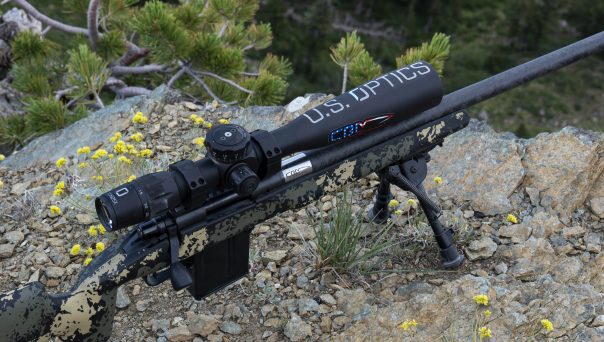
The Blackjack featuring a Proof Research carbon fiber barrel

Unboxing

As I opened the box of the 25X and first picked it up, I was surprised at the weight. At thirty-four and a half ounces, it’s not exactly light but it seemed light for its size. Perhaps I was expecting it to weigh more. I surely wasn’t going to waste much time, I wanted to get this scope mounted and get shooting with it.

In no time I mounted it on the rifle it was ordered for, my custom built 257 Blackjack. It is a lightweight carbon fiber hunting rifle to haul all over these Rocky Mountains for Mule Deer, Elk, and likely a few Antelope as well. The 25X makes a great companion optic for the Blackjack. It stays supersonic beyond two thousand yards, and its energy, drop, and wind deflection makes it ideal for long-range shooting. The 25X has been designed and built for just such shooting. With high-quality lenses to give a clear picture of distant targets. The JVCR reticle gives fine wind holds and holdovers, with .1, .2, and .5 subtensions.

JVCR Reticle detail, and green illumination

Rangetime with the FDN25X

So with the 25X mounted in rings on a 20 MOA scope base, I wandered off into the hills to get it zeroed and to put it to the test. Zeroing the scope was simple, the new EREK3 elevation turret was easy to figure out with a brief revision of the manual. I removed the center screw on top of the turret and adjusted my reticle with the provided hex wrench. After a couple adjustments, it was zeroed perfectly and my elevation set to zero.

Normally I slowly work my way out from closer targets to more distant ones, but that day, I went straight for the long shots. The first shots after zero were 1230 yards, I dialed 6.5 MRAD on the EREK3, and fired a few shots. After getting the wind call right, they were hammering the steel. The EREK3 turret is a good combination of stiff, and crisp. Not too hard to turn, but firm enough to avoid accidental movement.

As it happens, my first trip out with the FDN25X was a shoot with Donald Trump Jr. He was impressed by performance of the 257 Blackjack, and the FDN25X

Turret clicks are both audible and tactile, adjustments are easily made from the shooting position by simply counting the clicks either felt or heard. The magnification ring is also a welcome improvement, with only 180 degrees of rotation, you can go from 5x all the way up to 25x with one movement. Instead of having to release and turn again like other scopes. It’ also easier to turn than previous models.us optics

Refinement

After zeroing my scope, I swapped out the scope base for a 30MOA, to get the scope closer to an internal mechanical zero (to avoid the extremities of erector movement). And with it freshly zeroed, the turret had a full twenty-one MRAD of elevation available. It is highly unlikely I will ever use that much elevation, according to my ballistic computer, twenty-one MRAD will take the supersonic Blackjack to 2159 yards.

The EREK3 elevation, and US #1 windage turrets

US Optics’ JVCR reticle is one of my favorite reticles, I’ve got another one in another US Optics scope. The .2 MRAD marks are all over the reticle, giving a quick and easy reference for adjustments. An open center floating dot makes a perfect reference point when trying to shoot tiny groups on paper. And the open space around it will make it easy to hold center on any of the animals I plan on hunting this fall.

I ordered green illumination on the scope. Mainly because I’ve had red on every other scope I’ve ever had and wanted to see something different. I’m not overly worried about it, as illumination has rarely been used in most hunting scenarios I’ve been in. But for that occasional need, it is sure nice to have.

One little thing that I found that did bug me perhaps, is an abnormal crescent shaped shadow when the scope is dialed to either of its extremities. This is normal as US Optics has it listed under their FAQ’s on their website. To be fair, it is only visible at low power (less than 8x), and only when the EREK3 turret is almost all the way up or down. I think it is very unlikely that it will ever be an issue. Because if Im dialed all the way up, I’ll very likely be zoomed in at least to 12x or more. And if it is an issue bottoming out the scope, then you’ll need to use an additionally canted base. Like I said, a small issue, but one you may want to know about.

Beneficial features

The anti-cant bubble inside. When looking thru the scope and focusing on the target, the highlight of the bubble is seen at the bottom of the reticle

Another very cool feature of the Foundation 25X is the internal level or anti-cant device as it’s often called. I always loved the idea of having it inside the scope, but so many times its been done poorly. Not that I have anything against it being external, especially good ones you can see from the shooting position.

But it is so much nicer to see in real-time, through your aiming eye without taking it off the target. The way US Optics executed this level is very nice, I ordered the internal level. But it is so subtle that I didn’t even notice it the first time I looked through it. It is tucked neatly at the bottom of the field of view, and like I said, its so low profile that you actually have to make an effort to see it. I’m not sure if the engineers at USO want you to look at the actual bubble itself. Or if you are meant to see the highlight reflecting on the bubble as your reference point, either way, it is very handy when you’re in the shooting position.

Accuracy Testing

I also tested the scope for actual click value, which can vary greatly in rifle scopes. I tested the click value by measuring the turret movements against the values of the reticle, as well as against a ruler at a set distance. By doing this you can tell if the clicks actually represent the value claimed. I’ve never tested one that came out perfect, but this one is close enough for my purposes. Under 10 MRAD of adjustment, the actual value was no more than .02 MRAD off of claimed value. And at 20 MRAD, it was just over a tenth MRAD from claimed value. I am not a rocket surgeon, but I think it’s safe to assume that the difference between claimed and actual is spread progressively across the curve as elevation increases.
In addition to testing click value, while I had the scope clamped down solid I also checked the tracking and for reticle cant. Cranking the turrets up down and left and right shew no inconsistency. They always returned back to the exact same spot as I counted the clicks. No noticeable movement in the reticle either, as I zoomed from one magnification to another.

If 25X is a bit much for you, check out my review of the USO FDN17X

Final thoughts

The only thing I haven’t been able to test so far with the Foundation 25X, is its durability over time. My First US Optics scope took such a beating I was sure it would break, banging into rocks, falling off the tailgate onto concrete attached to a twenty-pound rifle, stuff like that. But I was blown away when not only did it survive these events, but didn’t even lose zero. That is a pretty hefty standard to live up to, and I hope that the Foundation scopes are up to it. Time will tell, I certainly don’t plan on dropping it, or bashing it against rocks, but who knows what the future holds?

There is no way this rifle and scope aren’t coming with me for hunting season this year. The 257 Blackjack will light up anything I intend to hunt. And coupled with the impressive view from the Foundation 25X, it should be unstoppable. I am extremely anxious to get up into the high country, and get comfortable and effective with this rifle and scope. You will no doubt be hearing from and seeing more pictures of us in the fall.
-CBM