Tag Archives: springfield armory

springfield Armory model 1898, 30-40, krag, krag jorgensen,

Springfield Armory Model 1898 30-40 Krag

Introduction

If you found yourself part of the United States Army during the American Imperialism wars, you probably would be very familiar with today’s subject. While I’ve never been property of Uncle Sam’s green team, I often wonder how previous generations of American servicemen would feel about modern armament. Fortunate we are to be in the position to analyze both modern military rifles and those of generations past as well. Today we will share the same walnut grip with nineteenth-century Americans, as we walk through the Springfield Armory Model 1898 30-40 Krag.

springfield Armory model 1898, 30-40, krag, krag jorgensen,

The 1898 Krag

I had always wondered where the strange name of this rifle came from, as it turns out it came from Norway. Which if you like guns and hunting is a pretty cool place. The US adopted the design from the Krag-Jorgensen rifle that was also in use from Northern Europe to eventual places like Rhodesian forces and Asia.

This US Model 1898 was manufactured by Springfield Armory just after the turn of the last century in 1902. Despite its age, this old rifle still feels fantastic. The bolt-action that is famously smooth feels better than many modern rifles. The interesting bolt lug design is much different than our modern prescription. There is a single bolt-lug that rotates down engaging the receiver in the six o’clock position, but there is another at the rear of the bolt-body that also engages the receiver at three o’clock. A spring-claw extractor runs the length of the bolt on top, and the ejector pops-up from where magazine followers typically are.

springfield Armory model 1898, 30-40, krag, krag jorgensen,

There is a bolt-shroud safety on top, very similar to the Springfield Model 1903 that replaced the Krag rifle. There is also a magazine disconnect switch that we’ll get to in a moment. The large and obtrusive magazine stands out on the right-side of the rifle. It’s spring-loaded door and follower hinge open to allow cartridges to be deposited within.

The long thirty-inch barrel is partially covered by the walnut stock that extends almost all the way to the muzzle. There are three sling-mounting rings placed along the underside of the stock, which seemed normal in those days. Also typical for the time, there was a ramped adjustable rear notch sight, with a very thin front blade sight.

How to Feed the 30-40 Krag

Krag cartridges come from a time when it was simply the caliber and powder charge that named the cartridge. The original Krag fired a 30 caliber bullet with 40 grains of powder, a step up over the 30-30’s thirty grains of powder. I load mine with 150 grain round-nose bullets, though you can use spitzer type bullets in the Krag due to its interesting magazine.

springfield Armory model 1898, 30-40, krag, krag jorgensen,

The magazine feeds in an almost rotary design, circling from the bottom right up and to the left side of the action where the bolt pushes them into the chamber. With the magazine folded open the cartridges are dropped into the loading gate. The spring follower folds out of the way during this process, but as soon as the gate is closed the follower pushes up to five cartridges into line.

Primary arms

During the loading process the fresh cartridges are presented on the left-side of the bolt to be pushed into battery. The magazine disconnect switch allows the rifleman to operate the bolt without feeding these cartridges from the magazine. This was likely used for single feeding cartridges dropping them in from the top of the action. And with the flip of a switch you could rapidly shoot the five rounds from the magazine.

Shooting a Relic

There is something interesting about shooting firearms from another epoch. I imagine the early Americans who shot these rifles appreciated the smooth bolt and feeding the same way I do. Taking up the first stage of the trigger I imagine the countless shots taken by Krag rifles over the last century.

Finish Reading here

springfield Armory model 1898, 30-40, krag, krag jorgensen,

Check out more rifle reviews here

Springfield Armory, Waypoint, 2020, 308 winchester, US Optics, TXH 3-18,

Springfield Armory Waypoint 2020

Preface

In our ever changing world there is some solace in knowing that we are spoiled for choice when it comes to sporting arms. Being a part of the firearm industry certainly offers me additional privileges and access, and today I intend to share with you another one the countless rifles I’ve been able to examine. Today we are taking a close look at the Springfield Armory Waypoint 2020 rifle chambered in 308 Winchester.

Springfield Armory, Waypoint, 2020, 308 winchester, US Optics, TXH 3-18,

The Waypoint 2020 is marketed as a lightweight precision rifle with a definite nod towards the hunting crowd. The Waypoint is a bolt-action rifle patterned after the extremely popular Remington 700 footprint. There is a variety of models but all of them feature a carbon fiber stock, and detachable box-magazines. Different color camo patterns can be selected, as well as other features like carbon-wrapped barrels and radial muzzle brakes. Let’s get into it.

The Springfield Armory Waypoint 2020

2020 Action

The foundation of the Waypoint rifle is the 2020 action, a two-lug ninety-degree bolt action much like the Remington 700 it closely resembles. I say closely because it greatly improves over it’s predecessor. The 2020 action uses a one-piece fluted bolt-body with a removable bolt-handle. At the front of the bolt you’ll find the sliding extractor and spring-plunger ejector. The sear is tripped by a Trigger Tech Field trigger, which in my experience is fantastic.

Springfield Armory, Waypoint, 2020, 308 winchester, US Optics, TXH 3-18, Banish backcountry, suppressor
the Banish Backcountry suppressor worked great with the Waypoint

At the back of the action you’ll find the bolt-stop/release. This is the stronger and superior design, making the bolt quick to remove and firmly stopped when it reaches the aft stroke. The Waypoint 2020 action comes with a scope base-rail installed, using both screws and dowel pins for security.

Carbon Fiber Stock

Rigid and lightweight are the first things that come to mind when feeling the Waypoint stock. At the back there is a soft rubber recoil pad as well as some flush mounted QD-cups for attaching a sling. The vertical grip is very modern and comfortable, allowing easy placement of your thumb at the proper angle. The Aluminum trigger-guard is also very well done, and features the mag-release in the front of the trigger area. And using AICS pattern magazines is a sure way to gain points with most shooters.

The front of the stock also features a QD-cup for sling attachment, as well as M-Lok slots on the bottom to attach a bipod. I found the stock to be very comfortable and very serviceable.

Carbon Wrapped Barrel

The twenty-inch barrel is carbon fiber wrapped, for weight reduction. At the muzzle it was threaded 5/8-24 with a radial muzzle brake installed to tame the rifle. Chambered in 308 Winchester the barrel features a 1:10 twist which allows for a great deal of bullet compatibility.

Springfield Armory, Waypoint, 2020, 308 winchester, US Optics, TXH 3-18, carbon fiber barrel

Specifications

                            Springfield Armory Waypoint 2020 308 Winchester
Weight6 Pounds 9 Ounces
Length41.5 Inches
Barrel20-inch 1:10 twist Carbon Fiber
Trigger Adjustment2.5-5 Lbs
Muzzle DeviceRadial Blast Brake ⅝-24 threads
MagazineAICS compatible 5-round
Optics MountingPicatinny Rail 6-48 Screws
Receiver Stainless Steel 2020 
ColorEvergreen Camo/Green Cerakote
MSRP$2599

Range Preparations

In order to properly test the Waypoint, I would add a few things and bring along others. First off was a good scope, for that I decided to go with one of my favorites. The US Optics TXH 3-18 is a perfect scope for a precision hunting rifle, with a set of 34mm rings it dropped perfectly into place on the Waypoint. I’d also add a Harris bipod for supported shooting, using the M-Lok slots I attached a pic-rail section to make my bipod easy to install and remove.

For ammunition I brought a nice spread as well. First off were a couple selections from Hornady, the American Whitetail 150 grain ammo, and the Precision Hunter 178 ELDX. I also brought along some Barnes Vor-TX 130 grain ammunition as well as a box of DTM 308 Match 175 grain.

And just for good measure I also threw in my Silencer Central Banish Backcountry suppressor, which would make a perfect lightweight companion to this rifle.

Continue Reading here

My first foray with the Waypoint was at a public range, not something I enjoy but worth the time. It took no time to zero the rifle with just a couple shots after I boresighted it. After which I shot a few different groups to see if the rifle preferred one ammo type over another. It came as no surprise that the DTM 175 match seemed to shoot the best, with a Barnes 130 grain in a very close second place. Velocities from those two were 2560fps and 3020fps respectively. After some accuracy testing, I continued shooting to see how the rifle functioned and fed.

Springfield Armory, Waypoint, 2020, 308 winchester, US Optics, TXH 3-18, Athlon Velocity pro chronograph,
testing Barnes VOR-TX ammo with the Athlon Velocity Pro Chronograph

Springfield Armory, Waypoint, 2020, 308 winchester, US Optics, TXH 3-18,
Magpul AICS mags work great in the Waypoint

Springfield Armory, Waypoint, 2020, 308 winchester, US Optics, TXH 3-18, target, accuracy
Some average groups from testing

Springfield Armory, Waypoint, 2020, 308 winchester, US Optics, TXH 3-18,
the US Optics TXH 3-18 was a perfect match for the rifle

Springfield Armory Hellcat Pro, 9mm, handgun, pistol, Viridian RFX11, red dot

The Springfield Armory Hellcat Pro Handgun

Introduction

Anyone who regularly carries a handgun is familiar with the downsides of concealed carry. But every now and then somebody innovates an idea that’s like a ray of sunshine in the dark. Polymer framed pistols have become a mainstay in our handgun market, and some of them bring incredible features to concealed carry enthusiasts. Today we are reviewing one such pistol that promises a perfect balance of concealment and capacity, the Springfield Armory Hellcat Pro.

Springfield Armory Hellcat Pro, 9mm, handgun, pistol, Viridian RFX11, red dot

Big claims by Springfield Armory (SA) about the smallest footprint in its class are matched with impressive magazine capacities of 15+1 and 17+1. From a small pistol that’s only an inch wide and weighs in at 21 ounces. As both a CCW and general firearm enthusiast, I was encouraged by the opportunity to see how the Hellcat Pro stands up to these claims.

The Hellcat Pro OSP

The Hellcat Pro OSP (optical sight pistol) also incorporates the very popular trend of allowing installation of red dot sights. It’s Melonited® slide comes ready to mount RMSC sized red dots that co-witness with the sights. The sights themselves include a Tritium luminescent front sights and U-shaped rear sight. The sights line up beautifully, and when the included Viridian RFXII red dot (actually green) its zeroed its very conducive to aiming well.

Hellcat Pro OSP, Viridian RFXII
note sight lineup, front and rear sight lined up perfectly with green dot from the RFXII

Additional features like the loaded chamber indicator are nice for safe operation. And the slide is texture-cut both front and rear allowing you options for grip. The polymer frame also features a nice texture for better purchase, and a reversible mag-release in case you grip with the wrong hand. The crisp trigger features a pretty standard blade safety, but no other safeties which I prefer for CCW. There is other models of the HC Pro that do include a manual safety if that’s your style.

I don’t consider my hands to be big or small (but don’t let that fool you), and my average hands fill the grip area perfectly. The extended 17-round magazines add additional grip area if you are one of those bigger handed fellows. And up front you’ll find the typical picatinny rail for weapon lights.

Specifications

Caliber9mm
Color Black
Barrel Length3.7 inches
SlideBillet Machined, Optics Ready
FrameBlack Polymer w/ Adaptive Grip
SightsTritium Front, Tactical Rack U-Notch Rear
Recoil SystemDual Recoil Spring, Full Length Guide Rod
Grip Width1 inch
Weight21 Ounces
Length 6.6 Inches
Height4.8 Inches
Magazines1x15rnd & 4x17rnd included
MSRP$1050.00

The Hellcat Pro I received came from Sportsman’s Warehouse as a package. It included the Mounted Viridian RFXII red dot, extra magazines, both a compact pistol soft case and a range bag.

Springfield Armory, Hellcat Pro, 9mm, OSP

Hellcat Pro OSP Initial Impressions

My first impressions when I pulled the Hellcat Pro from its soft case was how compact it is. The narrow frame is very apparent, making me immediately think of how less-invasive it would be on my belt. The whole design of the Hellcat is very conducive to concealment, it has very clean edges and few snag-points.

The gripping areas on the frame and slide were adequate. When I pulled the slide back the first few times I noticed the dual recoil springs are stiffer than I had anticipated. I suppose I wouldn’t have minded a slightly more course slide cut design for better purchase. But at the same time I understand this is a CCW gun, not a competition pistol. So there will be less drawing of slides, and more sliding in and out of your waistband, so the texture is probably just right. The overall feel of the gun was fantastic, and made me very optimistic about its potential.

Springfield Armory Hellcat Pro, 9mm, handgun, pistol, Viridian RFX11, red dot

Shooting the Hellcat Pro

With a can full of 115 grain ammunition from MWLP, I headed out to shoot the little Hellcat. It wasn’t long before I was stuffing mags full of cartridges. Unfortunately that was where I met my first hiccup. Stiff magazines springs are common when dealing with larger capacity, but I found that on the 17 round Hellcat mags loading the last round was unbearably hard. It literally felt like I was going to break something, on at least one of the mags I was unable to get the 17th cartridge in.

MWLP

Loading

Loading full magazines into the pistol took a really firm slap to seat unless the slide was open. With the gun loaded it was time to start snapping the trigger, which felt great. Small 9mm pistols like this are often a little harder to keep on target through recoil, and the Hellcat was no different. It was certainly pretty peppy as rounds flashed downrange. I tend to prefer larger pistols for this reason, but I’m sure that with proper practice and training I would be more comfortable.

Springfield Armory, Hellcat Pro OSP, 9mm, CCW

I shot through all the magazines, performing reloads in between. Again, I am used to larger pistols, and particularly those that use flared magwells. So it was no surprise that it took more focus to stab the fresh magazines into the narrow magwell of the Hellcat Pro. I also noticed another issue while performing reloads, the Hellcat would frequently fail to lock open when empty. At first I thought it was a specific magazine. Additional testing seemed to prove that it was just a random occurrence among all of them. I suppose it is possible that my finger might have been touching the slide release, but I don’t think so.

Springfield Armory Hellcat Pro, 9mm, handgun, pistol, Viridian RFX11, red dot

Sighting

The sights on the little Hellcat Pro stood out great for me. I felt they were easy enough to pick up even coming through the spicier recoil. The natural pointing angle of the little pistol felt right, and it was always quick to get on target.

The Viridian RFXII reflex sight seemed like a perfect match for the Hellcat, at only 4 ounces it doesn’t add much to the pistol. The RFX features an instant on/off feature, which I am afraid may have been a bit glitchy. During the course of our shooting, it turned off and back on more than once. The ambient light detection feature adjusts the brightness of the dot depending on conditions, but it changed far more than expected while shooting. Even in an indoor controlled shooting range. Obviously this is not what should be expected, and I suppose there may have been some reason for the malfunction, and its certainly nothing to hold against the Hellcat.

Shop all the Hellcat Models at Sportsmans Warehouse

hellcat pro

Controls

The trigger and other controls on the Hellcat Pro were great. The clean break of the trigger felt very consistent and just right for a CCW pistol. At first I thought maybe the slide release was a bit stiff, but it seemed to lighten up a bit after some shooting and break-in.

Springfield Armory, Hellcat Pro OSP, 9mm, CCW
the stripped Hellcat Pro OSP, note 15 & 17 round mags, the Streamlight TLR8 was a great companion

The magazine release is pretty low profile, which is good for a CCW pistol to avoid inadvertent release. Even so, dropping the mag was perfectly natural and tactile under your thumb. The takedown lever took a second to figure out, but it too made breaking down the pistol quick and painless for cleaning. Speaking of breaking-down, with the pistol apart for cleaning, I was happy to see some quality internals. By that I mean not a bunch of cheap stamped parts, but more cast and MIM’d parts it seemed.

Springfield Armory, Hellcat Pro OSP, 9mm, CCW

Pros & Cons of the Hellcat Pro

Lets get into some of the reasons why you would or wouldn’t pick this gun over others. We’ll start with the positive; This things is very compact and neat, it is easily concealed and comfortable to carry as well. I would say there are few pistols I found as comfy as this one, other guns like the S&W Shield and Glock 43 are also great but hold fewer rounds. If you are used to Glock 19 sized pistols then this will feel much better in your belt. I really appreciated the snag-free design, the great controls and especially the high capacity. From an aesthetic view, the gun looks good, and no demerits were added for the sin of molding “grip zone” into the grip of the pistol.

But I suppose the capacity comes at a price, I was a little bit let down by the mag performance. The occasional mag that won’t quite hold the full 17 rounds is a little irritating, but thats still quite a few more than the other pistols I mentioned. I was also turned off by the failures to lock open when empty, but again I’d rather get a click after shooting 16-17 rounds than have to reload after as few as 6-7 rounds.

All these little CCW pistols are a little harder to control than your full-size models. Depending on who is shooting the gun this could be a big deal. For example, I would not want my 100 pound wife to shoot this pistol as it would likely be a whole lotta flinching and vertical stringing. But with some practice these things can be overcome. If you are familiar with shooting, this is much less a problem. Lastly, the Hellcat is made overseas, which for some folks is a deal breaker.

Springfield Armory Hellcat Pro, 9mm, handgun, pistol, Viridian RFX11, red dot

Springfield Armory Hellcat Pro Value

Springfield Armory has an MSRP of $1050.00 which is no small token. However I have found this pistol for sale all over the internet for under six-hundred dollars, which is MUCH easier to swallow. I was genuinely surprised with the deal this one came in, with the RFXII red dot, one 15-round mag and three 17-round magazines, a padded soft-case and a range bag all for under six-hundred dollars as well. With other comparable guns asking the same price for half the capacity, I think the Hellcat Pro is easily a good value.

hellcat pro

Conclusion

Despite the few hiccups, the Hellcat Pro still seems like a pretty good value. Every time I expected it to go bang, it most certainly did (unless it was empty 😅). And that is likely the most important feature in a CCW pistol. The other features also make it a good option for a carry pistol, and I expect it might not take much tinkering to work out the bugs I mentioned above. But if you are the kind of guy who demands perfection, then maybe you might have to adjust your sights a little higher. I hope I’ve made it easier for you to make your choice, good luck!

-CBM

Check out our other handgun reviews here

Springfield Armory Saint AR15

The firearms market is littered with countless AR-15 revisions and designs, so when a company like Springfield Armory joined the vast AR market they must have had something to offer. Today we will be looking at one of the Springfield Saint AR-15 models, to see what Springfield has to offer in this flooded market of rifles.


Gun Specs

CALIBER:                       5.56x45mm NATO (.223 REM)
COLOR:                          Black
BARREL:                        16″ CMV, Melonite®, 1:8
UPPER RECEIVER:     Forged 7075 T6 Aluminum, Type III Hardcoat Anodized,                                                                            Forward Assist, M4 Feed Ramps
LOWER RECEIVER:     Forged 7075 T6 Aluminum, Type III Hardcoat Anodized,                                                                           Accu-Tite™ Tension System
BOLT CARRIER GROUP: M16 w/ Carpenter 158 Steel Bolt, HPT/MPI, Melonite®
GAS SYSTEM:                Direct Impingement Mid-Length, Picatinny Pinned Gas Block
HANDGUARD:               Victor M-Lok Handguard
STOCK:                            BCMGUNFIGHTER™ Mod 0
TRIGGER:                        Nickel Boron Coated GI
MUZZLE DEVICE:         A2 Flash Hider
BUFFER ASSEMBLY:   Carbine “H” Heavy Tungsten Buffer
CHARGING HANDLE: GI Style
SAFETY SWITCH:         Single Side
TRIGGER GUARD:        BCMGUNFIGHTER™
GRIP:                                BCMGUNFIGHTER™ Mod 3
MAGAZINES:                 (1) 30-Round Magpul PMAG Gen M3
WEIGHT:                         6 lbs 11 oz
LENGTH:                         32.25″ – 35.5″
MSRP:                              $1,023

Gun Background

Springfield Armory has been well known for decades for making great firearms. The Saint series of rifles is Springfield’s venture into the AR-15 or Modern Sporting Rifles (MSR) market. The Saint rifles claim all the best features that come with an MSR, the question I plan to answer today is whether the Saint is an exceptional rifle as far as MSR’s go or if it is just another AR.
Springfield has put extensive work into broadening the Saint rifle lineup, with a model of the rifle in near any desirable configuration, including dedicated marksman type rifles, compliant models, and SBR and pistol variants.

Features

BCM Gunfighter furniture- Buttstock and pistol grip come from the popular BCM Manufacturing
M-Lok compatible handguard- Allows for easy addition of accessories
Nickel Boron coated internals- Trigger parts and BCG parts treated for better wear and durability
Forged upper and lower receivers- for strength and hard anodized for durability

Models

The YHM Turbo suppressor was a great companion

The Saint comes in a black anodized color, with other color options in Cerakote like OD Green and FDE. The variants of the rifles can get quite extensive, there are both 5.56 and .308 caliber versions of the rifle. Most of the general options can be had in a low capacity or compliant configuration. There are both sixteen and twenty inch barrel options, and even an SBR 11.5 inch version of the rifle.

On the Range

My first impression of the Saint came as I lifted it from the box, it seemed light enough for its size. And most everything about it seemed exactly as I expected. The M-Lok handguard looked bare with nothing on it, I would change that soon enough. The BCM buttstock was easy to collapse and extend to alter the rifle’s length, there are a couple sling-mounting cups in the back of it to attach a carry sling. The matching BCM pistol grip was a comfortable fit, and textured to give better purchase.
I ran the charging handle a couple times to check the rifle for safety, the smooth melonited bolt carrier slapped back and forth with the familiar boing of the buffer spring. That familiar smell of freshly anodized aluminum sliding against itself reminded me of every other new AR that’s graced my shoulder. Springfield also nitrides their trigger assembly, I expected it would make it smoother than a standard mil-spec trigger. After giving the trigger a few presses, I’d say its a bit better than average, but nothing spectacular. It does have a nice firm and audible reset though.

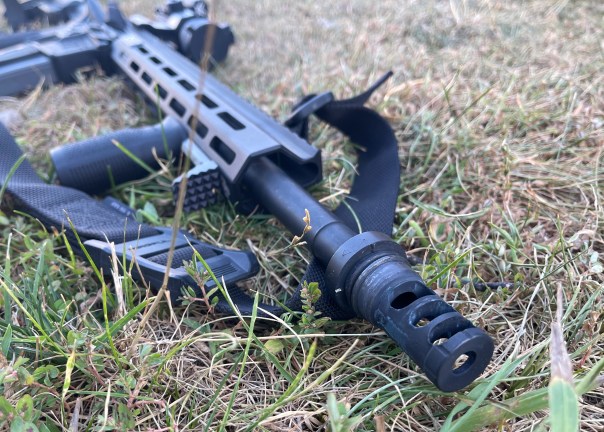
the Saint with a Yankee Hill Machine muzzle brake

Rifles like this are typically setup for short to medium range, with that in mind I decided to go with a simple Vortex red dot sight. With that taken care of, I added a couple other things to the rifle. A Magpul MS4 sling, and a small down-grip up front. I like using these as a place to grip and pull with my support hand. The Saint comes with a pretty standard bird-cage flash hider, but I was surely going to swap that out for one of my own. I intended on running my Yankee Hill Machine Turbo on the rifle, so I mounted up a compatible muzzle brake as well.

With nothing left to do but get treat this Saint to heat of hell’s fire, I grabbed some American Eagle ammo and headed up to my shooting spot. With a stack of GI and Pmags loaded, I set to zero my red dot. The rifle was easy enough to get zeroed which allowed me to spend more time shooting instead of goofing around with the turrets. The light weight of this rifle makes it very easy to throw around, recoil is very modest particularly when suppressed.
Accuracy of the Saint was pretty standard, I had no problems hitting most things that I aimed at within a reasonable distance. Hitting milk jug sized targets at nearly three-hundred yards was pretty repeatable, and close stuff like fifty yards was obviously no challenge at all.
The rifle felt just like it should, easily integrated into my shooting style. The ergonomics of the AR 15 have been perfected over the decades, and the Saint is no different, it fit me well allowing me to shoot it like we were old friends. I hammered through a couple hundred rounds which went all too fast, I’ll happily report that during this short duration I experienced zero malfunctions.
The several hours of range time with the Springfield Saint were great, and I think that for the $1100 or so dollars it goes for on the street are probably worth it. I’m sure there are countless similar rifles that go for much more, and others that go for far less. I prefer to pay enough to know that I got something worth having around.

Pros and Cons

Pros

Compatible- The Saint meets the needs of most modifications or accessories most shooters want
Reliable- No malfunctions were experienced, and it appears Springfield Armory has taken the extra steps to ensure reliability
Accurate- Accuracy was more than adequate for a rifle of this type
Many Options- Plenty of colors and models to choose from

Cons

Plane Jane- There wasn’t anything about this gun that made it stand out from any other to me


Report Card

Shootability (A) the gun was a blast to shoot, easily manipulated and adapted to various shooting positions
Reliability (A) No malfunctions of any kind were experienced
Ergonomics (B+) The Saint was a great fit, I would have loved to see something like extra bolt-catch or ambi mag release
Accuracy (B+) Accuracy was pretty typical, shooting 55 fmj’s typically rendered 1.5 MOA
Value (B+) I think the Saint is a safe buy if you are looking for an AR rifle of this type

Ammo

I shot mostly American Eagle ammunition through the rifle, though I also shot some PMC bronze 55 grain as well. Both ran flawlessly through the rifle and performed well downrange.

Best Upgrades

I think a good recoil reducing brake makes this rifle even easier to shoot well, I used the YHM Phantom Micro brake. It worked great and had the added benefit of allowing me to quick mount my suppressor to the rifle.
A good sling is a must, the Magpul MS4 was a good choice, but anything comparable to it would likely serve you well.
I enjoyed using a red dot sight on the Saint, the Vortex Strikefire worked great for me. But I also would recommend the Sig Romeo as well, as it is a little more compact.
The Magpul downgrip was also convenient for better handling the rifle, anything comparable or that better fits your grip would be a good choice.

-CBM

More info about the Saint here