Category Archives: hunting

bear, black bear, desert tech MDRX, WLVRN, bear hunting,

The Black and Blue of My First Black Bear Hunt

Introduction


It has taken me some time to prepare this story, not only because of the exciting adventure and memories in it, but because there is only so much one can tell with written and spoken words. There is a place in every adventurer’s heart, a place that seems almost magical like it spawned from your very own dreams. I’ll tell you about the particular place I speak of; it is wild, unpredictable, cold, desolate, and even a little bit scary. But despite its savage nature, it is some of the most beautiful country mine eyes have ever scoured. It is scattered with the most beautiful clear blue lakes you have ever seen, the sound of rivers roar through the towering forest mile after mile. It goes on and on, filled at times with herds of life, while at others completely void. This continental crown lies in the western mountains of Montana, the exact location is almost too sacred to speak lest it lose its magic. I bring you today my first black bear hunt.

For many years a dear friend of mine had spoken to me of Black Bear hunting in Montana, and I finally gave in to his invitation earlier this year. It certainly wasn’t a lack of desire that had kept me from going, but more of the right situation here at home.
Being my first bear hunt, and surely to be a hunt of a lifetime, I couldn’t go with out bringing my Father along. He too had never ventured after bear, but had enough interest in doing it that he decided to come along, rifle and all.

The MDRX and the Silencerco Hybrid 46

When the time came, we had everything loaded into Dad’s camper, and made the long and beautiful drive north along the spine of the Rocky Mountains. We truly were loaded for bear, we had enough food to last a fortnight, fuel, ammo, and enough anticipation to stay awake late into the night drive.
I am no stranger to western Montana, but as the sun came up that first morning I was once again smitten with its beauty. Clouds hung low as we made the last leg of our trip into coniferous forest’s covered with wolf moss. The mountains were all dissected by thousands of logging roads, most of which were closed off and gated. But the still many of them gave us untold space to cover, glass, and pursue.
We set camp next to a good sized river, rolling over rocks that hid big Brown and Bull Trout. I could hardly wait to get our gear out and explore, the river pulled at me, and even though I could almost think of nothing better than the beautiful fish beneath, we were here to hunt bears.

I pulled my hunting kit from the truck, it was all my best equipment carefully selected and tuned days before leaving. The basic stuff, survival gear, a days worth of snacks, knives, flashlights, and my choice of rifle. I had decided to bring along my Desert Tech MDRX, perhaps a little unorthodox for bear hunting but I found it to be a perfect fit. The MDRX is a multicaliber bullpup rifle, this makes it much shorter and compact than a conventional rifle. A piston operated semi-auto would allow for quick follow-up shots should they be necessary, and my MDRX shot accurately enough to put first round hits on a paper plate at six-hundred yards. I have several different caliber barrels for the rifle, but for this hunt I chose to go with the good ol’ 308 Winchester suppressed by the Silencerco Hybrid 46. The 308 is a familiar and potent cartridge, and with plenty of energy for black bear sized game. I had recently re configured my rifle with a Minox Optics 1-6 scope, and I had become quite comfortable shooting minute of bear lung targets at distances inside half a mile. So with that formidable firepower under my arm, we set off into the mountains in search of a bear, or two.

After only an hour or so of scouting the huge area we had to hunt, mother nature decided to remind us of her temper. The gray clouds brought us rain, and a stiff breeze that would make sure that the rain gotcha everywhere. It was not what I had hoped for, but we dealt with it as best we could. And that first night we spent much time drying out our socks and other clothes, but we were still ripe with excitement for this adventure. Especially after seeing so much beautiful country in such a short time.

The next morning brought sausage and eggs, and more wind and rain. To my discouragement, it continued like that for four days, it only ever stopped raining long enough to get your hopes up, then it would start again. We had many close encounters though, fresh bear scat was everywhere. We could almost trace their movements by observing the neatly trimmed grass, followed by more piles of bear breakfast. We would hike for hours through dripping forest, and cloudy ridges that were so wild that you whispered. Much like the deer and elk I frequently hunt, I gained a quick understanding that in this wild place I am just one of thousands of animals and we are all made of meat. That understanding and the majesty of the surrounding mountains just demanded a softer tone when you spoke. The huge expanse of country just kept opening up over and over, just when you’d thought you’d covered everything, another draw would open up. And every hill was covered with bear shaped stumps that had been blackened like soot by fires in the past.

After several days of hunting, we had only put eyes on one bear, from a good mile or two away. And unfortunately my friend and his Father had to go back home, leaving me and Dad alone in this untamed country that we had just barely become familiar with. It was a little daunting, we hadn’t seen the sun in days, so much of the time you didn’t even know what direction you were headed. But Dad and I felt up to the challenge, at least we were going to keep after it anyways, despite being complete rookie’s.

The next day we returned to the area we had seen the one bear, roughly sixteen miles away from our camp. We had a plan for Dad to sit and watch a meadow and a small lake that was frequented by bears, many of whom had left many wild berry deposits scattered about. Meanwhile I would make a slow and quiet stalk around a nearby area in hopes of spotting one.

After leaving Dad at the spot we had decided upon, I worked back around the valley anticipating a large circular stalk that would put me opposite him after a mile or so. My hike would take me through damp mossy swamp, and grassy thickets and all the while buried in deep timber. Nothing but the song of birds, and the occasional stream of runoff could be heard. During the entire trip we had only seen a dozen or so other vehicles, and at no time did we ever run into any people. Earlier I said the place was a little bit scary, what made this place scary was the isolation. I knew that there was nobody around, I knew that should something happen to us, it could be days before someone passed by close enough to hear. There was no phone service but for the highest peaks, and even that was sketchy.

My MDRX in 308 Winchester and the Minox 1-6

I continued my quiet stalk through the woods, and came into a clearing that sort of looked like where I wanted to be. A pair of ducks jumped from a puddle, startling me in the near silence. I was beginning to feel a bit worried, because I didn’t appear to be where I thought I was. Come to think of it, I’m not even sure where I am. As I trod on, it became flat and muddy, so I figured I was getting close to the lake. But things just kept getting different, and after another half hour or so I was seriously worried, considering that I was indeed lost. Not just lost, but lost in unfamiliar bear country, and even worse, I didn’t know if my Dad had any idea where I was, or which way to get back to camp since I had done all the driving. All these worries intensified as the sun got closer and closer to going down, but sheer panic was about to set in on me.
Just as I had about gotten to where I was sure the road was, I found myself again in a grassy clearing. The panic set in when I realized that it was the exact same clearing I had been startled by the ducks in nearly an hour before, it was like a bad dream.

I am not one to get lost, I am usually pretty good at keeping track of my direction and location. But the low hanging clouds and huge towering trees made it very difficult to keep track of where you were.
So I found myself nearing hysteria, not sure where I was, only that I was alone, far far away from anything like civilization, and my Father who relied on me to get back to camp. No amount of yelling could be heard, even shots from my rifle couldn’t reach with any discernible direction.
The fear that gripped me took me right to my knees, where I sought calm, and direction. Lucky for me, there was someone looking out for both of us. And humble as I have ever been, I emerged on a road. It turned out to be the same road I went in on, I had somehow completely turned around, and but for the quiet guidance I felt kneeling in that grassy duck meadow, I might still be up there walking in circles, or worse yet, stacked up with a bunch of grass and berry seeds. I had never felt so grateful to feel my butt in the seat of that Can-Am.

The very next day we were back at it, I was a bit more humble, and quite a bit more aware of my directions. So we continued scouting around the canyons and hills, looking for a black stump that would move. As it turns out, it wasn’t black at all. Dad spotted the first real chance at a bear, standing off in the trees. It was a big cinnamon colored bear, and it was eating away at the lush grass. Dad and I both hunkered over and made our way to a clear spot where we could get a shot. I saw the bear for just a second, and as I raised my rifle to engage him, he must have seen or smelled us. Before I could get a shot off, he bolted through the thick trees. Bear:1 Us:0.

The next day, in another area several miles away, we continued our search. This time we were a bit more successful.
The late afternoon had brought some slightly better weather, the rain had mostly stopped, and the breeze had slowed to where the mosquitoes could dig into you and carry you off. We were coming down a trail for the first time that day, and as always my eyes were in scan mode. Looking right through the trees, at all the shapes behind them.
It happened so fast I didn’t have time to think. My eyes were scanning the millionth patch of trees when I locked eyes with a small black bear, she stood there on all fours and simply watched as we passed her bye. I know better than to slam on the brakes in front of an animal I intend on taking, so I rolled right on, around the bend. As I lost sight of her, she slowly turned and walked off into the forest.
Wasting no time at all, I quickly halted the Can-Am, and grabbed my MDR off the back seat. I charged the rifle, and hoofed into the trees as fast and as quiet as I could. I was so hyped up on adrenaline, I’m not sure I was actually breathing, so much as maybe my heart pounding was enough to draw air in and out. I snuck through the trees, avoiding anything but the soft green grass, with my eyes going a hundred miles an hour as I searched the trees ahead of me. Despite all my effort to keep quiet, she must have either heard me, or smelled me. Because when I did catch up to her, she was looking right at me.
We locked eyes, time slowed as I recalled everything I had told myself beforehand. No cubs, nothing behind her, no hesitation. I drew my rifle up, knowing that any movement either to the ground or otherwise would likely spook her into running, so the only movement I made was to direct fire. As the reticle came to rest on the dark black fur of the bear, I was glad I had the forethought to turn on the reticle in my little scope. I centered it on the middle of the bear, and pulled the trigger.
The first shot hit her, and she immediately rolled over backwards, but almost in fluid motion she rolled back to her feet as she crossed behind a tree. As soon as she came out the other side of the tree, I was very glad to have brought my MDR, because those quick followup shots were exactly what I needed. Three shots (two of them critical) and she went silently to the ground.
I stood there in the silence, all I could hear was the steps of my Dad who came hurriedly towards the sound of the shots. I shouted out to him that she was down, and the excitement caught up to me. I began to shake, and my heart continued to pound as I walked up to the downed bear. My first shot was not a good one, it hit her in the shoulder which from the front is not a good angle of attack. The second and third hits went through the shoulder (broadside) and neck, which obviously put her straight down.

Dad caught up to me, and the two of us marveled at the first bear either of us had ever laid hands on. Soft black fur, that was much longer than I had expected. And she was such a beautiful animal, with brown patches on the side of her nose. Her feet and claws were fascinating to me, her soft ears, and stubby tail.

We took a bunch of pictures, and then cleaned her up. We happily made our way back to camp, where we hung her up and I skinned my first bear, which I thought I did a pretty good job of. The feelings had gone from a desperate panic, to complete triumph in the course of one day, I had never felt so grateful.
We built a huge victory fire that night, and the sky cleared for a spectacular show of stars.

Dad didn’t get a shot, and we never got another chance after that. But we were still satisfied with our first bear hunt. Not only did we get to see some of the most beautiful country there is, but we got beat down and humbled by it, only to make a great comeback and finish our very first bear hunt with bloody hands, and cut tag.

It will be hard to out-do this hunt, as I said in the beginning, it was hard to decide what parts of this story to tell. Almost like a birthday wish as you blow out the candle, I didn’t want to spill it all, for fear of it loosing it’s magic. I believe I will go back someday, with new dreams, and remembering my humility, to that special place where beauty abounds and calamity could be right around the next duck meadow, and bears of all colors wander through the most hallowed and cloudy timber that is.

-CBM

For more hunting stories, go to our hunting section

Reflected Majesty: a Bull Elk Hunt

Sunrise

Warm rays of sunshine, long-awaited since the cold darkness of early morning, poured through the Pinion pine trees. At first, they were weak and shallow, but they soon began to warm the soft brown soil beneath me. Shadows retreated, and that familiar sensation of sunlight beating down against your back brought comfort to my half-frozen body.
As my watery eyes wandered through my binoculars, my mind’s thoughts also wandered through heaps of memories, dreams, and expectations.

As I paused my glassing to blow into my fingers, I noticed the contrast of the sunlight and shadow. The rays of sunlight beat down, and it’s waves absorbed by everything it touches. So much more to absorb awaited us that day, my trembling hands would soon find.
It was November, and I was lucky to be along-side my Brother Spencer on a limited entry bull elk hunt. I say lucky because my Brother had waited fifteen years to accrue enough points to draw a tag, and in my eyes, there is nothing more exciting than hunting the biggest of Rocky Mountain Elk.

The Hunt

This late season hunt had the elk down from their summer ranges in the nearbye high rockies, they were now spread across their wintering grounds which consisted of a desert-like landscape, though still seven thousand feet above sea level. Sagebrush, Ceadar trees, and Pinion Pine’s covered miles and miles of country, all the way up to the pinetrees and aspens that grow above.
It was there in this landscape that my Brother and I waited, looking for the elk who’s tracks and sign were spread through the draws and hills.

With the help of some friends, we had wasted no time in getting close to the herds of bull elk that typically gather together after the rut. We had hiked several miles everyday, looking at elk, figuring out their patterns and bedding habbits.
We’d even had a look at several good bulls, but not long enough to make a play on them.

I knew this hunt wouldn’t be easy, nature has a wonderful way of testing you. Elk are an extremely tough animal, and bringing one down is no small task.
Today was our fourth day looking at elk, and trying to find one that would make all the time and effort worth it. And perhaps even more importantly, one that thirty years from now will still remind us of the amazing adventure and privilege it was to get him.
This particularly cold morning started out with a bit of a bust. We had moved to a slightly newer area but still close to where we knew the bulls to habit, and in a hasty move we were busted by two bulls who were paying better attention than we were.
Elk can be both like ghosts, and like a plague. So many times they have surprised me by being nowhere, anywhere, or at least somewhere besides here. And then suddenly, out of thin air, they appear.
In hopes that it had been just the two, and confiding that they would make their way off and hide. We continued our plan, moving slowly towards a high point that would give us a good outlook towards known elk territory.
The biting cold was just starting to loose its grip on our day, either that or the rush of blood and adrenaline took it from us.

Time for action

We walked over the last of what seemed like endless highpoints, and there before us stood the ghost we had been searching for. He walked slowly up a clearing about five hundred yards from us, and as far as we could tell, he had no idea we were there.
We watched his antlers glistening in the sun, and my brother got into position behind his rifle.
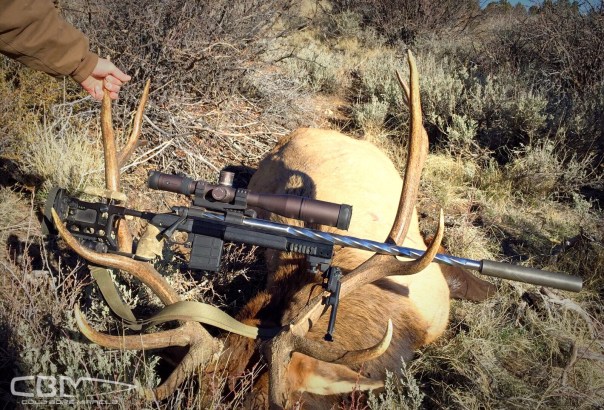
It wasn’t just any rifle either, it was there for a reason. Years of diligent practice had paid off, and there was no doubt that my Brother could park a bullet right through the boiler room.

The rifle is a custom Remington 700 with a Bartlein 260 Remington barrel. It road in a KRG Whiskey 3 chassis, upgraded with a Trigger Tech Diamond, a Vortex Optics Gen one Razor, and a Thunder Beast suppressor. Hornady 140 gr BTHP match bullets is all it eats.

It happened so quickly that I barely had time to get all my gear ready. I was hoping to spot the shot through my spotting scope, but instead watched through my binoculars as I fumbled blindly through my pack.
Everything went quiet as we anticipated the shot, the bull stopped his walk, and stood broadside to us, his beautiful color shining in the warm sunlight.
I watched silently as the bullet trace arched through the air, conditions were ideal for spotting the trace. Time slows as it often does in these tense moments, and I watched the trace disappear as it hit the bull. Seconds later, as the bull staggered, we heard the report come back to us. The sound of a bullet hitting flesh is a very recognizable one, and sure to get a hunter’s blood pumping.
The big bull continued to stagger about, as he forced himself to run, almost directly at us. Looking through my binoculars I thought his right front shoulder was broken, then I finally put hands on my spotting scope and pointed it at him. As he slowed down to stop, his legs looked buckled, his elbows almost touching. He crashed forward into the sagebrush, and lay there, head still up and looking for the threat.
Round two was hot on its way by then, again I watched the trace rise and then fall. The bull was laying down facing us, Spencer aimed the kill shot to go right inside his shoulder. The impact was severe, and the bull instantly dropped his head to the ground, leaving his mighty crown laying sideways in the brush.

We made our way over to the big bull, and as usual it was absolutely surreal. The size of these animals always impresses me, as does their beauty.

There is something majestic about every one of these animals, each one a fighter, each one a champion of his environment. This bull had actually broken his leg, either by accident, or someone broke it for him. But this incredible animal survived, and healed. His shoulder wasn’t broken, his right leg was crooked, it had healed at an angle.
Majestic almost doesn’t do honor to these magnificent creatures. Their strength, and their endurance is beyond impressive. Their instinct and natural wisdom, born of an unimaginable series of lifetimes that led right up to this one. Not only do I feel an incredible debt of gratitude for all of these merits, I feel inspired by them. Much the way the sunlight is absorbed by everything it touches, the merits, memories, and all that this animal is, will soak into our minds and memory.
elk, elk antler

My thoughts

Love, honor, and respect for these animals. It takes a lot of work to get the best of one, they live here everyday, they fight to survive, simply put, they are better at it than we are. The only way to feel good about besting an old warrior, is to be the best of yourself. Living right on the razor’s edge of your dedicated hard work and skill, and the utter failure of loosing him. And then, having triumphed, recognize the lesson, the hard work, and even the luck. You can see now why I said lucky before, lucky and grateful to have had such majesty, reflected upon us.

-CBM

More bull elk hunting can be found right here
bull elk, elk rifle

bull elk, rocky mountain elk

Remington Bartlein KRG Whiskey 3 Trigger Tech Vortex Optics Thunder Beast

Hunting Vernacular: Sacrifice, Harvest, and Killing

Do you think we are the only predators on this planet that contemplate these actions? What separates you and I from other top predators?
I have given it much thought over the years, and today I thought I might write about a death we should be satisfied with.

I often hear people refer to hunting and killing an animal as a harvest. This nomenclature has never sat well with me, as it is typically used in referrence to an agricultural crop. The commercialized hunting market seemed hasty to adopt this word, and for perfectly understandable reasons. Hunting and hunters are unfortunately ever less popular in modern society, and Harvest sounds friendlier than Killing.
That said, I dont like the word. You dont harvest a deer, I dont walk out in the pasture and pull a bundle of deer out of furrows. Nor do I pick a flock of ducks from a bush.

Hunting is so much deeper than that, more intimate. There is a very dedicated effort wherein a good hunter exhausts time, money, and practice of his craft in order to take the life of his prey. Better hunters spend even more time researching, scouting, and perfecting their skill. The crux of all this effort is to be a more effective and ethical predator, a skilled killer. It is a costly investment, both materially and emotionally.
I am a killer, I kill animals, and for that I make no apology. There are many reasons I hunt, most of which you’re probably familiar with if you’ve read much of this blog; food, game management, and especially the participation in natures way of taking and giving life. We are part of it, not some distant observer.
You may have heard “wolves lose no sleep over the opinions of sheep”, and just as the wolves sleep soundly in their dens, we should not apologize or soften our stance as both apex predators, and as stewards of the land we rule. Removing ourselves from the food chain does a disservice to the overall ecology, especially when it’s for self righteous reasons.

All that remains of a six-point bull elk after we finished

Sacrifice is an acient principle, it is a beautiful and fullfilling concept that gives meaning to what can often seem like a sufferable existance.
Men have sacrifced animals (for various reasons) since the beginning. And again, I often hear the phrase, this animal gave its life for us. It is used as evidence to care for and respect the flesh of the animal, a fine result but based on a flawed perspective.
Much as I dont care for using Harvest, I also dont feel right about This animal sacrificed its life for us.
Because if it were up to the animal in question, it would still be alive. I draw a similar distinction to my previous point about nomenclature, it goes much deaper than just This animal sacrificed its life for us. This animal was sacrificed against its will for us to live from its loss. There is a big difference you see.
Our agency allows us to choose what to sacrifce in our lives. Parents (both two and four legged) sacrifice for their offspring, soldiers sacrifice themselves for their countrymen, etc. But when a sacrifice is not made of free will, it carries an extremely heavy responsibility. When sacrificing an animals life, honor demands that its flesh be used with little to no waste, in a respectful and responsible manner.

These truths I believe are eternal, and from there comes our moral ethos as responsible hunters. It is what separates us from other apex predators like the wolf. It is the reason our conscience is so heavily taxed when we lose an animal, or when we cause un-nessesary suffering.
It is difficult for man not to think very highly of the animals we hunt. We spend so much time watching, admiring, and challenging them with our own skills, Yet even so we are frequently bested by them. This relationship betters us both, and elevates its value to us.
It is also what gives us such great satisfaction as we eat a tasty venison dinner. A meal that was achieved through great effort, and sacrifice, tastes so much better than one that was not.

Say what you mean, and use the appropriate words that accompany your actions. There is no doubt about the intentions of our brother the wolf when he stares down his nose at his prey. Neither should there be any doubt about our own intentions, and we should honor the sacrifice by giving the most swift and humane death we are capable of. A death we ourselves could make peace with.

-CBM

Home game processing: Make that Slaughterhouse a Slaughterhome

If you haven’t noticed yet, I love to eat. Nothing is more satisfying than a home-cooked meal made from ingredients procured by my own hands. Whether it’s tomatoes grown in the garden or a lean trimmed elk roast that I cut out by hand in a cold October garage.
One of the ways I maximize the flavor and the satisfaction that comes with it, is by home game processing my own animals. It started long ago, when as a child I watched my Father bring home deer to be butchered on the kitchen counter.

Many years later, more out of necessity than desire, I began carting my own deer carcasses into the kitchen. Being a bit of a germaphobe, as well as a bit picky at the table, I couldn’t fathom leaving the cleanliness of my food to the hands of some game processer. Just the look and smell of those outfits is enough to make me toss my lunch, so I was determined to do it all myself.
In the beginning, I’ll admit it wasn’t great, but I have become pretty good at it. I think its important to share a couple of the advantages that I have by doing it myself:

I am in complete control over what gets used and how. Being particular about my food, I like to know it was well cared for both before and after it was butchered. I always take great care of my animals, trying to get them gutted, cleaned and cooled as soon as possible. I have seen overwhelming evidence that the crucial time between death and the freezer has a huge impact on the flavor and quality of your meal.
Once the carcass is cleaned, and cooled down, comes the aging. I think that aging the meat is very important, second only to the quick cleaning and cooling of it. Call me crazy, but I like to age my venison a minimum of four to five days. I actually wait until the first signs of decomposition start to show. When little specks of white mold start showing on the carcass, its time to start cutting. Much like a good piece of fruit, the best flavor comes right before it spoils. Obviously this must be done in a state of refrigeration, lucky for me, October temperatures here hover around freezing.

Not only does the flavor and texture of the meat improve, but its easier to handle and separate. Meat peels right from the bone, leaving a clean white surface. All the hard work of removing tendons and silver skin is also simplified, little to any coaxing is needed to fillet them right off of your favorite cuts. The meat itself takes on a softer, stickier texture, it almost feels greasy in a way, like near room temperature bacon.
Another benefit of butchering my game at home, is the ability to cut the meat the way I want to cook it. I have recently explored many different bone-in cuts that not only increase the quality of my meats, but also cut down on waste. When cutting bone-in pieces, you get to eat all the meat in between the bones that is typically discarded.

Some of these great examples are cutting whole T-bone steaks. Since some deer aren’t that big, I actually cut them as Cross-bone steaks, basically, two T-bones that haven’t been split in the middle. I cut them about 1.5” thick, and sear them in a pan, till rare (120*) at the center near the bone. The only way to improve backstraps and tenderloins is to serve them together on the bone, with butter and rosemary.

Another great cut that I’ve tried is a bone-in Frenched rib rack. This is done by again leaving the backstraps attached, and sawing the backbone and ribs out. You can then either cut lengthwise down the back, splitting the two, or go really fancy and leave them whole.

Sawing the shanks is another great way to use bones that are almost always discarded. Cooked slowly the shanks are a very tender and tasty piece of meat.
I also like cutting out the meaty ribs of deer and elk. Cooking them twice, first in a pressure cooker, and then again in the oven. This melts off the undesirable fat from the ribs. I then season them a second time and slow cook them in the oven, it makes for an extremely soft and tasty meal.

All these custom cuts and preparations can be done at your own pace, and even cooked without having ever been frozen. I love a good fresh celebratory meal during the hunt.

I use a Cutco fillet knife to remove silverskin

I double wrap my meat in plastic and freezer paper, it keeps easily for years

I like to use a good fillet knife for processing my game. The flexible blade and the razor-sharp edge allow me to skin the dried rind off of most of my meat, exposing the perfectly aged and protected meat below. It also allows me to shave off any damaged parts, leaving as much meat as possible.

I start out with a sharp knife, and regularly sharpen it during the process, to keep the edge from dulling. The sharp blade easily separates broad tendons like those found on backstraps, just like skinning a fish fillet.

Many people grind a lot of their meat into burger. While I enjoy and love a good burger, I rarely grind mine until I’m ready to eat it. When I do, I use a LEM Big Bite grinder with excellent results.

Part of the reason I think so much meat is ground by so many, is because of the large scrap piles of meat that accumulate during the butchering process. I try and avoid this as best I can by keeping the meat in the largest pieces possible, and the scraps that I do get, I set aside for bottling.

Bottling venison is an often-overlooked process. I have had spectacular results putting my venison into jars instead of the freezer. A big benefit to this approach is no need to keep the meat frozen, and subsequently no loss should a freezer go down, or a power outage.
If those reasons aren’t enough, then the simple fact that it tastes so good should be enough. Bottled venison is extremely tender, and when bottled together with other ingredients like tomatoes, onions, or even a complete recipe, it is a whole meal ready to eat. One of my favorites is a simple chilli that consists of venison, tomatoes, roasted red or green peppers, onions, garlic, barley and black beans. Thrown together in a bottle with some salt, and cummin, it makes a delicious meal that requires nothing more than a source of heat to bring it to life.

Bottling meat is a slightly different process than you may be used to, do yourself a favor and look into it. It requires the use of a pressure canning pot.

When I do grind venison, I like to do it just before cooking. I also add in some pork fat, either straight fat, or fat with a little meat. This, as well as some good seasoning and some garlic and onions mixed into the burger will make one of the best hamburgers you will ever eat.

My “Meltdown Elk Burger” Elk patty with grilled jalapenos, bacon, horseradish Havarti cheese, grilled habanero onions, garden tomatoes, spicy pickles, lettuce and avocado.

I like to use good knives from Outdoor Edge to process my meat

Butchering an animal myself has led me to several practices while still on the mountain. One of them is a valiant effort to get the animal out whole if possible. Sometimes it is just too difficult, and an animal must be halved or quartered for extraction. I always prefer to get them out whole, this minimizes the amount of meat lost. For every cut that is made before the butcher table, there is meat lost. Whether it be from drying, contamination, or some other reason.
Keeping the animal whole keeps as much meat as possible protected from the elements.

Another field tactic that I use is the gutless extraction. Some of the places we hunt here in the Rockies are quite close to home. Almost every year, one or two of the deer or elk we kill, are close enough to home, that I can have them home, skinned, and washed out within thirty to forty minutes after the coup de gras is fired. That being the case, I will often leave the guts in the animal until we reach a vehicle. This avoids getting the chest cavity contaminated with dirt, leaves, or any other debris. The animal is then gutted, and transported home where it is skinned and washed in preparation for the aging process.

Another big lesson I have learned, for antelope, in particular, is to get as much blood out of the animal as you can. In my experience, one of the best practices is to take head shots. This leaves the circulatory system intact, allowing it to evacuate its volume even after brain-death has occurred. Obviously this practice is not recommended for an animal who’s head you intend to mount, or save. But for antlerless and meat hunts, it works great. Not only does it empty most of the blood via the headwound, but it does little to no damage to the eatin bits of the animal. And its much easier to gut and clean.

I cant believe how much venison I could have enjoyed so much more over the years, instead of suffering through it. It doesn’t take a huge amount of effort to put these things into practice, but it will make a night and day difference in how you enjoy all that beautiful game meat that you work so hard for. I hope these tips help make your meals better and more memorable, and please feel free to offer any tips you may have!

-CBM

If you like these ideas, there are more of them here

Why Do You Hunt?

Hunting Necessity

The world we live in is infinitely more convenient than it was even twenty years ago, we can have almost any commodity delivered to our door. We almost feel cheated if our food isn’t ready in moments, the services we use are expected to be streamlined and painless. With our lives being simplified and aided by technology and ingenuity, why do so many of us still find virtue in the massive efforts of hunting down our own food?

some hunts are more challenging than others

Despite the convenience of modern life, it is still no easy task to find a wild animal, and in one manner or another convince it to surrender to the dinner table. There are tedious applications and preparations to do, months in advance, and there is tackle to make or procure, and that is to say nothing of the actual physical work of scouting, hiking, butchering, hauling out, and preserving our kill. Depending on the hunt and what we put into it, it could be cheaper to just purchase our protein.

Like many of you, I reject the excuses made by our modern society to leave the forest to gather my food in little plastic containers. I choose to hunt for many reasons, some of which I can articulate, and others I may not be able to put to paper.

To be Involved

I was made to observe nature, but also to be part of it. An observer of nature is exposed to its beauty and cycle, but as a predator within the circle, you get far more than just a snapshot. The vivid imagery one gets when participating in the life-and-death struggle of nature cannot be seen, it is experienced. Everything from the beauty of a sunrise to the revolting stench of death are just part of the highs and lows you get to be a part of. The suffering that comes with the challenge of hunting makes the moments of beauty and success much more than victory, even triumph. As an active part of the ecosystem I inhabit, I am no longer an outsider, but part of the same circle as the animals I hunt.

venison
we enjoy wild meat in countless ways at our house

For all our technological advances, we cannot beat nature’s prescription for clean healthy food. Everyday as I prepare food for my family, it is with great pride that I feed them clean and healthy meats that are free from so many of the side effects of agriculture. Knowing that our food lived a free life, moving as it pleased, eating what nature provides gives me satisfaction as we fullfil our part in the food chain.  My children watch and participate as well, which brings me to my next point.

Legacy and Tradition

My children know exactly where their food comes from. Most of the time they are with me, they get to see what it takes to bring home these tasty meals. They know what it costs, they are intimately aware with the effort required to get it done. They know the value of the life of the animal, and the sacred responsibilty to respect it. Our traditions may or may not be important, but respect for sacrifice such as this is a must. And while speaking on tradition and its value, I’ll add this;

outdoor children
involving my children in the hunting lifestyle has been very rewarding

Doing something because we always have, is not necessarily a good reason to continue so. It is the virtue and moral value of our traditions that should earn them a place in our future.  Handing down a gun for example is traditionally something of great importance to many of us, but it means nothing if the responsibility and respect for it are not expressed in kind.

My Brothers and I, together in adventures of every kind.

Blood Brothers

Perhaps the greatest reason for the traditions and hunting in general, is the deep conection and camaraderie we feel with our fellows. Nothing I have experienced can quite compare to the friendship and company of loved ones who stand beside us in our adventures. I have so many close friends, like Ive said before, many of them are related by blood and others that should be. Most of these relationships have been cemented in both good times and bad, usually on a cold mountain also involving darkness, steep terrain, snow, rain, fire, heavy lifting, late nights and early mornings. It may sound bad, but the triumph over all is what makes memories. And memories are the lasting beautiful thing that we take with us to turn into tradition.

teaching our kids to hunt is an incredible way to make memories, read more about hunting with kids here

I will never apologize for being a hunter, and I will fight for the right to do so always. Not just for the reasons above, but because I take responsibility for what I eat instead of allowing others to kill on my behalf. Instead of distancing myself from the unpleasantness of taking a life, I respectfully do it on my own. Cleaning, butchering, and preserving it as best I can. Instead of absent consent, then scavenging on the sanitized remains at the market.

venison meat
teaching children where their food comes from

It is my hope that our future will be full of great experiences based on honored traditions. And that those traditions will keep the virtues of hunting safely treasured in the hearts of those that will someday take our place.

-CBM

Mule Deer Hunting with the 25 Creedmoor: Two Many First’s

A young man’s first deer is a memory that lasts a lifetime, but this story has more than one first time.

The 25 Creedmoor project that I named Operation Quarter Lord, has taken down its first big game animal. But it doesn’t stop there either, it is also the first time a Blackjack bullets ace 131 has been used on a deer.

It started late one afternoon, after a heavy rain storm had passed through the dry desert canyons of Utah. Myself, my Brother, and a good friend of ours headed up into the hills to see if we could get on to a deer or two. Also in tow was my friends son Aiden, who was eager to fill his first deer tag.

Can you spot the buck?

Only a few minutes after setting up the spotting scope, we had eyes on a fine little buck who would fill the tag nicely. The gun obviously was new to him, it was still new to me for that matter but I was very confident in its potential due to much practice.

Aiden was quickly voluntold to get in position for a shot, and after a few moments he more or less said “shooter ready”. We all focused through our perspective optics, and waited for the buck to give us a good broadside shot. When he did, just a moment later, everything went quiet, and we all concentrated on the small buck, six hundred and ten yards away.
Thats no short poke, but this wasn’t Aiden’s first rodeo either. He has practiced all summer shooting further distances with a custom .223 Remington his father built.

Excitement was in the air, and even my own heart pounded. We waited silently as Aiden took his time to get a good hold, and calmly broke the trigger.

I watched as the ultra flat shooting Ace flew through the cool evening air, barely arching above the target due to the uphill angle. It found its mark, as I have found it always does, impacting the young buck behind his left shoulder. He staggered forward a few steps, looking as though he was going to take a dive, but since he didn’t, Aiden sent round two. Running the bolt on the Tikka like some kind of pro. The second bullet also impacted the bucks chest, and after a couple more staggers, and coughing up much blood, he rolled over and died.

The excitement was thick in the air, a Boy’s first deer, a Father’s first successful hunt with his Son, and ontop of that, my excitement for a project perfectly executed.

The deer was dragged back down to the truck, cleaned and inspected, then back home where he was summarily skinned and washed for butchering.

The excitement never dims, be it the first, or just another hunt. These adventures bring so much flavor to our lives, and tables. I can only hope it stays so.

-CBM

Exit wound on the offside

High Tech Hunting

Has high tech hunting pushed back the goal posts for hunters?

I can remember, not too long ago, when shooting a deer from a distance like 600yds or more would get you raked over the coals by the general hunting public. I remember telling my own Father about my aspirations of hitting targets at 1000 yards, and hearing his skepticism. I remember a well known gunsmith telling me that it was silly to twist a .223 Remington barrel for 75 grain bullets and higher. “Everything else peeters out past six or seven hundred yards” I told him. Again, came the refrain; “you cant shoot that far.” 
Like Ralphie, in the famous Christmas Story, I felt like nobody understood my dream. Nobody could see what I saw in my mind. But there was a wave coming, and it was fueled by science, technology, and at least in my case, a quest for ballistic perfection.

Don’t get me wrong here, its not that I simply wanted to kill something from as far away as possible, that could be borderline recklessness. What I wanted was something more, I wanted to build a rifle or rifles that would make me unstoppable at hitting small targets at distances like half a mile or more. And to that end the ability, if needed, to take my game wherever it presented itself be it near or far. It’s easy now, to see my former folly. I had focused so hard on equipment, and failed to see my part as a marksman that is equally important. Thankfully, these Rocky Mountains are a great educator. In today’s hardware driven market, it is hard not to fall for the sales pitch of this rifle will make you a sniper. Many of the best manufactures sell more than just hardware, they sell you training to go with it. Dont be a fool thinking that your wallet will make up for your aspirations.

You can buy accuracy to a degree, but you cant buy skill.

A young buck being surveilled

There is so much more to making a good shot, than just the hardware. Skill is equally important, perhaps more so. “Its the Indian, not the arrow” many people say. You can put a good rifle in the hands of a skilled marksman, and he will deal deadly force against anything within range. But even the finest precision rifle in the unwashed hands of a novice may be useless beyond its point blank aiming radius.

I should move on from the generalizations and get down to real information we can use. The foundations of a good shot are anchored firmly on several things, I dont claim any kind of authority or prestige, so I’ll just throw em out there in the order I see em.

  • A properly built and accurate rifle, capable of  Minute of Angle (MOA) accuracy
  • A properly trained marksman, who can yield at least MOA accuracy in expected conditions
  • Ammunition matched to the rifle providing at least MOA accuracy

MOA is a good start, but ideally you should strive for much better

If you cover those three basic pillars, you are well on your way. But all three of them have been around for at least half a century, so why has it taken so long to break these time cemented barriers that I mentioned above? I think part of it is human nature, and conservative thinking.
If you cover these bases, all it takes is a little pinch of science and a dash of high tech equipment to shatter the barriers that once congested both minds and ranges.

Now lets talk a little bit about hunting. As I outlined in my last piece, killing an animal, is about placing enough energy in the right spot. To me, that is what accuracy is all about, being able to hit my target exactly where I want to. The capacity to place a shot accurately should be the main determining factor in a hunter’s killing radius. If two hundred yards is as far as you can shoot accurately, then you would be imprudent to shoot beyond that.
Now we have come back to my original point, which was people looking down their noses at long range shooting, and long range hunting in particular. Shooting animals at long range distances is a taboo subject, mainly because people have either shot beyond their accuracy envelope, or watched someone else do it, and experienced poor results (wounded/unrecovered animals). Nobody likes seeing things like that happen, so most will shy away from questionable shots, which is a safe and conservative choice.

And so it was for the better part of the twentieth century, few dared to push the limits, mostly those in competition or LE/Mil circles. But to the average shooter, and particularly the hunter, the subject remained taboo and legend.
The advent of technology has brought a miriad of supplies to the industry, this has allowed everyone, even rednecks like me the ability to crash through the taboo with impressive impacts.
Some of these technological advances are worth pointing out, in no particular order:

  • Better bullets with higher Ballistic Coefficients allowing the bullets to cheat wind and resistance, keeping them on track further.
  • Better propellants, giving higher velocities, more stable and efficient burns.
  • Compact, accurate, and affordable laser rangefinders, allowing marksmen to extract the data they require to make proper predictions.
  • Precise and accurate telescopic sights, to adjust their shots according to data with exactness.
  • Reticles that allow precise measurements and wind holds.
  • Chronographs, Doppler radar, and other bullet flight testing equipment.
  • Ballistic computers, inexpensive and incredibly valuable for predictions.
  • Handheld Weather Stations, giving exact local atmospheric data.

New tools like the Kestrel are available to hunters can increase your odds of success

All of these tools, as well as others have not only become available to the average shooter, but they are affordable, and fit in a pocket. The science of shooting has also progressed greatly, even in the short time I have been following it. And again, it is all available right at your fingertips.
So it seems no small wonder then, that what once seemed nearly impossible, is now commonplace. Even as little as twenty years ago, who would shoot at something so far away that a guess could be off by hundreds of yards? And the target could barely be made out in your 3X9 scope? And even if you doped the wind right, and managed the correct holdover, your bullet may have run completely out of energy before it gets there.
These high tech gadgets have given us the tools to cross all those T’s and dot all the i’s. Now you hear about it at every end of the internet, on hunting forums and Facebook pages.
Which begs the question; Are we now living in a post short-range world? And is taking those long shots any more irresponsible with the help of today’s technology? I guess that depends on how you look at it. I have heard both sides of the argument for some time, and I have yet to find a compelling argument against this new anomaly as long as one does his due diligence. For starters, anybody can make a poor shot on an animal. If you hunt long enough, you will eventually make a bad shot, we’ve all seen it. Whether its caused by buck fever, lack of experience, weather conditions, equipment failure, or any one of a million other things that people can blame it on rightly or wrongfully. I’m not making an excuse for it, nor am I defending it, it just happens. I would go as far as to say that more animals are wounded and go unrecovered at close range, than at long range. Simply due to the numbers, the majority of hunters probably never shoot beyond 400 yards. Hitch that to their hit a paper plate at 100yds mindset, and you can count on some animals going unrecovered or lost.

We’ve seen people miss easy and simple shots, as well as make incredible and amazing shots. I’ve said it before, a good shot should be no surprise to a marksman, it should be expected after much practice and experience making same or similar shots in the same conditions and circumstances regardless of range.
We know what it takes to make a good shot, we outlined that above. Making a good shot is the same whether you are shooting 200 yards or 800 yards, the difference of course is the variables that come into play. For example, the wind at 200 yards is much less a factor than it is at 800 yards. What might only blow your bullet off course by an inch or so up close, may blow you completely off target at the further distance. Also, at 800 yards, one MOA is eight plus inches, which is why sub MOA is a much better goal.

As long as one considers all the additional variables and their consequence, they can be mitigated and overcome.
Unless they cant be, what I mean by that is the further away your target the more downrange forces that simply cannot be anticipated unless you have forward observers or other assistance. And the further out the target, the more of these variables you have to worry about. Perhaps someday soon, technology will cover that as well.
Conditions will always dictate what you can and cant do, if it is a dead calm morning, you might be able to pull off something incredible. But if it is a switch wind breezy afternoon for example, it would be a wise choice to keep within your known envelope. A wise shooter, will always keep within his known realm of proficiency. But an even wiser shooter will recognize that his realm changes with atmosphere and weather. Keeping your finger in the air like a weak a politician, and paying close attention to what is happening around you, will go a long way towards letting you know when to shoot, or more importantly when not to shoot.

The ethics of long range hunting will be debated forever. There are those who think taking long shots will always be reckless, and there are those who are willing to take a long hard look at the data, make their calculations, and either take the shot, or choose another course of action.

Those who claim moral high ground, saying long range shots are unethical will always abound. But the truth is this; Not taking long range shots does not necessarily make you an ethical hunter, but staying inside your limits does. For some people, that limit may be four hundred yards, for others it might be twelve hundred yards. It is up to each individual to figure that out, and prove it to themselves repeatedly long before an animal falls in their crosshair.

I don’t hold anything against those who dislike long range shots, they are entitled to their opinion. But the irritating part of the debate comes when someone tells me (or anyone else) that you shouldn’t do that, simply because they cant do it. They love to make insults like; that’s not really hunting, or real hunters get closer. And it occasionally comes from people who hunt from a shoot house, with a Keurig and heater, overlooking senderos strewn with corn feeders on land so flat you cant see more than a hundred yards without jackin up the shoot house. Its really an ignorant position to take, particularly when you don’t know someone else’s skill-set or practices.
Just because a person can make a long shot, doesn’t mean they cant stalk into arrow range of an animal. There was a time where big bore muskets were used to shoot deer at what we today would consider archery range, should we go back in the name of purity? Would our ancestors look down their noses at our modern equipment thinking there is no challenge? It was the push for innovation that took us from those ancient smooth bores and stick bows to the rifle and/or bow you hunt with today.

Another problem with this way of thinking is that it is a never ending slippery slope. Long range hunting < spot and stalking < archery stalking < spear hunting < knife hunting < teeth and hands < etc. < etc. Where does it end? Are we so dedicated to our own ideal of hunting that we would deny another’s? Surely if a stalk into bow range is your thing, with wooden arrows and handmade broadheads, who am I to stop you? Despite having seen many wounded animals with arrows still in them, I wouldn’t argue that archery is unethical, nor would I want to keep people from doing it.
That leads me to my last point.
The worst thing that we hunters can do as a group, is to fracture off into different tribes pitted against each other. The anti hunting movement is growing wildly, everywhere you look there are people trying to take away our ability to hunt and fish the way we enjoy. We as a group need to stand together more than ever, for divided we will surely lose.
I used to be infuriated by the mass hordes of hunters that would flood my favorite hunting spots. It drove me nuts that they didn’t understand my plan, and walked right through my hunt. As years have passed, and age has toned my opinions, I have changed my attitude. Those hordes have just as much right to be there as I do, and I would rather it be other hunters interfering in my hunt than protesters.

Instead, I have evolved as a hunter. I now welcome these large groups of bush beaters, and like the predator that I am, I simply await the inevitable, like a hawk kiting in the sky. Instead of trying to beat them through the forest, and beat them to the stalk, I await the escaping game from a position where my skill allows me an advantage over the hordes. An advantage I intend to keep.

Technology and necessity have indeed pushed back the goal posts in todays hunt. I see nothing wrong with it, provided marksmen respect their prey enough to become swift and lethal, and stay within their known limits.

-CBM

Spring Chuckin’ :A Varmint Hunting Adventure

desert tech srs covert
I’ve been using my Desert Tech SRS for hunting marmots for nearly a decade

Preface

I used to think that I had a favorite time of year, fall definitely is at the top of that list. And yet I still find myself thinking “this is my favorite time of year” during almost every conceivable part of our annual orbit.
Season change is in the air again, the cold of winter slowly yields its grasp on the mountains and valleys. The sun reaches further and further into the deep wooded canyons where I love to spend these spring weekends. Many people pass by these places, completely unaware of the fun and challenging varmint hunting opportunity that lies within. I myself did the same for a long time, until one day a flash of movement revealed it to me.

a friends custom rifle in 223 Remington featuring a Bushnell 10X scope

Varmint Hunting

It was many years ago now, but during a hike through the high Rockies, I caught a glimpse of an animal I was unfamiliar with. The Yellow Bellied Marmot ,also known as a woodchuck,rockchuck, groundhog, or whistle pig, it is basically a giant squirrel. I’ve been known to put the hurt on squirrels, sod poodles, potguts, and any other variation of rodents and other little critters. You might say Im a bit of a varmint enthusiast. So when I first laid eyes on a Marmot, it was like the surfacing blow-hole of the mighty white whale.

Much time would pass before I became more familiar with these handsome and playful little rodents. But I came to know their habitat, and where to look for them. And as fast as you can whistle, I was hooked on what has lovingly come to be known as Chuckin’.

Every spring since that first chuck took a dirt nap in the cool shade at 9000 feet, we go back into the high country looking for beautiful brown pelts. That first chuck, got named Rusty, due to the color of his coat.

Coldboremiracle Junior scouring the ridge-crests for quarry with his Keystone Cricket rimfire rifle

This spring, we again make our preparations to go after Rusty’s kin. I say preparations because unlike the lesser squirrel species, the marmot is a keen eyed and wary little animal. Part of the reason I went so long without seeing them was because they are so easily hidden in the landscape where they live. And they are also quick to hide as well. One of my favorite reasons to hunt these cunning little creatures, is because they are the ideal practice for big game hunting. They live in the same canyons and hills where we hunt deer and elk, they are just as hard to sneak up on, and a good sized marmot is about the same size as a deer’s vital zone.

Desert Tech MDRX
one of my Desert Tech MDRX with US Optics scope also works well

The Yellow Bellied Marmot is as tough as the country they live in, even though they usually weigh in at under ten pounds, a poor shot from even a deer sized caliber might not shut Rusty down. I have seen it many times, where a massive impacts from something like a 308 Winchester didn’t stop a chuck from getting back to his burrow before dying.

One year, I specifically remember we hit a chuck off of a rock where we frequently hunted. He was hit, but he disappeared in the rocks leaving one of his legs behind. He managed to get down a burrow before we could finish him (something I don’t enjoy). Well, the following year, we made it back to that same rock. By happenstance, it was the first trip of that spring, and my good friend was on deck when that first chuck was spotted from nearly three hundred yards away. He wasted no time getting a 140 grain Barnes Match Burner right between his ears. About a half hour later, we hiked up onto the rock where fresh blood still ran in a glistening puddle. It turns out that ol’ stumpy had survived his last encounter with our rifles, his leg had healed leaving a bald little knee. Had I known stumpy was such a survivor, I would have given him a pass.

These rugged and towering Rocky Mountains offer some beautiful vistas, and adding this challenging little varmint hunt into such a beautiful landscape is the highlight of my spring. Long hikes through beautiful canyons, crossing noisy little creeks, sharing a sack lunch on soft green grass, its definitively my idea of a good time.
With small family groups scattered across the peaks of our mountains, it wouldn’t be hard to exterminate the little guys. So we try not to wear out any particular place, never more than one per den. Not only does this keep the clans going, but it also gives us more country to hunt and survey.

I use my Desert Tech SRS for chuckin’ . The multi-caliber platform gives me many options.

Check out the video at the end of the article to see the action

desert tech SRS covert
Another chuck that fell to my SRS in 260 Remington

Some of my best stalks have been on marmots. Crawling through waist deep grass, hiding behind rocks and trees, waiting for the perfect moment when Rusty either has his back turned, or perhaps wrestling with one of his burrow-mates. In the early spring, I’ve even found myself on the edge of a massive snow cornice, freezing in my t-shirt and shorts, but with a perfect rest to shoot my distant prey.

The day that junior shot his very first chuck, we had snuck into a high alpine bowl, with a glacial pond in the middle. There we positioned ourselves on a high point with a perfect view of the many rock formations situated around us. Junior had just setup his little Cricket EX17HMR rifle looking at a rockpile with known inhabitants. But as we waited for one to appear, we heard a noise from just a few yards in front of us. As luck would have it, two young marmots popped up on a rock barely fifteen feet away from us. Whispering under our breath, junior slowly brought his rifle onto the target, and thumped one of the two.

Whether it is silently stalking through thorny shrubs, climbing through waist deep snow, or hanging precariously over a stone precipice, there is always a great challenge and fun to be had in the pursuit of these cunning little animals.
Sharpening your stalking and shooting skills, enjoying the beauty of alpine forests, and just the camaraderie of the hunt with friends will make chucking another varmint hunting delight to add to your spring.

-CBM

Check out more hunting adventure here