Tag Archives: varmint

Varmint Hunting Makes Better Hunters and Shooters

Preface

Even decades ago, it seemed that varmint hunters had an insatiable taste for accuracy. Very precise and accurate shots are needed when you are after small targets like squirrels and prairie dogs. My old gunsmith used to tell me that when they’d shoot the little sod poodles inside five-hundred yards it had to be a headshot or they wouldn’t count it.

Varmint hunting, Desert Tech MDRX
I’ve smoked quite a few prairie dogs with my MDRX, seen here with the US Optics FDN17X

But can the competitive sport of shooting varmints make you a better shooter? In my experience, I think varmint hunting makes better shooters out of all of us. And that alone is good enough reason to engage in the practice.

Shooting Varmints

Varmints are typically small animals mostly of the rodent species or similar. Things like squirrels, ground hogs, and such. These varmints are often pests, and many folks enjoy eradicating them as a pass time. If you have a problem with that, perhaps knitting is a better fit for you.

ruger m77 220 swift
Varmint rifles and precision rifles share many traits, making them excellent marksman rifles. This is my Fathers Ruger M77

Personally I enjoy hunting marmots and prairie dogs. Marmots often provide a cunning opposition, requiring some level of stealth and strategy. The country where I hunt them is the exact same territory we hunt deer and elk in, so it doubles as exercise and reconnaissance in addition to a fun hunt. And the size of marmots (typically between 5-10 pounds) requires some degree of accurate shooting. Even deer cartridges have not acutely incapacitated a few of our marmots, so making a good shot is important.

Prairie dogs on the other hand, are much smaller animals. The pound or so they weigh is filled with small bones and lots of flesh. Their smaller size makes them a tougher target, but it also makes it a little more obvious when one is hit. The terrain they thrive in is usually flat, which draws its own challenges when ranging targets, and understanding the lay of the land. Additionally the smaller centerfire cartridges used to shoot them are more affordable to shoot.

desert tech WLVRN 5.56
This marmot fell to me and my Desert Tech WLVRN, thats a Lucid MLX scope and YHM suppressor

Improving your Skillset

You may have imagined by this point how these hunting practices might make you a better shot. While an escaping prairie dog might not be the end of the world, it adds a competitive angle. As well as an opponent in the cat and mouse game. Simply having an opponent with a mind of its own automatically adds a level of challenge compared to simply shooting targets.

The sportier side of this cat and mouse game is further sharpened by the small target. Your need to make an accurate shot is paramount to your prey not escaping. The level of accuracy required to engage something like a marmot or prairie dog at ranges as far as five or six-hundred yards is demanding. And when you add the complexity of moving targets, measuring the distance to the target, and switchy winds either on the prairie or alpine forest, it gets pretty challenging.

bergara HMR 6.5 creedmoor
Varmint hunting with my deer rifle gets me more practice, this Bergara HMR took a few marmots

While these micro-hunts might not compare to the big Mule Deer hunt you’ve got planned, it is every bit as educational. A typical scenario from one of my marmot hunts might entail spotting a target from as far as half a mile or so away. It takes good spotting practice to pick out a perched chuck laying among a rock-pile. Once you find one, the effort of sneaking into a comfortable shooting distance may require a level of stalking comparable to big game. The sharp eyes of these little critters don’t miss much. And if they see you within their safe-zone, they disappear before you can even get on your scope. Once you’ve closed the distance, and used the land to keep out of sight, its time to dope for the shot and conditions. Long shots often require offsetting for wind, and considering other ambient changes.

prairie dog hunt,
My Desert Tech SRS M2 has excellent accuracy, making one great shot after another on these PD’s

All this leads up to you taking one shot, a shot you likely wont get to followup on. So it’s with great anticipation and forethought each shot is taken. The beauty of varmint hunting is that typically you’ll get lot of chances to screw up and learn. With a kill zone about the size of a softball, practice is your ally.

Lessons and takeaways

The very things that will make you a better shot and a seasoned hunter are all in the scenario above. Mainly the following:

  • Honing your spotting skills
  • Rapidly coming up with a firing solution
  • Adapting to ambient conditions like wind, altitude and angles
  • Making every shot count (accuracy)
  • Keeping out of sight, or at least a minimal profile
  • Anticipating the moves of your prey

And perhaps the most important thing is the ability to repeat this process over and over, until you excel at it. And once you do, you will find yourself improving. And with any luck, it will make you a much better shooter and hunter all around. If you are proficient at quickly finding, ranging and engaging targets that are no bigger than a squirrel or ground hog, then doing the same on something like a deer or hog will be even easier.

25 creedmoor, 6 ARC, Howa Mini
Both of these rifle have done double duty on varmints and big game. Up front is the Howa Mini 6ARC, and in the back is my Tikka T3 in 25 Creedmoor

If you haven’t tried varmint hunting, let this be your invitation. Its a fun way to get better at shooting, and a great introduction to hunting in general if you are new to it. Its also a fun way to nerd out over gear and equipment, which is also becoming popular in the gun community. Let us know your favorite way to hunt varmints in the comments below.

-CBM

Ruger M77 Overhaul: Turning 50 aint so bad

Introduction

Everybody loves a good comeback story, and today I’ve got a good one for you. Many great things came from the American 1970’s. No I’m not talking about the Carter administration but as a product of the 70’s myself I can assure you there was some good stuff back in the day.       Shortly before I met my father, a committed hunter and shooting enthusiast. He purchased one of the many guns he managed to collect during early life. It was a Ruger M77 Mark 1 chambered in the popular at the time 220 Swift.

I remember as a youth fawning over Dad’s guns, thinking they must be the coolest thing ever. Nothing got me more excited than when Dad would take me shooting.

My Father, he also grew up hunting these same mountains with Grandpa

The Ruger M77

Sturm Ruger introduced the model 77 in the late 1960’s, so by the time today’s subject was manufactured years later they surely had it dialed in. The original MKI used a tang mounted safety. Like many other rifle actions it borrowed a great deal from the Mauser model 98 . The M77 uses a claw extractor and a two-lug bolt, fed by an internal box magazine. To this day even modern M77’s utilizes the original angled action screw that pulls the action down and back into the stock. This curious design has been arguably beneficial as well as irritating for owners and gunsmiths alike.

Modern M77’s, which come with the MKII designation use a bolt shroud mounted safety vs. the original tang mounted one. A plethora of different models of M77 have been made over the years, in too many calibers to list here.

Rest assured if you want an M77 in a specific caliber, they probably made it at one time. The rifle we are talking about today came with a twenty-six inch heavy barrel featuring a one in fourteen-inch twist, it was blued with a glossy finish and a traditional walnut stock.

History

My father is a man of few shots, sort of a quality over quantity kind of marksman. During the many outings where I accompanied my Dad, I don’t remember him ever firing many shots, sometimes only a single shot was ever fired. But that was enough to bring home the venison at our house.

My siblings and I enjoying one of Dad’s deer, thats me in the middle

The 220 Swift is nearly a hundred years old already, it was a very popular cartridge a generation ago. It gained fame as one of the fastest cartridges around, and it is still a very fast cartridge today. This rifle shoots the same .224 caliber bullets you will find in a .223 Remington, but it shoots them MUCH faster.

Shooting Hornady 55 grain hollow-points yielded velocities near 3900 FPS, and the Hornady 75 Grain ELDM leaves the muzzle at 3400 fps. Both of these loads seemed quite mild, with room for additional speed.

the claw extractor of the M77

An Impressive Memory

I remember a specific occurrence, when as a young man I learned exactly why Dad shot sparingly. And at the same time I learned a LOT about why he chose the Swift.
It was a rabbit hunt in the dry deserts of Utah. We would push the brushy draws hoping to drive a rabbit or two up the other side in hopes of claiming one.

As a youth, it was my responsibility to push through the worst of the terrain to give others a shot. One of the many jackrabbits ran up the hillside in front of me, I followed him through the brush with my sights. As he cleared the top of the hill before me, I was beginning to press the trigger when the rabbit suddenly disappeared. In its place there was a cloud of hair drifting on the dry breeze.

In the distance I heard the report of a rifle that surely wasn’t a rimfire. I turned and saw Dad standing way back on the other end of the draw still looking through the Leupold 3.5-10 scope mounted on the Swift. As I neared the spot where the rabbit disappeared, I was immediately educated on several things. First was the impressive performance of the Swift and its exemplary demonstration of the destructive power of rifle rounds. Second was the entire anatomy of the jackrabbit scattered across the weeds.

That was at least thirty something years ago, and that old Swift became legendary in our family. But with that speed it also has an appetite for barrels, and more recently its blistering speed has consumed its accuracy with bore erosion.

Few things have ever escaped the Swift, before or after the overhaul

A New Life

There was no way that I was going to let this gun that I had idolized my whole life disappear into inaccurate mediocrity. I made a plan to overhaul the old Ruger and build it into a “Super Swift”.

Dad doesn’t get out as often, and varmint hunting seems as appealing as ever. So turning his Swift into an even better version of itself would be ideal for varmint hunting.


I started with the barrel, a replacement match grade blank from K&P was ordered. To be finished at the same 26-inches but this time with a 1-8 twist, a significantly aggressive twist rate for a cartridge like this. For this I sent it to my good friend Eric at ES-Tactical. My plan was to still shoot the 50-55 grain bullets at Mach 3+. But also have the ability to shoot the Hornady 75 grain ELDM bullets for things that are out there a ways.

refinished bottom-metal and floorplate

The new barrel would be threaded for suppressors because this isn’t 1974 anymore. And the old walnut stock would also be swapped out for something that better fit in with the rest of our guns.

ruger m77 220 swift
Suppressed is the only way to shoot

For that I looked to Boyds Gunstocks, and selected a model had Dad would like. The At One model with adjustable butt and cheek-riser, and a vertical style grip. Installing the new heavy barrel of the rifle would require opening the barrel channel somewhat to make enough room to float it.us optics

But despite being a 50-year-old design, the stock’s fit was perfect. To ensure consistency I glass-bedded the recoil lug area of the action into the stock, after which it fit so well you almost didn’t need screws.

Refinished

While I had it apart, I completely disassembled the action and bead blasted the old finish off, in preparation for fresh Cerakote. Since the trigger was apart, I stone polished the mating surfaces to improve the trigger which was already good, but now feels incredible. The stock featured dual front sling studs for bipod mounting, as well as a QD cup at the rear to add a QD sling swivel.

One thing some might call a drawback to the M77 is the scope mounting options. I don’t mind the Ruger scope ring design and mount, but you are limited to using what is offered. Lucky for me I found a set of Leupold high rings in 34mm to mount the US Optics FDN17X scope to the old MKI. Which would make an excellent match to the rifle.

The beautiful tungsten Cerakote match made the whole thing look sharp. Now it was time to get the legendary Swift back out where it belonged, scattering varmints across the countryside.

If you like this rebuild, you’ll also like Rebuilding a Hunter

Swift Vengeance

With the completely rebuilt rifle in hand, as well as some fresh 75 grain handloads, my father, brother and I headed into the high Rockies to put it to the test. Not only did the rifle shoot the 75-grain bullet very well, but it still craved the twenty-year-old hand-loaded 52 grain Match Kings I loaded once upon a time.

220 Swift shown next to a 223 Remington

With the rifle zeroed, and after installing a Yankee Hill Machine Nitro N20 suppressor, it was time to exact the Swift vengeance it is so famous for.

We hunt Marmots all spring and summer long, and today would be an exceptional day of chuckin’. The blistering speed of the Swift had returned with incredible accuracy, allowing surgical pinpoint accuracy. We were all stunned at how fast the bullets arrived at their furry little targets. I can’t help but think that the aggressive 1-8 twist also greatly increases the rotational energy of the bullets making them even more explosive than before.

Continue reading here

Find your own Ruger rifle here

Conclusion

After renovating this old rifle, I am quite confident in the upgrades. This rifle will surely continue terrorizing varmints for the next generation. The match-grade barrel produces incredible accuracy, the new twist allows for a much broader selection of bullets to be used. And threaded for a suppressor will make doubling and tripling up on coyotes a possibility.father, son, ruger m77, 220 swift, us optics fdn17x

The new stock, besides being incredibly handsome, offers a great deal of modularity. Its polymer parts are in all the right places to avoid scratching the wood on the landscape.

The new scope vastly increases the rifles potential for shooting long-range. We’ve already shot it beyond 1100 yards, something near impossible with standard 220 Swift rifles. The further distance capability is also enhanced by the improved trigger.

The M77 with its new look and Cole -TAC suppressor cover

If you have an old Ruger M77 laying around, don’t be afraid to dive deep into a custom like this. Despite the fifty-year-old design, they still make a great rifle. I’m glad this project turned out to be such a fantastic result, that even eclipses the legendary performance it had before.

The unbelievable power of the 220 Swift shooting 75 gr ELDM’s

If your old M77 has passed its prime, do yourself a favor and breathe some new life into it. They could be a great performer for you as they are. Or serve as the base of your next project that may become its own legendary family heirloom.

-CBM

Me, Dad, Brad, and Spence. You can see the action in Major League Chuckers 9

Major League Chucker’s 7

The latest installment of your favorite series of varmint hunting adventures:

Todays chucks were mostly hunted with My SRS M2 in 6 GT, lots of springtime weather including snow and wind made this one a little more challenging than others. Hunting Marmots (woodchucks, rockchucks, groundhogs, etc.) is an incredibly fun hunting activity, if you haven’t tried it, you need to try Springtime Chuckin’.

Spring Chuckin’ :A Varmint Hunting Adventure

desert tech srs covert
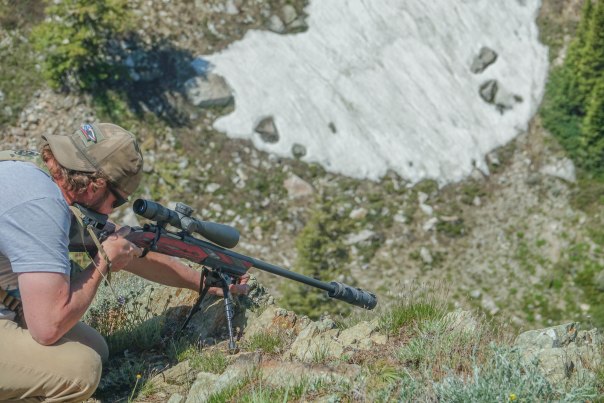
I’ve been using my Desert Tech SRS for hunting marmots for nearly a decade

Preface

I used to think that I had a favorite time of year, fall definitely is at the top of that list. And yet I still find myself thinking “this is my favorite time of year” during almost every conceivable part of our annual orbit.
Season change is in the air again, the cold of winter slowly yields its grasp on the mountains and valleys. The sun reaches further and further into the deep wooded canyons where I love to spend these spring weekends. Many people pass by these places, completely unaware of the fun and challenging varmint hunting opportunity that lies within. I myself did the same for a long time, until one day a flash of movement revealed it to me.

a friends custom rifle in 223 Remington featuring a Bushnell 10X scope

Varmint Hunting

It was many years ago now, but during a hike through the high Rockies, I caught a glimpse of an animal I was unfamiliar with. The Yellow Bellied Marmot ,also known as a woodchuck,rockchuck, groundhog, or whistle pig, it is basically a giant squirrel. I’ve been known to put the hurt on squirrels, sod poodles, potguts, and any other variation of rodents and other little critters. You might say Im a bit of a varmint enthusiast. So when I first laid eyes on a Marmot, it was like the surfacing blow-hole of the mighty white whale.

Much time would pass before I became more familiar with these handsome and playful little rodents. But I came to know their habitat, and where to look for them. And as fast as you can whistle, I was hooked on what has lovingly come to be known as Chuckin’.

Every spring since that first chuck took a dirt nap in the cool shade at 9000 feet, we go back into the high country looking for beautiful brown pelts. That first chuck, got named Rusty, due to the color of his coat.

Coldboremiracle Junior scouring the ridge-crests for quarry with his Keystone Cricket rimfire rifle

This spring, we again make our preparations to go after Rusty’s kin. I say preparations because unlike the lesser squirrel species, the marmot is a keen eyed and wary little animal. Part of the reason I went so long without seeing them was because they are so easily hidden in the landscape where they live. And they are also quick to hide as well. One of my favorite reasons to hunt these cunning little creatures, is because they are the ideal practice for big game hunting. They live in the same canyons and hills where we hunt deer and elk, they are just as hard to sneak up on, and a good sized marmot is about the same size as a deer’s vital zone.

Desert Tech MDRX
one of my Desert Tech MDRX with US Optics scope also works well

The Yellow Bellied Marmot is as tough as the country they live in, even though they usually weigh in at under ten pounds, a poor shot from even a deer sized caliber might not shut Rusty down. I have seen it many times, where a massive impacts from something like a 308 Winchester didn’t stop a chuck from getting back to his burrow before dying.

One year, I specifically remember we hit a chuck off of a rock where we frequently hunted. He was hit, but he disappeared in the rocks leaving one of his legs behind. He managed to get down a burrow before we could finish him (something I don’t enjoy). Well, the following year, we made it back to that same rock. By happenstance, it was the first trip of that spring, and my good friend was on deck when that first chuck was spotted from nearly three hundred yards away. He wasted no time getting a 140 grain Barnes Match Burner right between his ears. About a half hour later, we hiked up onto the rock where fresh blood still ran in a glistening puddle. It turns out that ol’ stumpy had survived his last encounter with our rifles, his leg had healed leaving a bald little knee. Had I known stumpy was such a survivor, I would have given him a pass.

These rugged and towering Rocky Mountains offer some beautiful vistas, and adding this challenging little varmint hunt into such a beautiful landscape is the highlight of my spring. Long hikes through beautiful canyons, crossing noisy little creeks, sharing a sack lunch on soft green grass, its definitively my idea of a good time.
With small family groups scattered across the peaks of our mountains, it wouldn’t be hard to exterminate the little guys. So we try not to wear out any particular place, never more than one per den. Not only does this keep the clans going, but it also gives us more country to hunt and survey.

I use my Desert Tech SRS for chuckin’ . The multi-caliber platform gives me many options.

Check out the video at the end of the article to see the action

desert tech SRS covert
Another chuck that fell to my SRS in 260 Remington

Some of my best stalks have been on marmots. Crawling through waist deep grass, hiding behind rocks and trees, waiting for the perfect moment when Rusty either has his back turned, or perhaps wrestling with one of his burrow-mates. In the early spring, I’ve even found myself on the edge of a massive snow cornice, freezing in my t-shirt and shorts, but with a perfect rest to shoot my distant prey.

The day that junior shot his very first chuck, we had snuck into a high alpine bowl, with a glacial pond in the middle. There we positioned ourselves on a high point with a perfect view of the many rock formations situated around us. Junior had just setup his little Cricket EX17HMR rifle looking at a rockpile with known inhabitants. But as we waited for one to appear, we heard a noise from just a few yards in front of us. As luck would have it, two young marmots popped up on a rock barely fifteen feet away from us. Whispering under our breath, junior slowly brought his rifle onto the target, and thumped one of the two.

Whether it is silently stalking through thorny shrubs, climbing through waist deep snow, or hanging precariously over a stone precipice, there is always a great challenge and fun to be had in the pursuit of these cunning little animals.
Sharpening your stalking and shooting skills, enjoying the beauty of alpine forests, and just the camaraderie of the hunt with friends will make chucking another varmint hunting delight to add to your spring.

-CBM

Check out more hunting adventure here