Category Archives: Product review

Products and equipment

Springfield Armory Saint AR15

The firearms market is littered with countless AR-15 revisions and designs, so when a company like Springfield Armory joined the vast AR market they must have had something to offer. Today we will be looking at one of the Springfield Saint AR-15 models, to see what Springfield has to offer in this flooded market of rifles.


Gun Specs

CALIBER:                       5.56x45mm NATO (.223 REM)
COLOR:                          Black
BARREL:                        16″ CMV, Melonite®, 1:8
UPPER RECEIVER:     Forged 7075 T6 Aluminum, Type III Hardcoat Anodized,                                                                            Forward Assist, M4 Feed Ramps
LOWER RECEIVER:     Forged 7075 T6 Aluminum, Type III Hardcoat Anodized,                                                                           Accu-Tite™ Tension System
BOLT CARRIER GROUP: M16 w/ Carpenter 158 Steel Bolt, HPT/MPI, Melonite®
GAS SYSTEM:                Direct Impingement Mid-Length, Picatinny Pinned Gas Block
HANDGUARD:               Victor M-Lok Handguard
STOCK:                            BCMGUNFIGHTER™ Mod 0
TRIGGER:                        Nickel Boron Coated GI
MUZZLE DEVICE:         A2 Flash Hider
BUFFER ASSEMBLY:   Carbine “H” Heavy Tungsten Buffer
CHARGING HANDLE: GI Style
SAFETY SWITCH:         Single Side
TRIGGER GUARD:        BCMGUNFIGHTER™
GRIP:                                BCMGUNFIGHTER™ Mod 3
MAGAZINES:                 (1) 30-Round Magpul PMAG Gen M3
WEIGHT:                         6 lbs 11 oz
LENGTH:                         32.25″ – 35.5″
MSRP:                              $1,023

Gun Background

Springfield Armory has been well known for decades for making great firearms. The Saint series of rifles is Springfield’s venture into the AR-15 or Modern Sporting Rifles (MSR) market. The Saint rifles claim all the best features that come with an MSR, the question I plan to answer today is whether the Saint is an exceptional rifle as far as MSR’s go or if it is just another AR.
Springfield has put extensive work into broadening the Saint rifle lineup, with a model of the rifle in near any desirable configuration, including dedicated marksman type rifles, compliant models, and SBR and pistol variants.

Features

BCM Gunfighter furniture- Buttstock and pistol grip come from the popular BCM Manufacturing
M-Lok compatible handguard- Allows for easy addition of accessories
Nickel Boron coated internals- Trigger parts and BCG parts treated for better wear and durability
Forged upper and lower receivers- for strength and hard anodized for durability

Models

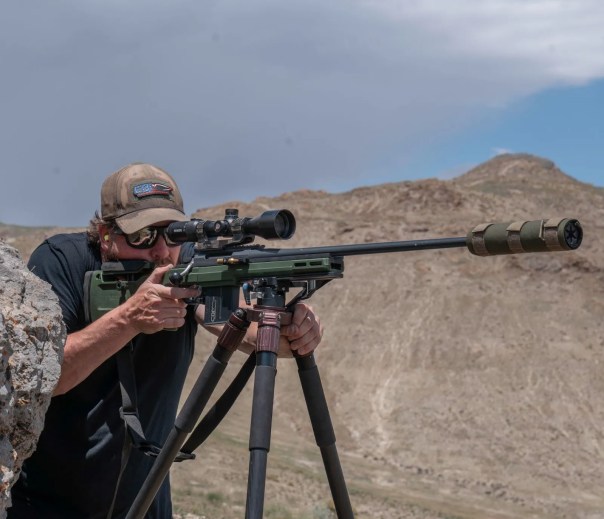
The YHM Turbo suppressor was a great companion

The Saint comes in a black anodized color, with other color options in Cerakote like OD Green and FDE. The variants of the rifles can get quite extensive, there are both 5.56 and .308 caliber versions of the rifle. Most of the general options can be had in a low capacity or compliant configuration. There are both sixteen and twenty inch barrel options, and even an SBR 11.5 inch version of the rifle.

On the Range

My first impression of the Saint came as I lifted it from the box, it seemed light enough for its size. And most everything about it seemed exactly as I expected. The M-Lok handguard looked bare with nothing on it, I would change that soon enough. The BCM buttstock was easy to collapse and extend to alter the rifle’s length, there are a couple sling-mounting cups in the back of it to attach a carry sling. The matching BCM pistol grip was a comfortable fit, and textured to give better purchase.
I ran the charging handle a couple times to check the rifle for safety, the smooth melonited bolt carrier slapped back and forth with the familiar boing of the buffer spring. That familiar smell of freshly anodized aluminum sliding against itself reminded me of every other new AR that’s graced my shoulder. Springfield also nitrides their trigger assembly, I expected it would make it smoother than a standard mil-spec trigger. After giving the trigger a few presses, I’d say its a bit better than average, but nothing spectacular. It does have a nice firm and audible reset though.
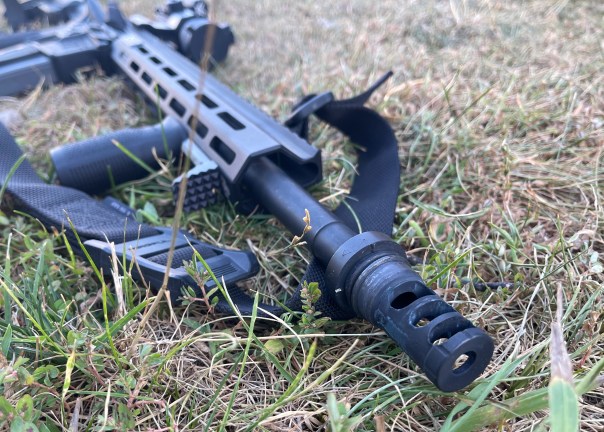
the Saint with a Yankee Hill Machine muzzle brake

Rifles like this are typically setup for short to medium range, with that in mind I decided to go with a simple Vortex red dot sight. With that taken care of, I added a couple other things to the rifle. A Magpul MS4 sling, and a small down-grip up front. I like using these as a place to grip and pull with my support hand. The Saint comes with a pretty standard bird-cage flash hider, but I was surely going to swap that out for one of my own. I intended on running my Yankee Hill Machine Turbo on the rifle, so I mounted up a compatible muzzle brake as well.

With nothing left to do but get treat this Saint to heat of hell’s fire, I grabbed some American Eagle ammo and headed up to my shooting spot. With a stack of GI and Pmags loaded, I set to zero my red dot. The rifle was easy enough to get zeroed which allowed me to spend more time shooting instead of goofing around with the turrets. The light weight of this rifle makes it very easy to throw around, recoil is very modest particularly when suppressed.
Accuracy of the Saint was pretty standard, I had no problems hitting most things that I aimed at within a reasonable distance. Hitting milk jug sized targets at nearly three-hundred yards was pretty repeatable, and close stuff like fifty yards was obviously no challenge at all.
The rifle felt just like it should, easily integrated into my shooting style. The ergonomics of the AR 15 have been perfected over the decades, and the Saint is no different, it fit me well allowing me to shoot it like we were old friends. I hammered through a couple hundred rounds which went all too fast, I’ll happily report that during this short duration I experienced zero malfunctions.
The several hours of range time with the Springfield Saint were great, and I think that for the $1100 or so dollars it goes for on the street are probably worth it. I’m sure there are countless similar rifles that go for much more, and others that go for far less. I prefer to pay enough to know that I got something worth having around.

Pros and Cons

Pros

Compatible- The Saint meets the needs of most modifications or accessories most shooters want
Reliable- No malfunctions were experienced, and it appears Springfield Armory has taken the extra steps to ensure reliability
Accurate- Accuracy was more than adequate for a rifle of this type
Many Options- Plenty of colors and models to choose from

Cons

Plane Jane- There wasn’t anything about this gun that made it stand out from any other to me


Report Card

Shootability (A) the gun was a blast to shoot, easily manipulated and adapted to various shooting positions
Reliability (A) No malfunctions of any kind were experienced
Ergonomics (B+) The Saint was a great fit, I would have loved to see something like extra bolt-catch or ambi mag release
Accuracy (B+) Accuracy was pretty typical, shooting 55 fmj’s typically rendered 1.5 MOA
Value (B+) I think the Saint is a safe buy if you are looking for an AR rifle of this type

Ammo

I shot mostly American Eagle ammunition through the rifle, though I also shot some PMC bronze 55 grain as well. Both ran flawlessly through the rifle and performed well downrange.

Best Upgrades

I think a good recoil reducing brake makes this rifle even easier to shoot well, I used the YHM Phantom Micro brake. It worked great and had the added benefit of allowing me to quick mount my suppressor to the rifle.
A good sling is a must, the Magpul MS4 was a good choice, but anything comparable to it would likely serve you well.
I enjoyed using a red dot sight on the Saint, the Vortex Strikefire worked great for me. But I also would recommend the Sig Romeo as well, as it is a little more compact.
The Magpul downgrip was also convenient for better handling the rifle, anything comparable or that better fits your grip would be a good choice.

-CBM

More info about the Saint here

Christensen Arms MPR 6.5 Creedmoor

Introduction

I am not new to Christensen Arms rifles, I’ve been lucky to play with several of them over the last couple years. But today we are looking at a new to me rifle; the Christensen Arms MPR 6.5 Creedmoor.

The Modern Precision Rifle (MPR) is Christensen’s version of a light-weight sharp-shooting rifle. Whether it’s used for competition shooting or as a sniper rifle, the MPR brings some very modern touches to the precision rifle market. But are those features worthy of praise?

The MPR

Christensen’s MPR is based around their stainless steel action, a two-lug action very similar to the very popular Remington 700 like many other modern actions. The rifle tested here is chambered in 6.5 Creedmoor, using a short action bolt. Like most Christensen rifles, the MPR is heavily reliant on carbon fiber.

Its carbon-wrapped match-grade barrel is largely responsible for the rifle’s lightweight, as are other parts of the chassis. At the end of the barrel it is threaded 5/8-24 and is fit with a matching muzzle brake for additional recoil reduction.

At the heart of the chassis is an aluminum block where the action is mounted. And the handguard is bolted on to the front and is made from a carbon fiber shaped tube. The MPR uses the very popular AICS pattern magazines and they feed nicely into the magwell of the rifle. Inspecting the grip looks to be a basic AR-15 type pistol grip, this is a nice feature as you can install whichever one suits your fancy.

The folding stock hinges just behind the tang of the action, I really like the way they designed the hinge mechanism. It’s quite tight and locks up as if there was no hinge at all. Just be careful to keep skin away from the area while folding or you may bleed a bit.

Fortunately the butt stock of the MPR is completely adjustable, which makes it very nice to adapt to each individual shooter. The whole thing is pretty handsome and put together very nicely.

Shop this and other Christensen Arms products

Rifle Setup

Surely I was going to need a good scope and at least a bipod to shoot this rifle well. I installed a Primary Arms ACSS Apollo 6-30X56 riflescope in a ZRO Delta Mount .  To simplify I went with  a Harris 6-9 bipod attached to the pic-rail on the bottom of the MPR handguard. For ammunition I brought along a few boxes of Hornady 140 grain match ammo. With everything put together, leveled and balanced I adjusted the rifle to fit me, and headed out for the range.

First Impressions

The Christensen Arms MPR 6.5 Creedmoor was plenty comfortable to shoot. It weighed so little compared to other similar rifles I have. As I sat behind it on a bench I ran the bolt a few times and felt the break of the trigger just to familiarize myself with it. Its bolt was easy to lift and snap shut, and the Trigger Tech trigger as usual felt outstanding.Primary arms

I loaded the magazine and closed the bolt. As I broke the trigger everything felt right, the recoil was quite modest and running the bolt for round two sent the empty case flying. The M16 style extractor of the MPR does a great job getting brass out of the way for the next round.

I fired a few more shots and adjusted my scope to get a proper zero. At that point I tried to settle down as best I could and shoot a few good groups using both the Hornady and some Federal 130 grain match.  I felt quite good about my shooting but I was not super excited about the grouping downrange, the first three groups of five-shots measured right around an inch. I tried again with my other ammo selection and got very similar results, my only hope is that perhaps this rifle doesn’t like what I feed it. And maybe there is something out there it will shoot better.

Into the snow

We decided to take the rifle for a hiking trip into the snow-covered Rocky Mountains, and I brought another type of Hornady ammunition to see if perhaps it faired better. With all my gear stowed on my back, my son and I headed into the cold.

The open country where we live makes an excellent place to hunt and shoot. Here in these breezy canyons I wanted to see how the MPR shot. Mainly to see how it would perform at longer distances and real-world shooting scenarios.

Normally this time of year I shoot at tiny snow patches in the dirt. But due to winter part 2, I was instead shooting at little dirt patches in the snow. The first target was about a three-inch muddy spot surrounded by white snow. I figured it would be easy to spot the impact and judge the shot.

After loading the rifle I steadied it and focused on my point of aim nearly four hundred yards away. I pressed the trigger and the suppressed gust of pressure echoed across the canyon. I’d added my Yankee Hill Machine R9 suppressor just to see if it helped the performance of the rifle.

The contrast of dark splattered dirt across the snow, and my hit was close enough to call it good in my opinion. So I continued my search for additional targets. We repeated the process until I had exhausted my curiosity and ammunition supply.

christensen arms MPR 6.5 Creedmoor
We also shot the MPR suppressed with the YHM R9 suppressor

Pros and Cons

I’ll be honest up front, I wasn’t exactly sold on the aesthetics of this rifle when I first saw it. I couldn’t exactly say what I didn’t like about it. But it has certainly grown on me a bit over the last few weeks. Everybody else thought it looked great so I’ll assume its just my weird taste.

I was really hoping this rifle would shoot better than it did. To be fair it is not a new rifle so its possible that it has been rode hard and put away wet too many times. But a rifle like this should shoot half-MOA groups all day.  I just couldn’t get it to reliably do that.

On the plus side, I really appreciated many of the rifles other qualities. The light weight is always appreciated. And its comfortable and adjustable chassis made shooting it very pleasant. Little features like the folding mechanism, great trigger, awesome cycling and threaded barrel made adapting the rifle to my purposes easy. And of course improved my shooting experience.

Click here to see more about the MPR

christensen arms MPR 6.5 Creedmoor
Shooting the Christensen Arms MPR 6.5 Creedmoor

Conclusion

I must say that I liked this rifle more than I expected to. And yet I’m torn because I am simply uninterested in rifles that won’t shoot reliably sub MOA. I’m lucky to have rifles ranging from discount economy models under four hundred dollars up to production sniper rifles that cost seven thousand dollars. And even the cheap ones I can typically get to shoot consistently sub MOA and often 1/2 MOA.

The Christensen Arms MPR 6.5 Creedmoor surely could be an outstanding rifle, I’ve heard of others that shoot outstanding and accurately. If this one did, I think I’d be hard pressed to let it go. But with a street price just under twenty-four hundred dollars, I’d need more convincing.

christensen arms MPR 6.5 Creedmoor

If you like this carbon fiber rifle, check out this custom one the 257 Blackjack
25 creedmoor, krg, tikke T3, Maven

MAVEN BUILT RS.3 5-30X50 RIFLE SCOPE

INTRODUCTION

As so many new optics companies flood the market with rifle scopes, it’s a great time for shooting nerds like me to get their hands full of options.

One of the more recent companies to arrive on the scene is Maven Optics, and today I will be inspecting one of their long-range riflescopes, the Maven RS.3 is a 5-30X50mm rifle scope. It promises to deliver high-quality images combined with the ballistic tools needed to give hunters and shooters an elite performance at any range.

I’ve been like a tick on the ass of the precision rifle community for a couple of decades now, and it has been incredible to see the changes achieved in this space. I remember when I first got into precision rifle shooting, and the options were very limited.

It was a different landscape than what we have today, where there are incredibly high-functioning options that are surprisingly inexpensive. This is no doubt attributable to imported products from all over, but mainly Asia.

The Maven RS.3 is made from Japanese components, which in my experience, has proven to be both affordable and optically sound. I’ve been able to use and test a great many of the options on the market today, so I look forward to sharing what I’ve found with today’s subject.

After a concise introduction to the scope, I already have a pretty good feeling about it.

MAVEN BUILT RS.3 5-30X50 RIFLE SCOPE REVIEW

The RS.3 is Maven’s premium option, and it comes full of features that shooters once dreamed about. It’s quality optics and desirable features come at a price that would surprise some of the other old-timers like myself.

The sport of precision rifle shooting has grown exponentially over the last twenty years, and growing right alongside it has been long-range hunting.

Both practices rely heavily on the ability to hit an often small target at ranges that, until recently, were quite inconceivable. After a short overindulgence in Maven’s marketing material, I get the feeling that they wish to supply both of these types of shooters.

Not that your traditional hunter/shooter wouldn’t benefit from such a rifle scope, but it may be more money than you need to spend if you are the type of shooter who rarely reaches beyond conventional distances.

Long-range rifle scopes like the RS.3 are optimized for tactical-style shooting and long-range hunting. These activities require correction for varying ballistic performances of the cartridges they are mated to.

So with that in mind, it’s important to consider the rifle and cartridge and the intended purpose to ensure you get the best tool for the job.

maven RS.3 5-30X50 mounted on tikka t3 long range test
The Maven Scope performed well on my Tikka 25 Creedmoor

SPECIFICATIONS

Magnification 5x to 30x
Tube Diameter 30mm
Objective Lens 50mm
Weight 26.9 ounces
Focal Plane First
Length 13.03 inches
Turret Values 1/10 MRAD
Reticle SHR-MIL
Warranty Lifetime

PROS & CONS

PROS
  • High quality optical performance
  • Front focal plane
  • Compact size
  • Milling reticle
  • Smooth controls
  • Zero-stop
CONS
  • Six MRAD turrets
  • Loses brightness at 30x

TESTING IN THE FIELD

As I lifted the Maven from its curious egg-carton-like box my curiosity had peaked. I had seen Maven scopes for years, on other’s rifles and in countless pictures.

I hadn’t really formed an opinion yet, but based on what I had vaguely seen and heard, people were happy with them. I inspected the RS.3, and gave the controls a cursory twist to see that everything had arrived intact.

From there, I went outside to have a look at the world around me, as presented by Maven. The image I saw was actually better than I might have expected. Very little aberration around the edges and a pleasantly bright picture that felt great to my eyes. I played with the focus a bit to see how clear I could get the picture at these neighborhood ranges.

Like a true reticle geek, I was immediately enticed by the many subtensions that adorned the posts. There were half MIL and whole MIL marks, out to five, where it turned to more course measurements. The open center housed a tiny dot that, even at 30X, seemed quite fine, and would work great for very precise shot placement.

But it was time to get this little scope ringed up and on a rifle. I mounted it in a 20 MOA canted AADland Engineering cantilever mount, with the plan to mount the scope to one of my favorite rifles, a Tikka T3 chambered in 25 Creedmoor.

I was a bit worried about how it would all line up, but as it turns out, everything was a pretty close fit.

As I set the rifle up to boresight the combination, I noticed a condition that would perhaps aid in shooting with the scope further than anticipated. I’d forgotten that the Tikka already had a 20MOA scope base installed, so the total cant on the scope was 40MOA.

I was worried I wouldn’t be able to zero it at my desired range, but as it happens, it worked out perfectly zeroed near the bottom of the scopes erector travel. This would allow me to use the full elevation capabilities of the RS.3. So, with plans to get way out there, I headed up into the Rocky Mountains to test this scope in the very country it was designed for.

It only took a few shots to get into a groove with the Maven. I really liked the bright image in the morning sun.

Using the tiny point at the center of the crosshair, I was able to adjust my zero till it was as good as it was going to get. The various holdover and windage points would come in very handy for holding wind and measuring corrections.

Many folks use the reticle sub tensions for various purposes, but for me, the main purpose is measuring where I hit compared to where I aimed. This allows for rapid corrections, which are very necessary in the field, particularly when hunting.

Shop all Maven Rifle Scopes Here

maven RS.3 5-30X50 mounted on tikka t3 long range test jeff wood
My Cole-TAC suppressor cover kept mirage down

With the sun shining, I shot several targets across a great spectrum of distances from one-hundred-fifty yards all the way out to one-thousand yards.

This is where I confirmed one of my suspicions that I’ve seen plenty of times before. Every scope I have ever used has a reduced image quality at maximum power. The disparity is often more obvious with optics that are lower priced. This is why you get what you pay for is even more true with glass.

I’ve found that at the highest 5-10% of magnification, most scopes become dark, and details become less obvious. The Maven was certainly not immune to this phenomenon; I found that at its highest ranges of power, it was darker and harder to make out the finer details.

But as I mentioned, I have seen this with nearly every scope out there, and the Maven was no worse than most scopes I’ve used before. In fact, being a 5-30 magnification scope means that at 25x it looks outstanding, whereas comparable 5-25 scopes will likely not look as good when viewed at 25x.

The six-MIL turrets are certainly serviceable, though I am a bigger fan of ten or higher MIL per revolution of the turret. This becomes more of an issue the further you shoot; if the distance you are shooting requires multiple revolutions of the turret to get the corrective elevation, the likelihood of losing track of which turn you are on increases.

maven rs.3 hunting
The rifle and scope combination made an excellent choice for my favorite hunt

It is for this purpose that some use indicators to show which revolution you are on, or another alternative is a zero-stop.

The folks at Maven chose to go the zero-stop route, which is not a bad idea as it is probably the simpler and more affordable way to go. The zero-stop allows you to set a hard zero for your elevation turret. This is very handy as you don’t even have to look while you turn the elevation turret down until it stops. And once there, you know the scope is back at its zero range setting.

There are many different ways to put a zero-stop on an elevation turret, and the design Maven uses isn’t a bad option. It allowed me to have a hard zero that is easily changed using only a small screwdriver tool included with the scope.

The parallax/side focus of the RS.3 was very functional, and I was surprised at how close it would function. What I mean by that is most precision rifle scopes tend to keep their range in the fifty-yard range out to infinity.

The Maven RS.3 can be focused as near as twenty yards, and removing parallax on targets that close would make it a good choice for those fancy new air rifles.

maven RS.3 5-30X50 mounted on tikka t3 profile photo
This combination would be an excellent long range Rocky Mountain hunting rifle

RELIABILITY

During the course of testing out the Maven RS.3, I experienced no issues with its functions. All the controls are easy to operate and with just the right amount of resistance. While I suppose I could have given it a beating with a larger caliber rifle, I have no reason to expect it would have any problems doing so.

As we have become accustomed to the modern optics market, Maven offers a lifetime warranty. So it is good to know that should you experience an issue, they promise to stand behind it.

PRECISION

I was quite happy with the performance of the RS.3 as far as precision is concerned. The measurements input on the turrets were accurate and commensurate to the values in the reticle.

Being a 6X zoom, I was a little worried that the reticle would become too thick at maximum power, but it was still fine enough for accurate use.

OVERALL FEEL

The Maven felt great in both my hands and on my rifle. Comparably priced scopes and including the RS.3 can often have a cheap feel, by which I mean you feel like it could be broken by using too much force on the controls and such.

I certainly don’t recommend abusing your rifle scope in such a way, but I do have and have had scopes that I never felt like I could damage by forcing the controls. And even dropping a fifteen-pound rifle on concrete didn’t ruin the turrets.

That said, I do not expect the Maven or comparably priced scope to endure such torture. Such a performance is more appropriate for scopes costing two and three times what the RS.3 costs.

For the asking price of the RS.3, I think the scope feels great. There are few things more that I could ask of it without adding significantly to its market cost.

maven RS.3 5-30X50 mounted on tikka t3 profile photo

FEATURES

maven RS.3 5-30X50 reticle view

RETICLE

The SHR-MIL front focal plane reticle was a good combination of adequate subtentions without getting too busy.

I like that they numbered many of the reticle points, as it can often get confusing when you are shooting quickly. I suppose there are some folks in the PRS community that may find the reticle a little simplistic for their purpose, which is certainly subjective.

For me, it was fine, and for my favorite activity which is hunting I find it to be ideal.

This is the first scope of its kind that I have reviewed that didn’t feature an illuminated reticle. Some may find this to be a downside. In my opinion, it’s not a big deal. I can count on my hand the times I needed an illuminated reticle over the last twenty years.

maven RS.3 5-30X50 zero stop

ZERO-STOP

The zero-stop, as I mentioned above, is a very handy feature to ensure you know when your scope is set at its original zero POI. The zero-stop functions by having a lockable ring threaded below the turret.

Once the rifle is zeroed, you turn the ring up to the bottom of the turret as a hard stop. The ring can be secured using a screw to tighten it down to prevent movement.

The typical set screws that secure the turret to the erector screw underneath have been cunningly replaced by using a toolless cap on the turrets. You can’t even see it, but the top of each turret’s textured grip area is the caps that can be removed by gripping the turret and loosening the top of it (lefty loosey), once removed you can lift the turret off and set it where you want it before resecuring it with the thumb-screw at the top of the turret.

maven RS.3 5-30X50 30mm tube

30MM TUBE

The 30mm tube has become pretty standard among long-range scopes and is quickly being replaced by the 34mm tube.

The 30mm tube used in the Maven RS.3 allows for greater internal travel than the traditional one-inch tubes your Dad used. This gives the Maven RS.3 a 23MRAD total travel, which is pretty good.

SCORE CARD

RELIABILITY (8/10)

I had no problems with the Maven RS.3 while shooting with it. All the controls worked great. The only thing I would have preferred would have been 10MIL turrets and perhaps a tiny bit more resistance on the turrets. During a hike, the rifle slung over my pack caused my windage to move a couple of clicks.

ERGONOMICS (9/10)

Ergos were great with this scope, easily gripped surfaces, and intuitive operation was great.

CUSTOMIZATION (9/10)

Maven does offer custom options for the scope, which is pretty cool. You can add custom colors to various controls as well as custom engraving.

APPEARANCE (9/10)

It is a great-looking little scope! The finish and quality are great for the price.

VALUE (9/10)

The RS.3 offers just about everything an aspiring long-range shooter needs. And with an MSRP of $1200, it is hard to beat. I remember twenty years ago. I would save up that much money to buy a scope with lesser features.

Click here for more information, comparisons and accessories

maven RS.3 5-30X50 hands on test

CONCLUSION

The steady flooding of the optics market has raised many brands to notoriety. Honestly, I wasn’t surprised that the Maven RS.3 fit right into my collection.

I have seen and heard about them for years. The shooting public has been spoiled with so many good options. This scope is a great buy, and its features are ideal for someone looking to get in on long-range hunting or shooting on a tight budget. Sure, there are higher-quality scopes out there, and if you have the money to get one, I would suggest spending what you can afford.

But if you are looking at scopes in this price range, I think you would do fine using the Maven RS.3. I won’t be selling off any of my high-end scopes to buy more of these, but I certainly don’t feel inadequately outfitted with the Maven on my rifle.

-CBM

FN FS2000 Bullpup Review

The world of bullpups is a unique one, and pretty much everybody knows each other there. There are several popular bullpups available on the market, and today we are reviewing one of the popular bullpups from the recent past. The FN Herstal FS2000 bullpup was produced for almost twenty years, and it has seen service by various military services across the world. If you don’t know what a bullpup is, lets get that out of the way first.

A bullpup firearm is one where the action is located behind the trigger versus in front of. The idea is to reduce the overall footprint of the weapon, but they are often looked down upon due to inherent designs that typically complicate some basic functions.

The FS2000

The FS2000 is a 5.56 NATO carbine designed for military and police use. The rifle utilizes a 17.5 barrel that is tucked deep into its bullpup chassis to shorten the platform. The gun utilizes Stanag pattern magazines but as far as I can tell only works with the metal GI type. The action uses a short-stroke gas piston, a rotating bolt and an interesting forward ejecting system to overcome the ambidextrousness of a bullpup, with the action being next to the face it would be very unpleasant to have brass ejecting out the side into your face should you be left-handed.

The FS2000 has a very unique look, and one that has earned it several nicknames such as the ‘tactical tuna’. Similar to the other FN bullpup the P90, the FS2000 borrowed a similar safety that is also ambidextrous. A small disc located at the bottom of the trigger-guard can be rotated from either side with the trigger finger to engage or disengage the safety. The trigger itself like many other bullpup designs is a little more mushy than most would care for. The other controls include the magazine release located just in front of the magazine itself, the magazine release can be pressed with the upper side of your hand while stripping the mag from the rifle. The charging handle is located on the front-left side of the rifle, and uses a claw detent to keep it in place. The bolt does not lock-back on the last round, so there isn’t a bolt-release.

Perhaps the most interesting feature of the rifle is at the breech. Since the chamber end of the barrel is deeply covered inside the rifle, there is a spring loaded trap door just in front of the cheek-rest that the operator can open to see the breech and clear any malfunctions.

The rifle features a great deal of sealing designs to prevent the ingress of debris into the rifle. All points of ingress have their own way of closing off, such as gaskets in the magwell, and a closed ejection port. The rifle weighs in just shy of eight pounds at seven-point-nine pounds, and the overall length of the rifle is twenty-nine and a quarter inches. The compact size of the rifle promises to give the user more maneuverability and mobility in action.

Lets see it!

When I opened the box containing the FS2000, I was surprised to find that it had been shipped with both the original foregrip panels, as well as a picatinny railed foregrip to utilize other accessories. The downgrip gave better purchase for me than the traditional smooth forearm panels, so I left it installed for the purposes of the review.

The gun seemed lighter than I expected, but I think thats because it appears bigger and bulkier than it should be. It felt lighter than expected because there seems to be a lot of empty space inside. As I lifted the gun to my shoulder, I was surprised by two things; first, I didn’t dislike the feel of the rifle as I expected I would based on my experience with the FN PS90. And second; it felt rather bulky compared to similar firearms whether bullpup or conventionally configured.

The FS2000 compared to the Springfield Armory Hellion

I ran the charging handle a few times to get a feel for the rifle, while it may offend some of the older crowd I have grown to like the feel of metal and polymers functioning in unison. The FS2000 felt smooth and locked up tight, I gave the trigger a few squeezes to see how it felt. I’ve felt a few bullpup triggers in my day, and this one was not too shabby to be fair. There are certainly better triggers but this one was certainly serviceable.

I gave the remaining controls a once over, I didn’t care for the safety much which again was no surprise. The mag release is another curious design, its a button just in front of the magazine well that you can depress with the edge of your hand while gripping the magazine. It is actually quite pleasant to use if you are stripping the mag with intent to retain it, but if you are reloading a fresh magazine it will definitely slow you down. It requires you to strip the mag with your support hand, then grabbing a fresh mag to insert.

Note mag release in front of magazine well

The muzzle of the 17.5 inch barrel is pinned (eye roll) with a muzzle brake, something I don’t care for. The gas block has two settings which I would have loved to tried with a suppressor, but I guess that’ll only happen in my dreams.

It was time to install a red dot, and get this thing to the range. Once upon a time the FS2000 was available with a 1.6X sight attached, the pictures alone made me shudder so I’m glad I had my own. I dropped a simple little Vortex red dot onto the rifle, and after gathering up some ammunition I was on my way to the range.

It had been a minute since I’d loaded some old metal GI mags, but it felt nostalgic. I loaded the magazines with some PMC Bronze 55 grain ammo, and began firing my first magazine. A handful of rounds in, the rifle stopped. That old familiar feeling of the bolt not going into battery told me something was up. The cunning mechanical device that grabs the spent case and pushes it into the long ejection chute had jammed. The spent case managed to get turned around inside the receiver and bound up, causing quite a disturbance in my shooting. After clearing the case, I finished out the mag and loaded another.

an unfortunate malfunction indeed

While shooting the rifle I actually enjoyed the feeling of it. I had no trouble hitting an IPSC target with every round in the magazine at two hundred yards, something every battle rifle should be able to do.

Keeping rapid shots on target at 200 yards seemed easy

Through the rest of my range time  that day, the gun ran almost flawlessly. I had one more malfunction as a round got bit going into the chamber, though I’m not sure if I could blame that one on the gun. I must admit that I enjoyed the gun much more than I expected too, and I’m even a bullpup fan.

Pros and Cons

One of my biggest gripes with so many gun owners is when they discount certain firearms or types of firearms based solely on negligent testing and arbitrary opinions. It’s easy to throw smoke at bullpups, they already get shamed for their looks so if they aren’t 100% perfect in their function they are quickly discarded.

As a bullpup fan, even I found myself quick to dismiss the FS2000. But I was quickly turned around by its smooth impulses and pleasant shooting. Though despite my positive experience with the rifle I must be fair to its critics. There are several awkward things about this gun, the bulk and controls seems to be the most of it for me. I didn’t care for the safety, mag release process, magazine compatibility, failure to lock back on empty and such.

In its favor, the rifle was accurate enough to be useful, completely ambidextrous for those lefties out there, and despite the awkward controls I still enjoyed the rifle quite a bit.

Read more about the FS2000 here

Conclusion

Yes I enjoyed the FS200, and though I’m already a bullpup fan I found something new by playing with the FS200. I’ve heard many people of the opinion that military service is some kind of indicator of a firearms suitability for severe duty, and the FN FS2000 certainly has seen much service across the world. And yet I felt a smidge let down because I’ve gotten to experience better suited rifles that those same people would call insufficient for service.

The FS2000 is a fun rifle, but I don’t think I could see myself paying the money for one with so many other good options available today.

-CBM

Tristar LR94 Lever Action Shotgun

INTRODUCTION

Like many of you, I grew up watching cowboy movies and loved the appeal of the old lever-gun-wielding hero. I always wanted to have a few lever-guns of my own, and have recently been adding them here and there to my collection. I was surprised to see the latest member of the group though, and despite my initial concerns it has turned out to be every bit as appealing. The Tristar LR94 lever action shotgun has every feature a lever-gun connoisseur would looks for, and maybe a few they wouldn’t have. My first thoughts about a lever-action .410 wandered into why a person would want or use such a firearm.

But after thinking about it for a bit, I figured it would be better to revisit that internal debate after I’d already proven the gun worthy.

Tristar is advertised as something of a more affordable brand, and I was worried that meant they would be cheap and come with comparable performance. The LR94 appears to offer a classy-looking shotgun with all the familiar function of a lever gun.

This brings a modest .410 shotgun performance, with mild recoil and a light load of shot for whatever you might point it at.

tristar lr94 lever action shotgun review test in mountains

TRISTAR LR94 SHOTGUN REVIEW

I was surprised when I opened the box containing the gun, as I was expecting a more traditional blued shotgun with a walnut stock.

As it turns out, mine was a Nickel plated model. They are also available in a matte black finish and a case-hardened color. As I lifted the handsome little shotgun from the box, I was impressed with the finish and quality look of the gun. Beautiful wood with a fine finish all around, and the nickel-plated metal had a bead-blasted look to it.

While it is sorta shiny, it also doesn’t have a hard flashy reflection like a blued shotgun would. Like anyone who ever watched a Western, I jacked open the action to see inside. The lever of the rifle was covered with a handsome little leather-stitched wrap. This was a welcome discovery as it added comfort to the back of your loading hand.

The LR94 features a two-and-a-half-inch only chamber, which makes ammo selection a little easier. The gun comes with a tubular magazine plug installed. This limits the capacity to three rounds only.

Check out the whole Tristar line of firearms here

This is typically done to accommodate many hunting regulations that require no more than three-round capacity. The plug can be removed to increase capacity to five rounds.

Like most lever-guns the Tristar LR94 uses a “squeeze-type” grip safety to allow the trigger to be pulled, which drops the hammer and ignites the chambered round.

In addition to that, the gun has a safety built into the top of the bolt. The safety is twisted clockwise or counter to engage or disengage the safety. The magazine is loaded through a side-gate like most other lever guns.

The muzzle of the rifle uses a Benelli Mobil style choke system and only came with one installed in the rifle. Also, at the muzzle is a clean front sight with a brass bead, easily indexed with the rear adjustable sight. It can be adjusted for both elevation and windage.

After my initial inspection, I was beginning to wonder if this shotgun was indeed going to be as inexpensive as Tristar’s “value experts” motto would suggest. It certainly didn’t appear to be a cheaply built or finished firearm.

tristar lr94 lever action shotgun review test young kid

SPECIFICATIONS

Caliber .410 2.5 inch shells only
Capacity 5 (without plug)
Barrel Length 22 inches
Barrel twist Ha! (Gotcha its a shotgun)
Weight 6.3 pounds
Length of pull 14.25 inches
Choke style Beretta®/Benelli® Mobil Style Choke (M)
Choke included CT-1

PROS & CONS

PROS
  • Very Handsome
  • Quality finish and fit
  • Interchangeable choke system
  • Adjustable sights
  • Top safety
CONS
  • Only 2.5 inch chamber (because I had a bunch of 3”)
  • Top safety (call me old fashion, I’d prefer half-cock)

ON THE RANGE TESTING

After toying with the shotgun for a while at home, I decided to get it up into the mountains where it would get used. With a few boxes of ammo, I headed up to see what kind of shotgun quarry I could muster up in these barren spring mountains. I was hoping a squirrel or something might cross my path, but it wasn’t meant to be.

But I was prepared to give the gun a workout either way, as I’d brought a case of clays with me.

And without wasting any time, we went straight to it. Throwing clays and smashing them immediately with the little Tristar LR94 .410. Despite its much smaller load of shot, I managed to hit most of the targets I shot at.

This was a bit of a surprise, not because I typically miss, but because I was completely new to using a shotgun with both a rear and front sight. It actually came to me pretty easily, and in no time we were dropping dust from the sky.

I may be a bit of a trigger snob, but when it comes to shotguns I am nowhere near as sensitive. I actually had to change to stationary targets to even be able to focus on the trigger pull enough to evaluate it seriously. This also allowed me the opportunity to see how the gun would serve shooting at stationary targets.

tristar lr94 lever action shotgun close up with federal shells

RELIABILITY

During the entire duration of my testing, the gun functioned flawlessly.

This may be one of the strong points of manually operated firearms. They typically work unless something is broken. Making it more of it an “it works or it doesn’t” evaluation. Unlike semi-autos and others that may, at some point, need tuning or other effort to ensure reliability.

The loading of the magazine is simple and doesn’t bite your finger like some others. The positive handling of the shells as they move from the magazine into the chamber is evident, and after firing, they are cleanly thrown aside.

This shotgun will be absolutely familiar and easy to operate for someone familiar with lever-guns and their operation.

ACCURACY

Accuracy with shotguns is obviously a varying thing, depending on ammunition, chokes, and other things.

I will say this; I was surprised at how easy I found it to hit what I was aiming at. This may just be my misunderstanding of the smaller shot load of the .410, but I felt just as confident shooting it as my old 870.

OVERALL FEEL

The quality feel of the LR94 was very tangible; it was just plain handsome. The nickel finish and laser work were immaculate, as were the checkering and finish of the walnut. The leather-wrapped lever was a nice little touch as well, and the adjustable sights seemed a feature fitting a fine firearm.

MANEUVERABILITY

The Tristar LR94 isn’t very heavy in my opinion, and its twenty-two inch barrel makes it easy to point quickly. And with its traditional “rifle” iron sights, it seems easier to aim accurately at stationary targets.

It was an easy gun to pack around and quickly point at things. I imagined myself chasing Chukars through these same canyons but in the fall. The LR94 would be perfect for such an adventure.

tristar lr94 lever action shotgun hands on test

FEATURES

LEVER ACTION

The lever action of the LR94 was flawless and familiar, like an old Winchester or Marlin you grew up with. No doubt, it will loosen up a bit with use, making it even easier to shoot.

TOP-MOUNTED SAFETY

I don’t use safeties that often, and if I do, I much prefer the traditional half-cock. I know it’s an unfortunate byproduct of our litigious society, but I don’t care for the look of the safety on top.

Obviously this is just my take; you may love it.

CHOKE

I wish I had a few different choke options for the LR94, but I didn’t have any trouble hitting what I aimed at, so maybe that wish was superfluous. The fact that it has a choke system, and you can adjust it to fit your purpose, is a fantastic trait. And being a very common and popular system used by both Benelli and Beretta makes it even better.

ADJUSTABLE SIGHTS

The sights of the Tristar LR94 are adjustable for windage and elevation. This is very handy if you’d like to adjust them for your use. Most shotguns don’t have or really need adjustable sights, but having them certainly has its upside.

This would be valuable if you plan on using the gun for turkey hunting or something similar.

tristar lr94 lever action shotgun hands on test woman shooter

HOW WE TESTED

The LR94, in my estimation, is a hunting shotgun. There are much better options for shooting clays and such, so I approached this from that perspective.

My father learned how to wing-shoot with a single-shot .410, which is probably why he got so good at it. With a smaller cup of shot, you have fewer chances to hit your target. Or you could look at it as you may hit it just as likely as with a 12 gauge, but fewer times, causing less damage.

.410 shotguns are ideal for shooting small game birds or other small animals for that very reason. Shooting a Quail or dove with bigger gauge shotguns runs the risk of significantly damaging your dinner. A .410 or 28 gauge is ideal for taking these smaller game animals without destroying them.

That is where I think this shotgun shines, in the pursuit of small game animals. With this in mind, I took the gun into the hills where Chukars call, and the squirrels watch closely for the movement of predators. The lightweight LR94 was easily carried around in the hills, and quite pleasant with its smaller size than shotguns that I would typically carry.

While it would work great as a squirrel or rabbit gun, shotguns are made for wing-shooting. With that at the forefront, I decided to shoot a few airborne clays to see how the Tristar performed pointed skyward.

I was quite surprised at how easily it came to me. I had perceived previously that the smaller .410 would prove more challenging to make hits. And yet I found myself dusting one target after another.

My wife and I would spend the better part of an afternoon hand-throwing clays for each other and enjoying every minute of it. We both found great success downing targets lining up the sights of the little Tristar.

AMMO USED

The majority of our shooting was done using Federal Game Shock 2.5-inch shells loaded with 7.5 shot. These loads seemed like a perfect fit for the little LR94. Find more .410 ammunition here.

tristar lr94 lever action shotgun with federal shotgun shells

SCORE CARD

RELIABILITY (10/10)

We experienced no malfunctions during the testing of the LR94. It cycled ammunition flawlessly and never failed to produce its pleasant little shove.

ERGONOMICS (9/10)

If lever-guns are your thing, then you will find this one to be very comfortable. The checkered grip areas feel great in the hand, and the leather-wrapped lever makes it a touch softer on the hands.

CUSTOMIZATION (7/10)

Other than changing out the chokes and adjusting the sights to your liking, I am unaware of any other customization for this shotgun. It does come with a front sling stud, so adding a sling is perhaps another option you may enjoy.

APPEARANCE (9/10)

I think the nickel/walnut look of this shotgun is quite handsome and a breath of fresh air compared to the constant blued/walnut look of 95% of lever guns.

VALUE (8/10)

With an MSRP of $1070.00, the LR94 doesn’t exactly come cheap. Though street prices typically hover around $700.00.

As you’ll see from the alternatives listed below, you can have a lever-action .410 for a little less or significantly more. Levered shotguns aren’t my thing, so I’d have to need one really bad to pay that price. That said, I believe the gun’s quality justifies that price.

CONCLUSION

tristar lr94 lever action shotgun test with shooting clays

After my time with the Tristar LR94, I wouldn’t exactly say I have been converted to the church of the lever-action shotgun. But I am certainly more open to their teachings.

Being my first run-in with Tristar I am also very open to seeing what they come up with next. If the LR94 is a great representative of what they sell, they deserve my attention.

If you find yourself looking for something perhaps a little unique then this shotgun might be right up your alley. I think it would serve as an excellent shotgun for a small game hunting gun, or as simply a conversation piece around a campfire.

The Tristar LR94 brings value and flawless function with nickel plated class in my opinion, and I’d be happy to take it into the woods this fall.

-CBM

Click here for more information on comparison, purchase, and alternatives.

A first look at the Canik METE MC9

INTRODUCTION

Canik has been knocking out one new model after another for the last few years; the polymer-framed striker-fired pistols have been received enthusiastically by the American shooting public.

Today we are looking at a new pistol from Canik, part of their METE lineup. The Canik METE MC9 is a micro-compact striker-fired pistol with an eye on the concealed carry market.

The MC9 uses many of the same stylings and features of Canik’s popular TP9 series of pistols. The micro-compact pistol promises to bring Canik’s performance and affordable quality to the average CCW enthusiast.

With both a twelve and fifteen-round magazines included and many other little extras that come with Canik pistols, it is very likely to be a big hit with consumers.

As a frequent carrier of pistols and a Canik owner, I was eager to see how this MC9 stacked up to other pistols I have used in the past. As a micro-compact pistol, I was immediately concerned about capacity, but with as many as fifteen+1 rounds in the gun, those concerns quickly dissolved.a case with canik mete mc9 and holster grips magazines unboxing

Canik pistols are frequently less expensive than their competitors, and when I saw the MSRP was only $419.99, I was even more interested in the pistol. This aggressive price definitely makes the gun more appealing to those with HK taste but a Glock budget. That wasn’t a direct comparison for you HK guys out there, so calm down and store your pitchforks…

The Turkish made Caniks are imported and sold as an outstanding value, giving a great deal of value-added features like coming optics ready.

They also typically include a great deal of accessories, cleaning tools, holsters, and other extras that really make you feel like you got something.

canik mete mc9 hands on test

SPECIFICATIONS

Caliber 9mm
Capacity 15+1 rounds (comes with 12 rnd also)
Weight 21.27 ounces
Sights Rear notch, front white dot
Barrel Length 3.18 inches
Overall Length 6.1 inches
Height 4.52 inches
Width 1.12 inches
Color Options Black, FDE, two-tone combination

PROS & CONS

PROS
  • Economically priced
  • Compact size
  • Good trigger
  • 15+1 capacity
  • Optics ready
  • Picatinny accessory rail
  • Interchangeable backstrap
  • Loaded chamber indicator
  • Flush magazine floorplate included
  • IWB holster included
CONS
  • Holster is kinda “meh”
  • I need one in each color
  • I couldn’t find any other downsides to the pistol

ON THE RANGE WITH THE CANIK MC9

Of course I couldn’t wait very long to try out this handsome little pistol, so literally the day after meeting it I ventured into the mountains to give it a good wringing.

I’d brought along a bunch of 124-grain reloaded ammunition that I’d produced on my brother’s Dillon 550. And I’d also brought along a couple of boxes of S&B 124 FMJ ammunition to try as well.

canik mete mc9 review with sellior bellot 9mm ammo

After familiarizing myself with everything I could, it was time to load up a few magazines. As is typical with Canik pistols, the magazines are quite nice, and have indication holes cut in the back to show capacity.

The twelve round magazine comes with an extension for the pinky. I found it to be a perfect fit for my hand.

Though if you are a really big-handed person you will probably prefer the fifteen-round magazine. Both of them loaded up nicely, and I snapped one into place securely as I stepped to the firing line.

The recoil of 9mm cartridges is not particularly significant, but I have found that with smaller pistols like this, they can frequently snap back a little more than expected. The first few shots through the MC9 were actually even more pleasant than I’d expected. Enough, in fact, that it didn’t even feel like a compact pistol.

I lined up the sights on my target and started stacking up the holes.

I can’t wait to get a red dot on this pistol, as I have quickly become a red dot guy. Not that there’s anything wrong with traditional sights, I have just grown to prefer them.

The white dot on the front sight must have slipped past QC, as they’d missed a little spot. But that didn’t stop me from hitting things with it. The pistol pointed nicely, and lined up with my natural aim, making the hit even easier to make.

We spent a few hours shooting, burning through the two boxes of ammo and about as many of my reloads. I would have loved to double or triple the amount of ammo we shot, as the little MC9 ran perfectly and proved to be very fun to shoot.

canik mete mc9 review hands on test

My second trip to the range with the MC9 included a Holosun 407K, which added another layer of ability to the pistol. The optics plate was a very tight fit, I needed to almost pry it off of the slide. I don’t think it was a big deal, but it gives me even more reason to leave the 407 in place because I don’t want to go through that again.

That said, the 407K is an absolutely perfect fit for the little Canik, literally like they were made for each other. The pins cut into the slide mated perfectly to the bottom, and there was no wiggle room for it to move even without tightening the screws.

Once installed, I didn’t even have to zero the red dot, as it lined up perfectly. Making my shooting even more fun. Using the red dot allowed me to focus purely on the target, and I didn’t even need to focus on the sights of the pistol. Just put the dot in place and squeeze.

RELIABILITY

The MC9 ran flawlessly for the most part. There were a couple of minor failures, but I am very confident the blame can be squarely placed on my reloading QC, I’m embarrassed to say. The feeding and function of the pistol were fantastic; the quality magazines fed perfectly.

Little things like the chamber-loaded indicator were a nice visual and tactile indication of a hot chamber.

Take the plunge, shop for your own Canik pistol here

ACCURACY

The short barrels of compact pistols aren’t particularly well known for great accuracy, but I had no problems hitting what I was aiming at. The adjustable backstrap ensured the pistol fit my hand well, which helped me shoot it better.

Despite its short 3.1-inch length, the barrel did seem pretty robust in its construction. Which probably helps keep bullets headed in the right direction.

The trigger in the little MC9 also felt great, which also aided in shooting the pistol well. The rounded and textured shoe of the trigger gave great purchase and control.

OVERALL FEEL

Like most Caniks I’ve shot, the MC9 felt great.

It was surprisingly light, and it filled my hand appropriately which is something I often complain about with compacts. The controls all felt smooth and easy to operate, and with a reversible mag release, it can work just as well for a left-handed shooter.

The ambidextrous slide release is just the right length to hit with my thumb without having to stretch.

canik mete mc9 review hands on test in mountains

The two magazines give you good options for avoiding the dreaded print of a CCW. The fifteen-round magazine is easily concealed if you’re a big person. While if you are a little more light in the frame, you may find the twelve-round magazine less obtrusive.

I am torn on the holster that came with the pistol. I understand that manufacturers like to offer accessories like these for added value. The problem is that holsters are subjective, and you either offer an inexpensive one that won’t break the bank, but many people won’t like or use.

Or conversely you have to research and see what most people want or like, and make the investment hoping it doesn’t go to waste. Either way, you run the risk of the holster being a dud.

canik mete mc9 review concealed carry

The included holster will certainly work, though I would probably replace it with something better like the Hidden Hybrid.

FEATURES

canik mete mc9 review close up with 12 15 round magazines

MAGAZINES

The twelve and fifteen-round magazines give you the option for various concealment scenarios. And the included flat-base floor plate gives you yet another option

SIGHTS

canik mete mc9 sights review

The included sights are perfectly serviceable, but it’s also very nice to have optics mounting solutions included in the box. Mounting up the Holosun 407k was easy, and made a great upgrade.

AMBIDEXTROUS CONTROLS

With no safety, an ambidextrous slide release, and the ability to reverse the magazine release button, the MC9 can easily be configured to shoot right or left-handed.

ADJUSTABLE BACKSTRAP

canik mete mc9 backstrap replacements review

The various back straps that can be swapped out allow you to further customize the gun to fit your hand. This is becoming more and more common, and it is certainly a welcome change.

ACCESSORY RAIL

The accessory rail under the front of the pistol is a perfect place to add a compact weapon light.

HOW WE TESTED

The duration of my testing with the Canik MC9 was mostly range shooting. We tried a bit of drawing and firing, as well as some reloading drills.

There is a stark difference between the full-size pistols with big flared magwells and such, and a small micro compact frame. It’s not as easy to stab the magazine perfectly out the gate. I expect it will take some practice to get good at it, like anything else.

Using the included iron sights, I found the pistol to be very useful and easy to hit targets at typical CCW anticipated ranges. The MC9 might be useful at further ranges, but I didn’t find that as relevant to the subject.

With the red dot installed on the slide, I found it to be even more fun to shoot. Making transitions from one target to another without having to shift focus.

Using the included holster, we also tucked in the pistol to see how it felt to draw from concealment. While I personally didn’t find the holster to be particularly great, it certainly worked as intended. And it sure beats not having one.

After the several hundred rounds fired between several trips to the range, I was quite happy with the performance of the MC9. And felt I had gotten a proper understanding of its strong points and the few issues I encountered.

AMMO USED

Apart from my 124-grain FMJ reloads, I also shot several boxes of S&B 124 FMJ Ball ammunition. Everything we shot through the MC9 worked perfectly except for a couple of malfunctions that were reload issues.

SCORE CARD

RELIABILITY (10/10)

The only malfunctions were due to improperly seated bullets, which has nothing to do with the little Canik’s reliability. Other than that, it ran flawlessly.

ERGONOMICS (9/10)

Micro compacts tend to be a bit small for my hands. I wouldn’t mind having a bit more grasp. The adjustable backstrap and magazine floorplates are great for accommodating, however.

CUSTOMIZATION (8/10)

With an accessory rail, and an optics platform milled into the slide, the MC9 offers some great options to customize it. No doubt there will be other barrel options and such if there aren’t already.

APPEARANCE (9/10)

I’ve always been a fan of Canik’s styling. The METE MC9 is another good example of a handsome pistol. The finish and surfaces all look outstanding.

VALUE (10/10)

For the MSRP of $439.00, I think this pistol is an excellent value

CONCLUSION

After my time with the Canik METE MC9, I was not surprised by how much I liked the little pistol. Much like the last few Canik pistols I have been through, this one met every need I had in a pistol, and it looked good and functioned great. And to top it off, the price is outstanding.

The MC9 provides a solid CCW pistol with better than most capacity while still being small enough to carry around every day. With minimal accessories and some practice, you could find yourself being quite proficient, which is everything in a concealed carry pistol.

-CBM

For more information, accessories, and comparisons, click here.

Savage Elite Precision 110 6.5 Creedmoor

Introduction

One of the fastest growing sectors in the sport of shooting is that of precision rifle, organizations like the Precision Rifle Series (PRS) and the National Rifle League (NRL) has rapidly grown the sport worldwide.  Today I present to you one example of the rifles that are driving this craze; the rifle is a Savage Elite Precision 110 chambered in 6.5 Creedmoor, married to a Modular Driven Technologies ACC chassis.

I say one example because there are so many great examples it would be daunting to list them all. Today’s subject is a great example to start with, precision shooting and long-range were once a rich man’s game using only custom built rifles. This rifle however is every bit as competitive, and is much easier to obtain for mainstream shooters looking for entry to the precision shooting circuit.

The Savage Model 110

Savage has been in the bolt-action rifle business for a long time, and in my opinion they have done a pretty good job of offering an affordable rifle that punches above its weight. Back when it was all custom rifles, Savage model 10’s and 110’s were often the choice for an effective donor action that wouldn’t break the bank.

The model we’re testing today utilizes Savages popular Accu-trigger, floating bolt-head, and tang-mounted safety. These are common and popular features for the Savage, and well tested over the past decade. On top of the tubular action is a 20 MOA scope mounting rail, also very common on long-range rifles. The base gives a canted starting point for your scope, which allows the internal movement of your reticle a wider range of travel, and helps keep it further from the extreme ends of its travel.

A twenty-six inch stainless barrel is mounted in the action, and it features a heavy profile and a one-in-eight-twist. The threaded muzzle carries a dual ported muzzle brake to help reduce recoil. Before the Fudd’s chime in about 6.5 Creedmoor’s being weak and not in need of recoil reduction, let’s make it clear: Recoil reduction in competitive shooting isn’t about weakness, it’s about spotting your own hits and misses. Muzzle brakes keep you on target so you can hopefully see your impact.

The MDT ACC Chassis

MDT has been building precision rifle chassis for quite some time, and their ACC rifle chassis is one of their more popular competition models. The chassis is compatible with many of the more popular rifle actions, allowing users an upgrade.

The chassis is built from aluminum, and features a skelotonized buttstock with completely adjustable positions. An adjustable pistol grip also allows customization for the user, making the rifle as comfortable as possible. MDT’s chassis is also compatible with the standard Accuracy International pattern magazines, which is a must have nowadays. The foregrip of the rifle is M-Lok compatible to allow adding accessories like weights and barricade stops. Or any other ad-on that PRS type shooting utilizes. There is also a built in ARCA rail on the bottom of the foregrip, this allows the rapid attachment of other support accessories and mounting the rifle atop a tripod.

But how comfortable is it?

I wasted no time prepping the rifle to be range-ready, I added a Harris bipod mounted to an ARCA clamp for easy adjustment on the ACC ARCA rail. And for a scope, I wanted something that would match the rifle’s needs, so I mounted my Kahles 318i in a set of Vortex rings. Once everything was together, I laid behind the rifle to adjust everything to my taste and prepared for the range.

Ready for the range with Hornady Match ammunition

In the field

As I lay on the firing line, looking through my little Kahles. I couldn’t help but think; this rifle is quite comfortable. And in no time I would produce some great results because of it.

I loaded a magazine with my Hornady Match ammo, closed the bolt and focused on the target. Tightening up my grip against the trigger, I pressed till it broke. It felt great, the recoil was linear and even, I ran the bolt fast and fired another. And continued till the mag went empty.

The TiN coated bolt of the Savage 110 action was smooth as could be. But I did notice there was a slight hitch in the feed as the cartridges went forward. Every so often I would have to pause my push of the bolt and start again to get it to feed right. I think perhap it didn’t like that particular magazine. Because it seemed to go away when I tried it with a polymer magazine from Magpul.

The rifle shot great besides that. It was easy to keep shots on target though the best I could get the rifle to group was around 1/2 MOA but average was more like .75 MOA. Not bad but also not what competitors would look for. Competition rifles often shoot sub .5 MOA and even as small as .4 or .3 MOA.

I ran the rifle through an afternoon of shooting, burning up my ammunition. It was very enjoyable and ended up teaching me a few things. I also added a Accuracy Solutions Bipod extender to see how it affected the rifle and its shooting, the results were steadier.

The MDT chassis played a big part in the comfort and ability to shoot the rifle well. I was quite pleased with how it felt in my shoulder, and adjusted properly it was a perfect fit for me.

Pros & Cons

I guess there are few things I wish were better, first and foremost would be accuracy. The rifle is apparently not new so I have no idea how many rounds it has downrange. It wouldn’t surprise me if it was excessive.

The magazine hiccup was also a little disheartening. Though I don’t think it’d be hard to correct with a little lip adjustment. But other than that I think the rifle is an outstanding piece of work, chassis and rifle both fit very well together.

The chassis is easily and quickly adjusted to fit any shooter. Its forend is easily adapted to accept accessories with its M-Lok slots and ARCA rail at the bottom. The feel of the chassis was excellent with a naturally occuring “gas-pedal” for the thumb (if you don’t know you gotta look that one up).

The Savage action is like every other savage action I’ve ever shot, not exactly tight but still runs like a sewing machine. All these years later I still don’t particularly care for the Accu-trigger. I usually take them off on personal rifles, but I must admit it is not bad. The muzzle brake was very effective at reducing recoil, and keeping the rifle on target.

In Closure

Despite being a little bit let down by this particular rifle’s accuracy, I still overall liked this setup. With a drop in barrel replacement it could be back in sub-half MOA accuracy if needed. Making everything about it helpful to any shooter in a competitive shooting scenario.

Continue Reading Here


Tristar Arms Viper G2 PRO 12 gauge shotgun

INTRODUCTION

Tristar is a manufacturer and importer of firearms. Their moniker of being the value experts suggests that their products offer a significant value over the competition. I am more of a rifle junkie than a shotgun devotee, but like any true gun enthusiast, I do enjoy shooting them. Today I will be taking on the Tristar Arms Viper G2 PRO, a 12 gauge semi-automatic shotgun designed for sporting and hunting purposes.

It seems over the last few decades, there has been a large influx of Turkish-made shotguns brought to the market. Being a rifle addict, as I mentioned, I have been mostly unaffected by this trend.

But I am happy to take on almost any firearm, and those brought in from the Turkish market definitely seem to bring value.

After just a few minutes handling the Viper, I expected I was going to like it.

THE TRISTAR ARMS VIPER G2 PRO

tristar viper g2 pro bronze review

The Viper G2 PRO features a twenty-eight inch barrel and is operated by a gas piston to cycle the action. Like most every other semi-auto shotgun, it uses a tubular magazine to carry up to four rounds plus one in the chamber.

The Viper utilizes a handsome blend of beautiful wood for the stock and a bronze color finished receiver mated to a blued barrel.

A push/push safety in the trigger guard will be very familiar to shotgunners, as are the rest of the controls. The bolt release is on the right side of the receiver, just under the bolt charging handle.

I was impressed with the presentation of the Viper, it is a handsome-looking shotgun, and it was time to see what it could do.

TRISTAR ARMS VIPER G2 PRO REVIEW

Tristar presents itself as a value option in shotguns. I wanted to see if that meant it was worth the money or if that just meant it was cheaply made. There are plenty of cheaply made options out there, and I have no interest in them.

After handling the Viper I think it was safe to assume it wasn’t slapped together by unskilled hands, the fit and finish of the shotgun looked very comparable to the competitive price.

The MSRP for the model tested is $990.00, but in a cursive search of the market, various configurations of the Viper can be had for as little as $460 to near the MSRP price. The majority of the ones I found were around the $600 mark, which isn’t bad for a good shotgun in my estimation.

To be fair, a guy like me would probably do well with the Viper. If you aren’t one of those haughty shotgunners looking down their nose through a strange shade of amber shooting glasses at non-Italian shotguns, you could also benefit from the Viper G2.

With a price like this, it could definitely be a winner for those looking to scatter shot on a budget.

tristar viper g2 pro bronze review and disassembly

The Tristar Viper G2 is available in a bunch of different setups, colors, and even a left-handed version. This is great for those looking, as it gives you more options at a decent price. Make sure you look at all of the models, as there may be one better suited for you than this model. Whether you are dusting clays on a range or seriously seeking turkeys, you have got some great options.

SPECIFICATIONS

Caliber 12 gauge three-inch chamber
Capacity 5 rounds max
Barrel length 28 inch
Caliber options 12g, 16g, 20g, 28g, .410
Color options Bronze, Silver, Black, and three different camo patterns.
Models available Right and left-handed
Weight 6.8 pounds
Length of pull 14.25 inches
Choke system Beretta®/Benell® Mobil
Chokes included Improved cylinder, Modified, Full

PROS & CONS

PROS
  • Very handsome shotgun
  • Reasonably priced
  • Functions excellent
  • Compatible choke system
  • Includes choke set
  • Feels very light
  • Cycled every kind of ammunition I tried
CONS
  • Not made in America (if that matters to you)
  • It bit my finger (obviously my fault)
tristar viper g2 pro bronze review and test in rocky mountains

FIELD TESTING

Enough chit chat about numbers and prices, it was time to get the Viper into action and heat it up.

For this, my brother and I ventured into the springtime Rocky Mountains, which are currently still stuck in February mode. But with a gorgeous day before us and several boxes of shells and clays, I knew we were going to have a good time.

Hand-thrown clays add an extra layer of fun to shooting shotguns, unless you bring my nephew, in which case it becomes a very hazardous two-way range. We took turns throwing targets for each other, running an assortment of shells from Remington and Fiocchi.

Shop all of the Tristar guns, you need a Star…

RELIABILITY

I had accidentally glanced at the manual that came with the Viper, and in doing so, I noticed that they recommend a break-in process using magnum loads. I was a bit concerned thinking there may be a reliability issue since my inventory was currently barren of any three-inch shells.

tristar viper g2 pro bronze review and test in rocky mountains with clay shooting

With that in mind, I approached the first few shots paying close attention to the cycling of the action. Whether it be good luck or simply the sunshine, the Viper ran like a typewriter despite my complete disregard for the break-in.

We cranked through several different boxes of ammunition to see how the Viper handled them. There were some light-weight 1oz. Sporting loads as well as some 1⅛ oz. loads, everything we shot was either 7.5 or 8 shot size.

During all of our shooting, we had zero malfunctions. The gun functioned perfectly and locked back every time.

ACCURACY

I usually don’t have much trouble hitting what I’m aiming at with shotguns. But it did take me a minute to get the flow right with the Viper, and once we did, we really hammered everything.

The fiber-optic front bead made it easy to see, and every time we lined it upright with the flight of the targets, we would be rewarded with a dark cloud of dust.

tristar viper g2 pro bronze review and test in rocky mountains with clay shooting 2

OVERALL FEEL

The Viper G2 felt excellent in my hands. Its lightweight made it quick to point and easy to keep on target. I say lightweight mainly because I am used to rifles; compared to those, the Viper is very light.

But it is lighter than some of its competitors, like the Beretta A300 or the Stoeger M3500.

I mentioned before that the fit and finish of the gun was great. It looks better than I expected it to, knowing that it was a “value” branded shotgun.

tristar arms viper

The trigger and other controls were perfectly familiar and easy to operate. Almost too easy as I managed to get my finger bit by the bolt when I got too close to the bolt release.

The gun goes together easy enough, though I did have a bit of an issue getting the barrel seated properly. This was likely more my struggling than anything.

FEATURES

MOBIL CHOKE SYSTEM

The Mobil choke system used by both Benelli and Beretta is extremely popular, which makes it an easy choice for most folks to use. This will allow you to upgrade to aftermarket choke tubes if you’re into that kind of thing.

FIBER OPTIC SIGHT

tristar viper g2 pro bronze parts

The orange fiber-optic bead at the end of the vented rib gives an excellent point of aim while wing-shooting.

RECOIL PAD

The soft rubber recoil pad made the Viper feel great on the shoulder. We didn’t shoot any particularly heavy loads, but I am sure the recoil would have been soaked up by the Viper’s action and recoil pad

tristar viper g2 pro bronze walnut stock

WALNUT STOCK

The beautiful Turkish walnut shows through the glossy finish on the Viper. The checkering gives great purchase for both hands to keep a good grip on the Viper.

tristar arms viper

HOW WE TESTED THE TRISTAR ARMS VIPER

For several hours, we ran the Viper through rounds of clays.

To make it fun, we changed position frequently, as well as the direction of targets. Switching back and forth between throwing and shooting made for great practice. Swapping chokes did seem to help somewhat for the different target presentations and distances. But it’s also likely that it was simply my perception that made it seem that way.

We shot three different types of ammunition during all this shooting, and for the most part, we didn’t notice any difference in operation or the ability to hit targets.

AMMO USED

In addition to the Remington Gun Club target loads and the Fiocchi dove loads, we also shot some Fiocchi Shooting Dynamics target loads.

tristar arms  viper
The Viper performed great with Fiocchi target loads

SCORE CARD

RELIABILITY (10/10)

I experienced no malfunctions during testing of the Viper G2

ERGONOMICS (9/10)

As far as shotguns can be comfortable, this one certainly was. The only way I would improve it is perhaps with an adjustable cheek-riser.

CUSTOMIZATION (8/10)

Other than the included shims for the stock, and the Mobil choke system, I’m not sure what you would customize on this gun. Perhaps additional beads or something, but it’s fine as is.

APPEARANCE (8/10)

I found the Tristar Viper G2 to be quite handsome. The contrast of the Cerkoted receiver and the blued-barrel matching the glossy finished walnut made a very handsome gun.

VALUE (8.5/10)

I think the Viper is a good buy for many of the prices I saw during my internet search. The less expensive models appear to be an outstanding value.

READ THE CONCLUSION

The Tristar Viper G2 PRO actually surprised me. I was expecting something a little more economical. Something cheaper I guess, is a good way to describe it.

But it turns out I quite liked the shotgun, and at no time did I ever really feel like it was a cheap alternative to something nice. Keep in mind I am no shotgun aficionado; that would be my father.

And as such, I have been exposed to plenty of ostentatious and extravagant shotguns, I’m not suggesting that the Viper can stand alongside them but I think it is still a perfectly suitable alternative.

Fine shotguns seem to last a very long time. That is the only thing missing from this review.

A year or two of hard use or a couple of seasons in a duck blind would certainly give a better indication as to the Viper’s long-term durability. I wish I had a time machine to do exactly that, but for now, you’ll have to just gauge the Viper off what we know and have shared here today.

That said, I would happily take the Viper G2 into the field again; it’s grown on me.

-CBM

Like 12 gauge autoloaders? Read this one next…