Category Archives: Product review

Products and equipment

Aero Precision M4E1 6.5 Grendel

The 6.5 Meme

You may have seen the popular meme about some of the more popular 6.5 cartridges, in this meme there are some satirical characterizations about the owners of these most popular 6.5mm cartridges. The 6.5 Grendel character is represented by a kooky and eccentric looking fellow you may not want to approach in the truck stop parking lot. I always laughed a bit a this meme, but today I find myself with that same wide eyed stare…

The 6.5 Grendel

Today we are looking at a 6.5 Grendel rifle made from an Aero Precision M4A1 lower and a 22″ Grendel Hunter upper receiver. Its Upper features a 22-inch 8 twist barrel with a threaded muzzle pitched 5/8-24 and of course chambered in 6.5 Grendel.

The Grendel is a bit of an oddity in that it uses a cartridge case that uses a bolt face between the very common 223 Remington, and the 308 Winchester. There are only a few common cartridges that use this sized case, such as the 224 Valkyrie and the 6mm ARC. The Grendel allows you to shoot 6.5 (.264) caliber bullets from a small frame AR-15 type rifle, which can vastly change the utility of your AR-15. I have heard of people using the Grendel for hunting animals as big as Rocky Mountain elk, and having used bullets of the same size and velocity I can see why.

Shop all ammo at Ammo to Go

The only difference I’ve noticed (apart from the 6.5 Grendel barrel) between this and other AR-15 rifles is the use of a different magazine. The Grendel magazines use a different follower, and I had a few laying around from my 6mm ARC project so they got put to good use.
The barrel is a fluted stainless one with a low profile gas block installed, and since it was threaded I fully intended on installing a suppressor to see how the rifle performed as a host.

The Aero Precision M4E1

After getting the rifle home, I set it on my bench and started looking for suitable accessories for the rifle. First and foremost it was going to need a good scope, for that I decided on installing my US Optics FDN17X, it seemed like a good match to the anticipated shooting for the Grendel. I also installed an MLok Harris bipod mount to the handguard so that I could install a bipod to shoot supported. I also grabbed my Yankee Hill Machine Nitro N20 suppressor to see how the rifle shot suppressed.

Ammunition

6.5 Grendel ammunition isn’t as common as most, so I knew going in I was going to have to improvise. I had a bunch of 6.5 Grendel brass already, yes I am unashamedly one of those range creeps that is always digging through brass piles. But I haven’t bought brass in years so I’ll happily take the troll title.
I have a broad selection of .264 bullets, but it seems that Grendel loads are frequently in the 100-120 grain category. So I decided I would load up some PRVI 120 grain BTHP bullets with some Hodgdon Benchmark in Hornady brass. While I claim no expertise in the dark art of handloading, I managed to get them together without any explosions or injury. So together with the outfitted rifle and my fresh loaded ammo, I headed into the hills to see how the rifle shot.
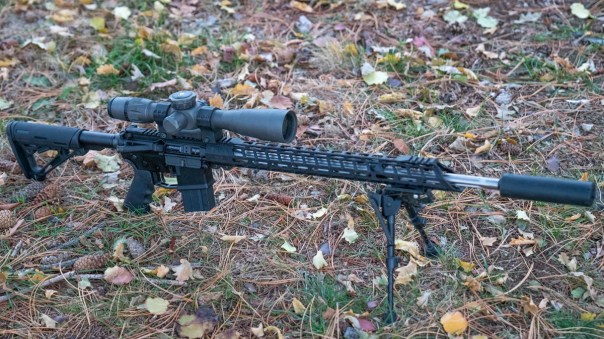
Aero Precision M4E1 Grendel Hunter rifleThe upper features a 22-inch barrel with an 1:8 twist and a 5/8×24 TPI threaded muzzle, of course chambered in 6.5 Grendel

On the Range with the Aero Precision 6.5 Grendel

With a fresh target hung at one hundred yards, I laid behind the rifle to get it zeroed. I had already bore-sighted it before I left the house, so it was ready to put on paper. After the first few shots I made some adjustments to the scope, and fired a group to see how it patterned. My grouping wasn’t terrible, a five shot average of one MOA is at least somewhere to start from. It’s certainly possible the rifle didn’t care for my handloads, and had I been shooting some Hornady Match it might have shot under a half inch. I shot several boxes worth of ammunition through the rifle, and to be honest I can see why so many people like this little cartridge. The recoil is very mild for starters, and I can’t imagine it would be much worse even shooting 140 grain bullets.
It was even better when I added my suppressor to the rifle. I was able to stretch the rifle out to about five hundred yards where I found it still quite easy to hit targets the size of a deer’s vitals.

Pros and Cons

Everybody has their preferences, and I surely have mine so I’ll tell you what I would do with this rifle if I had a magic wand. First I think I’d cut the barrel down a bit, it seems cumbersomely long to me. The long length of the barrel also makes it very front heavy, which if your shooting from a bipod isn’t a big deal but it can be for an offhand shooter.
The Grendel is one of those cartridges where I wouldn’t expect to be blasting one shot rapidly after another, so the ten-round magazine is more than enough for my purposes but you may want more if you are a high volume kind of shooter.

I do like the construction of the rifle, but the lightweight handguard doesn’t have anything more than what you want. The quality coatings look good, and everything fits together great. The bolt carrier appears to be nitrided for durability and smooth operation, while the raw steel surface of the barrel gives you that 2006 vibe. Continue Reading Here…

Aero Precision M4E1 Grendel Hunter rifle
I prefer to shoot my deer one at a time, but it’s still reassuring to know the Grendel Hunter has a magazine full of backup shots waiting

CONCLUSION

The Grendel Hunter part of this rifle makes a whole lot of sense to me. You get a handy little lightweight rifle, but at the same time you get a whole magazine full of 6.5mm bullets to pummel whatever it is you’re after. I prefer to shoot my deer one at a time, but it’s always reassuring to know you have a stack of backup shots waiting for you.

Furthermore, I think this would be an excellent hog gun, where you may need a whole bunch of hard-hitting shots close together. Loaded with 140-grain bullets, I could easily see using this rifle for big Western game like elk and bighorns. We’ve killed elk using the same bullets and velocities tested in this rifle.

There is obviously no shortage of good choices in today’s firearms markets, but this rifle is a great option for someone who needs this kind of firepower and weight. The kooky eyes and hairdo are entirely optional (I wouldn’t recommend the look).

-CBM

Building a Better Case: Pelican Vault 730 and Magpul DAKA Review

INTRODUCTION

Pelican cases have been the standard for firearm protection for years. Their new Pelican Vault 730 series, combined with the new Magpul DAKA case organizer, is proving to be a truly innovative firearm storage option.

The Vault series carries the Pelican name and warranty; like other hard gun cases, it features six locking latches that seal the case water-tight using an O-ring seal around the perimeter of the case.

From my perspective, the Vault line of cases appears to be a more affordable line of cases for those who take protecting their firearms seriously.

Get your own Pelican case

The DAKA grid organizer from Magpul makes customizing your hard gun case much simpler than before and gives you the option to alter it as well. If you were one of those weird Lego kids growing up, you’re gonna love this.

I’ve owned Pelican cases for years, and I’ve hauled guns all over the world in various case configurations with hard foam, soft foam, and textile interiors. So I was very excited to see an actual development regarding hard-case storage options.

Pelican Vault 730 and Magpul DAKA ORGANIZER REVIEW

As I mentioned, I’ve owned quite a few hard cases over the years. It seems that there comes a time in a gun owner’s life that he wants to take his most prized rifle and cut the foam in a hard case to fit it so he can pretend to be the assassin in a Bond film as he un-cases it out at the range.

It’s nice to have a custom foam-fit hard case for your rifles, but it also usually means you need several hard cases or sets of foam for each rifle.

The DAKA organizer system allows you to custom-fit the foam in your hard case to fit your rifles without using a knife. And you can also rearrange it to fit the next rifle by simply pulling the foam pieces apart and stacking them into the position you want them in.

The DAKA system is much like Legos, they are foam blocks with molded lugs that allow them to be stacked together like the famous toy blocks.

They come with a base plate that is essentially a foam pegboard, and an assortment of two and three-lug sections that you can plug into the baseplate in whatever configuration fits your chosen firearm. Then just as easily as they went in, you can pull them apart to reconfigure the case for a different firearm.

The whole system, when dropped into the Vault 730 case, makes for a very multi-use and secure transport for your weapons. The secure locking latches of the Vault 730 keep it secure, and it has the typical lugs at the ends to secure it with padlocks.

Handles on three sides make it easily maneuvered and/or tied down, and the low profile wheels at one end are nice for rolling the case across hard surfaces like those long walks through airport security. The Vault is available in a couple of different sizes, so you can customize your options.

FIRST IMPRESSIONS

I was excited to see the case when it arrived, I had seen several of the Vault cases while at SHOT Show 2023. And if the DAKA system lived up to my expectations, I knew I would have a very handy transportation system for my rifles.

First thing I opened was the Vault case. It came with a few layers of its own foam. I was quite pleased with how easy the latches were to open single-handedly.

Many cases I’ve used in the past have been far too stiff to release easily, and they sometimes seemed to bind on the locking mechanism. These were extremely easy to undo, and while opening all six latches to get into the case can sometimes feel like a bit much, I would rather have them than not. Especially after watching luggage workers toss things at the airport.

The lid of the Vault case is sealed with an O-ring. It also features a few interlocking molded dowel pins around the lid mating surface to help secure and keep the two parts aligned.

Inside I found a few sheets of the standard foam that comes with the case. I set them aside as it was time to open the box from Magpul.

The DAKA system came in a smaller box than I had anticipated, and I was even further surprised to see it appear nearly half empty. I thought they had surely sent me half of what I needed, but to my surprise, as I opened up the pieces, everything was there to make my case a safe storage place for my rifle.

I installed the base plate of foam into the bottom of the Vault 730, it was a snug fit, but I assume that is by design to keep things from sliding around inside the case.

I then laid my rifle into the case and started lining up with the patterns in the foam to see where my best fit would be. Installing the foam blocks came next, fitting them as close as I could to the rifle without compressing it.

I quickly was made aware of one thing I’d consider a drawback, attaching the foam blocks in such a way that would tightly hold my rifle was harder than I thought.

The interlocking teeth of the DAKA system are an inch or so wide, meaning that unless your rifle has the perfect proportions to match those spacings, you will have a little movement inside the case.

For the most part, that may not be a big deal, but if you have a very heavy firearm, this could result in significant shifting and potentially breaking through the foam blocks.

After I got my rifle situated and surrounded with foam blocks, it actually looked pretty good and snug. I closed the case to see how it carried, only to find that there was just enough flex in the case to cause a slight deformation from the installation of the foam baseplate.

The case mouth opened just enough to have to squeeze it to get it closed and latched.  Having let the case sit and rest with latches closed for a day or two has helped reduce the issue as both foam and plastic learn their new locations.

Making room in the case for things like accessories, boxes of ammo, and such was very easy. Much like an old game of Tetris, you could organize the blocks of foam to hold both your rifle and some shooting accessories around it in a very organized manner.

Pelican Vault 730 and Magpul DAKA DURABILITY

Hauling the case back and forth to gun shops and shooting ranges, I have come to appreciate it.

The case does seem to handle better than my old Pelican or SKB cases, perhaps due to less overall weight making it easier to handle.

The handles themselves are also pretty robust and big enough that even when the case is loaded fairly heavily, it’s easy on the hands. The latches and other parts of the case seem very reliable and robust, so much so that I don’t anticipate any issues to come.

OVERALL FEEL

My impression is that the Vault case and DAKA organizing system are worth their asking price. It does seem just a little less robust than the actual Pelican branded cases, but with a price of $200ish dollars, it is still worth it in my opinion.

And the DAKA system gives you some impressive improvisational gun storage options, though I think it came with even a few more blocks. Looking at Magpul’s website, it appears that they even have differently shaped blocks and other accessories on the way to improve the system. Continue reading here…

Features

Locking Latches

The self-locking latches are quick and easy to open and close. A spring-loaded lock button is centrally located in the middle of each latch.

Security Lock Locations

The Vault 730 features four heavily reinforced padlock eyes to allow the owner to securely store their property inside.

Weather Resistant

The O-ring sealed case keeps water, dirt, or other contaminants out of your case.

Adaptable

The DAKA system allows you to adapt the inside of your case to fit whatever firearm you wish, and in just a few moments, you can reset the foam for a different firearm.

Conclusion

The Vault 730 and Magpul DAKA system is a great way to store your rifles, particularly if you are a guy like me constantly using something different.

I suppose you could say that the DAKA system for $139 is a bit spendy for foam, but when you consider that you don’t have to buy twenty different sheets of custom-cut foam, it starts to make more sense.

The Pelican Vault 730 and Magpul DAKA combined make a strong and intuitive way to safely transport your rifles. I look forward to traveling more with mine!

-CBM

Check out more accessory reviews here

The FN PS90 bullpup: It came from the 80’s

Introduction

Perhaps one of the most recognizable firearms of the last half century is the FN PS90. It has appeared in countless films, video games, and other forms of media. The space-gun look of the PS90 sets it apart from most traditional firearms and makes it ideal for futuristic media.

The PS90 is a bullpup rifle, which is enough to differentiate it from most, but its curious design and borderline strange shape give it a uniqueness all its own.

The 5.7×28 cartridge used in the rifle is another anomaly, becoming much more prevalent in the last couple of years. Originally it was an obscure cartridge destined almost exclusively for the top-mounted magazines of the PS90 or the civilian-free model, the P90, which uses a shorter barrel and an auto-sear pack.

For many years, there was nothing like the PS90. It has seen new competition arise in the last couple of years, but for compact high-capacity firepower, only a few could match the little FN.

The industry giant FN Herstal has been a dominant power in firearms since the late 1800s, so it should be no surprise that many firearm developments have come from their factories. Weapons from FN have likely been a part of countless military operations, law enforcement agencies, and of course, civilian shooting activities.

Having grown up with the PS90 constantly before me, I like many others, always dreamed of having one to hold and call my own. So when given the opportunity to spend some time with this diminutive little novelty, I of course, stepped forward.

PS90 Review

The construction of the PS90 is an interesting design, using a polymer clamshell to house the rifle’s metal parts.

The action is a blowback type, typically using strong springs and a heavy bolt carrier. There are two metal shafts that the bolt carrier and spring ride on, anchored at the butt of the rifle.

The front half of the rifle simply slides into the polymer housing and has a spring-loaded button to hold it in place.

One of the more obscure parts of the rifle is the magazine function; the fifty-round magazine sits on top of the receiver underneath the sight bridge. The magazine carries the cartridges perpendicular to the bore axis of the rifle.

As the cartridges are pushed to the rifle’s rear, they are twisted ninety degrees as they come out of the magazine, just in time to be caught by the forward-moving bolt carrier.

Spent cases are expelled through the bottom of the rifle, where a small dust door opens when firing the rifle.
The controls of the PS90 are also, of course, different than most. The small charging handles are located on both sides of the front of the receiver, making the gun perfectly ambidextrous.

The safety is located at the bottom of the trigger and rotates between fire and safe from either side of the trigger guard. The top-side magazine release buttons are pressed in an almost pinching motion as you lift the magazine up and pull it out to the rear.

As I mentioned, this makes the rifle completely suitable to be used by right or left-handed shooters, which is a great thing for service weapons that multiple people use.

The bullpup design of the PS90 makes it very short, and with the short-barreled version, it is even concealable. The fifty-round magazines give you very long strings of fire before needing to reload.

These great features make the PS90 a good option for military and law enforcement professionals. Civilians can and should enjoy these same benefits because this is America, dammit!

TERRESTRIAL RANGE TESTING

I was excited to get the P90 to the range to see how it shot. I was lucky enough to get the restricted model P90 instead of the civilian PS90 (semi-auto). This development would greatly increase the cost of reviewing the gun due to my inability to hold back a full send. The basics of the two rifle models are very similar, so the rest of the review would be relatively the same.

I sourced ammunition boxes from different sources, including American Eagle and FN. With the three fifty-round magazines and several hundred dollars worth of ammunition, I figured I could reasonably determine the function and manual of arms.

I’ve been lucky to shoot several different PWD-type weapons and other short-barreled rifles, so I had a baseline to evaluate the P90.

Short rifles like this are typically used for personal defense, assaulting forces, or something similar. These activities are likely to take place at short distances, so these rifles are usually topped with a reflex or red dot sight to take advantage of the rapid target acquisition they provide. This model came with a small red dot sight already installed, making my selection pretty easy.

After inspecting the rifle, I started the long process of stuffing the magazines with cartridges. The small 5.7 cartridges look similar to a tiny 5.56 cartridge, including a little bottleneck. I snapped one of the loaded magazines into the rifle and started with my shooting regimen.

The snappy blast of the 5.7 was quite evident, mainly when it was only a few inches away from your face. The gun cycled its action rapidly, discharging pretty forcefully the spent cartridges straight down onto the shooting bench below me.

I could feel the short travel of the bolt carrier sliding back and forth in the rifle. Other than that, the recoil was very mild and easy to control. Shooting the rifle at twenty-five yards, it seemed quite easy to keep shots on target.

Transitioning between targets was fast, and the rifle tucked neatly into my shoulder pocket, making it easy to keep on target. The short rifle has almost no room to pivot under recoil, the butt tightly tucked into the shoulder, and the muzzle in front of your support hand doesn’t give it much room to jump around.

The longer barrel of the PS90 might make it even more controllable and provide higher velocity from the same ammunition.

The trigger in the P90 was just as I anticipated. Many bullpups utilize a linkage to operate the sear remotely, and the P90/PS90 is definitely one of those. You can feel the sliding linkage and delayed sensation when pulling the trigger.

To be fair, this isn’t a sniper rifle, so having a flexible trigger pull isn’t a deal breaker for me. For the kind of shooting this rifle was destined for, I think the trigger is perfectly suitable, but it may take some getting used to.

The strange grip design of the rifle also didn’t strike me as ideal. It certainly allows you to control the rifle, though.

I’d like to think there was some kind of “engineer” explanation that would somehow justify why it feels like holding two cups of tea with a trigger in one of them, but I don’t think I’ll ever get that answer. Continue reading here…

PROS & CONS

PROS
  • Extremely maneuverable & compact
  • High capacity magazines for fewer reloads
  • Distinguished service record
  • High-velocity ammunition superior to sub-guns
  • Spacegun
CONS
  • Awkward grip angles
  • Traditional bullpup trigger
  • Strange controls take getting used to
  • Ammo goes way too fast

RELIABILITY

The P90/PS90 functioned flawlessly during my testing process. Before firing the gun, I took it apart to inspect and clean it, giving it just a few squirts of lube before reassembly. The design of the rifle is surprisingly simple, considering what it accomplishes in such a small chassis.

Another one of the interesting design aspects of the full-auto version P90 is the trigger function for automatic fire. When the trigger is pressed enough to fire a shot, you can simply release the trigger for an audible reset, and a second shot can then be fired.

Without switching any selector or switch, you can simply pull harder to get an automatic rate of fire. Essentially you pull the trigger through the semi-auto feature and into the full-auto feature with the trigger fully depressed. An interesting design, for sure.

ACCURACY

The P90/PS90 is made to be a personal defense weapon, so we aren’t really looking for one-inch groups at a hundred yards.

But even with its bullpup trigger and a modest red dot sight, it wasn’t hard to keep the rifle on soda can-sized targets at 25 yards.

That may not sound like a ringing endorsement, but I wasn’t expecting impressive accuracy with this short-barreled machine gun.

OVERALL FEEL

The overall feel of the P90/PS90 was a little odd for me.

I’m sure that, like most things, it simply takes a moment to get used to, but I think it could be summed up with a comment I overheard myself say to another inquisitive shooter at the range; I think the gun is overrated, if I was going to spend the money it takes to get this rifle, particularly if you plan on going the NFA route, your money would be better spent on something else.

While there is nothing wrong with the rifle, and it works flawlessly as designed, I feel like there are better options.

The P90/PS90 does have a couple of things that are undeniably strong points that could make it the only logical choice for certain applications. If you need long strings of fire with no reloads, or if you absolutely need maximum concealment with rifle firepower, then the P90/PS90 is certainly a contender.

FEATURES

COMPLETELY AMBIDEXTROUS

The P90/PS90 utilizes completely ambidextrous controls. And it ejects spent cases through a down-chute behind the trigger-hand grip, so the rifle can be comfortably shot without inhibition regardless of right or left-handed shooters.

Dual charging handles on either side of the rifle are done simply and are subtle enough to be almost missed if you don’t know they are there. The rotating disc of the safety takes a second to get used to, but it does allow for simple operation using either trigger finger.

MAGAZINES

fn ps90 magazines

The magazines used in the P90/PS90 are one of the more interesting parts of the rifle. The cartridges are stacked perpendicular to the bore line; a turntable at the base of each magazine pushes the cartridge down while rotating it ninety degrees as it comes down. It is an incredibly innovative way to stack a large amount of ammunition in the rifle without reducing its portability.

Magazine changes are a little unorthodox compared to what most of us are used to. The magazines are inserted in the rifle by putting the blind end forward under the sight-bridge, then hinging it down, snapping the turntable into the top of the receiver.

The magazine release buttons are on both sides of the round turntable at the rear of the magazine, when they are pinched together the magazine is easily lifted and removed from the rifle.

While these mag changes might sound a little more intense than you’d like, particularly under life-threatening circumstances, the fact that the mags hold fifty rounds means you will spend more time shooting and less time reloading.

fn ps90

SIGHT MOUNTING

The curious magazine design definitely made FN engineers have to reconsider the sight mounting options for the P90/PS90. They came up with a bridge that goes over the top of the magazine, which also conveniently doubles as a more rigid metal structure to protect the polycarbonate magazines.

Whether you use some short radiused iron sights or a red dot type sight, they can be mounted to the Picatinny rail atop the bridge.

HOW WE TESTED

I spent a good portion of the afternoon burning through boxes of ammunition and the rest of my time loading magazines. Most of my time was spent shooting at twenty-five and fifty yards, which seemed appropriate for this little rifle.

Many targets transitioning, mag changes, and reloads were quite helpful in getting more proficient with the P/90/PS90.

I have to admit it is a fun little rifle to shoot. The near-recoilless shooting makes it fun to run quickly across a course of fire. Various targets, including clays and paper, were all easily used for running drills with this gun.

Most of the shooting was done from the standing position, or from a standing supported by leaning against a corner or something similar.

The compact size of the P90/PS90 made it easy to maneuver around the range, and corners and such were easy to negotiate. I also noticed that such a short firearm could also be a little bit more dangerous.

I would have really preferred to pull the muzzle brake to install a suppressor, not just for the noise but to have something else protecting the muzzle. Guns that are this small can get dangerously close to hands and fingers when opening doors and other operations.

If you shoot a shorty like this, watch your hands and muzzle.

The downward ejection of spent cases was a pleasant change from what many of us are used to. The brass is thrown at a pretty good speed, though, so don’t count on finding them all at your feet. The dust door that covers the ejection bay is supposed to snap shut, though the model I was using seemed to have a problem staying snapped in the closed position.

fn ps90 trigger

AMMO USED

Both the American Eagle FMJ and the FN branded ammunition functioned great.

Most people would want to use expanding bullets instead of FMJ ammunition, especially for defense purposes. I have heard that some folks have experienced issues with inexpensive 5.7×28 ammo, but I did not have that experience.

SCORE CARD

RELIABILITY (10/10)

The P90/PS90 functioned without any malfunctions during testing

ERGONOMICS (6/10)

I didn’t care for the grip design of the PS90; your experience may differ

CUSTOMIZATION (7/10)

The PS90 rifles don’t have a lot of customization as far as I can tell, other than sights. Even the muzzle device wasn’t changeable.

APPEARANCE (9/10)

As I mentioned from the beginning, the PS90 is iconic in its looks, but looks aren’t everything

VALUE (6/10)

I gave the PS90 a low score simply because there are more affordable firearms that do nearly the same job.

CONCLUSION

I guess you could say overall, I was just a bit let down by the P90/PS90. Kind of like with the Steyr AUG. As an eighties kid, you grew up thinking these were the coolest guns ever. But in real life, you pick them up, and they seem to be sort of a novelty.

Like I said, there are some specific situations where the PS90 could stand alone with no competition. But I think the scenario where I need long strings of fire with a slow rifle cartridge at close range from a gun I could hide under my coat just doesn’t seem reasonable.

I suppose if you’re in the Secret Service or something, there may be a good purpose, but for the average gun enthusiast, I think it’s more of a conversation piece, like 50 BMGs, Desert Eagles, and any of the Mac pistols.

Something you could pull out to impress company, but not something you’d shoot a lot regularly. It does fascinate me that to this day, the PS90 still looks as space-gunny as anything else, a gun before its time, perhaps.

-CBM

Aero Precision X15 5.56 carbine

Introduction

There is something to be said about a rifle that is near perfectly balanced and maneuverable. Today I am here to share with you one of those rifles, an AR-15 that just feels perfect in my hands, the Aero Precision X15 5.56 carbine. Built from an Aero Precision M4E1 lower receiver and mated with a lightweight eighteen-inch upper and barrel.

What makes a perfect carbine?


Obviously, that varies for most of us, but I’ll tell you what I think this carbine is perfect for. The lightweight barrel and handguard assembly make this rifle very balanced, and it has a very effective muzzle brake as well to help reduce any recoil or muzzle rise.
A fairly minimalist Magpul MOE SL-K buttstock also helps keep the weight down but still offers all the agility and modularity I’d want for shooting on the move. The trigger in this rifle is nothing extraordinary, but it breaks clean enough to shoot accurately.

On top of the rifle is a Vortex Crossfire II 1-4 LPVO, I know some of you are gonna disagree with me here but I like this scope for this gun. Apart from a good color combination, I think the 1-4 power is great for a rifle intended to shoot n’ scoot.


Any kind of shooting scenario where you expect to be rapidly moving and engaging targets from fairly close distances would be a great. That could be a two or three gun competition or a car lot in Wisconsin, but you’d find yourself pretty well equipped with a little carbine like this.
Your idea of a perfect carbine might be a little different than mine, I have no issue with that as ten years from now we may have swapped opinions.


Good Parts


Good parts make a good rifle, and while the X15 receiver from Aero may not be the greatest or best of all time but it is still a good place to start. The barrel in this rifle appears to be a Faxon gunner eighteen-inch barrel, it is nitride finished with a nickel teflon coated barrel extension and 5R rifled. Sounds like a winner, but we would see for sure on the range. The handguard is an MLok carbine length from AT3 Tactical, it’s pretty minimalist, and comfortable to hold.

Rangetime

The first time I took this rifle to the range I wanted to basically just prove it out and make sure everything worked together. I was quickly pleased to see that everything was in order and needed no additional attention, it was ready to burn up some ammo.


I ran several magazines through the rifle and I found it to be very controllable, the light recoil was further reduced by the brake making target acquisition quick and easy. I was also impressed that the light weight made it much easier to hold the rifle on target, not just hold it but to hold it still. Something I am not used to due to the heavy guns I usually shoot.
My daughter had come along and wanted to give the rifle a try herself. She too found the rifle comfortable to maneuver and shoot, which further credits the rifle’s handling.


I did put the rifle across some sandbags to see how it patterned. For a proper accuracy test I would have liked to put a better rifle scope on the gun, and perhaps shoot some better ammunition than I had on hand. The Crossfire II scope did work well enough for my purposes however, I didn’t have much trouble hitting what I was aiming at. The best group I came up with during my testing was a 2 MOA pattern, not exactly match-grade shooting but I’m sure I could have improved on that with a little more refined aiming and magnification. Continue Reading Here…

The maneuverability of the rifle was awesome and transitioning between various targets at different distances came easily. I really wish I could have shot the rifle in some kind of carbine match, as that surely would have exposed its weakness and mine. I also would love to shoot it more suppressed – personally I think it’s only proper to do so.
 

PROS & CONS
 

Aero Precision X15
Light and wieldable, the X15 is a perfect example of what makes the AR-15 so popular. (Photo: Jeff Wood/Guns.com)


I can’t say that this rifle is perfect, but it certainly is a great rifle for a lot of scenarios. I love the lightness and clean handling of the rifle. Matched with its flawless function and mean green exterior, there’s little for me to complain about.

As a precision rifle purist, I am always motivated by accuracy. Pencil-thin barrels and carbines aren’t typically the best combination for improving accuracy. But accuracy is defined entirely by the shooter and his or her targets, and for many practical purposes, the accuracy potential shown here is just fine in my opinion.

This rifle is a perfect example of what makes the AR-15 platform so appealing: compatibility with a massive assortment of parts and accessories that seem to mesh in perfect unison.
 

CONCLUSION

Aero Precision X15

Whether you are putting together a fighting rifle or a competition gun for matches, there is an innumerable selection of possibilities. I find this particular rifle to be fantastic for competitive-style shooting, but not ideal for the type of precision shooting I prefer myself.

The Aero Precision X15 or the more prevalent M4E1 receiver are both fantastic starting points for putting together a rifle, and as you might imagine, Aero has a whole catalog of other parts for your build.
 

-CBM

Like AR 15 rifles? Check out this one

Aero Precision X15 Rifle

Putting Together a Battle Belt

Who needs a gun-belt?

Depending on your profession, you might call it a battle belt, gun belt, or some other belt variation. Today we are going into the detail of putting together a battle belt, something I recently finished.
As I navigated through all the different options, I figured this might be something others would do, so I documented the process in the hopes of saving you time and money.

Shooting has become part of my profession. While you may or may not need a gun belt for your daily work, I hope that by the time I’m done sharing my experience, you will have a good idea of how you would do it yourself.
Unless you do any professional soldiering, law enforcement, or security, a gun belt will likely be recreational for the most part. It will likely be another part of your equipment when shooting at the range or in competitive events like two or three-gun matches.

I am by no means a competition pistol shooter, but I do enjoy practicing the skill. A proper gun belt is extremely useful for becoming proficient in shooting pistols and any kind of tactical discipline.

WHY USE A BATTLE BELT?

Battle belts are designed to help carry the weight and force of waist-bound shooting equipment. Not only do they carry the weight, but they also help distribute it with a degree of comfort.
A good belt also helps keep vital and life-saving equipment where you want it to be. Besides just your pistol, battle belts also have room for extra ammunition, knives, and other tools you may need depending on the task before you.
A good belt is customizable to fit the accessories and tools you need in the places that best fit your practice. With practice and time, you will likely change and adjust it until it perfectly fits your needs.

FIRST THING: THE ALL-IMPORTANT PISTOL & HOLSTER

Find a quality holster that properly fits your pistol. There are many good options from companies like Safariland or Blackhawk.Glock 47 9mm

Remember, these are not CCW holsters; they are for retaining your pistol under heavy movement and activity.
Good retention holsters are not exactly cheap, nor are they particularly compact. But they are well worth their cost and come in various styles and retention designs to keep your pistol safely at your side.

SELECT A BELT

There are a great many good choices to be had for a gun belt. Safariland and Blackhawk make belts for their holsters, but there are plenty of others like Blue Force Gear or Crye Precision.

With so many options, you may want to handle a couple before choosing one. After looking around, I decided to go with a 1.75-inch belt from the guys at Lead Devil.

There are two-layered and single-layered belts. I went with a two layered belt. They work by using a velcro under the belt that goes through your belt loops on your pants. The outer belt then attaches outside your belt loops by velcro to the inner belt and buckle in the front. It is a very robust system.

The outer belt has molle loops around the circumference to install whatever accessories or gear to the belt and the inner belt keeps your pants up and serves as a foundation for the load-bearing outer belt.

When selecting a belt, follow the manufacturer’s instructions on measuring yourself. A proper fit is vital to both function and comfort. Remember the size of your belt when selecting accessories. You can’t put 1.5-inch accessories on a 1.75-inch belt. The belt should fit fairly snug to keep your pistol and other gear from flopping around as you move.

Note: wearing a gun belt properly may be all the inspiration you need to get in better shape. They fit and work better when your “middle area” is trimmed.

Continue reading here

WHAT GOES ON MY GUN BELT?

battle belt setup belt position

HOLSTER

Obviously, the first priority should be your holster. Find a comfortable position on your belt that fits your draw location and attach the holster, either threading the belt through it or using the molle attachments.

I found it took some time to ensure I had my holster placed properly.

My pistol is a Sig Sauer P320 X5 Legion, and I bought the Safariland 7304RDS holster for it. The holster accepts both the pistol and the Surefire X300 weapon light in front, but after using the holster for a few days, I realized I needed a lower ride height.

I added a Safariland Cantable belt loop that added a few inches of drop, and I also added to it the Safariland Quick Locking System that allows the holster to detach from its base. I’ve come to find this very convenient.

Shop all Safariland Holsters and accessories here

The whole pistol and holster are easily removed from the belt. This also allows you to swap multiple holsters for different firearms to and from your belt. I adjusted the thigh strap that came with my holster for a better fit and to keep the holster as secure as possible.

Believe it or not, I actually wore the belt like this eight hours a day for over a month, making little adjustments here and there until I felt I had a perfect fit. I was constantly drawing my pistol to see what would make a smoother draw and holstering.

MAGAZINE POUCHES

battle belt setup belt magazine storage

A good battle belt will surely carry extra magazines for your pistol. I bought a couple of different options to try. The first was a pair of Tacos from High Speed Gear. I liked them, but I ended up swapping them out for a one-piece double mag pouch from Esstac. The HSG Tacos seemed to have more catch points and were easier to snag on things during movement. The Esstac pouches were smoother and had a nice exterior.

Position your mag pouches where they best fit your draw. This is another reason I like the Lead Devil belt. The molle allowed robust attachment of my accessories without sacrificing velcro engagement with the inner belt. Reducing the velcro engagement between the belt layers reduces the rigidity of the whole system and induces flopping.

If you incorporate a rifle mag pouch or two on your belt, you can attach it the same way via molle in whatever position you see fit. I run my rifle mags on my plate carrier, so I didn’t add any to my gun belt.

SHARP EDGES

battle belt setup belt pocket knife storage

Many guys put knives on their gun belts, whether for cutting tasks or when they run outta magazines. I actually run two knives on my belt; the main one is a Cold Steel Mini Tac.

The second one is just a cheap Gerber folder hooked into the molle behind my holster for things like digging sardines out of the can. I like the idea of having both options, one blade is kept in pristine razor sharp condition while the other is a day to day cutter.

Both are kept in convenient locations on the belt for quick and easy access, they also attach to the molle of the Lead Devil outer belt.

FLASHLIGHT

Besides the X300 on my pistol, I also keep a good flashlight on my belt. The Cloud Defensive MCH 2.0 Micro goes in a small 5.11 carry pouch behind my right kidney. I don’t often shoot in the dark, but if I need to, I sure want to have the tools to see what I’m shooting.

TOURNIQUET

battle belt setup tourniquet

A tourniquet is a must-have if you do any shooting. We’ve all seen how fast things can get ugly. Plate carriers and battle belts are often kitted out with tourniquets; the main reason is that they are typically used by folks who shoot and may get shot at.

Having a tourniquet immediately available can be the difference between life and death. Many professional soldiers getting shot at have multiple TQs on their kit, and they have them close.

I have one in my IFAK (Individual First Aid Kit) on my plate carrier, and I keep another one attached to my gun belt just in front of my holster. This way, it is very close should I need to use it on myself or some other unfortunate person.

It’s kept neat and tucked away by a 5.11 TQ pouch.

DROP POUCH

Drop pouches are also a common accessory to run on gun belts. They are typically used as a catch-all for things you need out of your hands quickly but don’t want to lose. Empty magazines, batteries, or Twinkie wrappers can all get tossed in to be policed later.

I personally don’t run a drop pouch on my belt because I have one on my plate carrier. The one I have is a roll-up velcro type to stay out of the way until you need it.

TETHER

Lastly, I have a 550 cord braided tether on my left side. It has a snap hook convenient for gloves, keys, or anything else you want to keep handy. It also can be unwoven and used as cordage in an emergency.

battle belt cord braided tether

FREQUENTLY ASKED QUESTIONS

DOES A BATTLE BELT GO THROUGH BELT LOOPS?

Some battle belts go through belt loops, and others go outside the belt loops. I prefer the two-layered outside-the-belt loop type with an inner strap that goes through the belt loops.

HOW TIGHT SHOULD A BATTLE BELT BE?

A belt should be tight enough to keep your equipment secure and close without being uncomfortably tight. The better shape you are in, the more comfortable they seem to fit. I do find that the wider belt seems more comfortable for guys like me who are a little round in the middle.

HOW MUCH WEIGHT DOES A BATTLE BELT HOLD?

That can depend on how you set it up. Some belts come wide, and with padded load-bearing surfaces, a good belt is undoubtedly strong enough that you could be picked up by it.

CONCLUSION

If you’re a gear queer like me, you will likely enjoy the process of putting all this together. I hope what I have done has shed some light or given you ideas for your own belt build.

holosun 507 comp, staccato XC, safariland ALS

I would strongly recommend doing what I did if you can; for the better part of two months, I wore my gun belt every day to work. This allowed me to make adjustments for comfort and practical use, adjusting the angle of my holster, and so on. The familiarity I gained from wearing the belt for such a long time made me very comfortable using the system at the range.

Don’t be afraid to try different belt accessories to find the one that fits your needs best, and if you have any questions about the subject, feel free to drop them in the comment section.

Make sure you share your battle belt build with us when you finish it, and share this with your gun buddies!

-CBM

Steiner Optics T6Xi 5-30×56 riflescope

Introduction

Being an absolute precision rifle junkie, there are a few things that get my excitement up. Besides precision rifles themselves, riflescopes are probably my biggest affinity. Today we are looking at the Steiner Optics T6Xi 5-30X56 riflescope, an American-made riflescope by the international optics giant.
Steiner started mid-last century on the American side of post-war Germany, and has since been working on making the highest quality riflescopes and other optics they can. I have long been a fan of Steiner’s optics, though I have only recently been able to take one home for my own use. I was excited for the chance to shoot behind one of these scopes that I had fawned over for so long.

The Steiner mounted to my Desert Tech SRS M2

The Steiner T6Xi 5-30×56

The T6Xi is a variable scope based on a thirty-four millimeter tube, and up front is the industry standard fifty-six millimeter objective lens. The power of six-times magnification is where the T6 gets it five to thirty power range, which is no insignificant thing. The all important erector housing carries a great deal of additional features, twelve MRAD per revolution turrets with an intuitive turret lock. The elevation turret also incorporates a very interesting rotating number scroll to prevent you from ever being off a revolution on the turret. A typical side parallax adjustment knob, with the illumination rheostat stacked on top. Inside the erector itself sits the MSR2 MRAD reticle, after just a few trips I was quite pleased with this reticle and its subtensions. At the back of the scope there is the magnification ring to adjust the zoom from five to thirty power. In addition to the great features of this scope, it also came with a few extras I wasn’t expecting. Including a factory made throw-lever (or cattail) to make adjusting the magnification faster to execute, as well as a sun-shade, and Tenebraex scope-caps.

T6Xi Features

The Steiner mounted to my SRS M2 over an Atlas Bipod

-6x Zoom Range
-Locking windage and elevation turrets
-Low-profile never-lost turrets
-Second rotation indicator
-Locking diopter ring
-Optional throw lever
-Tenebraex cover
-Illumination – 4 night / 7 day levels
-Waterproof / Fogproof / Shockproof

Mounting the T6Xi

I planned on installing the Steiner on my Desert Tech SRS M2, wherein I do most of my precision shooting. I have used a plethora of excellent riflescopes on this rifle, so I figured it would be a great match to see how it compared to the others I’ve used.
I mounted the T6Xi into a 40 MOA canted scope base, and leveled in on the rifle. My very first impressions were regarding the size of the scope, I prefer scopes that don’t come across as “dainty”. The Steiner was in my opinion just the right size, smaller than some but big and robust enough to stand beside most competitors.
With the scope mounted to the rifle, I set it on a bench and put myself to bore-sighting the scope. I grabbed the hex-key wrenches from the box to zero the turret once I had the rifle zeroed properly, all that remained was grabbing the rest of my kit and ammunition and heading into the hills.

Shop all Steiner optics at Scopelist
Euro Optics also has the full Steiner line

On the range

In a short time, I found myself in my fortress of solitude. The silent and vacant white canyons of the Rocky Mountains are where I spend my free time, and this time of year the blanket of sound soaking snow are spectacular for shooting.
I had brought two barrels for my SRS, the first was a .223 Remington match barrel I planned on zeroing the scope with. Even though I get paid to shoot, I still try to save money where I can. Once the rifle was zeroed with the .223 barrel, I would switch over to my 7mm SAUM barrel for shooting at more significant distances that would actually test this Steiner’s abilities.
I was immediately enamored with the view through this scope, it was crystal clear and a beautiful image to behold. I typically avoid running scopes at maximum magnification due to the fact that many of them seem to darken or lose clarity, but the T6Xi was still an excellent view even at 30X. The MSR2 reticle was an instant hit for me, I love the tiny center dot. It made perfect aim-point definition easy, and in just a few shots I had confirmed a good zero, after shooting a quick five-shot group to ensure I hadn’t lost my touch.

After zeroing the turrets on the T6, it was time to run both rifle and scope out to some distance. In less than a minute I’d switched barrels to the 7mm SAUM, and I turned my attention to the distant ridge across the canyon from me. Snow had covered most of my targets, but I could still pick out what I needed to see.
My density altitude and the cartridges I shoot typically keep me from needing the second rotation of most scopes. Many of the cartridges I shoot will reach beyond 3/4 of a mile without even cracking the second rotation, and my 7 SAUM was certainly in that group. I was going to have to shoot beyond fifteen-hundred yards to dial past the 12MRAD mark on the turret.
But before I did that, I wanted to see how the turret values lined up with the known dope for this rifle. I tried a few shots at targets from five-hundred to seven-hundred yards, with very predictable impacts. Spotting impacts at those distances is important, which is why I typically use lower power settings on my rifle scopes when shooting long range. With the power set at about half I was easily watching the 150 grain Cayuga solid bullets impact, and they were hitting with good authority as well.
Increasing the distance to the target made spotting impacts even easier, giving me additional time to get settled back on target before my bullet got there. Watching through the Steiner I was also able to see the trace of the bullet as it arched up over the target one it’s way there. The MSR2 reticle was very useful at measuring and holding corrections, in my opinion it is a perfect hybrid of substantial subtensions, but thin enough not to become cumbersome. Continue Reading Here…

I have other scopes in the same price bracket as this one, and it performs optically better than some and as well as others. The scope’s mechanical function was flawless, which should be expected at this level of the game. Optically, the scope is fantastic, and my eyes always felt comfortable and in charge when looking through the T6Xi. Even in low-light conditions, it had a great light transmission producing a clean image.

Pros:

  • MSR2 reticle
  • Great precision-shooting reticle
  • Flawless mechanical function
  • Excellent optical performance
  • Solid optics brand name
  • Quality machined aluminum throw lever
  • Good price compared to the competition
  • Tenebraex scope caps
  • Made in the USA

Cons:

  • It’s not cheap, but comparable to its competition

I do love the well-known quality that comes from European optics companies like Steiner, but the fact that this one is made right here in the U.S. almost makes it a slam dunk for me. The little things like the quality scope caps and throw lever are also very nice additions.

FINAL THOUGHTS

When you get to this price point in the optics market, it’s more about preference than a direct comparison. What I mean by that is most comparable riflescopes have very similar features and performance, which basically leaves you to choose the one that has the features you prefer the most.

The precision-rifle junkie in me is more than satisfied with this little scope. I often judge products based on their ability to sustain my addiction for the duration of my shooting career. I’m quite confident – even if the Steiner T6Xi 5-30×56 was the very last scope I ever bought – I could rock it for the rest of my time in these mountains. While that’s not the case, I still look forward to every outing with it.

CBM

Sig Sauer MCX 5.56

Introduction to the MCX

You may have been hiding under a rock if you’ve not heard of the new Sig Sauer MCX Spear, the MCX family of rifles has been a popular stalwart in the Sig Sauer lineup for some time. The industry giant has been bringing all kinds of developments over the decades they have been manufacturing firearms, and the MCX is one of them. At a glance, the Sig Sauer MCX appears to be just an AR-15, but a deeper look into the rifle will show something quite different.

The Dawn of Modern Sporting rifles

Since the first Stoner variant of the AR-15, a buffer tube protruding from the rear of the lower receiver has long been commonplace. The buffer tube serves two purposes; first it houses the buffer and spring which are vital parts of the function of the action, and second it serves as the base structure for the buttstock of the firearm. Buttstocks are typically attached around or to the buffer tube itself, which has dominated the design of all the various available buttstocks for AR patterned rifles.
The design of the MCX migrated the buffer spring and its associated hardware into the upper receiver, an in doing so has changed several aspects of the platform itself. Gone are the days of fitting your buttstock to the tube, in fact, you don’t even need a stock with the MCX. There are “pistol” configurations that don’t even utilize a buttstock.
This tubeless design makes the MCX stand out from the AR crowd, but there is more to this gun than just the buttstock.

The Sig Sauer MCX

The MCX shares a great deal of parts with most AR-15 style rifles. Magazines, triggers, and such are compatible, but there are also plenty of differences. The bolt carrier in the MCX is driven forward by a pair of springs that ride just above the carrier inside the receiver. The charging handle also sandwiches into the same area as the recoil springs and bolt carrier. The handguard is attached to the upper receiver and features a very skeletonized keymod attachment section, newer models also have MLok compatible handguards. There is a small window in the front of the handguard to access the two-position gas valve.

Bolt carrier and receivers detail


The lower receiver is very similar to traditional AR lowers except where the buttstock attaches, and additionally features an extra magazine release on the left side of the receiver. There is also a small spring plunger mounted behind the trigger, it appears to be an accurizing add-on to reduce the play between upper and lower receivers. The buttstock itself is a skeletonized design with a built in folding hinge allowing the stock to be stowed to the side of the rifle, this of course doesn’t effect the operation of the rifle. All the mechanics of the operating system are contained within the receivers, so the rifle can fire regardless of the stock position.

Rangetime


As soon as I could, I prepared the MCX for the range. I mounted up a fresh Tango MSR scope also from Sig Sauer, the 1-6 power scope would be an excellent compliment to the MCX. I also grabbed a suppressor because I wanted to see how the rifle functioned suppressed. I packed up some PMC Xtac 55 grain ball ammo to shoot in the rifle, as well as a Magpul MS4 sling to use on the rifle. I also brought a couple assorted P-mags and GI magazines to try in the rifle.

After boresighting the scope, I cracked off the first few rounds and they were quite close to my point of aim. It only took minor adjustments to get the scope zeroed and then it was go time. Shooting the rifle at a hundred yards I quickly gained familiarity with both the rifle and scope, hits came easily as the MCX churned away smoothly. The weight felt surprisingly light, I believe they were advertised at six pounds though I think that is a little under what this one weighed naked.
The three-pronged flash hider seemed very effective at reducing muzzle flash, and the recoil of the 5.56 cartridge is very easy to handle in a rifle this size. The rifle was very comfortable in maneuvering and made for a very enjoyable time spending my money. I stretched the rifle out to the three-hundred yard line where I found it to be still quite accurate, I imagined an errant coyote who might have wandered into range would have been easily dispatched.
Shooting from P-mags and GI metal mags both functioned flawlessly as I would expect from this rifle, I figured it was time to install my suppressor to see how the rifle performed suppressed. This required removing the factory flash hider, and installing my suppressor mount. Sig uses a taper on many of their muzzle devices to aid in alignment, since I wasn’t using a Sig suppressor the taper was unneeded. I mounted up my Yankee Hill Machine Turbo 556 suppressor and went right back to town on the targets.

note handguard and gas valve detail


Suppressed shooting made the MCX really shine. The increased weight seemed to calm down the recoil impulse even further making it easy enough to spot my own hits at 200 yards. The reduced noise is always welcome, and hearing steel targets ring without hearing protection is always better.


Accuracy


Accuracy shown here from the MCX wasn’t spectacular, but I can certainly explain that. The included picture shows five shots from 55 grain PMC Xtac ammunition, it shot much better with Hornady Black 75 gr match but I didn’t get it on paper. Shooting from bags at one-hundred yards with an eight-power scope shivering in below freezing temps may not have given the MCX a fair shake. Continue Reading Here…

Pros & Cons

It was easy to find things about the MCX that I liked. The controls were all comfortable and smooth. There is a little bit of noticeable refinement with many of the little things on this rifle. The reliability and flawless function are definitely at the top of my list, as is the lightweight of the rifle. I really prefer accurate rifles, and this one seemed to have a very acceptable level of accuracy. It seemed enhanced when used with a suppressor. It was perfectly familiar and uniquely exceptional.

Now for the things I didn’t like. These were few, and I’m sure I could probably live with them if needed. The skeletonized buttstock was perfect except for a good cheek rest. It seemed a touch low. In this winter weather, it was way too cold to be resting your face on. It seems like it would be really easy to fashion a simple polymer snap-on cheekpiece that would be unobtrusive and serve that purpose.


Also due to the cold temps, I considered some synthetic material to add to the handguard. Obviously, this could be overcome with gloves, as I imagine the same problem is to be had in the extreme heat.

Pros:

  • Comfortable and smooth controls
  • Low recoil
  • No buffer tube
  • Reliable
  • Lightweight
  • Accurate
  • Suppressor ready

Cons:

  • Could use a better cheek rest
  • Furniture can be cold/hot depending on temps

FINAL THOUGHTS


It came as no surprise that I really enjoyed the MCX from SIG Sauer. I have long been a SIG fan, and the MCX fits perfect into my collection of carbines.

The reliable piston-driven and bufferless system seems to have worked out perfectly for SIG, at least the next-generation MCX Spear would suggest so. This rifle would make a fine addition to your collection if your tastes are similar to mine. It has certainly driven my desire to get the next-generation MCX even more.

-CBM

Ruger Super Redhawk Alaskan

Big wheelguns

Powerful revolvers carry more than just a cylinder full of cartridges, they also carry some mystique. The hero of every old Western film always had a big iron to deal justice. While that may not be our purpose here today it’s nice to keep it in mind. Today we are taking a closer look at the Ruger Super Redhawk Alaskan.

Alaskan?

The Super Redhawk line of pistols from Ruger has a long history of performance, but what does the Alaskan do you might say? I suppose the Alaskan model was purpose built thinking of those who might spend time up north. Folks who prefer not to be without six doses of bear medicine. The Super Redhawk Alaskan is a stainless steel double-action revolver, a hammer forged 2.5 inch barrel. It comes with a Hogue Tamer grip to keep a good hold of the gun. You’ll need a good grip because the Alaskan’s robust cylinder has holes bored for six cartridges in only three calibers; .44 Remington mag, 454 Casull, and .480 Ruger. These powerful choices in chambering are nothing to shake a stick at as my father would say. And certainly enough to make even a brown bear reconsider you as a snack.

Loading 300 grain .454 Casull rounds

Considerable size

Despite the large chamberings for the Redhawk, the pistol isn’t so big as to be cumbersome. The short barrel makes it a reasonable gun to carry in a holster, even if you are engaged in other activities. The Alaskan would be a great choice for fisherman who anticipate potential close encounters with awnry eight hundred pound salmon fishermen. Or just someone who is out in rough country and wants to be safe.
The Alaskan is big enough to stand up to the tasks of bear country, and yet small enough to bring along on a fly fishing trip. And even if you aren’t in the cold white north, it alway gives some solace to have a good strong pistol close. I’ve spent enough time in the incredibly dark and remote forests of northern Montana and Idaho to appreciate the comfort of that heavy steel piece riding on the hip. The extra 2.75 pounds is worth having to me.

A pair of Super Redhawks, note fluted cylinder of .44 Mag model

Shooting time

Shooting the Super Redhawk Alaskan was going to be expensive in today’s market. Especially since I had both the .44 Magnum model, and the 454 Casull to feed. Both pistols are dual chambered to allow for shooting lighter loads with .44 Special and .45 Colt cartridges. But I didn’t have any of those, so it was full house power loads from Hornady to test these guns.

I have shot plenty of .44 Magnum over the years, so shooting the Redhawk wasn’t significantly new. Noticing immediately the comfortable grip, which allowed me excellent purchase to control the pistol. The 454 Casull pistol had a bit more power behind it, and you could feel it. Recoil and muzzle blast from the two are fairly comparable, with the Casull showing a bit more unsurprisingly. I was shooting 225 grain Horandy FTX ammunition in the .44 Magnum model, and in the .454 I was shooting Hornady’s 300 grain flat point.

Evaluating the Redhawks Power

Considering the purpose I initially mentioned for these pistols they shoot quite well. A dangerous game defensive pistol like this certainly needs to hit what your aiming at. I found both pistols to be easy enough to control despite the significant recoil from the heavy loads. Obviously that would change if an angry sow was charging at me. But I’d like to think I could shoot them well enough to hit a moving target at danger close distances.

The impressive power of the Super Redhawks wasn’t the only thing that stood out when shooting them. Both models felt fantastic in the hand, the soft rubber Hogue grips made them very comfortable to shoot. The quality of the operation also struck me, smooth controls and very clean breaking triggers added to the superior feeling of these pistols.

Shop all Ruger revolvers here

The adjustable sights of the Alaskan aren’t exactly huge, they come across as pretty simple and no nonsense. That said I found them to be more than adequate for the purposes of relatively close shooting. That is to say anything inside of fifty-yards or so that rivaled the size of a paper plate was bound to be perforated with a big hole.

Ammunition for this article was supplied by Gun Mag Warehouse

Pros and Cons

Pros

I have always been a fan of Ruger’s revolvers, so it should come as no surprise that I found a great many things I like about the Super Redhawk Alaskan. First of all, it’s just a plain handsome design. It has all the classic and sexy features of the hero’s gun from the old westerns we watched as kids. And yet it has just enough modern flair to make it appealing as a modern firearm as well.
The simplicity of the Alaskan’s design also makes it very quick to put into service. It’s double-action design makes it ideal for a gun that needs to be jerked from the holster and immediately fired at inbound danger. The reliable operating system rolls the next chamber full of wrath right into position to deal one blow after another of heavy hitting power.
A quality finish of the pistol also makes it built to last. The Alaskan is built from stainless steel to protect it from the rough weather you’d be sure to encounter up north. Features like the clean breaking trigger, triple locked cylinder, and modern transfer bar allow the gun to serve its power with finesse, precision and safety.

Cons

I had a really hard time coming up with cons for this pistol. It has a fairly specific purpose and it serves that purpose extremely well in my opinion. Perhaps it wouldn’t be ideal for day to day carrying in places where dangerous predators over five-hundred pounds aren’t expected. It might be a bit heavy for a purpose like that. Though I won’t deny having conceal carried one of the Redhawks on multiple occasions.
There is the obvious downside of having to feed these large and expensive cartridges to such a large pistol. But if you truly need a pistol like this I’d wager you are willing to pay quite a randsome to ensure it has plenty of ammo.

Continue reading here…

Conclusion

I have really enjoyed shooting the Ruger Super Redhawk Alaskan pistols. Despite the impressive power, they are still very fun pistols to shoot and can serve you well as a defensive firearm. Perhaps the most important aspect of the pistol is that it is pleasant enough to shoot that you won’t be afraid of it if the time ever comes that you need to use it. Having enjoyed shooting the pistol as much as I have, I think it wouldn’t be hard to gain a level of proficiency suitable for shooting it well under pressure.

If you need a defensive sidearm for dangerous animals, or if you just find yourself enchanted by the big bore of the Super Redhawks, this is a great option to buy.

-CBM