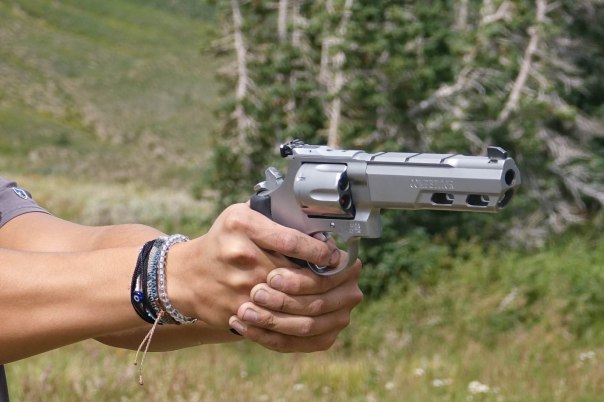
There is a soft spot in my holster for big wheel guns, there is something romantic about their husky built cylinders and the intimidatingly large muzzle. With so many things you can do with them as well, which makes them not just fun but useful. Today’s review is the Smith & Wesson Performance Center® Model 629 Competitor.
As we take a look at one of Smith & Wesson’s big Performance CenterCompetitor pistols built on an N frame. You might be thinking the same thing I was when I first saw the pistol; who competes with a .44 Magnum?
But I stopped asking questions that start with “I wonder why people…” a long time ago. The Performance Center model 629 Competitor is a robust and impressive handgun, so I guess whoever has it in their hands can do whatever they want.
This Competitor is built from stainless steel all the way around, which helps it build up the weight to over 57 ounces. Big pistols like this are a lot easier on the hand with their additional weight. And the Competitor also includes a weighting system to add additional weight to the gun to better balance it. Smith & Wesson’s big pistol is just over 11 inches long, which gives it a large sight radius. But it also has a rail for optics mounting across the top of the barrel, which gives you even more sighting options. Different rubberized gripsmake it very easy to hold onto, which is definitely a plus with this big pistol.
Loading the big cylinder
WIDTH1.7 in
LENGTH11.3 in
HEIGHT6.1 in
WEIGHT57.2 oz
CALIBER44 MAGNUM
SIZE LARGE
CAPACITY6
ACTIONSINGLE/DOUBLE ACTION
BARREL LENGTH6
GRIPSYNTHETIC
SIGHTSPATRIDGE
OPTIC READYYES
SAFETYNONE
COLOR/FINISHSILVER
Unboxing
When I opened the box containing the Competitor, I wasn’t exactly ready for it. Immediately impressive is the size of this handgun, it is certainly not for the faint of heart. As is typical with Smith & Wesson revolvers, it felt fantastic in the hand. All controls of the pistol all worked smooth and without taxing effort. Every part of me wanted to feel the trigger, as I wondered just what a competitor’s trigger would feel like.
Drawing back the hammer for that satisfactory click as the trigger set, I rested my finger on the smooth chrome trigger and started pressing. The smooth crack of the hammer dropping was extremely clean and the gun barely moved as a result. A smile to came over my face thinking this gun was going to be a blast to shoot.
Curiously I inspected the sights which looked very high quality, and easy to pick up. But like a real optics weenie I really wanted to get a red dot mounted to the pistol, since I don’t have a pistol scope.
We started putting together some supplies to take the gun to the range and get it warmed up. I had some Hornady Lever Revolution 225 grain ammunition to shoot in the gun. In addition I also had some handloaded 240 grain semi-wadcutter handloads that I figured I’d try out as well. I also had the proper mounting devices to incorporate a red dot to my shooting, so I grabbed that as well to see how the gun shot using the optic.
With ammo, tools, red dot, and the weight system for the Competitor all in tow I hit my favorite shooting spot. I spread it out on the tailgate of my truck, and started my process of evaluation.
The large size of the revolver definitely reduced to feeling of recoil some, and it wasn’t bad at all to shoot. My initial concerns about why someone would want to competitively shoot a caliber this big were immediately resolved.
Shooting the big Competitor was actually very fun and enjoyable, the trigger felt immaculate, even the double action pull felt better than I expected. Though I don’t know how accurate I would be able to shoot with it that way.
The Competitor came with a set of various weights that you can add to a vacant bore that runs underneath the barrel itself. The system allows you to add or take away the cylindrical weights to tune the recoil of the pistol. While the system seems to have a good purpose, I didn’t notice a significant change in my ability to shoot it much better. This could just as easily been me, and nothing to do with the S&W.
Shooting the pistol at 10 and 25 yards to see how accurately I could shoot the gun was actually pretty impressive, even without the fine aimpoint of a red dot sight.
Pros and Cons
The 629 Competitor definitely has some good features, the high quality of its parts and function are surely at the top of my list. I can’t get excited about guns that aren’t accurate enough to be useful, and this one is certainly very useful. While I am not competitive pistol shooter material, I still found it easy enough to hit just what I was aiming at with this pistol I’m more of a hunter, and I could easily see myself taking down a deer or elk in the deep dark forest of these Rocky Mountains with just such a pistol.
The weight system I could take or leave, it didn’t seem to make a difference for me. But the smooth rolling cylinder and crispy clean trigger sure go a long ways. The sights are perfectly suitable for most of my kind of shooting but the added bonus of being able to mount an optic only increase my affinity for this gun.
If you are a competitive shooter then you surely might find the weight of this pistol to be an asset, whereas if you aren’t a competitor you might find it a bit heavy. The good news is that either way it’s going to shoot well for you.
I really wish I’d of had a pistol scope, so I could try shooting the Competitor with a scope. As it was I tried shooting it with a red dot mounted to the rail, which turned out to be pretty interesting. I like the fine aiming point and the ability to keep my eye focused on the target and not worry about the sights.
Smith & Wesson Performance Center® Model 629 Competitor
The title of “Gold Standard” is no easy achievement to attain in any real competition. Having said such, if you put the proverbial gun to my head demanding I crown the greatest of all time American hunting rifle. I would have to pick between the Winchester Model 70, and the Remington Model 700. And lucky for you, today we will focus on the latter of the two, and what makes its reign so supreme.
this custom Remington 700 has taken quite a few mule deer and elk
The Model 700
The 700 was first produced in the early 60’s. A design meant to be mass produced with all the best that Remington had learned since its inception. It has since been revised, refined, improved, copied, cloned, and adopted. One would hope that the diverse offerings in the 700 line were not a contributing factor to Remington’s financial problems (but Im sure it did). There has been quite a few variants over the years, some stood the test of time. While others quickly faded away in dust covered gun cabinets. I’ve had a few myself during my firearm infatuation, and I can say none of them ever let me down.
The 700 has always had some great features that make it an excellent choice for hunters. Whether you like wood or synthetic, there is a stock selection that should fit your taste. Stainless all-weather models for those of us who love to hunt in the clouds, as well as traditional bluing and satin coated spray finishes. Left-hand models for those who were mis-wired, assorted barrel lengths, twists and contours, as well as some with threaded muzzles. And whether you are hunting varmints with a .223or moose with a 338WM there are incredible choices in calibers across the many variants.
great aftermarket support parts are available from companies like Hawkins Precision
Its All About the Options
Few rifles in the market enjoy as much aftermarket support as the Remington 700, you can find almost any conceivable accessory made for rifles. This gives shooters the ability to customize their rifle in subtle or extreme ways. And we know how much everybody loves to make their rifle their own. All of the best trigger manufacturers have a model for the 700, which is great considering the recent issues Remington faced with the X-mark. Rifle chassis for the 700 are everywhere, making it easy for beginners to upgrade their rifle as their skills improve. Scope mounting systems, bolt-releases, improved extractors, floor-plates and magazines of all kinds can be used to fit a rifle to your specified purpose.
So prevalent is the Model 700 that it’s footprint has become the standard for the growing mass of custom action makers. This is not so much an endorsement of superiority in design, but more of a recognition of market direction.
A rifle that grows with you
A new hunter could start out with a bone-stock 700 SPS from a pawn shop, and as skills and needs grow, a better barrel might be installed. A new stock or chassis could be added to increase rigidity, followed by perhaps a muzzle brake to help visualize impacts and recoil management. Better scope options with canted bases for increasing range as hit ratio increases at typical distances. You get the idea…
this bone-stock model 700 has killed more venison than it’s worth
And years later the same hunter may be using the same carbon fiber stock but has since upgraded to a Defiance Action and carbon-wrapped barrel. Many of us have traveled this road that started with a humble little Remington 700 picked up from a swap meet. My first 700 came from way back in the 60’s when the guns were still quite new. It’s since moved along to a new owner, but sometimes I miss that old smooth action. At least one elk and a few deer succumbed to its shots.
History
The venerable model 700 has seen action across the planet. Whether it be hunting, or as a law enforcement/military tool. Being in the business of shooting things for over fifty years can sure build a case for setting the standard, and the Remington 700 has surely shown to be that. Perhaps you’re one of the lucky ones who got handed down a rifle from Father or Grandfather, a rifle that came with both history and prestige.
Much of the same could be said about the 700’s former biggest competitor, the Model 70. But not to same degree. But that ship sailed, and all that are left besides the limited 700’s are countless 700 clones from companies like Bergaraand others. As well as seemingly cheaper models that while serviceable, don’t carry the same reputation or performance.
another successful hunt with a Remington 700
Final Thoughts
The Remington 700 definitively has everything a budding hunter could ask for. And you could probably find a dozen of them between here and the next sporting goods shop. Its a rifle that can grow with you, or spend generations giving families their annual venison. All this without much more than the occasional oiling.
Mossberg has been well-known for making firearms for over a hundred years. My first Mossberg experience was a shotgun my brother got decades ago. Since, Mossberghas recently joined the rifle market with several models, and today we are taking a look at one of them: The Mossberg Patriot LR Hunter chambered in 6.5 PRC.
I’ve been around the precision rifle block a few times, so I thought it was time to see what these new Mossberg rifles were all about. The Patriot line of rifles has something for everyone, with too many different models to mention and chambered in almost every popular caliber.
With all these different models, you should be able to find something in your budget. They can be pretty affordable, with models priced as low as $380. Besides being a good buy, they also have a list of features that will get many excited. Features like detachable box magazines and factory-threaded barrels make these rifles popular with the American hunting public.
The Patriot LR with a Patriot Valley Arms Muzzle Brake is an excellent combination
Unboxing the Patriot
I was eager to see how the Patriot compared to similar rifles I’d played with in the past. I enjoy rifles of all types, so this one surely fits right in. The Patriot LR model is at the higher end of the Patriot price line, so I expected it to have the best Patriot features.
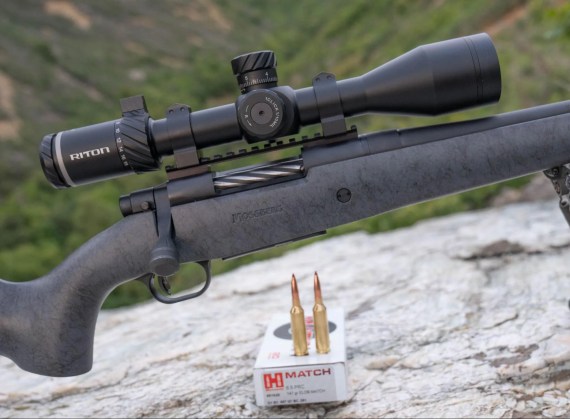
I opened the box to find the gray synthetic stock under plastic. As I pulled the Mossberg Patriot LR Hunter from its protective bag, I was impressed with the attractive finish. The helically fluted bolt came in its own little baggy, and I quickly installed it, completing the rifle.
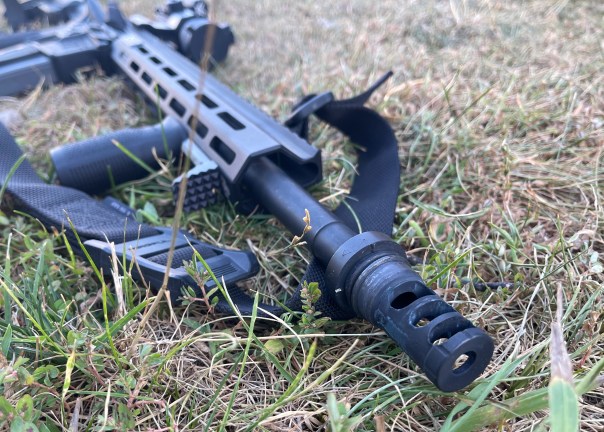
I was thrilled that Mossberg had fluted and threaded the barrel from the factory. The fluting helps reduce weight, while the threaded barrel allows you to install various muzzle accouterments, such as recoil-reducing muzzle brakes or suppressors.
I inspected the rifle to see what else there was, such as the blade safety on the trigger, something I’m not a huge fan of, but it’s also not a big deal.
The rifle all set up and ready to shoot
The Patriot uses a detachable box magazine made from polymer and allows four 6.5 PRC cartridgesto be carried inside. A two-position safety sits on the right side of the bolt-shroud.
Features like these make the Patriot LR suitable for aspiring long-range shooters and hunters. According to Mossberg, with modern manufacturing techniques, shooters will get performance far above the price point of the Patriot LR.
SPECIFICATIONS
Caliber
6.5 PRC
Capacity
4+1
Barrel Length
24 inches
Twist
1:8
Trigger
LBA Adjustable (2-7 pounds)
Stock
Monte Carlo Hunting Stock
Length
44.25 inches
Weight
7.25 ounces
PROS & CONS
PROS
Affordably priced
Great shooting performance (accurate and reliable)
Threaded barrel
Adjustable trigger
Fluted barrel & bolt
Detachable box magazine
Includes Picatinny scope base
Dual sling studs
CONS
Has a slightly “cheaper” look to it
The magazine feels kind of cheap
TESTING IN THE FIELD
To get a good feel for the Patriot, and its intended purpose, I took the rifle and some ammo into the Rocky Mountains nearby. I figured nothing would be a better test for a hunting rifle than to conquer the distances and conditions of the mountains where we hunt big game.
I mounted a Riton 3 Primal 3-18X44 rifle scope via Warne 30mm rings. With the rifle boresighted, I set up a target at a hundred yards, confirmed by my laser rangefinder.
I had only brought one type of ammunition because it was all I could find at the local shop. Shooting the Hornady Match load with 147 ELDM bullets would prove to be a great combination with the Patriot.
After a couple of correcting shots, I shot the first five-shot group at one hundred yards. The first five-shot group rendered just over 1 MOA, but it also showed that the rifle was undoubtedly capable of even better accuracy.
Much of the testing was done shooting from the prone position at 100 yards. This was for the initial testing, but there was plenty of additional shooting from improvised positions, much like those that hunters would use during their engagements.
The 6.5 PRC is an excellent choice for these big Rocky Mountain spaces
Shooting all Day
We spent the afternoon shooting several boxes of ammunition across the sunny canyons where we often hunt deer and elk. Hitting deer vital-sized targets at distances as far as 800 yards proved very doable.
The majority of our shooting was hiking around from one place to another to get shots at different targets from different angles and wind deflections.
Out for a hike with the Mossberg Patriot LR Hunter
Accuracy testing was done with a suppressor installed, as was most of our shooting. I mean, how rude is it to shoot unsuppressed?
We also shot the rifle using a Patriot Valley Arms Jet Blast muzzle brake during our testing. It calmed the rifle down to very modest recoil, as did adding a suppressor. Thank goodness for threaded muzzles!
Shooting the rifle became familiar and comfortable, and it didn’t take long to get used to the trigger safety or the clunk of the bolt closing. The four-round detachable box magazine was effortless to load, though it did feel a little cheap for my taste.
Running the rifle’s bolt was smooth and easy, but it seemed just a little unrefined and loose. Regardless, it worked flawlessly throughout my testing.
RELIABILITY
I experienced no failures or malfunctions while shooting the Patriot LR.
The simplicity of bolt action rifles means they should work every time. The closest thing to a malfunction we had was when the mag dropped out at one point. It’s likely the magazine simply wasn’t seated fully, so we can chalk it up to shooter error.
The Patriot’s detachable box magazine
AMMO USED
The only ammunition I had available was the Hornady Match 147 grain ammunition. It performed as well as I had hoped, and I’m not worried about other ammo types. We shoot Hornady around here, and I won’t apologize for it.
For a rifle at this price, I think the Patriot shot exceptionally well. I’ve tested far more expensive rifles that didn’t shoot this well. One MOA is acceptable for most rifles.
I think that the Patriot will shoot even better with a small amount of work on the handloading bench. Furthermore, it would probably shoot better still with some cleaning up of the trigger and some work with the stock.
A typical five-shot group from the Patriot
OVERALL FEEL
The rifle felt just fine. I have almost no complaints other than those I’ve mentioned already. For the most part, I think the average American hunter would be more than happy with the rifle.
FEATURES
THREADED MUZZLE
It’s about time manufacturers get on this train; Fuddery needs to become extinct. Many people now use suppressors, muzzle brakes, and other devices.
I love seeing rifles come with threaded muzzles. It allows you to customize the rifle to your shooting activities.
The ⅝-24 threads were a perfect fit for my muzzle devices, and they were protected by a knurled thread protector when bare.
The threaded muzzle allows for easy installation of your favorite muzzle devices
ADJUSTABLE TRIGGER
The Patriot LR’s trigger is adjustable from 2-7 pounds, which is not a bad spread. I prefer the lighter pull weights; it’s an easy crutch for shooting a little better. Even though I’m not a big fan of trigger safeties, this one was no better or worse than any of the others I have used. I wish manufacturers would quit adding them, though.
If only that trigger safety was removed!
MONTE CARLO STOCK
The Monte Carlo stock fit me well and didn’t require anything special to shoot comfortably. The stock felt like it didn’t contribute significantly to the rifle’s overall weight, which is nice.
The aluminum bedding pillars are part of what helps the Patriot perform well, mating the action properly to the stock. The addition of double front sling studs was also a nice touch, allowing you to use a Harris bipod without losing your slingplacement.
HELICALLY FLUTED BOLT
The handsome fluting of the bolt doesn’t just look good, it also provides some benefits while running the bolt. Reduced friction and debris clearing are also potential benefits of the design.
I do feel like there was missed an opportunity to make it even better by improving the bolt-knob and finish.
The fluted bolt of the Patriot LR, notice extractor and ejector details
Mossberg Patriot LR Hunter Report CARD
RELIABILITY (10/10)
No malfunctions were experienced during testing.
ERGONOMICS (8/10)
It feels just like it looks in the pictures if that makes sense to you. It has a good grip angle, proper cheek-weld, wide front grip area, etc. Nothing out of this world, but everything you need.
CUSTOMIZATION (7/10)
Being its own design, it may take a little time for the aftermarket to come up with as many accessories as other rifle models I enjoy. To be fair, the Patriot seems pretty good, just the way it came.
APPEARANCE (8/10)
There was only one thing I would have liked to improve on if given the chance; I would have finished the bolt handle the same as everything else. It looked odd for the whole barreled action to have a satin-like finish, and the bolt handle and knob looked like some other flat finish.
VALUE (8.5/10)
I think the accuracy and performance of the Mossberg Patriot put it at a solid 8.5. It has good accuracy, comfortable ergos, and almost everything a long-range hunter on a budget would need.
With a good scope, the Patriot LR will be a fantastic long-range hunting rifle
Conclusion on the Mossberg Patriot LR Hunter
I liked the Mossberg PatriotLR more than I thought I would. I was concerned that the accuracy wouldn’t meet my expectations, but the Patriot liberated my mind from such concerns. The Patriot brings some pretty great features at an affordable price, and it looks good enough for people to take pride in.
The Patriot LR would make an excellent entry-level long-range rifle, particularly for hunting. Most hunters would welcome its lightweight and comfortable stock, and with things like a detachable box mag and a threaded muzzle, there is some added value from Mossberg.
The Patriot would be a cost-effective place to start your search if you are looking for a new hunting rifle, particularly for long-range shooting.
If you’ve ever built or configured a precision rifle, you may be familiar with an undiagnosed condition that has afflicted me for some time. The symptoms are broad but almost invariably it is the feverish desire to build another rifle. And it begins to foment as soon as the previous one is broken in.
One way I have managed to regulate this terrible disorder of mine is to embrace rifle systems over individual rifles. It may sound a bit like a weak defense, but let me explain. Rifle systems with similar chassis and features are easier to become proficient. They can be easier on your bank account depending on what you choose. Today our topic is regarding a series of rifles that much like a system keep many features in common; the Ruger Precision Rifle family.
Just a Ruger?
You may have read my article about the Ruger RPR 22Lr, or the piece I wrote about the 6.5 Creedmoor RPR. And in both of those pieces I mentioned the phenomenon that was the arrival of the RPR to the precision rifle world. Until Ruger introduced their rifle, the precision rifle world was dominated by custom built rifles. The cost of admittance was high, usually to the tune of three or four thousand dollars just for the rifle itself.
Ruger managed to squeeze right into the vacant market of less-expensive production precision rifles at what seemed like the beginning of the PRS craze. And in a cunning move they swept up a massive share of the market which continues to grow like wildfire. The RPR has changed the way the PRS community looks at production rifles from mainstream manufacturers. What once was looked down upon is now commonplace even at the podium.
Start Small
The NRL 22 matches have proven that the precision shooting craze isn’t limited to centerfire rifles. Whether you are an adult or a youth shooter there is much that can be learned from rimfire shooting. The RPR 22LR is the smallest of the RPR family, and an excellent place to learn the basics of marksmanship. It is a bolt action box fed rifle, built into a chassis system just like the entire RPR family. As with every member of the family it features a fully adjustable buttstock. And it’s modular chassis is made to be accessorized. Great controls that are well thought round out these rifles as excellent for training or for competition.
The RPR 22LR can be used as a tool to perfect your processes and techniques if you plan on competing. And if you just like shooting it can provide a lifetime of inexpensive plinking fun for both children and adults.
One of my kids just recently used the RPR 22LR to pass his hunter safety program here in our state. He even managed to get an honorable mention for marksmanship. The easily customized rifle was a perfect fit for what he needed, and he continues to shoot it still. And should he choose to keep with it, his experience from the wee 22 will carry right over to the next rifle.
The OG
The original RPR came out as a short action chambered in 308 and 6.5cm. It is probably still the most popular RPR of the whole family.
Utilizing SR25 patterned magazines and compatible components already available in the flooded AR market made the rifle both appealing and familiar to the AR crowd. The controls my kids learned on the rimfire RPR will have them pre-familiarized with this larger version of the rifle.
The medium to long-range capabilities that came with the RPR opened the long-range shooting craze to folks who before then couldn’t or wouldn’t spend the money for a custom. The RPR produces incredible accuracy patterns, it punches above its weight I guess you could say.
Another appealing benefit is the similarities of the RPR to America’s favorite rifle, the AR 15. It doesn’t just feel similar, it also looks like one. And as much as we often pretend looks are secondary, the similar looks and aesthetics to the AR have certainly affected the RPR’s popularity. The RPR created a space, that quickly started getting crowded with other manufacturer options like Savage, Howa, and even Mossberg.
All Grown Up
The RPR has even been produced in the larger calibers, like 300 PRC, Winchester Magnum, and 338 Lapua Magnum. With chamberings such as those, there are few things out of reasonable distance for the RPR family. I’ve shot a few Lapua’s in my day, and I was impressed with the way the Ruger performed. Just like it’s smaller siblings, the rifle flat out performed. Making hits beyond one-thousand yards was like shooting five hundred yards with a 308. Running the longer bolt and magazines were flawless. And the massive muzzle brake tamed the 338 to be quite manageable.
As I mentioned at the beginning, a series of rifle systems can add value to your purchase. Learning to shoot long-range on the 6.5 Creedmoor RPR makes it an easy step up to the magnum version of the rifle for even more distance. And if you want to train on the cheap for a competition, the little rimfire RPR can help you work out the kinks in your game without spending as much.
The RPR is still a production rifle, and you can tell the difference between a custom built competition gun and the humble RPR. But once the timer starts it depends a lot more on the nut behind the trigger than comparing the price tags of the rifles being shot.
Conclusion
Both young and old can benefit from the Ruger Precision Rifle family. Graduating from one rifle to the next can increase familiarity and comfort for all. And the modularity of the rifles can allow everyone to customize the rifle to their own purposes whether that be competitive or otherwise.
The obvious popularity of the RPR family could be a result of some brilliant marketing over at Ruger. But I think thousands of happy and religiously loyal RPR owners cant be wrong. I think it’s more a combination of a good product. Marketed well to a customer-base that was ripe with desire for just such a product. If you are looking into the precision shooting game, you’d be well served by looking at the RPR family.
Semi-automatic 22 pistols have been a bit of a conundrum in the past. It seems every manufacturer has tried to make one that is both reliable and feature filled. But there always seems to be a shortcoming or compromise. When I first put hands on the Taurus TX22 years ago. I had a preconceived notion that it too would become another obligatory 22 pistol that was almost good enough. That was the initial TX22 pistol, but today we are going to look at one of the newest TX22 models. To see if it measures up, or exceeds what we are used to. I am happy to bring you a review of the TX22 Compact pistol from Taurus USA.
The TX22 Compact
The TX22 Compact is a polymer-frame striker fired pistol. It is fed from polymer magazines that hold up to 13-rounds. The compact version of the pistol also has some slide cuts to reduce weight. As well as an optics cut at the rear for mourning your favorite red dot sight. In a departure from the standard TX22, the compact features non-adjustable sights. That is probably because you can mount a red dot and adjust that instead.
The small pistol also features a standard picatinny accessory rail under the muzzle for attaching whatever light or aiming accessory you’d prefer. Like its larger sibling, the TX22 Compact also features a threaded barrel. And comes with a factory suppressor collar to install your favorite hush-tube. At the rear of the frame there is an ambidextrous safety that is easily manipulated with the firing-hand thumb.
My very first impression of the TX22 Compact was its weight, it felt incredibly light. This is surely due to the polymer construction and aluminum parts. And much the same way as the full size TX22, I immediately fell in love with the grip. It fits my hand perfectly and the texturing makes it very easy to keep hold of. The lightweight and comfortable grip had already hooked me, but would it perform as good as it looked and felt? If my initial feelings were right, I was pretty confident that this pistol would be a winner.
The TX22 has a relatively short history. The original model was released only a few years ago, and Taurus has since expanded the line with an assortment of models and colors. The competition model uses a cut slide with a reduced front end on the slide as well as an optics mounting platform. The Compact is the most recent development, though I’m sure there will likely be additional offerings.
Features
Lets go over some of the key features that set the TX22 Compact apart. Perhaps one of the most exciting developments with the TX22 is the magazines. For decades it seemed like 22 auto pistols had but one option for capacity, a single stack 10-round magazine. The TX22 uses what I guess you could call a double stack, in that the rims of the stacked cartridges are offset to the right and left as they are stacked into the magazine.
The original full-size TX22 holds 16-rounds, while the flush-fitting magazines of the Compact model hold only 13. But to be fair, 13 rounds in a pistol this small, and this light make it very appealing. Also, the 16-round magazines of the full size TX22 also fit into the compact, though they do hang out exposed.
The trigger of the TX22 is another fantastic feature, instead of using a blade-safety, the TX22 utilizes the entire shoe. As the trigger is pulled, the shoe pivots into its firing position where the sear can be activated. It feels quite good considering the inexpensive cost of the TX22’s. The trigger also has a pretty short reset which I find spectacular, and greatly increases your ability to shoot rapidly with minimal movement.
The threaded barrel of the TX22 is another fantastic feature that comes from the factory. And the included suppressor collar allows you to go straight to the range with suppressor in hand. The barrel comes with a thread-cap installed, it is easily removed with a wrench using the machined flats on the thread-cap. You can then install the shouldered suppressor collar, which just threads over the muzzle with a flush fit. The collar also had a nice shoulder to tighten your suppressor against.
The TX22 Compact slide comes pre-cut for optics, and it fits micro red dots like the Holosun 407K and the new Vortex Defender. This is such a fantastic feature, especially to me who has become more and more addicted to red dots on my pistols. The steel plate is easily removed with the two screws, and your micro red dot will take its place.
The controls of the TX22 are easy to operate and understand, the slide release is easy to press with the thumb to drop the slide while shooting. The safety is not obtrusive but easy to reach and activate when needed. And it’s on both sides of the pistol for those wrong-handed folks out there. The mag release button is small and very functional, it too can be reversed to the opposite side of the frame for left-handers.
I guess my favorite feature of the TX22 family is that unlike most 22 auto-loading pistols, it doesn’t feel like a toy. While it is very light, even lighter than my son’s airsoft pistol, it still feels like a real gun. It doesn’t have the undersized grip that many others do, when you pick it up it feels like you’ve got a real gun in your hand. Add to that the dashing good looks of the pistol, and you’ve got a winner in your hand.
Performance and Precision
Accuracy (8.5-10)
Being a humble little 22lr pistol, I’m not sure what level of accuracy people will expect from it. But I find the pistol to be very accurate for the purposes that I would use a 22 pistol for. I have used it to train my kids a great deal for pistol shooting. Every one of them absolutely loves shooting the TX22. It never fails, every time we go shooting I hear: can we bring the Taurus?
Shooting inexpensive bulk packed ammunition is what I expect most other people to shoot, as do I. The TX22 Compact is easy to keep on targets as small as squirrels at distances like 15 to 20 yards. Dispatching small rodents and even rats in the shed is surprisingly easy with the little TX22.
In addition to its accurate shooting, the near lack of any felt recoil seems to help shoot the pistol even better.
Ergonomics (8.5-10)
As I mentioned above, the fit in my hand is one of the first things that sold me on this pistol. It feels comfortable, and fills a man’s hand. The texturing on the frame makes it easy to keep hold of when manipulating the pistol. And the slightly flared magwell makes reloading an easy and smooth operation.
The trigger feels great, and all the controls are right where they should be and easy to operate. Even my wife who has particularly petite hands finds the TX22 Compact easy to operate and shoot well.
Features (9-10)
The TX22’s features are outstanding. Not only does it have most everything a person could ask for, they are included from the factory. With a price this low you get quite a few features I am both surprised and happy to get.
The higher capacity magazines, the optics ready slide, and factory threaded barrel are probably my favorite features of this pistol.
The TX22 compact (L) shown next to the full size TX22 (R)
Fit & Finish (8.5-10)
The TX22 family of pistols all come with a pretty handsome look to them. The different color frame options are nice, and the pistol seems to be put together well. I know it’s only a 22, and most people aren’t going to be betting their life on the durability of the TX22. That said, I think there are just a few things that do give the impression of a “cheap” pistol, such as the plastic firing pin bushings. And as much as I like the magazines, they are all plastic, and they don’t feel like it would be hard to crush them if accidentally stepped on or something. I also noticed that the coating of the slide isn’t as tough as I would like it to be, but at this price I can’t complain.
Despite the few things that may make it seem cheap, I cannot find where the TX22 is flawed or poorly assembled. It’s a great looking pistol.
Reliability
I’ve been shooting the TX22 compact for nearly six months now, and I’ve lost track of how many boxes of Federal AutoMatch we’ve put through it. But at 325 rounds per box I’d estimate we have shot nearly two thousand rounds through the Compact TX22, this with a negligible occurrence of malfunctions. I was not surprised, as that was the same experience I had with the full size TX22, shooting through thousands of rounds with nearly zero issues.
Of course being a 22lr, the TX22 is going to be dirty, and will need occasional cleaning to keep it running in top shape. Particularly if you are shooting suppressed, which a great deal of our shooting has been.
I ran my Yankee Hill Machine Phantom 22 on the TX22 Compact, it was a perfect match that provided hours and hours of incredibly quiet fun for the family. Of course you should always wear eye protection when shooting, but it is an absolute must when shooting this pistol suppressed. There is a good deal of debris blown back when suppressed, so keep your glasses on.
With a street price just over $300, I think the TX22 Compact is an absolutely incredible value. There are other competitors like the Sig 322 that cost a bit more, and offer a higher capacity. The Keltec P17 is cheaper still, if you want a gun that looks like it was designed by a high school shop class.
I think the TX22 performance and features are well worth the asking price, and having spent a great deal of time shooting this and other TX22’s I am quite confident its performance is long term.
Pro & Cons
Pros
Excellent value
Reliable performance
High capacity magazines
Optics ready
Picatinny accessory rail
Ambidextrous controls
Suppressor ready from factory
Comes with 2 magazines
Cons
Magazines could be arguably fragile
I need more of them
Alternative Options
I mentioned the Sig P322 above, it would likely be a good alternative to the TX22. It carries a higher capacity magazine, and weighs a bit more but that is expected. It also comes with the big Sig Sauer name that so many crave.
The Keltec P17 is another option, with a comparable capacity to the TX22, and at an even cheaper price. It is also lighter than both the Sig and Taurus, but it also appears to come with fewer features.
FAQ’s
How much is the Taurus TX22?
The Taurus TX22 can be had for as little as $308 depending on where you buy
Is it safe to dry fire the Taurus TX22?
Many 22lr pistols are not supposed to be dry fired, but according to Taurus USA, the TX22 series is made to be safely dry fired
What red dot will fit the Taurus TX22 Compact?
The TX22 compact accepts micro red dots with the same pattern as the Holosun 407K, I installed that model, as well as the Vortex Defender red dot.
Is the TX22 Compact?
The standard TX22 is compact enough to conceal, and the compact model is even moreso. It is very comparable in size to the Glock 19.
So if you haven’t gathered by now, I am a big fan of the entire TX22 family of pistols. I’ve spent the last 3 or 4 years shooting one version or another, and they have proven to be accurate, reliable, and incredibly fun to shoot. Compact pistols are typically designed for concealed carry purposes, which makes sense. I will say that I am not going to recommend carrying a 22lr as your concealed carry, but I will mention a few positive things for those that might. The TX22 Compact is very comfortable to carry, it’s both small and light so you wont notice it as much as other guns. And in the event that you should ever have to draw it, it can be emptied very quickly, and all thirteen shots can be dumped into a target with great accuracy and speed.
Other features like the threaded barrel and optics cut slide give you many of the more desired features of modern auto-loading pistols. It may not be some top tier handgun, but when it comes to 22’s I don’t know of one that I would say is top tier.
I would say that if you are looking for a fun, reliable, and accurate 22lr pistol, you will not likely find a better option. There might be one that is comparable, but it will be more expensive for sure. I must admit that I have found the TX22 to be well worth the asking price, so much in fact that I have returned to the TX22 again and again. I now own four of them in one configuration or another, if you need a good 22 pistol, buy the TX22 with confidence.
The firearms market is littered with countless AR-15 revisions and designs, so when a company like Springfield Armory joined the vast AR market they must have had something to offer. Today we will be looking at one of the Springfield Saint AR-15 models, to see what Springfield has to offer in this flooded market of rifles.
Gun Specs
CALIBER: 5.56x45mm NATO (.223 REM) COLOR: Black BARREL: 16″ CMV, Melonite®, 1:8 UPPER RECEIVER: Forged 7075 T6 Aluminum, Type III Hardcoat Anodized, Forward Assist, M4 Feed Ramps LOWER RECEIVER: Forged 7075 T6 Aluminum, Type III Hardcoat Anodized, Accu-Tite™ Tension System BOLT CARRIER GROUP: M16 w/ Carpenter 158 Steel Bolt, HPT/MPI, Melonite® GAS SYSTEM: Direct Impingement Mid-Length, Picatinny Pinned Gas Block HANDGUARD: Victor M-Lok Handguard STOCK: BCMGUNFIGHTER™ Mod 0 TRIGGER: Nickel Boron Coated GI MUZZLE DEVICE: A2 Flash Hider BUFFER ASSEMBLY: Carbine “H” Heavy Tungsten Buffer CHARGING HANDLE: GI Style SAFETY SWITCH: Single Side TRIGGER GUARD: BCMGUNFIGHTER™ GRIP: BCMGUNFIGHTER™ Mod 3 MAGAZINES: (1) 30-Round Magpul PMAG Gen M3 WEIGHT: 6 lbs 11 oz LENGTH: 32.25″ – 35.5″ MSRP: $1,023
Gun Background
Springfield Armory has been well known for decades for making great firearms. The Saint series of rifles is Springfield’s venture into the AR-15 or Modern Sporting Rifles(MSR) market. The Saint rifles claim all the best features that come with an MSR, the question I plan to answer today is whether the Saint is an exceptional rifle as far as MSR’s go or if it is just another AR.
Springfield has put extensive work into broadening the Saint rifle lineup, with a model of the rifle in near any desirable configuration, including dedicated marksman type rifles, compliant models, and SBR and pistol variants.
Features
BCM Gunfighter furniture- Buttstock and pistol grip come from the popular BCM Manufacturing M-Lok compatible handguard- Allows for easy addition of accessories Nickel Boron coated internals- Trigger parts and BCG parts treated for better wear and durability Forged upper and lower receivers- for strength and hard anodized for durability
The Saint comes in a black anodized color, with other color options in Cerakote like OD Green and FDE. The variants of the rifles can get quite extensive, there are both 5.56 and .308 caliber versions of the rifle. Most of the general options can be had in a low capacity or compliant configuration. There are both sixteen and twenty inch barrel options, and even an SBR 11.5 inch version of the rifle.
On the Range
My first impression of the Saint came as I lifted it from the box, it seemed light enough for its size. And most everything about it seemed exactly as I expected. The M-Lok handguard looked bare with nothing on it, I would change that soon enough. The BCM buttstock was easy to collapse and extend to alter the rifle’s length, there are a couple sling-mounting cups in the back of it to attach a carry sling. The matching BCM pistol grip was a comfortable fit, and textured to give better purchase.
I ran the charging handle a couple times to check the rifle for safety, the smooth melonited bolt carrier slapped back and forth with the familiar boing of the buffer spring. That familiar smell of freshly anodized aluminum sliding against itself reminded me of every other new AR that’s graced my shoulder. Springfield also nitrides their trigger assembly, I expected it would make it smoother than a standard mil-spec trigger. After giving the trigger a few presses, I’d say its a bit better than average, but nothing spectacular. It does have a nice firm and audible reset though.
Rifles like this are typically setup for short to medium range, with that in mind I decided to go with a simpleVortex red dot sight. With that taken care of, I added a couple other things to the rifle. A Magpul MS4 sling, and a small down-grip up front. I like using these as a place to grip and pull with my support hand. The Saint comes with a pretty standard bird-cage flash hider, but I was surely going to swap that out for one of my own. I intended on running my Yankee Hill Machine Turbo on the rifle, so I mounted up a compatible muzzle brake as well.
With nothing left to do but get treat this Saint to heat of hell’s fire, I grabbed some American Eagle ammo and headed up to my shooting spot. With a stack of GI and Pmags loaded, I set to zero my red dot. The rifle was easy enough to get zeroed which allowed me to spend more time shooting instead of goofing around with the turrets. The light weight of this rifle makes it very easy to throw around, recoil is very modest particularly when suppressed.
Accuracy of the Saint was pretty standard, I had no problems hitting most things that I aimed at within a reasonable distance. Hitting milk jug sized targets at nearly three-hundred yards was pretty repeatable, and close stuff like fifty yards was obviously no challenge at all.
The rifle felt just like it should, easily integrated into my shooting style. The ergonomics of the AR 15 have been perfected over the decades, and the Saint is no different, it fit me well allowing me to shoot it like we were old friends. I hammered through a couple hundred rounds which went all too fast, I’ll happily report that during this short duration I experienced zero malfunctions.
The several hours of range time with the Springfield Saint were great, and I think that for the $1100 or so dollars it goes for on the street are probably worth it. I’m sure there are countless similar rifles that go for much more, and others that go for far less. I prefer to pay enough to know that I got something worth having around.
Pros and Cons
Pros
Compatible- The Saint meets the needs of most modifications or accessories most shooters want Reliable- No malfunctions were experienced, and it appears Springfield Armory has taken the extra steps to ensure reliability Accurate- Accuracy was more than adequate for a rifle of this type
Many Options- Plenty of colors and models to choose from
Cons
Plane Jane- There wasn’t anything about this gun that made it stand out from any other to me
Report Card
Shootability (A) the gun was a blast to shoot, easily manipulated and adapted to various shooting positions Reliability (A) No malfunctions of any kind were experienced Ergonomics (B+) The Saint was a great fit, I would have loved to see something like extra bolt-catch or ambi mag release Accuracy (B+) Accuracy was pretty typical, shooting 55 fmj’s typically rendered 1.5 MOA Value (B+) I think the Saint is a safe buy if you are looking for an AR rifle of this type
Ammo
I shot mostly American Eagle ammunition through the rifle, though I also shot some PMC bronze 55 grain as well. Both ran flawlessly through the rifle and performed well downrange.
Best Upgrades
I think a good recoil reducing brake makes this rifle even easier to shoot well, I used the YHM Phantom Micro brake. It worked great and had the added benefit of allowing me to quick mount my suppressor to the rifle.
A good sling is a must, the Magpul MS4 was a good choice, but anything comparable to it would likely serve you well.
I enjoyed using a red dot sight on the Saint, the Vortex Strikefire worked great for me. But I also would recommend the Sig Romeo as well, as it is a little more compact.
The Magpul downgrip was also convenient for better handling the rifle, anything comparable or that better fits your grip would be a good choice.
I am not new to Christensen Arms rifles, I’ve been lucky to play with several of them over the last couple years. But today we are looking at a new to me rifle; the Christensen Arms MPR 6.5 Creedmoor.
The Modern Precision Rifle (MPR) is Christensen’s version of a light-weight sharp-shooting rifle. Whether it’s used for competition shooting or as a sniper rifle, the MPR brings some very modern touches to the precision rifle market. But are those features worthy of praise?
The MPR
Christensen’s MPR is based around their stainless steel action, a two-lug action very similar to the very popular Remington 700 like many other modern actions. The rifle tested here is chambered in 6.5 Creedmoor, using a short action bolt. Like most Christensen rifles, the MPR is heavily reliant on carbon fiber.
Its carbon-wrapped match-grade barrel is largely responsible for the rifle’s lightweight, as are other parts of the chassis. At the end of the barrel it is threaded 5/8-24 and is fit with a matching muzzle brake for additional recoil reduction.
At the heart of the chassis is an aluminum block where the action is mounted. And the handguard is bolted on to the front and is made from a carbon fiber shaped tube. The MPR uses the very popular AICS pattern magazines and they feed nicely into the magwell of the rifle. Inspecting the grip looks to be a basic AR-15 type pistol grip, this is a nice feature as you can install whichever one suits your fancy.
The folding stock hinges just behind the tang of the action, I really like the way they designed the hinge mechanism. It’s quite tight and locks up as if there was no hinge at all. Just be careful to keep skin away from the area while folding or you may bleed a bit.
Fortunately the butt stock of the MPR is completely adjustable, which makes it very nice to adapt to each individual shooter. The whole thing is pretty handsome and put together very nicely.
Surely I was going to need a good scope and at least a bipod to shoot this rifle well. I installed a Primary Arms ACSS Apollo 6-30X56 riflescope in a ZRO Delta Mount . To simplify I went with a Harris 6-9 bipod attached to the pic-rail on the bottom of the MPR handguard. For ammunition I brought along a few boxes ofHornady 140grain match ammo. With everything put together, leveled and balanced I adjusted the rifle to fit me, and headed out for the range.
First Impressions
The Christensen Arms MPR 6.5 Creedmoor was plenty comfortable to shoot. It weighed so little compared to other similar rifles I have. As I sat behind it on a bench I ran the bolt a few times and felt the break of the trigger just to familiarize myself with it. Its bolt was easy to lift and snap shut, and the Trigger Tech trigger as usual felt outstanding.
I loaded the magazineand closed the bolt. As I broke the trigger everything felt right, the recoil was quite modest and running the bolt for round two sent the empty case flying. The M16 style extractor of the MPR does a great job getting brass out of the way for the next round.
I fired a few more shots and adjusted my scope to get a proper zero. At that point I tried to settle down as best I could and shoot a few good groups using both the Hornady and some Federal 130 grain match. I felt quite good about my shooting but I was not super excited about the grouping downrange, the first three groups of five-shots measured right around an inch. I tried again with my other ammo selection and got very similar results, my only hope is that perhaps this rifle doesn’t like what I feed it. And maybe there is something out there it will shoot better.
Into the snow
We decided to take the rifle for a hiking trip into the snow-covered Rocky Mountains, and I brought another type of Hornady ammunition to see if perhaps it faired better. With all my gear stowed on my back, my son and I headed into the cold.
The open country where we live makes an excellent place to hunt and shoot. Here in these breezy canyons I wanted to see how the MPR shot. Mainly to see how it would perform at longer distances and real-world shooting scenarios.
Normally this time of year I shoot at tiny snow patches in the dirt. But due to winter part 2, I was instead shooting at little dirt patches in the snow. The first target was about a three-inch muddy spot surrounded by white snow. I figured it would be easy to spot the impact and judge the shot.
After loading the rifle I steadied it and focused on my point of aim nearly four hundred yards away. I pressed the trigger and the suppressed gust of pressure echoed across the canyon. I’d added my Yankee Hill Machine R9 suppressor just to see if it helped the performance of the rifle.
The contrast of dark splattered dirt across the snow, and my hit was close enough to call it good in my opinion. So I continued my search for additional targets. We repeated the process until I had exhausted my curiosity and ammunition supply.
I’ll be honest up front, I wasn’t exactly sold on the aesthetics of this rifle when I first saw it. I couldn’t exactly say what I didn’t like about it. But it has certainly grown on me a bit over the last few weeks. Everybody else thought it looked great so I’ll assume its just my weird taste.
I was really hoping this rifle would shoot better than it did. To be fair it is not a new rifle so its possible that it has been rode hard and put away wet too many times. But a rifle like this should shoot half-MOA groups all day. I just couldn’t get it to reliably do that.
On the plus side, I really appreciated many of the rifles other qualities. The light weight is always appreciated. And its comfortable and adjustable chassis made shooting it very pleasant. Little features like the folding mechanism, great trigger, awesome cycling and threaded barrel made adapting the rifle to my purposes easy. And of course improved my shooting experience.
I must say that I liked this rifle more than I expected to. And yet I’m torn because I am simply uninterested in rifles that won’t shoot reliably sub MOA. I’m lucky to have rifles ranging from discount economy models under four hundred dollars up to production sniper rifles that cost seven thousand dollars. And even the cheap ones I can typically get to shoot consistently sub MOA and often 1/2 MOA.
The Christensen Arms MPR 6.5 Creedmoor surely could be an outstanding rifle, I’ve heard of others that shoot outstanding and accurately. If this one did, I think I’d be hard pressed to let it go. But with a street price just under twenty-four hundred dollars, I’d need more convincing.
The world of bullpups is a unique one, and pretty much everybody knows each other there. There are several popular bullpups available on the market, and today we are reviewing one of the popular bullpups from the recent past. The FN Herstal FS2000 bullpup was produced for almost twenty years, and it has seen service by various military services across the world. If you don’t know what a bullpup is, lets get that out of the way first.
A bullpup firearm is one where the action is located behind the trigger versus in front of. The idea is to reduce the overall footprint of the weapon, but they are often looked down upon due to inherent designs that typically complicate some basic functions.
The FS2000
The FS2000 is a 5.56 NATO carbine designed for military and police use. The rifle utilizes a 17.5 barrel that is tucked deep into its bullpup chassis to shorten the platform. The gun utilizes Stanag pattern magazines but as far as I can tell only works with the metal GI type. The action uses a short-stroke gas piston, a rotating bolt and an interesting forward ejecting system to overcome the ambidextrousness of a bullpup, with the action being next to the face it would be very unpleasant to have brass ejecting out the side into your face should you be left-handed.
The FS2000 has a very unique look, and one that has earned it several nicknames such as the ‘tactical tuna’. Similar to the other FN bullpup the P90, the FS2000 borrowed a similar safety that is also ambidextrous. A small disc located at the bottom of the trigger-guard can be rotated from either side with the trigger finger to engage or disengage the safety. The trigger itself like many other bullpup designs is a little more mushy than most would care for. The other controls include the magazine release located just in front of the magazine itself, the magazine release can be pressed with the upper side of your hand while stripping the mag from the rifle. The charging handle is located on the front-left side of the rifle, and uses a claw detent to keep it in place. The bolt does not lock-back on the last round, so there isn’t a bolt-release.
Perhaps the most interesting feature of the rifle is at the breech. Since the chamber end of the barrel is deeply covered inside the rifle, there is a spring loaded trap door just in front of the cheek-rest that the operator can open to see the breech and clear any malfunctions.
The rifle features a great deal of sealing designs to prevent the ingress of debris into the rifle. All points of ingress have their own way of closing off, such as gaskets in the magwell, and a closed ejection port. The rifle weighs in just shy of eight pounds at seven-point-nine pounds, and the overall length of the rifle is twenty-nine and a quarter inches. The compact size of the rifle promises to give the user more maneuverability and mobility in action.
Lets see it!
When I opened the box containing the FS2000, I was surprised to find that it had been shipped with both the original foregrip panels, as well as a picatinny railed foregrip to utilize other accessories. The downgrip gave better purchase for me than the traditional smooth forearm panels, so I left it installed for the purposes of the review.
The gun seemed lighter than I expected, but I think thats because it appears bigger and bulkier than it should be. It felt lighter than expected because there seems to be a lot of empty space inside. As I lifted the gun to my shoulder, I was surprised by two things; first, I didn’t dislike the feel of the rifle as I expected I would based on my experience with the FN PS90. And second; it felt rather bulky compared to similar firearms whether bullpup or conventionally configured.
I ran the charging handle a few times to get a feel for the rifle, while it may offend some of the older crowd I have grown to like the feel of metal and polymers functioning in unison. The FS2000 felt smooth and locked up tight, I gave the trigger a few squeezes to see how it felt. I’ve felt a few bullpup triggers in my day, and this one was not too shabby to be fair. There are certainly better triggers but this one was certainly serviceable.
I gave the remaining controls a once over, I didn’t care for the safety much which again was no surprise. The mag release is another curious design, its a button just in front of the magazine well that you can depress with the edge of your hand while gripping the magazine. It is actually quite pleasant to use if you are stripping the mag with intent to retain it, but if you are reloading a fresh magazine it will definitely slow you down. It requires you to strip the mag with your support hand, then grabbing a fresh mag to insert.
Note mag release in front of magazine well
The muzzle of the 17.5 inch barrel is pinned (eye roll) with a muzzle brake, something I don’t care for. The gas block has two settings which I would have loved to tried with a suppressor, but I guess that’ll only happen in my dreams.
It was time to install a red dot, and get this thing to the range. Once upon a time the FS2000 was available with a 1.6X sight attached, the pictures alone made me shudder so I’m glad I had my own. I dropped a simple littleVortex red dotonto the rifle, and after gathering up some ammunition I was on my way to the range.
It had been a minute since I’d loaded some old metal GI mags, but it felt nostalgic. I loaded the magazines with some PMC Bronze 55 grain ammo, and began firing my first magazine. A handful of rounds in, the rifle stopped. That old familiar feeling of the bolt not going into battery told me something was up. The cunning mechanical device that grabs the spent case and pushes it into the long ejection chute had jammed. The spent case managed to get turned around inside the receiver and bound up, causing quite a disturbance in my shooting. After clearing the case, I finished out the mag and loaded another.
an unfortunate malfunction indeed
While shooting the rifle I actually enjoyed the feeling of it. I had no trouble hitting an IPSC target with every round in the magazine at two hundred yards, something every battle rifle should be able to do.
Keeping rapid shots on target at 200 yards seemed easy
Through the rest of my range time that day, the gun ran almost flawlessly. I had one more malfunction as a round got bit going into the chamber, though I’m not sure if I could blame that one on the gun. I must admit that I enjoyed the gun much more than I expected too, and I’m even a bullpup fan.
Pros and Cons
One of my biggest gripes with so many gun owners is when they discount certain firearms or types of firearms based solely on negligent testing and arbitrary opinions. It’s easy to throw smoke at bullpups, they already get shamed for their looks so if they aren’t 100% perfect in their function they are quickly discarded.
As a bullpup fan, even I found myself quick to dismiss the FS2000. But I was quickly turned around by its smooth impulses and pleasant shooting. Though despite my positive experience with the rifle I must be fair to its critics. There are several awkward things about this gun, the bulk and controls seems to be the most of it for me. I didn’t care for the safety, mag release process, magazine compatibility, failure to lock back on empty and such.
In its favor, the rifle was accurate enough to be useful, completely ambidextrous for those lefties out there, and despite the awkward controls I still enjoyed the rifle quite a bit.
Yes I enjoyed the FS200, and though I’m already a bullpup fan I found something new by playing with the FS200. I’ve heard many people of the opinion that military service is some kind of indicator of a firearms suitability for severe duty, and the FN FS2000 certainly has seen much service across the world. And yet I felt a smidge let down because I’ve gotten to experience better suited rifles that those same people would call insufficient for service.
The FS2000 is a fun rifle, but I don’t think I could see myself paying the money for one with so many other good options available today.