It’s no secret that I am an optics nerd, riflescopes are probably number two for me, right after precision rifles. As such, I get to spend a great deal of time playing with riflescopes of all kinds. Whether it be a five-thousand dollar optic, or a five-hundred dollar optic, I really enjoy seeing what can be done with riflescopes. A secret pleasure of mine is finding high performing rifle scopes at low price points, and today I am on that mission again. The subject of our review today is the Lucid Optics MLX 4.5-18X44 riflescope.
Lucid Optics
Lucid Optics is a relatively new optics manufacturer based in Wyoming, where the air is as clear as the glass in their scopes. It seems that part of getting into the optics business is starting with some no-nonsense slam-dunk products like long-range rifle scopes. I don’t know for sure, but I’d say it’s a fair bet that the open country and big game animals of Wyoming inspired somebody to create an affordable rifle scope for conquering the western landscapes.
The Lucid Optics MLX is a 4X precision riflescope with a 4.5-18 power magnification. Built on a 30mm tube with a reticle in the first focal plane, the scope features MRAD turrets and reticle, both of which have become more and more desirable in the last decade. Inside the scope you’ll find the MLX reticle. It has a good mix of whole and half-MIL measurements as well as fine aiming points and a mostly open center.
MLX reticle, note subtensions and even a detailed elevation post
The turrets themselves are 6 MIL per revolution. My preference would have been 10-MIL turrets, as they are easier to track. The turrets are lockable by pushing down for a positive click, and lifting them disengages the lock. In addition to all these great features, the MLX comes with a couple other nice little extras.
Included in the box was a 44mm sunshade as well as a threaded “cattail” or throw lever for the magnification ring. Also included were the cheap flip caps you often find on most imports, as well as a stretchy scope cover to protect it from the elements.
Mounting the Lucid MLX
With the MLX in hand, I wasted no time getting it ready for its debut. I happened to have a brand-new Bergara B-14 HMR Carbon handy, which would make an excellent host for the MLX. Since the rifle already has a scope base, all I needed was a set of scope rings to mount it. I found a pair of Burris rings that were just the right height, and after messing around with tools for a bit, I managed to get the scope mounted and leveled.
I found a pair of Burris rings that were just the right height
Two Years later:
Updating this in 2026; the Lucid scope is still going, having spent some time on several host rifles over the years. Overall I still like the scope, but I will say that the parallax turret has developed some varied tension that I dislike. To be fair it could be a result of getting banged around in an ATV during hunting season. It still works, but the tension disparity is a little concerning. It makes me wonder if the parallax setting is off as a result. Other than that the scope continues to work fine. As the market has deepened with other options, it seems the Lucid price point might be a bit steep as well, I have found better scopes for less money since getting this one.
You may have heard the term before, it is often some variation of getting kissed by the scope or some other colorful reference. But they typically all mean the same thing, it is caused by the eye piece of a scope hitting the shooter in the eyebrow or nose area.
The impact of the scope is caused by the recoil of the firearm. It can cause anything from a red spot, to outright bleeding or a black eye.
This Remington 700 does not feature a muzzle device, but it does have a heavier barrel, and chambered in the low recoiling 308 Winchester
What Causes it?
The cause of this phenomenon is a simple result of physics. As a firearm fires a projectile from the muzzle, it produces recoil pushing the whole weapon towards your shoulder. The force at which it comes at you depends entirely on a few things. The biggest factor is usually the size of the cartridge and the energy it produces.
The bigger the force pushed forward by the cartridge, the larger the force will be coming back at you. This can be arbitrated somewhat by other factors, such as the weight of the firearm in question.
Why is it a hunting ritual?
Probably the biggest reason getting scoped occurs is due to a lack of practice. Proper shooting practices include recoil management. Holding a rifle or shotgun properly in order to control the recoil as you pull the trigger. For many gun owners, shooting a scoped and heavy recoiling gun may not be as frequent as plinking with their preferred firearm.
A very typical case is this one; A person can shoot frequently and in high volumes with one rifle. But perhaps when hunting season rolls around each fall, they pull out their preferred hunting rifle. Which may be of a large caliber, and frequently a light-weight firearm.
Since many hunters only shoot a few rounds a year (at least from their hunting weapon). They run the risk of being unfamiliar with its recoil. And when you couple that to a heated hunting moment, where you have worked hard to get into a shooting position.
You often have to make a quick shot, and it’s easy to forget your recoil management or hold the gun in just such a way that it kicks you right in the eyebrow. We’ve all seen the hunting pics where a grinning hunter smiles behind a set of antlers with blood running down their nose.
How to avoid it
As mentioned above, proper recoil management is the best way to avoid getting scoped. Properly seating the rifle against your shoulder and doing so in the correct position will greatly reduce your chances of redecorating your eyebrows.
Other ways you can protect yourself from the shame of scope eye is to use mechanical aids, such as a muzzle brake. Brakes reduce felt recoil by redirecting the high-pressure gasses from the muzzle. Deflecting at an angle that reduces the recoil that is felt by the shooter. Some folks use gun-vises, something I don’t encourage for good reason.
A gun-vise holds a rifle and takes up much of the felt recoil for the shooter, but in doing so they affect the way the gun recoils and can change your point of impact as compared to shooting without the vise. This could easily cause a miss in the field when you least expect it. So unless you plan on hunting from your gun vise, it is perhaps more harmful than helpful.
Another good option to avoid mockery by your shooting companions is to avoid some monster caliber in the first place. Much of the hunting done in North America takes place inside three-hundred yards. Animals like white-tail deer and comparable animals do not need a 300 Ultra Magnum to effectively and ethically take them.
A Soft Option
There are plenty of softer-shooting cartridges with more than enough power to take game animals without rearranging your face. The way your firearm is configured can greatly affect the way it recoils. A heavier gun will require more energy to push it back. Therefore a heavier gun will recoil less than a comparable gun of lesser weight.
You can apply any or all these methods to avoid getting scoped, but recoil management is the most important. It is part of the foundation of good shooting, so don’t jump immediately to mechanical aids until you master the basics. A good hold tight in your shoulder pocket, and a good cheek weld, will keep the gun from recoiling more than the distance your brow needs to stay safe. We should also mention length of pull and scope mounting. Your firearm should be setup with a proper length buttstock, and proper eye relief to keep your eye a safe distance from a recoiling scope. If it doesn’t fit you, you’re asking for trouble.
Conclusion
If you’ve made it this far in life without getting scoped, chances are you are doing things right. And if you are one of those in the exclusive “Split-brow” club, you probably learned how to avoid it the hard way.
If you’re somewhere in between these two groups, I encourage you to employ the tactics we’ve discussed here. Continue your shooting endeavors so that perhaps someday your unscarred face might grace this publication.
Primary Arms (PA) has been a huge name in the shooting scene for many years. Part of what makes Primary Arms so relevant is its ability to cater to shooters’ needs with excellent products that don’t require taking out a second mortgage. Primary Arms has recently released a new scope in its GLx line of scopes, and today we will be taking a look at it; the Primary Arms GLx 3-18X44mm FFP precision rifle scope.
It’s hard to beat the view through the scope.
The GLx line of scopes seems to be the mid-series, but don’t tell the kids that. A few GLx scopes have been out for some time, but the 3-18x is a new development.
The 6x magnification of the 3-18x model gives a nice spectrum of usable capabilities, but this little scope has far more features that will earn its keep in your collection.
I’ve used a few PA optics before, but this would be the first one of my own. My previous experiences had been great, so I had no reason to expect this one to be different. I’d also heard good stories from many other shooting professionals I trust.
When I opened up the black and orange box, I was struck again by that old familiar feeling. I had a good feeling that this scope and I were going to make some serious hits.
The scope is built on a 34MM tube, which is fast becoming the mainstay for tactical scopes over the more traditional 30mm. Its 44mm objective soaks up as much light as possible to give you the best image of your target.
Locking turrets and a hard zero-stop are great tactical features, as is the ACSS Athena reticle, which can be used for measuring and hold-overs on target.
And yet even for those who are accustomed to high-tier optics, the GLx 3-18 will feel very familiar and comfortable. It provides most of the features professional shooters would be accustomed to, making it ideal for activities like PRS shooting, hunting, long-range, or any other precision rifle application.
It may be a little much if you are hunting bean fields in Ohio, but I prefer to have more scope than I need for many hunting purposes.
I figured there was no better way to test the GLx than to mount it to my primary rifle and take it on one of my high country Marmot hunts. This would give me a great opportunity to truly test the PA GLx. Shots can frequently be very long and require quick identification of often tiny targets and perfect shot placement.
Several days of shooting high country Marmots was an excellent test of the function of the scope. Aside from that, I also shot the rifle through a training session on a rifle range, shooting out to 1,200 yards.
I used the scope to find and engage target after target and moved back and forth from different target zones. The GLx was quick to adjust and right on with the measurements.
Not many things escaped us while shooting with the PA GLx
FIELD TESTING THE GLX 3-18X44
First, I would need to mount the scope up to my Desert Tech SRS M2; for that, I used a ZroDelta 34mm scope mount. With the scope settled in and level, I torqued down the ring caps.
The next step was to zero the rifle and set the zero-stop under the elevation turret. After that, I did a quick bore-sight job to align the crosshairs with my bore’s centerline.
I’d brought a .223 Remington barrel and a 6GT barrel for the SRS, but since I’d planned on shooting mainly the GT, I figured I’d zero it for that. I loaded a single round, centered the Athena reticle on my target, and pressed the trigger.
The impact was easily noted a few inches from the target’s center bull. With the reticle again held center on the bullseye, I measured the elevation and windage distance from the crosshair to the hole in the paper. I dialed 1.3 up and .4 left based on the estimates I could get on the reticle subtensions.
After loading another round, I aimed this time for the black hole in the paper and pressed the trigger again. The second 112-grain Barnes Match Burner ripped through the paper, leaving an egg-shaped single hole in the paper.
With zeroing out of the way, it was time to get serious about shooting the rifle and putting the GLx to work finding furry little targets scattered across the beautiful landscape.
A view thru the GLx 3-18X44
Shooting for Days
We spent the whole day chasing after Marmots using the SRS and other rifles with comparable scopes mounted. Over and over, I saw the action through the Primary GLx, watching both my impacts and the other’s shots.
Switching back and forth from one rifle to another gave me a great appreciation for the features of the GLx. The built-in throw-lever made it quick to find different targets and quickly zoom in on them without taking your eye off them.
At 3X, the GLx quickly transitioned between various close targets
Adjusting for different distances was straightforward using the turrets; I could count the clicks without losing track of small moving targets. Or I could hold over or under using the reticle. And the zero-stop made it easy to blindly dial back to my hundred-yard zero without even thinking about it.
The parallax adjustment was easy to keep in line with targets, mainly since we would only move incredible distances a few times. The image was always clear and detailed, and only the hiding skills of our quarry made identifying them a challenge.
Optical Issues
The one “not so good” thing I noticed was a bit of a fish-eye phenomenon. It was mostly visible when I panned the rifle from one side to the other. A slight optical aberration around the edge of the lens makes the image feel slightly convex.
It was just enough to grab my attention. I took the time to look for it in the other scopes I was shooting that day, and to my surprise, they also had a little bit of the same phenomenon. But I never noticed it until I looked for it.
I don’t consider it a huge problem, as it didn’t affect my ability to shoot the rifle well. And considering the price point, I wouldn’t consider it a dealbreaker.
The throw lever adjusted the magnification ring quickly
RELIABILITY & ACCURACY
As far as scopes can be reliable, this scope was. All mechanical components of the scope are built very robust and feel like they’ll stand the test of time.
The turret values are reliable and match up with the reticle values inside. Cranking up and down on the turrets through several days of hunting show that the erector inside was consistent in its movement.
The accurate movement of the scopes internals translates into reliable corrections. This is extremely important for accuracy.
OVERALL FEEL
The Primary Arms GLx feels excellent in the hands, and the controls have all the right feels. The clicks are clean and audible, and the tension on all the controls have a nice level of stiffness.
The built-in throw lever is nice, but there is also a flip-up version of the throw lever, which can be folded down when not needed. The turrets have great texturing for a good grip and are also a good height. This makes them more snag-proof.
Primary Arms GLx 3-18×44 Precision Rifle Scope Features
FIRST FOCAL PLANE
The GLx is a first focal plane scope, meaning that the reticle is magnified with the scope’s power setting. This means the reticle and its details will be smaller at low power and fill the whole scope at maximum power. This is done so that the reticle values remain constant regardless of the magnification setting, which is very valuable to shooters who frequently switch magnification settings with time constraints.
In the past, FFP scopes have commanded much higher prices, sometimes prohibitively expensive. But modern market competition has made them more and more affordable, which is where we find the Primary Arms GLx 3-18X44.
ATHENA BPR-MIL RETICLE
The ACSS Athena BPR-MIL reticle incorporates a great deal of technology. If you haven’t taken the time to learn weaponized math, I recommend it.
The Athena reticle has several valuable tools built right into it, like a chevron center, a target-ranging ladder, and a MIL grid for rapid measuring and engagement. With subtensions as small as .1 MIL, you can measure just about anything you need to.
The Athena reticle does a good job of walking the line of being detailed but not overly detailed. It has an incredible amount of details and subtensions, but it is also fine enough not to overwhelm the eye. It may be too much for some shooters, though. The reticle is far more pronounced at the very high end of magnification.
ZERO-STOP
The zero-stop on the GLx scope is a fantastic design but one I needed to familiarize myself with. After zeroing the rifle, setting the zero-stop wound up being quite simple to engage.
With the scope zeroed, you loosen the turret screws around the top until the turret can be lifted. Underneath, you will find a red anodized stop, with three screws holding it in place from three raised bosses on the erector housing. Once loosened, you can raise the red zero-stop until it contacts the bottom of the internal turret hub.
After retorquing the screws to support the stop, you can reinstall the turret by lining up the zero with the centerline and retorquing the turret screws. It is pretty simple, and as soon as I had it back together, the elevation turret lock button engaged as designed.
A closer look at the zero-stop internal parts
34MM TUBE
The large 34mm tube of the GLx allows for its broad elevation adjustment. The larger tube gives more space for erector movement, translating into more elevation potential.
The turrets are 10 MIL per rotation, which is better than most scopes that fall in the economically priced category. For me, 10 MIL turrets are great; even better if they have more like 12 or 15 MILs. With the rifle zeroed and the zero-stop set, my GLx had 38.5 MIL of travel, which is pretty significant.
I experienced no reliability issues or problems with the Primary Arms GLx scope. The nature of mechanical things means they can suddenly break, but time will certainly show if that happens. As it stands now, there is no evidence or experience I’ve had that would suggest any impending issues.
ERGONOMICS (9/10)
All the controls of the GLx were easy to handle and adjust. The tension set on each turret and ring was adequate to prevent accidental movements but still be easily adjusted when needed. Added benefits like the locking turrets and throw-lever only added to the easy operation. I was initially worried about whether I’d like the turret lock, but the fact that it only engages on zero makes it just right in my book.
CUSTOMIZATION (8/10)
While scopes aren’t exactly customizable, there are many different options to select that will customize the scope to your purpose. Selecting MOA vs. MIL is a handy option for those shopping for scopes, and other little things like included scope caps and interchangeable throw levers give the user options.
APPEARANCE (8/10)
The GLx 3-18 is a sharp-looking scope. It has all the right curves right where I want them and all the right textures in the right places too.
VALUE (9/10)
I recommend this scope to someone looking for a good precision rifle scope under $800. I remember it wasn’t that long ago that I would have expected to pay twice that much for a scope with similar features.
ACCESSORIES
ZRODELTA SCOPE MOUNT
Any good 34mm scope mount would be a solid match for this scope. I used a ZroDelta mount and didn’t regret it for a second. A good mount like this allows for rapid transition from one rifle to another or simply to take the scope on and off for cleaning the rifle.
SCOPE CHAPS
A good set of Scope Chaps will help protect your scope from scratches or other damage when moving around or transporting it. The chaps velcro to the bell of the scope and give a layer of protection. They also provide a place to put your favorite PVC patches.
After shooting the Primary Arms GLxover the last few months, it has given me plenty of experience to judge the little scope.
As a lower-cost precision rifle optic, the GLx stands out against its competition and offers its users some refined features and benefits for a surprising price. The scope gives a superb optical performance and robust mechanical function for those that shoot on the move. It’s light enough to not be eliminated from a hunting rifle project too.
If you find yourself looking for an affordable optic that won’t leave you squinting into the distance, consider pulling the trigger on the Primary Arms GLx 3-18×44 Precision Rifle Scope.
As so many new optics companies flood the market with rifle scopes, it’s a great time for shooting nerds like me to get their hands full of options.
One of the more recent companies to arrive on the scene is Maven Optics, and today I will be inspecting one of their long-range riflescopes, the Maven RS.3 is a 5-30X50mm rifle scope. It promises to deliver high-quality images combined with the ballistic tools needed to give hunters and shooters an elite performance at any range.
I’ve been like a tick on the ass of the precision rifle community for a couple of decades now, and it has been incredible to see the changes achieved in this space. I remember when I first got into precision rifle shooting, and the options were very limited.
It was a different landscape than what we have today, where there are incredibly high-functioning options that are surprisingly inexpensive. This is no doubt attributable to imported products from all over, but mainly Asia.
The Maven RS.3 is made from Japanese components, which in my experience, has proven to be both affordable and optically sound. I’ve been able to use and test a great many of the options on the market today, so I look forward to sharing what I’ve found with today’s subject.
After a concise introduction to the scope, I already have a pretty good feeling about it.
MAVEN BUILT RS.3 5-30X50 RIFLE SCOPE REVIEW
The RS.3 is Maven’s premium option, and it comes full of features that shooters once dreamed about. It’s quality optics and desirable features come at a price that would surprise some of the other old-timers like myself.
The sport of precision rifle shooting has grown exponentially over the last twenty years, and growing right alongside it has been long-range hunting.
Both practices rely heavily on the ability to hit an often small target at ranges that, until recently, were quite inconceivable. After a short overindulgence in Maven’s marketing material, I get the feeling that they wish to supply both of these types of shooters.
Not that your traditional hunter/shooter wouldn’t benefit from such a rifle scope, but it may be more money than you need to spend if you are the type of shooter who rarely reaches beyond conventional distances.
Long-range rifle scopes like the RS.3 are optimized for tactical-style shooting and long-range hunting. These activities require correction for varying ballistic performances of the cartridges they are mated to.
So with that in mind, it’s important to consider the rifle and cartridge and the intended purpose to ensure you get the best tool for the job.
As I lifted the Maven from its curious egg-carton-like box my curiosity had peaked. I had seen Maven scopes for years, on other’s rifles and in countless pictures.
I hadn’t really formed an opinion yet, but based on what I had vaguely seen and heard, people were happy with them. I inspected the RS.3, and gave the controls a cursory twist to see that everything had arrived intact.
From there, I went outside to have a look at the world around me, as presented by Maven. The image I saw was actually better than I might have expected. Very little aberration around the edges and a pleasantly bright picture that felt great to my eyes. I played with the focus a bit to see how clear I could get the picture at these neighborhood ranges.
Like a true reticle geek, I was immediately enticed by the many subtensions that adorned the posts. There were half MIL and whole MIL marks, out to five, where it turned to more course measurements. The open center housed a tiny dot that, even at 30X, seemed quite fine, and would work great for very precise shot placement.
But it was time to get this little scope ringed up and on a rifle. I mounted it in a 20 MOA canted AADland Engineering cantilever mount, with the plan to mount the scope to one of my favorite rifles, a Tikka T3 chambered in 25 Creedmoor.
I was a bit worried about how it would all line up, but as it turns out, everything was a pretty close fit.
As I set the rifle up to boresight the combination, I noticed a condition that would perhaps aid in shooting with the scope further than anticipated. I’d forgotten that the Tikka already had a 20MOA scope base installed, so the total cant on the scope was 40MOA.
I was worried I wouldn’t be able to zero it at my desired range, but as it happens, it worked out perfectly zeroed near the bottom of the scopes erector travel. This would allow me to use the full elevation capabilities of the RS.3. So, with plans to get way out there, I headed up into the Rocky Mountains to test this scope in the very country it was designed for.
It only took a few shots to get into a groove with the Maven. I really liked the bright image in the morning sun.
Using the tiny point at the center of the crosshair, I was able to adjust my zero till it was as good as it was going to get. The various holdover and windage points would come in very handy for holding wind and measuring corrections.
Many folks use the reticle sub tensions for various purposes, but for me, the main purpose is measuring where I hit compared to where I aimed. This allows for rapid corrections, which are very necessary in the field, particularly when hunting.
With the sun shining, I shot several targets across a great spectrum of distances from one-hundred-fifty yards all the way out to one-thousand yards.
This is where I confirmed one of my suspicions that I’ve seen plenty of times before. Every scope I have ever used has a reduced image quality at maximum power. The disparity is often more obvious with optics that are lower priced. This is why you get what you pay for is even more true with glass.
I’ve found that at the highest 5-10% of magnification, most scopes become dark, and details become less obvious. The Maven was certainly not immune to this phenomenon; I found that at its highest ranges of power, it was darker and harder to make out the finer details.
But as I mentioned, I have seen this with nearly every scope out there, and the Maven was no worse than most scopes I’ve used before. In fact, being a 5-30 magnification scope means that at 25x it looks outstanding, whereas comparable 5-25 scopes will likely not look as good when viewed at 25x.
The six-MIL turrets are certainly serviceable, though I am a bigger fan of ten or higher MIL per revolution of the turret. This becomes more of an issue the further you shoot; if the distance you are shooting requires multiple revolutions of the turret to get the corrective elevation, the likelihood of losing track of which turn you are on increases.
The rifle and scope combination made an excellent choice for my favorite hunt
It is for this purpose that some use indicators to show which revolution you are on, or another alternative is a zero-stop.
The folks at Maven chose to go the zero-stop route, which is not a bad idea as it is probably the simpler and more affordable way to go. The zero-stop allows you to set a hard zero for your elevation turret. This is very handy as you don’t even have to look while you turn the elevation turret down until it stops. And once there, you know the scope is back at its zero range setting.
There are many different ways to put a zero-stop on an elevation turret, and the design Maven uses isn’t a bad option. It allowed me to have a hard zero that is easily changed using only a small screwdriver tool included with the scope.
The parallax/side focus of the RS.3 was very functional, and I was surprised at how close it would function. What I mean by that is most precision rifle scopes tend to keep their range in the fifty-yard range out to infinity.
The Maven RS.3 can be focused as near as twenty yards, and removing parallax on targets that close would make it a good choice for those fancy new air rifles.
This combination would be an excellent long range Rocky Mountain hunting rifle
RELIABILITY
During the course of testing out the Maven RS.3, I experienced no issues with its functions. All the controls are easy to operate and with just the right amount of resistance. While I suppose I could have given it a beating with a larger caliber rifle, I have no reason to expect it would have any problems doing so.
As we have become accustomed to the modern optics market, Maven offers a lifetime warranty. So it is good to know that should you experience an issue, they promise to stand behind it.
PRECISION
I was quite happy with the performance of the RS.3 as far as precision is concerned. The measurements input on the turrets were accurate and commensurate to the values in the reticle.
Being a 6X zoom, I was a little worried that the reticle would become too thick at maximum power, but it was still fine enough for accurate use.
OVERALL FEEL
The Maven felt great in both my hands and on my rifle. Comparably priced scopes and including the RS.3 can often have a cheap feel, by which I mean you feel like it could be broken by using too much force on the controls and such.
I certainly don’t recommend abusing your rifle scope in such a way, but I do have and have had scopes that I never felt like I could damage by forcing the controls. And even dropping a fifteen-pound rifle on concrete didn’t ruin the turrets.
That said, I do not expect the Maven or comparably priced scope to endure such torture. Such a performance is more appropriate for scopes costing two and three times what the RS.3 costs.
For the asking price of the RS.3, I think the scope feels great. There are few things more that I could ask of it without adding significantly to its market cost.
FEATURES
RETICLE
The SHR-MIL front focal plane reticle was a good combination of adequate subtentions without getting too busy.
I like that they numbered many of the reticle points, as it can often get confusing when you are shooting quickly. I suppose there are some folks in the PRS community that may find the reticle a little simplistic for their purpose, which is certainly subjective.
For me, it was fine, and for my favorite activity which is hunting I find it to be ideal.
This is the first scope of its kind that I have reviewed that didn’t feature an illuminated reticle. Some may find this to be a downside. In my opinion, it’s not a big deal. I can count on my hand the times I needed an illuminated reticle over the last twenty years.
ZERO-STOP
The zero-stop, as I mentioned above, is a very handy feature to ensure you know when your scope is set at its original zero POI. The zero-stop functions by having a lockable ring threaded below the turret.
Once the rifle is zeroed, you turn the ring up to the bottom of the turret as a hard stop. The ring can be secured using a screw to tighten it down to prevent movement.
The typical set screws that secure the turret to the erector screw underneath have been cunningly replaced by using a toolless cap on the turrets. You can’t even see it, but the top of each turret’s textured grip area is the caps that can be removed by gripping the turret and loosening the top of it (lefty loosey), once removed you can lift the turret off and set it where you want it before resecuring it with the thumb-screw at the top of the turret.
30MM TUBE
The 30mm tube has become pretty standard among long-range scopes and is quickly being replaced by the 34mm tube.
The 30mm tube used in the Maven RS.3 allows for greater internal travel than the traditional one-inch tubes your Dad used. This gives the Maven RS.3 a 23MRAD total travel, which is pretty good.
SCORE CARD
RELIABILITY (8/10)
I had no problems with the Maven RS.3 while shooting with it. All the controls worked great. The only thing I would have preferred would have been 10MIL turrets and perhaps a tiny bit more resistance on the turrets. During a hike, the rifle slung over my pack caused my windage to move a couple of clicks.
ERGONOMICS (9/10)
Ergos were great with this scope, easily gripped surfaces, and intuitive operation was great.
CUSTOMIZATION (9/10)
Maven does offer custom options for the scope, which is pretty cool. You can add custom colors to various controls as well as custom engraving.
APPEARANCE (9/10)
It is a great-looking little scope! The finish and quality are great for the price.
VALUE (9/10)
The RS.3 offers just about everything an aspiring long-range shooter needs. And with an MSRP of $1200, it is hard to beat. I remember twenty years ago. I would save up that much money to buy a scope with lesser features.
The steady flooding of the optics market has raised many brands to notoriety. Honestly, I wasn’t surprised that the Maven RS.3 fit right into my collection.
I have seen and heard about them for years. The shooting public has been spoiled with so many good options. This scope is a great buy, and its features are ideal for someone looking to get in on long-range hunting or shooting on a tight budget. Sure, there are higher-quality scopes out there, and if you have the money to get one, I would suggest spending what you can afford.
But if you are looking at scopes in this price range, I think you would do fine using the Maven RS.3. I won’t be selling off any of my high-end scopes to buy more of these, but I certainly don’t feel inadequately outfitted with the Maven on my rifle.
You have probably seen some of my opinions on other US Optics rifle scopes, but today we are going to talk about another one. The Tactical Sport line of optics from US Optics is a more affordable line of optics. And in my opinion, they are a great choice for someone who needs a good repeatable riflescope without going broke. Today we test one of those scopes, the US Optics TS25X .
Today’s subject is the TS25X, it is a 5-25 power riflescope built on a 30mm tube. The 25X is the highest magnification scope in the TS line, but the TS20X scope has a 34mm tube. While I think I prefer the 34mm tube the TS25X is still a great option for various applications. The objective of the 25X is a 50mm to gather enough light to present a clear image, and the side-focus parallax adjustment is on the left side of the turret housing as we have come to expect.
Most of the controls and features will be very familiar to most shooters, the ocular lens adjustment can be focused by turning the rubberized ring at the back of the scope. The five MRAD turrets have a locking feature, they must be popped up to rotate. This helps avoid accidental turning of the turrets when moving. I prefer turrets that use at least ten MRAD per rotation, but considering the size and price of this scope its not a big deal to me. Inside the erector of the 25X sits the JVCR reticle, this has become my favorite US Optics reticle and I use it in all myUS Optics scopes. It gives plenty of holdover and windage points to use for corrections, and not so much as to become cluttered like many other can. The reticle is illuminated red by rotating the rheostat on the outside of the side-focus knob with six brightness settings.
I’ve been running this scope for over a year now, and I’ve gotten a good feel for what its capabilities are. I love shooting, and I’ve found that this little scope can be an excellent tool in various shooting applications. Whether you are going to use it for long-range target shooting, competitive shooting, or more traditional purposes like hunting.
I have used the TS25X for all of the above and it has served me well. In fact I have used the 25X as sort of a gap-filling scope, one that I have swapped back and forth from one rifle to another. Mounting and dismounting from an assortment of rings and mounts, zeroing and re-zeroing it over and over again. It has done very well in this role, and has performed as well as I could have hoped.
Field Use
The 5-25 power of the TS25X is an excellent range for multipurpose use in the shooting field. Like most scopes the maximum power tends to be a little darker and some resolution is lost, but that is easily remedied by maxing out at something like 21 or 22X. The 25X went on many hunts with us over the past year, as well as many different rifle reviews. The five MRAD turrets work great, but they can be easier to accidentally be off by a revolution. I’ve had that happen before with this and other similar scopes, it’s just something that happens. I ended up putting a piece of tape under the elevation turret to show where actual zero is to avoid it happening again. I can simply look to see if the bottom of the turret is flush with the tape, and if I see a gap then I’m one turn off.
The JVCR reticle in the scope is very handy for measuring your misses, there are just the right amount of subtensions to be able to measure a correction.
I have been impressed by the durability of this little scope, it has been dialed up and down as much any scope has rights to, clamped in rings over and over again and at least one time too hard. And after all the swapping and dialing it just keeps on ticking, and the hits keep coming.
Hunting
The twenty-seven ounce scope is a great option for a hunting rifle, and it has spent a good deal of time mounted to hunting rifles in my time with it. We have used it to take several mule deer here in the Rocky Mountains, and I would have felt every confidence that it would continue to perform in the ice cold weather of winter too.
After having spent a whole year using this scope across multiple different semi-auto and bolt action rifles, I can tell you with confidence that it is a great little scope. I wouldn’t go as far as to say I have abused it, but I have certainly used it harder than many folks will. So if you are looking for a riflescope with features like these, I can recommend the TS25X to you with confidence.
Being a sucker for nice optics, I enjoy exceptional riflescopes from both American and European manufacturers. But I really want to buy American-made optics as much as I can.
Burris is a well-known American optics manufacturer that has recently teamed up with optics stalwart Steiner Optics. Being a fan of both, I was excited to review the new Burris Veracity PH 4-20X50.
The Veracity is Burris’s premier hunting scope line, and the PH model is at the top of that line.
The Veracity PH incorporates Burris’s PĒK elevation turret, an electronic programmable and mechanical hybrid adjustment turret. Housed inside the 30mm tube of the PH, you will also find a digital Heads-up-display (HUD) that gives you all the information as you look through the scope.
The reticle is in the first focal plane, which always represents the indicated values regardless of magnification.
A traditional side-focus/parallax adjustment is on the scope’s left side; on the right, you will find a capped windage knob. Since hunters typically utilize the MOA scale instead of the MRAD one, it makes sense to have built the Veracity PH in MOA.
The reticle inside the Veracity was built for holding wind corrections with graduated windage marks.
The Veracity PH promises to give hunters a rapid and accurate firing solution for long-range hunting scenarios. Often when pursuing animals, there is little time to make corrections for distance. The PH allows users to use either MOA come-ups or have the actual distance shown rapidly in the internal HUD.
I can think of several scenarios over the past couple decades of hunting where that would have been very helpful. Hunting open country and long-range has been my bread and butter for at least that long, so I figured it would be a good place to put this scope to the test.
My initial impressions of the Veracity PH are pretty positive, it looks good, feels solid, and the optical quality seemed on par for its price.
I was pleased with the simplicity of the Bluetooth intercourse and integration with the Burris Connect app used to control the Veracity PH.
BURRIS VERACITY PH REVIEW
As a hunting scope for long-range hunters, the Veracity PH provides fast information for making quick shots.
Technology like rangefinders and ballistic computers have greatly increased the potential for making longer shots with predictability. The Burris Veracity PH was made to capitalize on those advances, and bring some of this technology aboard your riflescope.
With uploadable ballistic profiles, you can put the data right into your scope. These profiles carry bullet drop and windage deflection rates.
This is necessary when making longer shots to correct for distance and atmospheric changes around you. Having this data in your scope is a great advantage for long-range hunters in wide-open country.
If you are more of a bean-field hunter, where shots may not exceed two to three hundred yards, it’s probably more of a novelty than a necessity.
SPECIFICATIONS
Power
5X
Magnification
4-20
Objective
50mm
Tube Diameter
30mm
Reticle
PTC Wind MOA reticle
Illumination
yes
Turret Graduation
¼ MOA
Focal Plane
First focal
Length
15 inches
Weight
27.2 ounces
PROS & CONS
PROS
Made in America by Americans
Aggressively priced
Good optical quality
First focal plane
Heads up display (I mean C’mon!)
Internal level
Bluetooth connection with free downloadable app
Includes sunshade and flip caps
Zero stop elevation turret
CONS
Elevation PĒK turret is stiffer than I would like
I really wish there was an MRAD version
Wouldn’t mind a few more elevation subtensions on the reticle
FIELDING THE VERACITY PH
I’ve had a few experiences with Burris optics over the years, and they have all been good ones. So I was eager to open up the Veracity PH package and get it into shooting condition as soon as possible.
My plan was to replace the Steiner T6X that I was currently running on my Desert Tech SRS M2. It is essentially the big brother to the Veracity, made in the same Colorado factory.
I mounted the Veracity in aNightforce scope mount and leveled it on the rifle. It was during this process that I discovered one of the technological gadgets on the Burris scope; the internal level was not showing level compared to my bubble level, or my eye for that matter.
I assumed something was wrong, but after booting up the Burris connect app, I found the calibration procedure for the internal bubble level. You can zero the level on the scope physically using traditional procedures and then zero the internal digital level.
Before I’d even done that, I of course installed the two CR2450 lithium batteries that power the Veracity by loosening the battery cap on the side of the scope.
With the scope leveled and torqued down, I bore-sighted it looking out the window at the mountains above. Like most scopes, the PH turrets have three allen screws around the top to loosen the turret and reset them back to zero after getting the rifle sighted in.
I appreciated the capped windage turret since I rarely dial wind; I prefer to hold it instead. The Wind MOA reticle inside the scope was perfect for that.
Once I was on my range, I fired a few shots to adjust the zero of the rifle, and then it was time to see how this thing performed.
Before leaving the house, I had downloaded the ballistic profile of the ammunition I planned on shooting. It was easily added to the PH’s heads-up display, and using the app, I could select to have the HUD show either the actual MOA correction or the equivalent distance to the MOA dialed.
Again this seems like a very handy tool for hunters since you can upload your data, and after proofing it with the scope, it’s as easy as dialing the distance.
I’m not always a fan of “just dial the number” systems such as caliber/ballistic custom turrets because, typically, they do not allow for atmospheric changes and other common variations. The Veracity PH system, however, when used with the Connect App, allows you to update density altitude (DA) and other important factors to increase the accuracy of the firing solution.
It was time to stretch the rifle and scope combo out and see how all this tech lined up in an actual shot. The first thing I noticed when dialing the scope out for a longer shot was how stiff the elevation turret was.
I might have blamed it on the extreme cold that day, but it was just as stiff sitting on my kitchen table earlier that morning. I guess you could consider this a positive in some ways because the turret is unlikely to get accidentally turned before you make a shot. But even if it did, as you looked through the scope to make the shot, you could see if the elevation had been moved via the HUD inside.
I also noticed, to my surprise, that there were no clicks on the turret, a feature so common on riflescopes that it startled me. But due to the 1/10 MOA sensitivity of the turret, the clicks are unnecessary. You can see either on the turret housing or by the HUD inside what the turret is set to.
The focus/parallax adjustment on the side of the scope on the other hand is very smooth and easy to adjust. The variable 4-20 power magnification is an excellent choice for hunting and long-range hunting in my opinion, allowing for close up shots under one hundred yards or long shots as far as you have the skill to make.
Twenty power magnification is plenty for making shots as far as a thousand yards in my opinion, and it wasn’t long before we were doing just that with the Veracity PH.
The magnification adjustment ring was also easy to adjust, adding to my ability to zoom out to find targets, and right back in to engage them. With the scoped zoomed out to the four power setting, the reticle detail became quite fine, almost fine enough to lose its value.
Not a huge concern in my opinion because chances are if you are shooting at an animal at four power, it is likely going to be quite close and won’t require using reticle subtensions. The tapered reticle posts that thin as they approach the center also create a very natural point of aim that also reduces the importance of the center reticle details.
We fired a bunch of shots that afternoon, closely mimicking the same kinds of shots we would have taken on deer in these very same canyons. The Veracity PH made it very easy to move from one target to the next, and not much was getting away from me at that point.
The Veracity PH was quite reliable during my tests.
If I were to anticipate a failure it would likely be of the electronic portions of the scope simply because it is new technology being used for the first time. It’s good to know that even if the electronic features of the scope were to fail completely from something like a dead battery, everything you need to make a good shot is still there.
And should something fail, it’s nice to know that Burris stands behind their product with an excellent warranty.
ACCURACY
The PĒK elevation turret measures movement of the turret down to 1/10th of an MOA, making it much more sensitive to movement than what we are used to.
I mounted the scope to a solid base, and measured the actual movement vs. what it said it was moving and it was quite accurate in its movement.
OVERALL FEEL
The Veracity PH feels like a great little scope. It keeps the handsome looks of a classic riflescope while incorporating some really cool technology inside.
Other scopes that have incorporated electronics like this have resulted in a turd looking finished product. I applaud Burris for not making that mistake here.
FEATURES
PĒK TURRET
Probably the most defining feature of the Veracity PH, I found the turret to be very handy other than the resistance mentioned earlier.
The ability to use the solid zero-stop is very handy for those in stressful shooting situations like hunting. Connected to the HUD inside, these features can make shooting far on the fly quite doable.
HEADS UP DISPLAY
The internal Heads Up Display is an outstanding little feature, allowing you to see all the pertinent data from the shooting position without taking your eyes off your target which will likely be moving.
You can get an estimated wind hold, the elevation or distance setting to hit the target, and level up your rifle all without taking your eyes off the scope. The only outside information needed would come from a rangefinder.
BURRIS CONNECT APP
The Burris Connect App allows you to connect to and update data within your Veracity PH riflescope.
It is easily downloaded for free, and I found it pretty easy to navigate and update information with the app. Ballistic profiles for various bullets could be selected and adjusted with real data after shooting, and you could true the data by adjusting data points in the app.
Once you had a good profile for your ammunition, it was as easy as turning on the bluetooth connection on the Veracity PH and tapping the “upload settings” button in the app. This uploads that profile to the scope which then lines up perfectly with the displayed information in the HUD.
You can also use the connect app to adjust other settings like zeroing the level indicator once installed. Other functions like selecting incline compensation, zeroing the elevation turret, the timeout for the HUD, and the auto-off time for the scope to save battery life.
HOW WE TESTED
After uploading my ammunition profile to the Veracity PH, it was easy to shoot the rifle at various distances.
I’m typically a guy who simply dials corrections for distance, but with the ability to true the drop-chart in the app, I actually found it quite pleasant to use the scope in the impact distance setting.
Much like the custom turrets were sold to us years ago as a; just dial the distance and shoot, you actually can just dial the distance and shoot with this scope.
After truing up the ballistic data in the app, it was deadly close at most ranges I shot. I could simply hit the target with my rangefinder and dial the distance it came back with.
While this might be a change for some of us and our practices, it is an easy change in practice and will surely speed up the process for many people. For several hours I found myself simply picking out different targets all across the deep snowy canyon and engaging them individually.
The Wind MOA reticle has plenty of good hold points for offsetting the wind, which I found to be very helpful as the wind and distance changed during the day. But I found that the reticle’s elevation holdover points were significantly fewer. This makes sense, though, as theoretically, most if not all elevation will be counted for with the turret.
Maybe I’m just old school, but I like to have options; when measuring targets with the reticle, I found myself having to use the horizontal windage marks to try and measure vertical targets since there weren’t enough vertical marks to do so. Again, this is not a huge deal, just something I noticed.
SCORE CARD
RELIABILITY (10/10)
I experienced no failures during testing
ERGONOMICS (8/10)
Everything felt great except for the elevation turret
CUSTOMIZATION (9/10)
Some very cool features with the connect app. I wish there was an MRAD version and perhaps the connectivity to allow drop tables from other ballistic apps
APPEARANCE (10/10)
Good looking scope with all the right curves.
VALUE (10/10)
I was actually blown away that this scope was priced at $1200 MSRP, but even more seeing it go for $999 in the market. I figured any scope with an internal digital display was going to cost at least $1500 or more.
ACCESSORIES
BURRIS SIGNATURE 2000 LASER RF
I got to use the Burris Signature 2000 laser rangefinder, which worked out to be a great companion to the Veracity PH. The 7X Signature 2000 rangefinder is rated to reach 2400 yards, which is pretty good for most hunters as they will not need that much range.
Whether you use this one or another rangefinder, you definitely want one to fully take advantage of the Veracity’s capabilities.
I must say I was very pleased with the Burris Veracity PH. It was one pleasant surprise after another. The scope was optically excellent, or at least better than its price-point, I would say.
The features were outstanding, even though I would have changed some slightly to suit my personal taste better. I think the Veracity PH is designed with the average long-range hunter in mind, and I think it’s a perfect fit for them.
It brings a pretty impressive technology suite to a good riflescope that is competitively priced. And so far as I can tell, it seems to do everything it claims to do. Most notably, reducing the activities between spotting my game and hitting it.
This scope gets me even more excited than normal for hunting season to come back around. With technology creeping into everything we do, what are your thoughts on the Burris Veracity PH?
Wisdom often comes with age, at least it used to. As years pass we learn new things and experience new practices, and despite the semi-conservative nature of many gun owners we should never miss out on an opportunity to improve on what we can. Our equipment can also improve as we learn new tactics and skills, and today we are discussing how you can breathe new life into an older rifle doing nothing more than upgrade your riflescope.
an old Winchester with a modern scope and Warne Bipod
But why tho?
Why fix something that isn’t broken you might ask? We either are the person or know one that seems to religiously keep one or more firearms in a certain configuration or style. While there is nothing inherently wrong with this, there are also great gains to be made with upgrades. Technology has made great advances in a very short time. Modern riflescopes incorporate an incredible amount of features and new tech, so much in fact that a good scope from years past can and have been easily eclipsed by modern designs. It also rings true that they don’t make them like they used to, but sometimes they do it better.
Upgrade to what?
To actually qualify as an upgrade, there needs to be added value or performance by replacing your riflescope. That could mean better optical quality or a different variable power range. It also could mean added features that increase your ability to hit more targets. A perfect example of this comes from my father’s first hunting rifle. A sporterized 1903 Springfield from the post war era, part of it’s post service alteration was to drill and tap for scope mounting. And Dad had put a4X Weaveron it much like everyone else did back then, making the rifle into a venerable deer rifle for these rugged Rocky Mountains. The old Springfield can still put five shots into a sub MOA group, making it certainly capable of doing more and better shooting than the 4X scope would allow. Removing the old Weaver scope, and replacing it with something a bit more modern could greatly improve the capabilities of this old rifle. Installing something like a Leupold VX Freedom 3-9X40, would do several things to improve the rifle’s performance. The greater magnification will offer the shooter a more detailed view of the target and its surroundings, in addition, the newer optical lens coatings will surely outperform the old scope. Furthermore, with the ability to dial corrected elevation for more distant targets the old Springfield could easily reach targets as far as five and six-hundred yards or more. Something as simple as a change in scope can put new life and action into an old rifle.
Reticles
Another example of what can be done comes from an old model 70 I have. It’s probably had the same Leupold VXIII 3-9X40 on it for the last 30 years or so, its not one of Hathcock’s Model 70’s but it does shoot well. The old duplex reticle that has inhabited Leupold scopes forever can be useful for sure, but I was thinking something a little more useful was in order. I have a little Vortex Crossfire 3-9X40 that would easily drop into the same rings, and instead of the plain jane duplex it has a few added points. The elevation post has 1.5, 4.5 and a 7.5 MOA drop point on it, which give perfect holdovers for 180, 315, and 410 yards for that rifle. Not that you couldn’t shoot those ranges with a duplex, it just makes it more consistent to have a fixed point you can hold for those distances. Something that simple can greatly effect your ability to hit targets, and we haven’t even had to mess with your rifle or load at all. I could keep going all day about other ways to improve the performance of your old rifle, but we’ll stay on topic.
Electronics
A discussion on optics upgrades would be incomplete without mentioning some of the electronic advancements that have been made over the past decade. Simple electronic advancements like the Level-plex system from Sig Sauergive the shooter real-time leveling indications to ensure the rifle is on a level plane prior to making the shot. Also from Sig come the BDX riflescopes that include illuminated holdover points that are calculated from a rangefinder’s measurement. There are also night vision and thermal riflescopes that will allow nighttime hunting opportunities that include digital recording and other data hunters will find useful. While many of these gizmos may seem foreign to some, they can greatly improve your old rifles performance and your experience shooting them. Continue Reading Here…
Don’t overlook the new and better mounting options for your optics. Canted optics bases help with long-range optics, allowing the shooter to better use the internal adjustment of the scope to their fullest capacity. Things like Picatinny rails allow for easy changes between optical options, so you can quickly swap from one scope to another without worrying much about losing zero. Or, if you have a favorite scope, you can switch it between multiple rifles that use the same kind of mounting system.
CONCLUSION
There are countless ways you can improve your favorite old rifle. A fresh look at the scope or sighting system can make genuine improvements by increasing your effective shooting range and providing better accuracy, taking your shooting to a whole new level.
These are just some of the tips you can use to improve your rifle-shooting experience. There are plenty of others, but improving your riflescope game is one of the simplest and can have a drastic impact for you with minimal effort.
When I was a child, I spent a good amount of time under the tutelage of my Grandfather. One of the many things I spent time doing with grandpa was shooting, he always made it fun and ensured that I came away having learned something. The very first time I heard the name Kahles, it was uttered my my grandpa, and probably like most Americans in the early eighties he pronounced it wrong. He said it just like you’d expect a cowboy raised in the desert would: Kales.
All these years later, I’ve managed to become quite familiar with Kahles and their high-quality riflescopes. Something I think grandpa would have enjoyed.
Kahles is one of the oldest riflescope manufacturers in the world, so it should come as no surprise that they make a good product. They have taken over the competitive rifle circuit like a storm over the last ten years or so, and with good reason. The Kahles K318i is a more recent development from Kahles, its short length I can only assume was designed to be competitive with other short scopes from several other manufacturers. The short length of the scope makes it a perfect match for a rifle you may want to keep a little more compact. This without giving up much if any performance.
The K318i is a 6X variable zoom optic, it utilizes a thirty-four millimeter tube with a fifty millimeter objective. The K318i utilizes many of the same features found in other top-tier Kahles scopes; features like first-focal-plane reticles, MOA & MRAD models, an illuminated reticle, and the ability to choose which side of the scope you want the windage turret on. And the choice of which direction you want said turret to rotate. Quite a few options there if you are a finicky shooter, I myself am pretty easy going, so however it comes to me is perfectly suitable.
The reticle itself is also an option you can select, mine came with the SKMR2 which I think is just about as good as you can get. But there are other options as well if this one doesn’t meet your fancy.
Details of the SKMR2 reticle
Perhaps the most curious feature of this an other Kahles scopes is the position of the parallax adjustment. The adjustment knob is at the twelve o’clock position underneath the elevation turret itself. A larger knob with clear printed settings makes it very easy to set the parallax for whatever shot you might need to make.
Other features like a zero-stop and turret rotation indicator are also very handy, the indicator is a small red pin that pops up on the top of the turret giving the shooter both a visible and tactile indication of which rotation of the turret you are on. The elevation turret itself is a boastful sixteen MRAD per turn, which decreases the likelihood of missing your rotation anyways. It also allows the majority of practical shooting to be done without ever going into the second rotation of the turret.
There is one last cunning feature, which is Kahles’ Twist-Guard windage turret. A free-spinning end to the turret prevents the turret from being inadvertently turned when rubbing or pushed into something such as a barricade.
In the Field
I’ve run many a Kahles scopes over the years, but I was just a little excited to see how this newer model looked. I have always been impressed with the optical clarity of Kahles scopes, and I was curious to see what this little 318 had in store for me. I’ve lost track of how many different rifles this scope has ridden in the last year, but they were not just a few. Like any good scope should, the Kahles was easily transferred back and forth, rezeroed, bore-sighted, torqued, over and over again. And it has never skipped a beat.
For a time the scope directed fire for my 257 Blackjack, a mostly carbon fiber rifle with a sharp recoil impulse that is lightning on animals. It also spent some time on my Desert Tech SRS M2, getting a large variety of testing on various calibers like 300 and 338 Norma. In more recent adventures the chubby little Kahles was the scope of choice for my Tikka T3 TACT A1 in .260 Remington, which made an unstoppable combination. At the moment the scope is mounted on a Bergara BMP 6.5 Creedmoor where it has been for the last month or two. Wherever I put the K318 it seems to shine, I love the moderate magnification range. I rarely set my scopes above 16X unless I am looking at or shooting something really far out there. For average everyday shooting inside a thousand yards I find the 3-18X range to be ideal.
Picking out small targets on distant hillsides is not hard with the bright and clear image from this scope. The impressive transfer of the image from across the canyon to my retina comes with great ease. The eye-box is plenty forgiving for my taste, I’ve only used it on one rifle that didn’t have an adjustable comb. Nevertheless I always found the scope easy to get behind, and very quick to ascertain a good full image.
Shooting the K318 in the field I was quickly enamored with the turret tension and detents, just easy enough to turn without becoming a problem. And the clicks are crisp and audible, I can almost feel it in my cheek-bone as I look through the scope. The zero-stop on Kahles scopes has always befuddled me, there is always four clicks under zero. Perhaps there is a reason to which I’m not privy, but it seems like it would be better to just stop at zero.
The illumination turret is opposite the windage turret on the erector housing, it is a variable rheostat so there are no numbered settings like many other brands. The brightness of the reticle increases as the knob is turned. The SKMR2 reticle is particularly useful for field shooting, where corrections and holdovers are needed. With .1, .2, .5, and 1.0 MRAD subtensions to use for various measuring purposes, and even-numbered graduations for those significant hold-points.
I know it says pros & cons just now, but I have had a hard time finding anything to hold against this scope. With a street price around $3350.00 I guess you could say the cost is a bit of a challenge for many people, but if you are in the market for a scope like this you probably were ready for that price before you got here. Being that the 5-25X sibling to this scope is only an additional $200, it almost seems a premium to pay this much for “less” scope, but again I think prospective shoppers for these scopes know what they are getting into. The K318 is no lightweight, at just over 33 ounces it is heavier than many of its competitors. But said competitors also don’t boast as many feathers in their cap either.
Pretty much everything else about the scope is as advertised, the very robust turrets are accurate and repeatable. The optical clarity is as good as any scope I’ve ever used, particularly with lower light conditions. Granted, the lower power range tends to give the appearance of brighter image than comparable larger magnification scopes. Generous adjustments and solid construction just seem to make this scope feel bulletproof.
Final comments
If you haven’t gotten on the Kahles train, its worth your time even if it’s just for a few stops. I think there is good reason and evidence as to why so many competitors and pro’s use the Kahles line of precision optics, I’ve run this scope all over the mountains, and I’m not easy on equipment. The scopes perform like a professional scope should, I think that whether you are engaging steel targets in world class competition or shooting with lives on the line, you will be happy with this one. The short and compact K318iwill likely never leave my collection, its just that good.


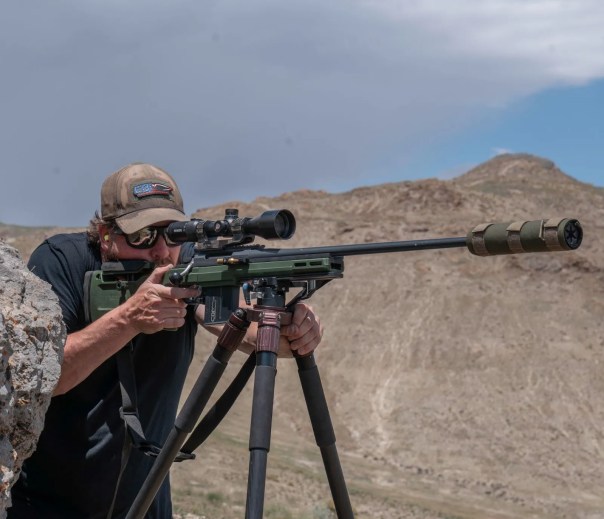


 I assumed something was wrong, but after booting up the Burris connect app, I found the calibration procedure for the internal bubble level. You can zero the level on the scope physically using traditional procedures and then zero the internal digital level.
 I might have blamed it on the extreme cold that day, but it was just as stiff sitting on my kitchen table earlier that morning. I guess you could consider this a positive in some ways because the turret is unlikely to get accidentally turned before you make a shot. But even if it did, as you looked through the scope to make the shot, you could see if the elevation had been moved via the HUD inside.


