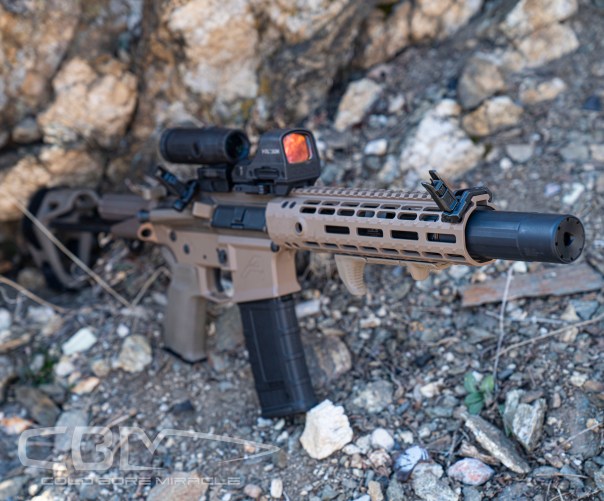
You could say I’m a bit of a fan of the Meateater show, I do my fair share of hunting and eating. I never would have expected the brand would have made it into my daily use. But that’s the subject for today; I bring you a review of the Banish Meateater Suppressor from Silencer Central.
Banish suppressors have been everywhere lately, and I have been pretty impressed with their lineup. The Meateater Suppressor is a more recent development, and based on the name alone I suspect it is targeting the hunting public.
The Banish Meateater Suppressor
As I dug into the Banish Meateater, I could see that its hunting focus was more than just in the name. The titanium construction made the suppressor quite lightweight, which is a paramount feature for hunters.
Part of the reason the can is so light is because of its simple design. A traditional baffle stack held in by two threaded end caps. On the breech side you have the industry standard 1.375 x 24 threaded hub, which allows you to change the mount to whatever best fits your needs. The suppressor comes with a 5/8-24 threaded cap, but you could easily swap it out for a different one should you need to. This is a nice feature vs. having to have your barrel re-threaded.
the Meateater made my multi-caliber Desert Tech SRS M2 even more pleasant to shoot
Innovative Design
At the front end of the Meateater is where this can gets interesting. The threaded end cap houses some very cunning features; the muzzle can be interchanged between thirty-caliber and 6.5mm. These two inserts allow users to optimize the suppressor for most every popular hunting caliber thirty or less. Reducing the muzzle cap to 6.5mm will optimize its performance for 22, 6mm, 25 and 6.5mm cartridges. While the thirty-caliber cap keeps it tight for .270, 7mm, and 30 caliber options.
here you can see the two different muzzle ports, the black one for smaller calibers, and the grey one for 30 caliber
Using the optimal muzzle cap in the Meateater is important because there is another innovative feature in the muzzle of this can. The endcap keeps back pressure to help force more of the pressure out through the radial brake that is incorporated to the front of the suppressor. Its purpose is to help reduce recoil felt by the shooter.
here you can see the on/off feature of the Meateater brake
The suppressed report of my rifles sounded very good, not quite as sharp as other suppressors. Almost as if the bleeding off of pressure through the brake vents made it sound better. It was an impressive suppression performance from a can that is neither heavy nor bulky.
As a long-time suppressor enthusiast I rarely see one I don’t want. In the decades since my first suppressor interaction however, I have noticed a few things about short suppressors. For a long time, there were suppressors designed primarily for law enforcement and military use that were very short. This effected their ability to subdue the report of a rifle to my taste. Times are changing however, and today we are looking at two very short and compact suppressors that do exactly what you’d want them to do. We are comparing the YHM Fat Cat VS. Banish Speed K.
Both of these suppressors are very compact, and they both do a good job of subduing rifle noise. So today I wanted to put them up against each other to see which one I would pick if I couldn’t have both. These compact suppressors are designed for use on 5.56 or .223 caliber semi-auto rifles which most of us commonly use. My analysis will be based on various features but most importantly how these can’s stand up to a heavily used carbine or what many have colloquially called a “fighting rifle” or “battle rifle”.
Fat Cat and Banish Speed K Specifications
YHM Fat Cat
Banish Speed K
Caliber
5.56mm
.223/5.56mm
Weight
13.2oz (with adaptor)
14.1 oz
Length
4.5” (with adaptor)
4”
Diameter
1.94”
2”
Construction Material
17-4 Stainless/ Cobalt 6
Inconel
Decibel Reduction
20dB
20.9dB
Minimum Barrel Length
10” min.
None
Full-Auto Rated
Yes
Yes
Mount Style
Ind. Standard Hub Mount
Finish
Black Cerakote
Black Cerakote
Warranty
Limited Lifetime
Limited Lifetime
Baffle Design
Traditional Stacked baffles
Controlled Flow
User Serviceable
No
No
Included Mount
½-28 sRx Mini QD brake
½-28 Direct Thread
These two suppressors are very similar in size and specifications though there are some differences. The biggest differences that I feel are important I’ll point out here; The Banish Speed K is either 3D printed or DMLS fabricated from Inconel. Inconel is a very robust material (nickel chromium alloy) that is very resistant to both heat and abrasion. This makes the Speed K one solid piece of material, which can be very robust. But for those of us who have broken suppressors before, it makes them nearly impossible to repair if needed. The Speed K uses a finned blast chamber and clipped wall baffles to help reduce sound.
The YHM Fat Cat is built in the more traditional fashion, welding together 17-4 Stainless steel. It uses a cobalt 6 blast baffle to help tame the extreme pressure, heat and abrasion coming from the muzzle. Cobalt 6 (cobalt-chromium-tungsten alloy) is also very resistant to heat and erosion. The fat cat uses an interesting funnel shape to increase the volume of the blast chamber, and it appears the design also helps create a turbulent flow to help reduce sound.
Both suppressors use the industry standard hub mounting system. I can’t tell you how much I like and appreciate the industry moving this direction. It has made mounting your suppressors infinitely easier. You can use whichever mounting system you prefer, whether it be the YHM sRx QD system as provided with the Fat Cat, or something else like the Dead Air KeyMo system, or Plan B from Q. Both suppressors also use a tri-clipped muzzle port, this has become a common feature among many cans.
this combination is an excellent medium range carbine
Host Firearms
To properly test these two suppressors, I put together a small collection of rifles that would give them both a good workout. For pure sound testing, I would run them on my Savage Model 12 chambered in .223. The bolt-action rifle would give the best opportunity to hear the report of both suppressors. I would also use My Desert Tech WLVRN with the 20-inch .223 barrel, the adjustable gas system of the WLVRN would allow me to tune for performance and see how the two cans affected its function.
this little rifle’s upper half is from CMMG, while the lower is from Desert Tech
Additionally I would run them both on a couple other AR15 based rifles like most folks would likely use. One of them a 16-inch Aero Precision build and the other a short barreled 5.56 that we’d also run some full auto through the cans.
Shooting these two suppressors across the host firearms gave a pretty good idea of how they compare. I kept switching them out back and forth to compare.
Both suppressors sounded very hearing safe on the longer rifles. The 16″ Quattro 15 and the 20″ WLVRN were very pleasant to shoot without hearing protection. Of course I have to add the caveat that you should always wear ear protection, even when suppressed.
Backpressure
Almost every suppressor out there adds at least some back-pressure in my experience. And these two were not exempt.
As suppressors continue to increase in popularity and application, you are going to see a lot more of them around here. For those of you who are new to suppressors, today we are going to go over the various suppressor types to help you better understand the subject. Even if you think you don’t want or will never need one, it’s a good topic because your perspective might change sooner than you think. Today we’ll go over everything including materials, manufacturing processes, internal designs, mounting configurations and such. Hopefully by the time you finish reading, you will have a better understanding of your suppressor options.
Suppressors have been called a lot of things; in the movies they call them silencers though it’s a bit misleading because they are hardly silent. A suppressor is like a muffler, but they don’t work the same way. Mufflers simply bounce pressure and sound waves inside a chamber to reduce the noise that comes out the tailpipe. A suppressor is similar but has to overcome the enormous volume and pressure of a gunshot. Most rifle cartridges generate in the ballpark of near 50,000 PSI, your vehicle’s engine generates around a hundred times LESS pressure.
The deafening noise of a rifle going off will make your ears ring, because of the supersonic wave created by all this pressure leaving your muzzle. The job of a suppressor is to slow the expansion of all that gas, so that when it leaves the muzzle of your firearm, it is no longer creating the sonic boom. This is done by slowing the high pressure gas as it exits the muzzle using various chambers, while letting the bullet escape its way to target untouched.
As all this high-pressure gas is slowed within the walls of the suppressor, the energy has to go somewhere. The result is a rapid increase in heat. Essentially all the energy of the expanding gas is turned into heat instead of noise.
Suppressor Construction
For the longest time suppressors were mostly made with the same idea; a sequence of baffled chambers that would capture the expanding gas. Enough of these chambers would be stacked until the exiting gas was slowed enough to be sufficiently quiet for its owner. “K” cans as they are often called are a compromise of putting just enough of these chambers to reduce the report of the gun. Just enough means that they are usually louder than larger suppressor designs.
The baffles between these chambers have a hole just big enough for the bullet to pass through, while trapping much of the gas behind it. Many of these baffles and holes have features to increase turbulence of gas as it passes through. Clipped baffles have offset ports in them, and as gas passes through them it creates turbulence further restricting the straight flow of gas to the muzzle, much like a Tesla valve. Additionally different suppressor designs might vent pressure through just the muzzle, or from multiple points at the front of the can. Some designs even incorporate a muzzle break at the front of the suppressor to help reduce recoil.
Pistol suppressors often use a booster piston assembly, these are necessary to allow many semi-automatic pistols to function. The booster piston allows movement in the barrel/suppressor assembly, this movement is needed for the pistol to unlock the barrel and slide during operation.
If you grew up watching movies where assassins and heroes alike would covertly shoot their adversary using a silencer, that might be reason enough to buy one. But today we are going to discuss other reasons to own a suppressor, or suppressor as they are more correctly called.
adding a suppressor to your favorite rifle will only make it better, this SRS M2 is my favorite
Due to the unreasonably complicated and costly process to obtain a suppressor, it isn’t something many take lightly. With any luck and some hard work that might change soon. In the meantime, I’ll go over the reasons I think you should own a suppressor.
America
First off, this is America. It pains me to know that Europeans can walk into a local gun shop and pickup a suppressor (or moderator as they call them there) and walk out without any further drama. While they can’t do the same with a firearm, it still seems unfair to me.
The right to bear arms is clear, any infringement on that right is immoral. So many of us have endured the intruding touch of the federal government in exchange for owning and using suppressors. While I hate to pay an unfair tax, I also see an incredible value with suppressors. It is with great distaste and contempt that any of us should continue buying our rights back from the government. But if we continue pushing the topic, it could eventually change.
Owning NFA regulated items is one way to normalize them, and convert them into what is called common use. Making them more commonly used among the public will help turn the tide against those who want your $200.
The whole reason you bought a suppressor was to get rid of the noise involved with shooting right? Today we are going to discuss one of the phenomenon that comes with suppressors, and one not everybody is familiar with. First Round pop (FRP) as it is most commonly known, is the additional sound that comes when the first shot of a string is fired from a suppressed firearm. But is it something you need to worry about?
FRP is caused by the presence of unburned oxygen in the suppressor when a shot is fired. The available oxygen inside the suppressor is ignited by the burning gasses and pressure from the muzzle. Subsequent shots are typically less volatile due to the combustion of the oxygen during the first shot. As you continue to fire cartridges, the suppressor body is filled with burnt gas from previous shots, eliminating secondary combustion inside the suppressor. Obviously, if your shots are spaced out enough, the gasses can leave the suppressor and be replaced by fresh air, allowing the cycle to start anew.
What Effects First Round Pop?
FRP varies between suppressor type, cartridges, velocity and other variables. A larger suppressor can house more oxygen, and higher pressure cartridges can cause additional pop volume. You could also experience additional pop from using a suppressor of a larger bore than necessary, as it allows faster ventilation of the suppressor body. The size of the cartridge and the powder charge inside it can also effect the significance of FRP.
Sub-sonic vs. Supersonic
Subsonic shooting is the apex of suppressed shooting, movie-quiet suppression is the goal with sub-sonic suppressed weapons. So as you might imagine, FRP is the adversary of sub-sonic shooters. Some folks even go as far as purging their suppressor with inert gasses prior to shooting to avoid it. Other things such as suppressor wipes can also help keep oxygen from entering the suppressor body and causing FRP.
Supersonic cartridges are already quite noisy, so it is less likely as big a concern for those shooters. Personally I don’t worry too much about it, and for the most part I rarely even notice.
Living with First Round Pop
If your like me, you probably don’t worry much about a few extra decibels when you start a shot string. But if you are one of those who like to play sniper in the back 40 with raccoons or hogs, then you may go to extremes to avoid this pesky pop. Make sure you have the best suppressor for the host you intend to shoot with, some are much better matched to your host than others. The right suppressor can produce less FRP, and if you use some of the other practices to reduce it you can get some very unsuspicious results. There are suppressor gels that you can squirt into the suppressor prior to your first shot that will aid in suppressing FRP. You could also purge your can with inert gas before heading out, and cover the muzzle to keep it inert. You could also do something as simple as adding a touch of water to the inside of your suppressor prior to shooting to help keep down the FRP. Just make sure that whatever practice you use is approved by the suppressor manufacturer, this will help you avoid costly repairs and additional wasteful NFA taxes.
Final Pop
First round pop is simply a biproduct of suppressor design, it can be a problem if you are a CIA spook or suburban hunter. But in the end it is mostly a manageable problem for some, and very minor inconvenience for others. Fuss with it if you must, and enjoy the pleasant sound of silence when it seems least likely.
In the search for a very small and useful rifle, my brother put together a 300 Blackout pistol. Though a deeply committed rifle junkie, I’m not exactly a huge Blackout proponent but I can surely see what the appeal is. One thing I do know for sure, is that unless you are going to run it suppressed, you are leaving most of the Blackout’s magic on the table. That is where todays subject comes in, the Sandman Kwas selected to go with this little project, and today we’ll take a look at how it performed the task.
The Sandman
The name suggests a peaceful slumber, I interpret that to mean the Sandman at a minimum won’t cause a huge disturbing raucous. Which is exactly what the Blackout was meant to avoid.
The Sandman family of suppressors was meant to provide heavy duty service to shooters who prefer suppressed fire. Dead Air claims the Stellite and stainless construction are among the most durable materials used in the suppressor market today. The suppressor is five and a half inches long, and weighs in at just under thirteen ounces. The Sandman has a thirty-caliber bore rated for cartridges up to 300 Winchester Magnum, and it also has available end caps with 5.56 and 6.5 bores. The Sandman mounts to Dead Air’s QD nitrided muzzle devices, they boast single-hand installation and removal that is simple and fast. All this comes with a Cerakote finish for a handsome and durable service life.
Installation
Once the Blackout pistol had been finished, it was time to install the KeyMount muzzle brake. This was a little bit of a challenge because the barrel was recessed inside the handguard, and to be sure it stayed there a serious thread-locking plan was undertaken. The KeyMount design is easy to understand, but I have had a couple issues with it. It uses a three lug ratchet cap that aligns with the muzzle device, and once pushed all the way down to the seat you can twist the suppressor a couple times tightening up the entire assembly on a tapered shoulder.
I say problems, but really it was just a lack of training or getting used to the function of the Sandman. Getting the lugs lined up properly can take a few tries at first, much like a USB you have to try it the same way a couple times to get it right. Once the can is locked up though, it is solid as can be. The system is indeed quick, and strong which explains why so many have switched to it. One thing I did find, which I think can happen with many of these QD type suppressor mounts is they get quite tight to the mount at times. Particularly when whoever installed it did so with significant exertion, the suppressor can be a bit of a chore to break loose and even more so if it has been on the host for a significant period of shooting and time.
One of the great benefits of this system and again what has made it so popular and prolific is the ability to switch the suppressor between hosts quickly and easily. Having extra muzzle devices can give you a great many options for using the Sandman and others that utilize the same mounting system.
On the Range
Once the K-Man was mounted, we set to test firing the host, and adjusting the gas system for optimal operation. As you might expect from a can this small, there was a little more noise than I was used to for suppressed fire. I also noticed a fairly prominent first round pop, with an accompanying flash. Super-sonic shooting with the Sandman K was definitely louder than what I am used to, but again that is a normal and expected occurrence for a suppressor this short. K cans are typically used for different situations where maximum suppression is not the main goal of the suppressor. They are more just to take the edge off for shooting inside buildings or similar situations where massive muzzle blasts are particularly unwelcome.
Sub-sonic shooting on the other hand is much more tolerable, and the real reason the blackout shines. Sub-sonic ammunition doesn’t have the noise associated with bullets breaking the sound barrier, and the Sandman K does just enough to break up the noise produced by the muzzle-blast to make it very pleasant to shoot. And it does it while adding as little as possible to the length of the host firearm.
The Blackout and Sandman combo turned out to be a excellent pairing. Much better I think than had we run the K on a regular centerfire rifle such as a 308 or something similar. While it of course would provide some suppression, it would certainly not be hearing safe. To be fair very few suppressors are hearing “safe”, but my personal position is; I don’t collect stamps and pay money to continue using ear plugs. So for me the Sandman K is going to stick with subsonic hosts, or at a minimum with diminutive cartridges.
There are so many excellent suppressors on the market today, but some I feel are better for niche uses. Would I recommend the Sandman K for a first time suppressor purchaser? Absolutely not. The S or L model on the other hand would be an excellent choice.
But if you are knee deep in stamps and trusts, there’s nothing wrong with having a few dedicated cans for very specific purposes or hosts. For that purpose I think the Sandman K is a bulletproof option, it is neither the first and certainly wont be the last can purchased for a calculated purpose around here. As for the little Blackout, it does its thing real quiet now.
The first time I heard the name Phantom, I assumed like many of you probably did that the name implied a ghostly illusion of anonymity while shooting. Having shot quite a bit of suppressed rifle-fire over the years, and having heard other’s shots from various angles and distances gives the name more credence in my mind.
The latest suppressor to join my NFAmily is the Yankee Hill Machine Phantom 22, and another Phantom it surely is.
The Yankee Hill Machine Phantom 22
The aggressive suppressor market is doing an outstanding job of giving end users the great gift of choice, and the Phantom 22 is an excellent example of giving customers what they want.
The Phantom 22 is constructed of both aluminum and stainless steel, the outer tube being made of aluminum and the baffles themselves being machined from stainless steel. The attachment to the host utilizes a stainless steel threaded insert as well for robust mounting and durability.
The suppressor uses a threaded end-cap at the muzzle, and the main tube is comprised of two sections that thread together just ahead of the blast chamber. Inside the main-tube is the baffle stack, with indexing tabs to keep them all aligned in the same orientation. The blast chamber also has a stainless steel liner that slips into place at the back of the baffle stack. The short section of the main tube at the rear features all the serial numbers and identifying marks.
The Phantom 22 weighs in at a miniscule four ounces, which is a good two ounces lighter than most twenty-two suppressors on the market. The diameter of 1.1 inches and only five and a half inches long make it not only light but less intrusive into your shooting. The suppressor is rated at 114 decibels (which I assume was with a 22Lr), because the suppressor is also rated for 22 magnum, 17 HMR, and even 5.7×28.
All this at a street price not far from three-hundred dollars makes the Phantom 22 a great option for those looking to get quiet in the rimfire game.
I managed to get my hands on one of the very first production model Phantoms, with a single digit serial number I knew it was at the head of the line. I couldn’t believe how light it was as I lifted it from the box, before I even got it opened I was worried I had been shipped an empty box. But there it was, the beautifully anodized little tube I had been anticipating for some time. After admiring the exterior of the suppressor for a moment I decided to get right into the guts of what makes it so light. The front and rear tube sections are undone by hand without tools, the compression and friction of the assembly keep it quite snug.
Upon removing the rear section of the tube I noticed that the breach of the suppressor has an embossed tool as part of it to be used in loosening the end cap which I also threaded carefully out. The smooth stack of baffles slid smoothly out the front, making one of those soothing metallic slipping sounds. I took a couple of them off the stack, to see exactly how it was that they went together. And at the back of the stack was the blast chamber sleeve.
Basically the liner and stack of baffles contain the entirety of the gasses and rimfire debris, the outer tube is simply there to align and hold it together. It was immediately apparent that the idea was to keep all carbon and lead buildup contained inside the blast chamber sleeve. This would keep buildup from locking the assembly together as carbon builds up, which it of course it will, at an impressive rate. So even if you shoot thousands of rounds through this can, and stack the crud deep into it, you will still be able to disassemble it for cleaning.
Another feature that quickly manifest to me was the location of the legal markings, they were all part of the short portion of the main tube at the breach end. This made a lot of sense to me, in the unfortunate event that the can should come loose under fire, and you suffered the dreaded baffle strike, it would be very unlikely to damage the serialized part of the can. This would make repair or part replacement very easy, with something like 85% of the suppressor being easily swapped out for a new part.
I couldn’t wait to get the Phantom mounted on a rifle and outside, but it’s first host actually turned out being my Taurus TX 22 pistol. I had shot thousands of rounds through my two TX pistols with various suppressors so I figured it would be a great place to start my comparison. I installed the 1/2-28 thread collar on my pistol, an threaded up the Phantom onto it. Two ounces doesn’t seem like much, but it sure seemed like I could feel a difference between the Phantom and the Dear Air Mask that had been on it last. And it was definitely a noticeable difference from the SiCo can that also frequented the muzzle of my TX’s. There are lighter suppressors sure, but who wants a suppressor that looks like anal beads?
I wasted no time burning through a paycheck’s worth of ammo, a couple mags later I needed to swing by the house to pick up more. Shooting the TX with the Phantom installed was similar to what I was used to, the increased backpressure caused by suppressors was noticeable. Particularly when dumping large quantities of ammo through the gun I could see and feel plenty of gas and debris in my vicinity. (Note: always wear the appropriate safety equipment when shooting)
I will say that with this pistol, you better be wearing glasses when shooting suppressed because you WILL feel stuff hitting you in the face.
I don’t recall how many rounds I’ve put through that pistol/can combination since, but it is no insignificant number. And yes there tends to build up carbon and other crud around the breach and ejection port of the pistol, but not so much as to deter me from keeping them married.
I’m more of a rifle guy than a pistol guy though, so I really wanted to see how it would do on a rifle.
The first rifle I was able to use with the Phantom was a Tikka T1X in 17 HMR, a very smooth little rifle you can read about here shortly. The rifle was fairly heavy for a rimfire, making recoil non-existent. The noise was still there though, the higher velocity of the 17HMR obviously creates quite a bit more racket than a 22Lr. But it was plenty quiet for my ears, shooting with the Phantom in the open country of the Rocky Mountains needed no hearing protection. The cold winter snow seemed to help soak up some of the sound as well. The Tikka saw no decrease in accuracy with the Phantom installed, which I expected to be the case.
Next I threaded the Phantom onto a Ruger RPR 22Lr to give it an additional workout. The Ruger shot outstanding with the Phantom installed, watching all my impacts one-hundred and fifty yards away was beautiful, and the icing on the cake was the thud sound every-time I pulled the trigger. I tried both super-sonic and sub-sonic ammunition through it and the results were outstanding. The anonymity that comes with shooting that quiet can certainly inspire the sensation of a Phantom presence.
Shooting long strings of fire barely heated the Phantom 22 up at all, though that could have something to do with the below freezing temperatures around here.
Score-Card
I’ve shot a few cans, but the other two rimfire cans I have are in the same competitive league as this one, so I think they are a great comparison.
I have to give the Phantom all high marks, it is just as if not quieter than my other cans. And the significant weight reduction cannot be ignored when compared to the others. And the price on the Phantom is hard to beat, if you can find one they are priced around $325 up to near the $400 mark.
The sound is outstanding, and the ease with which you can disassemble and clean this can makes it a perfect suppressor for just about any rimfire need.
The Phantom 22 next to the author’s SilencerCOSpectre II and Dead Air Mask, both excellent company for comparison.
Conclusion
As usual with YHM cans, this one is an obvious winner in my opinion, at least when compared to those that I’m familiar with. There may be better cans, there may be lighter cans or some other feature that outperforms this one. But I’ll have a hard time justifying to myself looking for a better one with this spectacular little suppressor in my stable, it is an absolute joy to shoot.
One of the biggest questions when buying a suppressor, is selecting one out of the hundreds of options. I’ve been through a bunch at this point in my life, so let me shed some light on the subject for you. What caliber? what configuration? Today we will take a look at the Yankee Hill Machine R9 suppressor.
Many other questions you’ll be asking yourself. With so many options how can you pick one that is best for your purposes? The right answer is that there are always too many good choices to pick only one. Today we are going to look at the subject as a first time suppressor buyer, and a suppressor that might just cover all your bases.
What makes the YHM R9 a perfect can for an NFA Greenhorn? I’ll get right into it. Todays gun owners come from every walk of life. Our modern world has given them overwhelming opportunities for firearms and accessories.
That said, there’s a good chance that most firearm enthusiasts looking into a suppressor probably have an Modern Sporting Rifle (MSR) of one kind or another. That rifle is probably chambered in the extremely popular 5.56. Or one of the other calibers that are growing in popularity like 300blk, 6.5G, 6 ARC, etc.
The R9 from YHM is ideal for using with any of these calibers. It can suppress large frame cartridges too, like the 6.5 Creedmoor and 308 Winchester. It is rated to suppress pretty much anything under 308 Winchester really, even with limited amounts of full auto. But Wait! There’s more! The R9 is also a perfect fit for a 9mm pistol or carbine. It’s stainless construction is more than enough to retain pressures generated by the cartridge, and other 9mm rifle cartridges like the 350 Legend.
As I see it, it is pretty damn likely that your apprentice level prospective suppressor purchaser would benefit greatly with an R9. One could swap it back and forth from various rifles. Or install a booster and run it on their Glock or other handgun as well.
The R9 is ideal for the Desert Tech MDRX and its assorted calibers
Adaptation
YHM is one of many manufacturers that has embraced the uniformity of threads. The threaded rear end of the R9 can be fitted with a direct thread cap (1/2-28 or 5/8-24). It can also fit a Nielsen booster assembly and run with one of various piston manufacturers. It doesn’t end there, it can also use YHM’s Phantom QD system. The system allows rapid swapping of the suppressor from various YHM muzzle devices.
Further still, the can uses the same threads as other major manufacturers like Dead Air and SilencerCo, so you could also install those devices. All three options are used for my R9, I have both thread caps that I use when shooting the R9 on my precision guns. I also have the QD mount so I can swap it back and forth on my carbines as well. I run a Rugged suppressors piston inside my Nielson Booster assembly, which makes my Canik TP9 quiet and smooth as ever I could ask.
Yankee Hill Machine’s R9 is only threaded on the breach end, the rest of it’s construction is solid baffles welded together making it simple and no non-sense. All the provided tools allow the user to tighten down the various assorted mounting options. Or perhaps more importantly disassemble them after being used.
Shooting with the YHM R9
Some of the very first shots I fired through the R9 were with my pistol. It was the first mounting adaptor in my possession so I went straight to the range to try it out.
The R9 tamed all the sounds produced by my pistol, adding of course its due weight and a bit of added backpressure. But the heavier muzzle sure made the pistol smooth and even more controllable. Shooting the pistol in closed quarters was very tolerable. Sound reduction was everything I’d hoped for, and the function was flawless.
The R9 seen mounted direct on my SRS M2 6mm GT
Shortly thereafter I received the 5/8-24 direct thread adaptor, and the R9 went straight to my Desert Tech SRS M2chambered in 6mm GT. There it stayed for quite some time, hundreds of rounds sent through the R9 from fifty to seventeen-hundred yards. Accuracy of the rifle was if anything enhanced by the presence of the R9, this is typical in my experience. Cartridges like the 6mm GT were easily suppressed by the R9, making precision even more pleasant.
Using the QD mount for the R9 is perfect for running the suppressor back and forth between rifles. I ran the Phantom flash hider on my 308 carbine threaded 5/8-24. and on my 5.56 chambered carbine I use the Phantom Turbo 556 muzzle brake. Which made it easy to swap the R9 back and forth between the two rifles, both of which sounded great when suppressed with the R9. With the gas turned down a notch on both rifles, they functioned perfectly without gassing me out at the breach.
Carbines like this 350 Legend are a perfect host
First or Fifth suppressor?
Ya, I said first or fifth. The reason I put it that way is because even though I have a dozen or so cans at any given time, the R9 is still an excellent addition to my collection. A modular suppressor like this is very useful on better than half of my gun collection. With an MSRP of only $494.00 it is pretty economical compared to many other cans.
I’m at a point in life where I seldom go places without a rifle, and much of the time I have two or three rifles. Having an additional suppressor that will fit most of my rifles makes it an easy choice for me.
Conclusion
If my positivity is hasn’t been obvious enough about my feelings about this little suppressor, let me make it clear; I think this is the perfect suppressor for a first time NFA victim. It has everything most people need, multi-caliber, adaptable, tough as nails, and all at a very reasonable price. If I had to say something about the R9 that I dislike, you’d really have to force it out of me. The only issue I’ve ever had was keeping the thread caps tight, this was almost certainly due to me not tightening them on using the supplied tools as I’m a lazy ass. But I wouldn’t put that at the feet of the boys over at YHM.
So there you have it, the R9 is nearly a flawless purchase in my opinion. Short from needing magnum capabilities or a bunch of machine guns you need to suppress, this is an excellent suppressor for your typical firearms consumer. Best get yourself one.