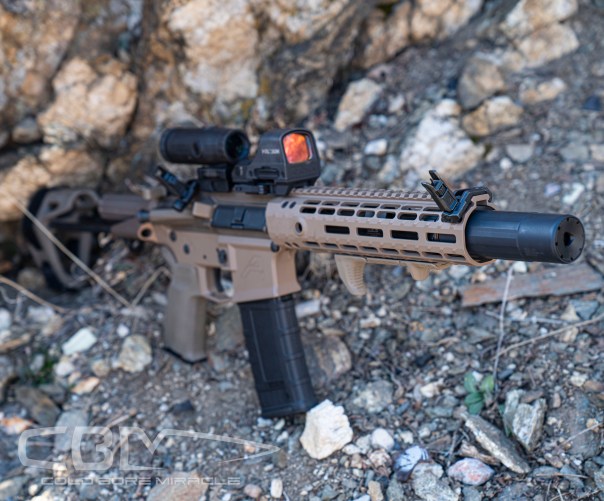
Welcome to the good old days folks, as far as suppressors are concerned anyways. We are living through a boon of suppressor activity that could only be improved by a complete repeal of the NFA. With so many new suppressor offerings, it may be a challenge to decide where to start. But today I bring you an easy option; the Silencer Central Banish Buck 30.
The Buck 30 Banish
The “Buck Commander” signature suppressor apparently gets its name from a popular media personality. One I am not familiar with as I avoid television and its influence. But luckily that has no effect on the function of the suppressor.
The Buck 30 is optimized for hunters, with a weight of only 13.8 ounces it wont add a lot to your hunting rifle. And its simple industry compatible hub system will allow you to mount it to the host firearm any way you choose. The suppressor is rated for up to 300 Winchester Magnum, which will cover most of your typical hunting rifles. And according to the manufacturer, the accuracy baffle used in the Buck 30 helps reduce the impact shift when switching between suppressed and unsuppressed.
Specifications
Length: 6.9”
Diameter: 1.54″
Number of Baffles: 8 baffles with 1st being an accuracy baffle
Weight: 13.8oz
Material: Stainless Steel
Thread Pitch: Various Direct Mounts
Brand: BANISH
Self-Service: No
Caliber: 30 caliber
Caliber Range: .17 HMR – .300 Win Mag
Color: Black
Finish: Cerakote
dB Readings: .308 with 18″ barrel: 131 dB to ear; 6.5 CM with 20″ barrel: 132 dB
Mount Style: Industry Standard Hub
Full-Auto Rated: No
Lifetime Warranty: Yes
Shooting the Buck 30 Suppressor
I decided to test the Buck 30 on a variety of firearms, as I imagine many of you might do. I am starting to think of this suppressor as a great first suppressor for some folks. The ability to change out the mounting configuration makes it easy to switch from one host to another.
The first rifle I used the Buck 30 suppressor on was my bolt action 223 Remington. A custom rifle mainly used for varmint hunting and target shooting. The Buck 30 fit perfectly using the provided 5/8-24 direct thread hub. Next up was a Bergara HMR Carbon chambered in 6.5 Creedmoor. This rifle is also threaded 5/8 -24 so the same thread cap was used and matched up well to the muzzle thread tenon.
On the bolt-action rifles the suppressor was fantastic, keeping the report down to a pleasant ruckus. And it didn’t add much length to the rifles, though I rarely shoot unsuppressed so that could just be my bias. One of the two rifles is particularly heavy, so the weight of the Buck 30 wasn’t even noticeable.
Conventional suppressors are becoming more and more common. And as overall suppressor ownership increases, unique designs continue to come to market. Today we are going to bring you one of these new and unique designs. Silencer Central has been aggressively pursuing the suppressor market with their Banish line of in house suppressors. Though they sell many other brands as well, it is no surprise that the Banish line gets lots of attention and continues to develop with new options. Among those new Banish suppressors you will find today’s subject; the Silencer Central Banish Speed K suppressor.
The Speed K is a duty designed suppressor, developed for the purpose of heavy shooting service carbines. Its design utilizes clipped baffles and finned blast chamber, these features help create turbulence and retard the escape of gas. Additionally, the fourth baffle is vented which help reduce the velocity of exiting gasses. These features coupled with the complete inconel construction make the Speed K both effective and durable.
The Banish Speed K
The Banish Speed K was developed during testing procedures for law enforcement and military use. I suppose you could translate that to mean that it was designed around high volume shooting protocols. According to the manufacturer the Speed K passed multiple courses of heavy duty SOCOM testing, which many suppressors can’t pass once.
This durability is likely due to the inconel construction and ventilated baffle design. I’m no rocket scientist but I imagine the erosion resistant inconel stands up much better than traditional materials. And allowing a portion of gas to bypass probably helps reduce heat building up like a traditional suppressor design might.
Another feature I like about the Speed K is its mounting solutions. With an industry standard hub, the Speed K can use direct thread mounting or one of various manufacturers QD or brake mounted options. For example I used a YHM Phantom QD mount which made it nice to swap between host firearms. That and the compact size of the Speed K make it a great option for guns made to shoot and scoot.
Specifications
Length: 4″
Diameter: 2″
Weight: 14.1 oz
Material: Inconel
Thread Pitch: Various Direct Mounts
Caliber: 5.56
Caliber Range:. 223 to 5.56
Sound Reduction: 20.9 dB
Self-Service: No
Full-Auto Rated: Yes
Color: Black
Finish: Cerakote
Mount Style: Industry Standard Hub Mount
Lifetime Warranty: Yes
Mounting the Banish Speed K
I planned on running the Speed K on a variety of different 5.56 rifles. First was my Desert Tech WLVRN, a twenty-inch barreled bullpup carbine. I used the provided direct thread end cap for this configuration. I don’t do a particularly high volume of shooting with this rifle, its more like a DMR type rifle.
I also used the direct thread cap to attach it to my Quattro 15 PDW type rifle. This one is more along the lines of the Speed K, in that it is made to put down lots of shots. With 53-round magazines and a very short barrel, this gun would give the Speed K a workout and push it’s durability.
Additionally I ran the Banish Speed K on a full-size AR rifle using a sixteen-inch barrel. Just for fun I swapped out the mounting solution on that rifle. With the aforementioned YHM ratcheting QD mount I didn’t need to worry about the direct thread coming loose.
Using different end caps from different manufacturers proved to be very compatible. All the threads matched up nicely making it easy to choose different options for different mounting choices.
As suppressors continue to increase in popularity and application, you are going to see a lot more of them around here. For those of you who are new to suppressors, today we are going to go over the various suppressor types to help you better understand the subject. Even if you think you don’t want or will never need one, it’s a good topic because your perspective might change sooner than you think. Today we’ll go over everything including materials, manufacturing processes, internal designs, mounting configurations and such. Hopefully by the time you finish reading, you will have a better understanding of your suppressor options.
Suppressors have been called a lot of things; in the movies they call them silencers though it’s a bit misleading because they are hardly silent. A suppressor is like a muffler, but they don’t work the same way. Mufflers simply bounce pressure and sound waves inside a chamber to reduce the noise that comes out the tailpipe. A suppressor is similar but has to overcome the enormous volume and pressure of a gunshot. Most rifle cartridges generate in the ballpark of near 50,000 PSI, your vehicle’s engine generates around a hundred times LESS pressure.
The deafening noise of a rifle going off will make your ears ring, because of the supersonic wave created by all this pressure leaving your muzzle. The job of a suppressor is to slow the expansion of all that gas, so that when it leaves the muzzle of your firearm, it is no longer creating the sonic boom. This is done by slowing the high pressure gas as it exits the muzzle using various chambers, while letting the bullet escape its way to target untouched.
As all this high-pressure gas is slowed within the walls of the suppressor, the energy has to go somewhere. The result is a rapid increase in heat. Essentially all the energy of the expanding gas is turned into heat instead of noise.
Suppressor Construction
For the longest time suppressors were mostly made with the same idea; a sequence of baffled chambers that would capture the expanding gas. Enough of these chambers would be stacked until the exiting gas was slowed enough to be sufficiently quiet for its owner. “K” cans as they are often called are a compromise of putting just enough of these chambers to reduce the report of the gun. Just enough means that they are usually louder than larger suppressor designs.
The baffles between these chambers have a hole just big enough for the bullet to pass through, while trapping much of the gas behind it. Many of these baffles and holes have features to increase turbulence of gas as it passes through. Clipped baffles have offset ports in them, and as gas passes through them it creates turbulence further restricting the straight flow of gas to the muzzle, much like a Tesla valve. Additionally different suppressor designs might vent pressure through just the muzzle, or from multiple points at the front of the can. Some designs even incorporate a muzzle break at the front of the suppressor to help reduce recoil.
Pistol suppressors often use a booster piston assembly, these are necessary to allow many semi-automatic pistols to function. The booster piston allows movement in the barrel/suppressor assembly, this movement is needed for the pistol to unlock the barrel and slide during operation.
If you grew up watching movies where assassins and heroes alike would covertly shoot their adversary using a silencer, that might be reason enough to buy one. But today we are going to discuss other reasons to own a suppressor, or suppressor as they are more correctly called.
adding a suppressor to your favorite rifle will only make it better, this SRS M2 is my favorite
Due to the unreasonably complicated and costly process to obtain a suppressor, it isn’t something many take lightly. With any luck and some hard work that might change soon. In the meantime, I’ll go over the reasons I think you should own a suppressor.
America
First off, this is America. It pains me to know that Europeans can walk into a local gun shop and pickup a suppressor (or moderator as they call them there) and walk out without any further drama. While they can’t do the same with a firearm, it still seems unfair to me.
The right to bear arms is clear, any infringement on that right is immoral. So many of us have endured the intruding touch of the federal government in exchange for owning and using suppressors. While I hate to pay an unfair tax, I also see an incredible value with suppressors. It is with great distaste and contempt that any of us should continue buying our rights back from the government. But if we continue pushing the topic, it could eventually change.
Owning NFA regulated items is one way to normalize them, and convert them into what is called common use. Making them more commonly used among the public will help turn the tide against those who want your $200.
You can’t swing a dead cat in my house without hitting a good suppressor. I suppose you could say I am a bit of an addict. No, it isn’t because I like to keep ATF agents employed, nor do I enjoy collecting stamps. I just love shooting suppressed. My rights were first violated over twenty years ago now, and it has only gotten worse with time. By that I mean both the violation and the addiction to cans.
Today I wanted to tell you all about the latest suppressor I was able to get hands-on, the CGS Group Hyperion K suppressor. I have seen them all over on social media and gun-tubers channels, but I had yet to put any ammo through one. As you might imagine I jumped at the chance.
The Hyperion
According to CGS, the Hyperion utilizes a proprietary technology to manufacture and heat treat this all grade 5 titanium suppressor. It is the product of 3D printing using the direct metal laser sintered (DMLS) process. Using a laser fired into a bed of titanium powder to melt it into the pattern of their design. This alone sounds like an amazingly complicated and expensive process. But I’m just a dummy who swings hammers and gets greasy.
What I can tell you, is that the result of this process has created one of the cleanest looking cans I’ve seen. The curious design and textures of this suppressor make it aesthetically pleasing and more importantly extremely light. The Hyperion senior weighs in at fifteen ounces, and this K model is even lighter at 10.5 ounces.
The back of the can is threaded 5/8-24, and also features a tapered opening to use CGS’s proprietary mounts. I would also assume that if you had a tapered muzzle to the same angle it would help there as well. The technology with which these suppressors are manufactured make them very durable according to the manufacturer. That gives them higher ratings than expected, and increased durability rating as well. The Hyperion K has special boron nitride coating inside that helps reduce fouling inside the suppressor. The outside has very attractive and durable DLC coating.
The Hyperion K (rear) shown next to a comparable titanium suppressor on my Desert Tech rifles
Welcome to the Family
I tucked the Hyperion K into my bag with a few other suppressors, and I retreated to my mountain hide. Having planned on shooting the Hyperion on various rifles I was already very familiar with, as well as how the rifles react to suppressors. The first rifle and the primary one I was to introduce to the Hyperion was my Desert Tech SRS M2. It is a multi-caliber precision rifle. There are untold possibilities as far as custom calibers. At the moment I probably have over a dozen different caliber conversions for this rifle.
Today on this particular range trip I had installed my 6mm GT conversion kit, which has become one of my favorites. Seeing as how the Hyperion is rated for much larger calibers, I expected it to work very well on this configuration. I have shot this same barrel with half a dozen other suppressors, so I was prepared to feel and hear something different.
Upon installing the Hyperion I did notice one little thing that concerned me. The tapered breach of the threads resulted in the threads starting approximately two to three tenths of an inch farther into the suppressor. The result obviously is that there is less thread engagement than a non-tapered thread cap. I suppose this could be a much bigger concern if you were running the suppressor on a larger rifle such as the 300RUM it is max rated for. But I felt there was enough thread engagement to be safe, so I started sending rounds.
The Hyperion K mounted on my Desert Tech SRS M2 6mm GT
The Sound
When I first broke the trigger, I was more focused on making sure the can was still there. Thats something that comes when trying a new can on most any host. By the second shot I was definitely paying more attention, and I did notice the difference from what I usually hear. The Hyperion does an excellent job at suppressing the noise. It seems to have a lower tone than many of my other cans. I guess you could say it’s not as “hissy” as most cans, and has a bit deeper tone.
After a couple rounds I decided to start burning through some ammo. Mainly because I love that damn GT and hitting things with it. The Hyperion stayed right where I’d put it. After about twenty rounds fired over the course of a few minutes as far away as twelve-hundred yards it was definitely warm to the touch. But as titanium does, it cooled down very quickly, especially in the cold Rocky Mountain breeze.
The Hyperion K performed flawlessly, with very pleasing results on various firearms
More Shooting the CGS Group Hyperion K suppressor
In a very short time the can was easily handled, so I removed it and swapped it over to my Bergara BMP 6.5 Creedmoor. Certainly not a huge step up in case volume and powder charge, but it was a step up. The Hyperion sounded very nice on the twenty-four inch Bergara Rifleas well. I have shot a couple other comparable titanium suppressors on these rifles and I just like the sound the Hyperion makes a little more. It became quite apparent that would need some serious firepower in order to make this suppressor really sweat, something I wasn’t real keen to do, but I figured you guys wouldn’t be happy if I didn’t.
I would have loved to try out CGS’s vented low profile front cap, it has additional ports to allow more gas to bypass. This would have been ideal to use on a semi-auto rifle, as it would likely reduce the gas back pressure coming at the shooter.
The breech of the Hyperion K, note taper
I figured I’d so a couple good twenty round mag dumps with a 308 to get it hot, and see how the Hyperion reacts. The semi-auto rating of the Hyperion made me quite confident that nothing I was about to do was going to hurt it. After forty-rounds of 308 Winchester the can was smoking hot, so I figured one more was in order. A whole lot of heat could be seen, but the sound still sounded about the same. I have to assume it began to lose some of its effectiveness as the can got hotter and hotter. But it still was very pleasing to my ears.
Thoughts
I prefer shooting precision rifles over high volume fighting guns, so keep that in mind as I write this. The Hyperion K offers a shorter length than most full size rifle cans, and yet it seems to be quieter. Having used both brake mounted and direct thread cans. I typically prefer the later so it should come as no surprise that this Hyperion fits squarely in my near perfect solution. It has lightweight, short length, and superior suppression power over most. Durability with full-auto ratings is nice to have. I’m sure to many people that is important, but to me not so much. I am fine with the Hyperion not being full-auto rated.
The only thing about this can I didn’t like was the shorter threads, something I think I could easily overcome. I don’t like shooting big bastard magnums that often anyways, so it is of little concern. The back of the threads spun up snug and perfectly square to all my barrels.
I am mystified by the special technology they are weaving over at CGS Group, but it sure seems like they are onto something. If this Hyperion is any indicator, I think I may need to look into additional offerings to see if I’ve been missing out on anything else. I know I may be just a nobody, but the CGS Group Hyperion K is definitely worth looking at if you are in the market.
The whole reason you bought a suppressor was to get rid of the noise involved with shooting right? Today we are going to discuss one of the phenomenon that comes with suppressors, and one not everybody is familiar with. First Round pop (FRP) as it is most commonly known, is the additional sound that comes when the first shot of a string is fired from a suppressed firearm. But is it something you need to worry about?
FRP is caused by the presence of unburned oxygen in the suppressor when a shot is fired. The available oxygen inside the suppressor is ignited by the burning gasses and pressure from the muzzle. Subsequent shots are typically less volatile due to the combustion of the oxygen during the first shot. As you continue to fire cartridges, the suppressor body is filled with burnt gas from previous shots, eliminating secondary combustion inside the suppressor. Obviously, if your shots are spaced out enough, the gasses can leave the suppressor and be replaced by fresh air, allowing the cycle to start anew.
What Effects First Round Pop?
FRP varies between suppressor type, cartridges, velocity and other variables. A larger suppressor can house more oxygen, and higher pressure cartridges can cause additional pop volume. You could also experience additional pop from using a suppressor of a larger bore than necessary, as it allows faster ventilation of the suppressor body. The size of the cartridge and the powder charge inside it can also effect the significance of FRP.
Sub-sonic vs. Supersonic
Subsonic shooting is the apex of suppressed shooting, movie-quiet suppression is the goal with sub-sonic suppressed weapons. So as you might imagine, FRP is the adversary of sub-sonic shooters. Some folks even go as far as purging their suppressor with inert gasses prior to shooting to avoid it. Other things such as suppressor wipes can also help keep oxygen from entering the suppressor body and causing FRP.
Supersonic cartridges are already quite noisy, so it is less likely as big a concern for those shooters. Personally I don’t worry too much about it, and for the most part I rarely even notice.
Living with First Round Pop
If your like me, you probably don’t worry much about a few extra decibels when you start a shot string. But if you are one of those who like to play sniper in the back 40 with raccoons or hogs, then you may go to extremes to avoid this pesky pop. Make sure you have the best suppressor for the host you intend to shoot with, some are much better matched to your host than others. The right suppressor can produce less FRP, and if you use some of the other practices to reduce it you can get some very unsuspicious results. There are suppressor gels that you can squirt into the suppressor prior to your first shot that will aid in suppressing FRP. You could also purge your can with inert gas before heading out, and cover the muzzle to keep it inert. You could also do something as simple as adding a touch of water to the inside of your suppressor prior to shooting to help keep down the FRP. Just make sure that whatever practice you use is approved by the suppressor manufacturer, this will help you avoid costly repairs and additional wasteful NFA taxes.
Final Pop
First round pop is simply a biproduct of suppressor design, it can be a problem if you are a CIA spook or suburban hunter. But in the end it is mostly a manageable problem for some, and very minor inconvenience for others. Fuss with it if you must, and enjoy the pleasant sound of silence when it seems least likely.
In the search for a very small and useful rifle, my brother put together a 300 Blackout pistol. Though a deeply committed rifle junkie, I’m not exactly a huge Blackout proponent but I can surely see what the appeal is. One thing I do know for sure, is that unless you are going to run it suppressed, you are leaving most of the Blackout’s magic on the table. That is where todays subject comes in, the Sandman Kwas selected to go with this little project, and today we’ll take a look at how it performed the task.
The Sandman
The name suggests a peaceful slumber, I interpret that to mean the Sandman at a minimum won’t cause a huge disturbing raucous. Which is exactly what the Blackout was meant to avoid.
The Sandman family of suppressors was meant to provide heavy duty service to shooters who prefer suppressed fire. Dead Air claims the Stellite and stainless construction are among the most durable materials used in the suppressor market today. The suppressor is five and a half inches long, and weighs in at just under thirteen ounces. The Sandman has a thirty-caliber bore rated for cartridges up to 300 Winchester Magnum, and it also has available end caps with 5.56 and 6.5 bores. The Sandman mounts to Dead Air’s QD nitrided muzzle devices, they boast single-hand installation and removal that is simple and fast. All this comes with a Cerakote finish for a handsome and durable service life.
Installation
Once the Blackout pistol had been finished, it was time to install the KeyMount muzzle brake. This was a little bit of a challenge because the barrel was recessed inside the handguard, and to be sure it stayed there a serious thread-locking plan was undertaken. The KeyMount design is easy to understand, but I have had a couple issues with it. It uses a three lug ratchet cap that aligns with the muzzle device, and once pushed all the way down to the seat you can twist the suppressor a couple times tightening up the entire assembly on a tapered shoulder.
I say problems, but really it was just a lack of training or getting used to the function of the Sandman. Getting the lugs lined up properly can take a few tries at first, much like a USB you have to try it the same way a couple times to get it right. Once the can is locked up though, it is solid as can be. The system is indeed quick, and strong which explains why so many have switched to it. One thing I did find, which I think can happen with many of these QD type suppressor mounts is they get quite tight to the mount at times. Particularly when whoever installed it did so with significant exertion, the suppressor can be a bit of a chore to break loose and even more so if it has been on the host for a significant period of shooting and time.
One of the great benefits of this system and again what has made it so popular and prolific is the ability to switch the suppressor between hosts quickly and easily. Having extra muzzle devices can give you a great many options for using the Sandman and others that utilize the same mounting system.
On the Range
Once the K-Man was mounted, we set to test firing the host, and adjusting the gas system for optimal operation. As you might expect from a can this small, there was a little more noise than I was used to for suppressed fire. I also noticed a fairly prominent first round pop, with an accompanying flash. Super-sonic shooting with the Sandman K was definitely louder than what I am used to, but again that is a normal and expected occurrence for a suppressor this short. K cans are typically used for different situations where maximum suppression is not the main goal of the suppressor. They are more just to take the edge off for shooting inside buildings or similar situations where massive muzzle blasts are particularly unwelcome.
Sub-sonic shooting on the other hand is much more tolerable, and the real reason the blackout shines. Sub-sonic ammunition doesn’t have the noise associated with bullets breaking the sound barrier, and the Sandman K does just enough to break up the noise produced by the muzzle-blast to make it very pleasant to shoot. And it does it while adding as little as possible to the length of the host firearm.
The Blackout and Sandman combo turned out to be a excellent pairing. Much better I think than had we run the K on a regular centerfire rifle such as a 308 or something similar. While it of course would provide some suppression, it would certainly not be hearing safe. To be fair very few suppressors are hearing “safe”, but my personal position is; I don’t collect stamps and pay money to continue using ear plugs. So for me the Sandman K is going to stick with subsonic hosts, or at a minimum with diminutive cartridges.
There are so many excellent suppressors on the market today, but some I feel are better for niche uses. Would I recommend the Sandman K for a first time suppressor purchaser? Absolutely not. The S or L model on the other hand would be an excellent choice.
But if you are knee deep in stamps and trusts, there’s nothing wrong with having a few dedicated cans for very specific purposes or hosts. For that purpose I think the Sandman K is a bulletproof option, it is neither the first and certainly wont be the last can purchased for a calculated purpose around here. As for the little Blackout, it does its thing real quiet now.
Life is so much better with a suppressor, and the more suppressors you have the better in my opinion. Suppressed shooting brings a new level of enjoyment to the shooting sports, whether it be hearing your bullets impact on the target or just not having to wear ear protection and being able to speak with each other without yelling. Rimfire’s are already quiet compared to their centerfire counterparts, and when you put a suppressor on them they are even more quiet. The Dead Air Mask 22 rimfire suppressor has been in my inventory for over a year now, and I can certainly say it has made the year more pleasant. And if you are looking for one yourself, I’m here to give you my opinion on it.
The Mask
unbelievable amounts of fun can be had with a suppressed 22
The Dead Air Mask is titanium and stainless steel rimfire suppressor, it is rated for everything from 22LR up to 5.7×28 cartridges. It is just over five inches long, and has a diameter of 1.070 inches and weighs in at 6.6 ounces. The Mask is disassembled using the provided tool for the muzzle cap, and the threaded breach of the can also threads out making cleaning the suppressor very easy.
The Mask has been with me for some time now, through the summer heat and the cold of winter. I think I’ve gotten a good handle on how it performs.
The Mask was easily installed on an assortment of host rimfire weapons, and in every instance it made everything better. I use my firearms mostly for hunting and practice prior to hunting. A good portion of the summer time was spent using the mask on several 22 pistols to hunt small game such as squirrels and marmots.
Using suppressed rimfire hosts can get you up close, the Taurus TX22 was another excellent host
The Mask made a perfect companion for that purpose, allowing me to take multiple animals without spooking them with muzzle reports. And it was easily threaded on and off of my firearms, and had what I consider minimal shift. The stainless mounting threads and square cut breach cap provide an excellent interface with the host.
Through the winter time the mask stayed with me and my rimfires, providing the children with all kinds of fun. All while not adding a bunch of length or weight to the host rifle.
With so many admittedly good options out there, what would make you choose the Mask over something else? Its a subject I’ve often thought about, not just with the Mask but all kinds of products. I have other rimfire suppressors, and to be perfectly honest there is not a huge disparity between them all. Which again begs the question, why pick one over the other? Obviously there is a commercial aspect to the answer that has some validity, if there is only one suppressor in stock when you go to purchase one then it pretty much answers your question. Dead Air has done a great job at keeping up with demand, even during the darkest days of the last supply crisis I could still find an assortment of Dead Air suppressors in stock.
Pretty much all of the US suppressor market is domestically manufactured mostly if not wholly. So buying American is easy as far as that goes, but its nice to know that parts for my Dead Air cans were made just down the road a piece by some of my friends.
I don’t consider myself married to one particular manufacturer, as I have cans from several of the larger manufacturers. But if you are one of those people who likes to stick to one brand, you certainly wouldn’t go wrong picking Dead Air as that brand.
A pair of Marmots, one of which was not threatened by the report from the Mask
Price seems to be the most common decision factor on many things, the Mask has a street price as I write this around 420-480 dollars. That’s not exactly cheap for a rimfire suppressor, but you can surely spend a lot more money. And I wouldn’t bet the average shooter would see a huge difference between the Mask and suppressors that cost much more. So many times it can come down to who and where gives you the best price.
There are lighter suppressors, but we are talking in ounces so unless you are so high speed that two ounces is going to change your mind its probably not an issue.
Final words
The Dead Air Mask offers the same thing the rest of the Dead Air family does; excellent suppression and robust durability that won’t require a loan application (unless you want a really big collection). So if you are a Dead Air fan, or if you have been considering the Mask as an addition to your firearms collection I am here to tell you, you will love it. -CBM