Tag Archives: us optics

US Optics TS8X

Low Power Variable Optics (LVPO’s) have been flooding through the firearm market for years now, likely due to the proliferation of medium-range carbines. It didn’t take long for shooters to realize the value of variable low power optics, but what makes an LVPO shine over another?

I’ve had several different models from a wide range of manufacturers, and today we will discuss in depth the US Optics TS8X.

The Tactical Sport 8 power LVPO is one of several great scopes I’ve been able to shoot in the offshore line of scopes from USO. So far they have proven to be a great option for shooters in my opinion. I have been shooting USO scopes for many years now, and to be completely honest I was a bit worried when I saw they were releasing a more affordable line of scopes. My concerns were quality and performance, for which USO’s are well known. My concerns were assuaged with the TS20x, which quickly became one of my favorites. The TS8X has so far been just as good an experience.

Why an LVPO?

I also have the TS6X, which is the little brother to the TS8x. I wanted the 8X because having used several 1-4’s and 1-6’s, I wanted just a little bit more power for seeing those downrange targets. Again in my opinion, a 1-8 or 1-10 is about perfect for a medium range rifle, for distances around six to eight hundred yards. The TS8X fit that spot perfectly in my estimation, and with the RBR Reticle, it would give me plenty of holdover points for shooting at those further distances.

Features

The TS8X features a 30mm tube, with adjustable diopter eyepiece, covered turrets, and an illuminated front focal plane reticle.
Many manufacturers have moved to the 30 or 34mm scope tube now, it gives a larger tube to pass light through, as well as allow a larger erector to increase the internal mechanical movement of the scope. The parallax is fixed for 100 yards, which leaves the diopter eyepiece focus the only adjustment for the image seen. This is common in most LVPO’s, particularly in this price range. If I had one wish for the TS8 it would be adjustable parallax, I frequently shoot well beyond 500 yards with this scope and others like it. The ability to adjust parallax for those distance targets would be very welcome.
Another feature that thankfully is becoming more commonplace, is the reticle placed in the front focal plane (second focal plane models are also available at a lower cost). This means the reticle is magnified with the power setting of the optic, keeping the reticle values always the same regardless of power setting.

The RBR reticle is illuminated red, with an adjustable rheostat for brightness. It also features both MRAD hash marks (both whole and half) as well as range based holdover points, including wind holds at five and ten MPH.

With the stiff competition in the LVPO market, the TS8X fits in the middle ground of price range. There are many options that are far less in price, and many others that cost double, triple, or more.
My initial concerns about quality were more based on mechanical performance and robust construction. I knew that due to its price point, it would likely not have the same optical quality as scopes costing more, which I was okay with.
Speaking of optical quality, I found the image to be bright, and clean. Not much to complain about there, but don’t expect to see the same image as a $1600-$2400 scope.
I found the RBR reticle to be very useful at distances out to nearly 1000 yards, at 8X it could possibly be a little thick for tiny targets, but I don’t expect many people will be doing benchrest or squirrel hunting at that range. For real world shooting, such as echo targets inside 600 yds, it is perfect. The rifle its currently mounted on will be doing some coyote hunting, and I’m very confident that anything inside 800 yards will be easily identified, targeted, and engaged using the RBR.
As I mentioned above, the reticle features both MRAD marks, as well as estimated drop and wind marks. This is handy, because if you need an honest elevation or wind call, you have the actual MRAD values. Whereas if your shooting at the aforementioned coyote, you can use the drop values according to how far away he is.

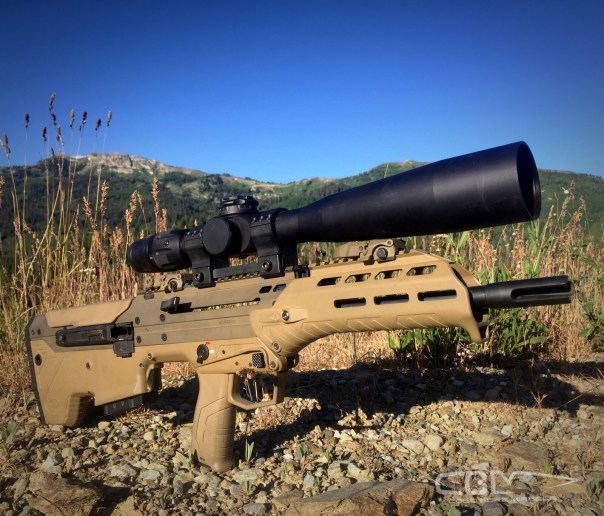
I mounted the TS8X on my Desert Tech MDR, which at the time was a sixteen-inch 223. The scope was easily zeroed with no tools, and in no time I was shooting steel all over the range.

The MDRX with the TS8X and YHM Turbo suppressor

I love using the scope at 1X, with the reticle lit up, it is just like using a red dot scope. Up close shooting at steel, animals, or whatever else is easily done with both eyes open. Cover the target with red as you break the trigger will give you sure hits.
I then switched out the barrel for the new Hornady 6mm ARC barrel, to see how the TS8X would match up to its ballistic curve.
Without even rezeroing the scope, I was in business, perhaps more a testament to the rifle than the scope. I later made a few corrective adjustments, and the rifle was punching centers very consistently. The click values of the turrets seemed to be close enough to values marked, but to be honest, I hardly had to move them.

us optics
Stretching the rifle out would require using the drop points indicated on the RBR reticle, I figured they would be close since the 6 ARC is not too far off of the 223 trajectory it is based on.
It was close enough to be dangerous that is for sure, at 960 yds I shot over the target. The 6 ARC has less drop than a 223 at that distance, so I held a corrected hold (7MRAD) and a bit of left wind for a perfect center punch hit.
I followed it up with a few more shots to confirm, inside I was giggling like a child watching the trace of my bullets on the way to the target.

I’m not sure if its the TS8X or just better optics that we are spoiled with today. When I first started shooting these farther distances, it seemed like 10X was barely enough, and 15-25 was more like what you needed for shooting long range. But I found shooting almost everything inside a kilometer to be relatively easy with the 8X of this little USO.
I recently took a LE Carbine LVPO course and was extremely happy with the way this little scope ran on the range. We engaged targets all over from 50 to 600 yards in every position you can imagine, I was able to use the wind holds to get some great hits on windswept targets boiling in mirage.
I guess the technology is catching up, soon one thousand yards will no longer be a long range benchmark. It will be more like medium range for drills at a beginners carbine class. If you find yourself on that spectrum, the US Optics TS8X will fill the need for a medium range optic. And it will do it without needing a signature loan to checkout, and you’ll still have the quality and guarantee US Optics has always put on their scopes.
-CBM

US Optics TS20X Rifle Scope

Introduction

Im a sucker for scopes, you might say I have a weak spot for them. I have used most of the very best scopes, and Ive also used many that weren’t worth straining my eye to focus through them. Part of my affliction is due to being spoiled for some time now, and I blame US Optics for it, at least partially. I have had several of them over the years, and they have earned their keep in my safe. Today I bring you another review of the US Optics TS20X rifle scope.

US Optics has a history for robust builds, with nail driving strength. They have seen many changes over the years, and we could argue surely over the pros and cons. But for me, only one thing matters, whats on-top of my rifle, and how does it perform.

The USO TS20 mounted on my Desert Tech SRS A2

The TS20X

As a riflescope addict, I was interested when US Optics launched their Tactical Sporting line of scopes, the TS Series. Like any true addict I rested not until I had the TS 20 in my hands. It was love at first sight.

My initial impression of the TS 20 was its weight, it seemed light for a USO. This new TS line was clearly a more economical series of scopes, so I expected a simpler construction. Lightweight, and a very clear and clean image were both very welcome features. The JVCR reticle was new to me, and well received. I prefer the newer “Christmas tree” style milling reticles, and I found the JVCR to be very handy to use. The offset two tenth windage holds made perfect sense when hurriedly making a wind call. And like most good reticles, even numbering to keep track of your holds. With as many as ten mils to hold over, and five wide for windage, it makes a perfect companion for todays ultra-flat shooting rifles.

Another feature that impressed me very quickly was the focus/parallax adjustment, which is adjustable down to ten yards. At first I didn’t think it was a big deal, but when I dialed the scope down to 2.5X, I realized that this scope could almost be used like a red-dot. If I ever had any up close shooting to do such as approaching a wounded animal, I could simply turn on the illumination, and mark the target with the red cross and pull the trigger. This to me seemed like a very handy feature for a scope I would surely use while hunting. And yet with the max power of 20X from the scope, there are few things I would not be able to shoot at inside my distance envelope.us optics

US Optics has always helped me put food on the table

The turrets of the TS20 are ten MIL per revolution, that for me is a minimum. Long gone are the days of five MIL per turn scopes, that was so 2010. The clicks are clean, and you can both feel and hear them as you turn the turret. The TS20 has an interesting zero-stop feature, but it requires you to limit the rotation to one turn only. Not a big deal for many things, but since I like to live on the edge, I decided to pull any stops and run it wide open. One complaint if you’ll allow it, the turret housing isn’t numbered to help you keep track of what revolution you are on. Bit of a pet peeve of mine, but not a deal breaker by any stretch. The tension of the turrets, power ring, and focus knob were all just right, not too hard to turn, but stiff enough to avoid accidental movement while packing it around.
I already mentioned the parallax/focus adjustment, but just next to it on the left side of the scope, is the rheostat to adjust the illumination on the JVCR reticle. It’s your standard 1-10 clicks with an off position in between each setting. 10 is bright enough to use as a red-dot in dim daylight, and 1 is dim enough to use with night-vision and thermals.

A downed animal, as seen at 500yds through the TS20 and thermal. Notice JVCR reticle detail

With 24 useable MILS of elevation from its 34mm tube, the TS20 is a very useful long range tool. The rifle it currently commands only needs 5MRAD of elevation to get to a thousand yards. But even if you are shooting a 308 you wont have a problem getting way out there. But with it’s super low power setting, and 28 ounce weight, it is a good option for a long-range hunting rifle as well.

The TS20 mounted on my all carbon 257 Blackjack

Shooting with the TS20X

In the field the TS20 performed exactly like every other USO I’ve ever fielded. Click values were consistent, and lined up with my known ballistic data. I keep coming back to it so forgive me, but I love the high and low range of this scope. I never thought I would want a 2X precision rifle optic, but I sure am glad I have one now. In the field was the best place to see the value.
I am not huge on high magnification, I rarely use my scopes above 20X. So the TS20 is right in the middle of where I want all my X’s. Even at max power the image is still clear, and the reticle is very useful. Even so, I usually find my power ring somewhere between 10 and 15. It is at those medium settings that I find the optical magnification and reticle proportions to be ideal, both for targeting, and making corrections.

The USO TS20 played well with everything, especially this clip-on thermal
Shop all US Optics rifle scopes

I mounted the TS20 on three different rifles, first on my Desert Tech SRS A2, and then on my MDR. Regardless of which caliber I was shooting I had every confidence that the TS would keep up. Whether it was hunting varmints on the foothills around my home, or chasing big game like mule deer or elk through these big Rocky Mountains. I’ve never had to worry about my US Optics scopes while traipsing through the brush, and no amount of bumps, drops, or bouncing around in the bed of a truck has ever knocked them out of zero. The heavy recoil from my 300 Remington Ultra Mag didn’t phase the scope, and neither did the repetitive cycling of my 450 Bushmaster chambered Desert Tech MDRX, it just kept on ticking.

This young buck couldn’t escape into the dusk, not from this combo. 450BM/MDR/TS20

Final Thoughts

The Tactical Sporting Series of scopes from US Optics looks like it has a bright future. The scopes are well made, and fit a price point that opens the door to a less expensive market than historically available to those wanting US Optics products. The premium Foundation Series remains the flagship of US Optics quality, I may need to get one of those too, but for now I will enjoy the view from this little TS20.

-CBM

US Optics B25

Introduction

The craziness of youth has somewhat subsided in me, I used to haul all kinds of garbage with me all over the mountains. To some degree I still do, but the wisdom that comes with age has also taught me when to say enough. There was a time when I would carry in my pack a days worth of snacks, water, lots of ammo, shooting mat, tools and who knows how many other things. All this for a quick couple-hour hike around the steep Rocky Mountains that tower over the valley I call home, the Scout motto was never lost on me. Perhaps it was experience that assuaged the contents of my backpack, maybe it was the tired back and legs that carried all my gear that convinced me to lighten up. But like it always does, it seems that technology has snuck in and played a big part in lightening the load. Good gear tends to be heavy, light good gear tends to be expensive, today I want to discuss how I have applied all this to my backcountry recreating. Today I bring you a review of the US Optics B25 rifle scope.

Many of you may remember that for quite some time I carried a US Optics ER-25 scope, it was a spectacular optic. It carried almost every option I could have dreamed up when I first got into this business, and it was tougher than I could have ever imagined. US Optics scopes are famous for their robust construction, and they stand up to abuse that would make a safe queen owner toss their lunch. Hardly a gimmick, I can attest that my USO took several spills, many of which I thought for sure would end up costing me money, a trip back to the factory, and some serious downtime. But to my surprise and delight, my scope never lost zero, or required re calibration. Even falling onto concrete mounted to a twenty pound rifle landing on the scope itself wasn’t enough to damage the scope beyond a few dings.

A young buck seen through the B25 and Gen2 XR Reticle

With experience like that, countless trips into the wild, constantly dialing and working the scope, you might imagine my discomposure when I first saw and lusted over US Optics new line of scopes. The B series of scopes have what I would consider smooth and more modern lines, I know that some people don’t care about looks, but I am a sucker for performance when it meets precision and beauty. When I first got my hands on one, I couldn’t help but be impressed. Clean and bright were the images I saw through the glass, and the always ample selection of reticles leaves no excuse to even the pickiest of reticle snobs. Simple and strong turrets, with improved features like locks, and a quick tooless rezero for the elevation only increased my desire to run these scopes through the paces of my alpine shooting adventures. But one of the significant improvements of the B series of scope was the weight. The robustness of US Optics scopes has always translated into significant weight, something I was okay with because I knew it going in. The B 25 weighs six ounces less than my old ER 25, yet boasts all these improvements. The scope may feel light because I’m used to something heavier, but it sure felt like a bonus to me.us optics

Giving up weight isn’t a bad thing, as long as you don’t loose the benefits of strength and durability. Which the B25 certainly seems to have retained. I still wouldn’t say I am anywhere near having a lightweight rig, but it still goes with me everywhere. Reducing the weight certainly helps, but having what some might call excessive scope can pay huge dividends in these mountains. Glassing a nice buck from a mile away usually requires a spotting scope, and a good one too. And while I wouldn’t compare a riflescope to a good spotter, I don’t have to worry about carrying them both.

The EREK 2 Turret Lock
the B25 mounted on my Desert Tech SRS with an Atlas Bipod

The B25 is very clear, regardless of magnification I found my eye was quite comfortable focusing on my target, and the parallax adjustment made both downrange and reticle very clean. Any scope looses much of its brightness as you zoom in, but even at dusk I had no problem seeing and holding perfectly on very distant deer. It was also very handy in picking out Marmots from their hides in and around the boulders.

The new EREK 2 elevation turret is one of my favorite features of the scopes. The turret has a lock ring that you simply pull up on, and it engages the turret keeping it from being rotated. I like the idea a lot more than the pull-up/push-down turrets, it seems like a much stronger design, and less likely to be damaged or messed with. The turret lock is also used when re-zeroing the scope (see video below). The EREK 2 turret has a tool-less zeroing feature that allows you with your bare hands to quickly reset your scope’s zero, I found this feature incredibly useful. On any given day, my density altitude can vary from 4000 ft up to 11,000 ft depending on atmospheric conditions. With drastic changes like that, its nice to be able to quickly adjust my zero, without needing to break out my tool bag. The windage turret also locks, it is much simpler, and of the push pull design. I have no problem with that since I rarely dial wind, due to its fickle and switchy nature.

With so many options today, there is literally something for everybody. The new lighter weight of the US Optics B25 is a great excuse to re-scope my rifle, as I have become quite accustomed to having more scope than some would deem needed. I think there is plenty of room for larger tactical style optics in the hunting realm, obviously they will only appeal to those willing to carry it. I for one have seen the value of these scopes, and the advantage they give me.

I hit the field with the B25 in earnest, after some range time which consisted of a couple rifles chambered in 308win, 300wm, and also a big one chambered in 408 Cheytac. I figured if the big calibers didn’t hurt the B25, then surely my Desert Tech SRS A1 Covert wouldn’t do it any harm. Most of my shooting was using my little Short Action Customs 223 Remington barrrel, but I also shot 6.5CM, 308win, and 338LM with it. Again, the quick re-zeroing of the turrets made these transitions very easy. The high magnification of the scope was also very handy when trying to shoot tiny groups on paper, something I am not very good at, so I avoid it whenever possible. It also proved valuable when shooting at distances beyond what most routine shots are taken at, I managed to shoot an 18 inchish group at 1133yds with my little 223 Rem. Through the clear 25X I could see my trace coming down on the target, and the impacts and voids left by my bullets. Switching from one target to another I dialed back and forth, the audible clicks were also crisp, allowing me to count them even if I wasn’t looking up at the turret. I also noticed the magnification ring was not as stiff as many other scopes I have used, I don’t think a cattail would be needed on these scopes but for serious competition.

Shop the full line of US Optics riflescopes
Too much scope? Never!

Shooting with this scope felt like a chat with an old friend, everything where it was and as it should be. Dope lined up meticulously where I expected it to, and nothing ever surprised me. I found it difficult to find a downside to the B25. Of course for a scope mounted to a mountain rifle such as mine, you could always wish for something lighter, or more compact. But I fear until new manufacturing and materials become available, it will be hard to make them much lighter, or smaller. But I am sure that when it happens, companies like US Optics will be the first to bring them to market.

-CBM

Check out our other rifle scope reviews here