Tag Archives: winchester

winchester supreme optics, 6-18x50, riflescope, winchester, CVA, CVA Cascade, Cascade SB, 6.5 Creedmoor

Winchester Supreme Optics 6-18×50 Riflescope

Preface

Winchester Supreme Optics is on a mission to grow the famous brand once again, and today we are taking a look at one of the products doing the work. Our topic today is Winchester Supreme Optics 6-18X50 riflescope, built on a 30mm tube and with a second focal plane reticle. Offering a variety of quality features at an affordable price is part of the program here, and I was curious to see how this scope stood up to my biases.

winchester supreme optics, 6-18x50, riflescope, winchester,

Winchester Supreme Optics

Winchester Supreme Optics looks to bring back the quality and standard of the Winchester name. Our first look at this riflescope proved to impress me, so I am looking forward to seeing how the rest of their products perform.

Besides the scope tested here today, Winchester Supreme Optics also makes other products like binoculars, rifle scopes, thermal optics as well as spotting scopes. I have also been able to test and evaluate Winchesters 10×50 binoculars, you can read all about that here. And I look forward to seeing additional products from the brand, as so far I am impressed.

Specifications

WINCHESTER® SUPREME® RIFLESCOPE6-18×50 mm SFIR(Side Focus Illuminated Reticle)
MAGNIFICATION RANGE6X-18X
OBJECTIVE LENS DIAMETER50 mm
OBJECTIVE OUTSIDE DIAMETER57.5 mm
OCULAR LENS DIAMETER35.5 mm
OCULAR OUTSIDE DIAMETER44 mm
BODY TUBE DIAMETER30 mm
LENGTH352 mm / 13.8 in
WEIGHT659.5 g / 23 oz
CONSTRUCTION MATERIALA6063-T6
BODY CONSTRUCTION1 Piece
COLOR / FINISHBlack Matte
WATERPROOFYES
FOGPROOFYES
SHOCKPROOFYES
SIDE FOCUSYES
PARALLAX ADJUSTMENTYES
PARALLAX ADJUSTMENT RANGE10 y – ∞
PARALLAX SETTING100 y
ADJUSTMENT TURRET TYPELow Turret-Finger Adjustable
WINDAGE ADJUSTMENT RANGE70 MOA
HORIZONTAL EFFECTIVE RANGE±30 MOA
ELEVATION ADJUSTMENT RANGE70 MOA
EFFECTIVE VERTICAL ADJUSTMENT RANGE±30 MOA
CLICK VALUE0.25 MOA
RETICLE TYPE (ETCHED / WIRE)Etched
RETICLE DESIGNIlluminated
EYE RELIEF109-93 mm / 4.3-3.6 in
EXIT PUPIL8.33 mm – 2.77 mm
FIELD OF VIEW (FOV)19.2 ft – 6.4 ft
FOCAL PLANESecond (SFP)
DIOPTER COMPENSATION+2/-2.5
BATTERYCR2032
ZERO STOPNO
RESETTABLE TURRETYES
IP RATINGIPX7 (1m/30min)
FULL MULTICOAT TYPEWinchester WINcoat™

Winchester 6-18×50 Features

Building on the quality, Winchester kept within well known boundaries to guarantee success. And at the same time they pushed their own advancements to improve their products. Time would tell if this made this scope an exceptional value or just a marketing ploy.

One of their claims to quality is based off of quality lenses and coatings. Their proprietary WINcoat™ claims to reduce glare, and aid in light transmission while protecting the lens from things like fingers and dirt. Lens coatings have become standard these days, so I would look to see if there was a discernible difference to similar priced scopes.

The large 50 millimeter objective promises to compress details of your target into a bright image for your observation. That paired with the 30mm tube gives a pretty standard construction for long-range precision riflescopes. The 30mm tube allows wider range of adjustment internally than smaller sized scopes.

winchester supreme optics, 6-18x50, riflescope, winchester, CVA, CVA Cascade, Cascade SB, 6.5 Creedmoor
the Winchester 6-18 scope isn’t heavy, making for a very agile rifle

A reticle in the second focal plane (SFP) means that the reticle stays the same regardless of magnification power setting. Most of us likely learned to shoot on SFP scopes so this should be nothing new, though I will say I tend to prefer the first focal plane (FFP) that seems to be more common among precision shooters. If you’d like to read more on the subject, I go into more detail on selecting FFP vs. SFP here.

Inside the scope we also found some more traditional features. The turrets are 15 MOA per revolution and can easily be set to zero using a tool or coin. The parallax is user adjustable and can go as low as 10 yards, which could come in handy if you mount it to a rimfire.

Unboxing, Setup and Mounting

winchester supreme optics,  6-18x50, riflescope, winchester,

The packaging for the scope was handsome, and right to the point. By that I mean there wasn’t a lot to it, a polymer clamshell holding the scope, bikini covers, lens-cloth and owners manual. I’m not complaining about it, as for the most part people just toss packaging. And it’s that much less cost involved which keeps the price lower.

After opening the box and inspecting everything, I installed the battery into the illuminated reticle rheostat housing. After which I snugged down the lid using a coin.

winchester supreme optics, 6-18x50, riflescope, winchester, battery, cr2032,

I chose to mount the scope to my CVA Cascade SB, an eighteen-inch 6.5 Creedmoor hunting rifle. The Winchester would make a good companion for it. I used a simple set of Vortex rings to attach the scope, followed by torquing it all down. My tradition of boresighting the rifle was quick and easy on the kitchen table. All that was left was a few more accessories.

A Harris bipod would make both field and range shooting easier. And because I like some variety, I also threw on a PVA Jetblast muzzle brake for when I wasn’t using the Banish Buck 30 suppressor.

On the Range

My first trip into the field with the rifle and scope combo would be into the early winter in the Rocky Mountains. With a few cow elk tags in our party, I thought it might be handy to have a potent little rifle like this along. And if we didn’t see any elk, I could engage in one of my favorite pastimes of picking out targets in the windswept canyons. Either way I was sure to find out how this little Winchester scope performed.

shooting supported from the Two Vets Tripod

My initial impressions were positive, the scope had a very bright image with excellent clarity and detail. The magnification range was a touch shorter than I am used to, but I don’t see anything particularly wrong with it. I can’t think of one of my typical hunting scenarios where 6X would have been too much, and 18X wouldn’t have been enough.

As it was, we engaged targets as far as 900 yards with the Winchester scope. The known dope for the rifle crossed over perfectly to the turrets of the Winchester, allowing for near first round hits at that range if it wasn’t for the wind.

Quality

The optical quality of this little scope was great, I dare say punching above its weight at this price point. Regardless of power it felt like the image was fantastic and clear, though the eye-box felt a bit touchy at higher power.

Adjusting the turrets gave a nice audible and tactile click, this would come in very handy should you need to make adjustments while on the scope. I am a bit more fond of MRAD than MOA, but it seems that the hunting public seems more accustomed to MOA. The 15-MOA per turn turrets would certainly do for most purposes I planned on with this rifle. But it wouldn’t hurt my feelings if it was a 30-MOA turret instead.

Inside the scope, the duplex-dot reticle is a nice combination for hunting. The illumination only affects the center dot, giving you a bright aimpoint in low light conditions. It’s been a while since I used such a simple reticle, and I found it a little refreshing. That said, if long-range shooting is in your future it might be harder to evaluate wind corrections without any reference points.

winchester supreme optics, 6-18x50, riflescope, winchester, reticle

Durability

The mechanical simplicity of this scope in nice, there are fewer things to go wrong I guess. I look forward to using it over the next year or two to give it a good workout. Make sure you follow along as I will update this story in the future as time passes.

During the course of my testing. we ran the turrets on this scope up and down constantly. Moving the turrets and magnification from extreme to extreme was part of the daily routine. Additionally, I ran the scope up and down against a yardstick. This was to see how consistent the movement of the scopes erector was, and how accurate the movement was compared to the indicated turret travel.

Junior’s WSO Binoculars are safely secured inside a Cole-TAC Bino Harness

Using the scope in the ice cold air of the winter Rocky Mountains didn’t affect its operation. And the image was pristine looking through the crisp winter landscape.

Value

There are many layers of quality and value in the optics market. Bottom tier optics like the kind manufacturers give away in a rifle package are often barely worth the trouble of zeroing them. Some might assume because of the Winchester name, that these scopes are in that class. But that would be a big mistake. While this scope is priced under $300 on Optics Planet, it is definitely above average compared to the three hundred dollar scopes I am used to. Though to be honest that is changing rapidly. The optical quality of this scope, its turret operation, and sharp focus stand out against other similarly priced scopes.

CBM Junior is seen here using the WSO 10×50 Binoculars which are another great buy if you’re interested

Pros and Cons

Let’s start out with the negatives on this one, just to get them out of the way. First of all a couple of design features; the illuminated reticle control has only one “off” position on the zero out of eleven settings. This is a bit of a minor thing I’ll admit, but everybody else has been able to make various off settings on comparable scopes. I’d also like some kind of zero-stop, its very easy to get lost in the rotations without one. To be fair, zero-stops are typically for scopes priced higher than this.

winchester supreme optics, 6-18x50, riflescope, winchester, CVA, CVA Cascade, Cascade SB, 6.5 Creedmoor
the Compact CVA Cascade SB with the PVA Jetblast brake was an excellent host

On the optical performance I found a couple things to knit-pick as well. While the overall imagery through this scope was very good, I did find the eye relief to be a bit picky at 18X. With the scope at max power it required you be very consistent with your positioning on the rifle to get the best view. This wasn’t a deal breaker for me or anything, but something to note. Additionally, most parallax adjustments go from something like 100, 300, 500, 600, 700, etc. The parallax adjustment on this scope is much more course, with a broad close range spanning from 10 to 100 yards. But then goes from 200 yards to infinity, making it a very small amount of adjustment range when shooting at longer ranges. This was a small inconvenience, and I had no problem focusing the reticle on targets as far as 900 yards away.

After evaluating those drawbacks, I can still say I like this scope for a variety of shooting purposes. With its price point and market presentation, I think this scope is optimal for a typical hunter who might be after big game, predators or varmints. It might not be optimal for longer range shooting such as 600 yard plus shooting, but it is a great affordable option for inside that distance.

The bright dot illuminated reticle is great for fast target acquisition, or making good shot placement in dark woods. The second focal plane is consistent and simple for those who like that. The turrets are accurate in their travel, and easy to reset at zero. I am more of an MRAD fan, but there is nothing wrong with MOA. All the scopes controls are easy enough to adjust from the shooting position, and not too easy to either. This helps avoid inadvertent adjustments when brushing against packs and other gear while hiking. And the crisp image through the scope is more impressive than the pictures I can take through it.

winchester supreme optics, 6-18x50, riflescope, winchester, CVA, CVA Cascade, Cascade SB, 6.5 Creedmoor
the 50mm objective does require a slightly higher mounting, this rifle might benefit from a stock pack to best fit me

My Conclusion

If you are one of those who likes to look down their nose at lower priced optics, you might find yourself surprised by the Winchester Supreme Optics 6-18X50. I think this scope would be a great addition to a hunting rifle, a definite upgrade from the cheap giveaway scopes that come preinstalled on some rifles. I am certainly not an elitist when it comes to optics, but I don’t typically use scopes in the 200-300 dollar range. But I was more than happy to go hunting with this one mounted on my rifle, and felt perfectly comfortable chasing big game through rough country with it.

winchester supreme optics, 6-18x50, riflescope, winchester, CVA, CVA Cascade, Cascade SB, 6.5 Creedmoor

I’m happy to see the famous Winchester name making a comeback, and with good products like this at an affordable price I expect the brand will grow. I will continue my pursuits through these mountains, and this little Winchester will be by my side. Follow along to see how it stands up over time.

-CBM

Check out more optics reviews here

winchester supreme optics, binoculars, 10x50, winchester, bino,

Winchester Supreme Optics 10×50 Binoculars

Preface

In another time of my life, it seemed popular for big outdoor names to offer everything from knives to cufflinks. Even as a child I figured out that some of these items were just rebranded Chinese junk. It seems many of the mighty have fallen these days, and their names sold time and again. Our subject today is the Winchester Supreme Optics 10×50 Binoculars, a competitively priced and quality built binocular. If your’e not sure what that has to do with my intro, let me clarify.

winchester supreme optics, binoculars, 10x50, winchester, bino,

Sadly, the great Winchester name lost its place some time ago. The name suffered various changes of hands and its product lines were sold to different interests. Having once been a dominant firearms company, I was very sad to see this happen over the course of my life. But, Americans are good at comebacks…

Winchester Supreme Optics

Winchester Supreme Optics looks to bring back the quality and standard of the Winchester name. Our first look at these binoculars proved to impress me, so I am looking forward to seeing how the rest of their products perform.

winchester supreme optics, binoculars, 10x50, winchester, bino,
note controls; central focus knob, the right diopter adjustment, adjustable eye cups, and the tripod mount center front

Besides the binoculars tested here today, Winchester Supreme Optics also makes other binocular models as well as several rifle scopes, thermal optics as well as spotting scopes. I can assure you based on the binos in-hand, these are not some rebranded trash. It seems the new management at Winchester Supreme Optics has their eye on higher quality and more modern products.

Supreme 10×50 Binoculars

These Supreme binoculars are built on a robust thermoplastic body, with fully coated lenses and tactile grip exterior. The HD glass makes for sharp viewing with edge to edge clarity and brightening low-light images. The internal silver coated prism transmit light better and add contrast to the image. Of course it is nitrogen filled to prevent fogging and sealed to be impervious to the elements.

winchester supreme optics, binoculars, 10x50, winchester, bino, eye cups,

It also has the standard things you’d expect; tripod mounting lug, lens covers, lens cloth, sling attachments etc. It comes with a padded case and the typical padded sling to hang from your neck. As you might expect like with most binoculars, the sling and case would be set aside in favor of something more comfortable.

Specifications

MAGNIFICATION10x
OBJECTIVE LENS DIAMETER50 mm
OCULAR LENS DIAMETER23.5 mm
TYPE OF PRISMRoof / BaK4
PRISM COATINGSilver
LENS COATINGWINcoat™ full multicoat
FOCUS SYSTEMCentral focus
EXIT PUPIL DIAMETER4.88 mm
EXIT PUPIL DISTANCE17 mm
FIELD OF VIEW (FOV)6.1°
FOV 1000 YARDS321 ft
FOV 1000 METERS107 m
CLOSE FOCUS MINIMUM3m / 10ft
DIOPTER SYSTEMRight diopter ring
DIOPTER COMPENSATION±3
INTERPUPILLARY DISTANCE57~72 mm
WEATHER PROOFYes
WATER PROOFYes
SUBMERSIBLE1m/15 minutes
NITROGEN FILLEDYes
EYECUPS SYSTEMTwist-up
CHASSIS MATERIALPPS
IP RATINGIPX7 (1m/30min)
winchester supreme optics, binoculars, 10x50, winchester, bino,

Fielding the Winchester Supreme Binoculars

Immediately after receiving the 10×50 binoculars, I went outside to begin evaluating them. I was greeted with a bright image, with clean edges and great contrast. Me and the boys in the office spend every fall hunting in these Rocky Mountains, all took turns looking around the neighborhood. My very first impression was very good, and the others also offered a positive impression.

winchester supreme optics, binoculars, 10x50, winchester, bino,

One of my pet peeves about binoculars is the need to focus each individual barrel of the bino. I understand it is normal especially since not everyone’s eyes are the same. However I found that with these Supreme 10×50’s we spent very little time adjusting between users. It seemed as though the sweet spot focal-length was far more forgiving than other binoculars I’ve used. Even models that cost four or five times more than these.

Into the Mountains

With fall upon us, we took the Winchester Supreme binoculars into the mountains to do our typical scouting trips for mule deer and elk. The clean air at 9,000 feet looked spectacular through these binoculars. We glassed for hours inspecting every thicket and rock formation. I was impressed with how well these binoculars gave sharp focus at any realistic range.

winchester supreme optics, binoculars, 10x50, winchester, bino,
CBM Junior is seen here using the Cole-TAC bino harness system with the binoculars

Even in the early predawn light, I found the contrast of these binoculars to be great. Like those moments right at shooting light where you need to identify a shooter versus a non-shooter. The large 50mm objective does well at compressing the available light into a clean image with good depth. This allows you to properly identify your quarry.

Desert Heat

As summer nears its close, my son and I spent some time in the dry desert of the Great Basin. We would soon be chasing Pronghorn Antelope out here, and using the Supreme binoculars to inspect potential bucks would come in handy.

The yellowing landscape makes it feel warmer than it really is, and there is plenty of mirage to perceive. Again, the clear contrast of these binoculars made it an excellent tool as we scoured the desert looking for antelope.
winchester supreme optics, binoculars, 10x50, winchester, bino,

Pros and Cons

I’ll start out with the positive aspects of these binoculars. First off I must say that for the price these are a great deal. Sub $200 binoculars are often trash-tier, like something you’d give your sticky fingered nephew for his birthday. I must say that for the $219 price of these binoculars they are fantastic. They also look sharp, avoiding the often cheesy look of lower priced products. The binos fit perfectly in both of my binocular harness’.

winchester supreme optics, binoculars, 10x50, winchester, bino,
I also used my Eberlestock Recon bino harness with the Winchester binos

I already mentioned how I really like the ease of which they are focused, and the adjustable eye-cups make it quick to customize for each user. The optical performance is for sure the star of the show. Had I not been able to see the binoculars prior to looking through them, I would have expected them to cost double or more.

If I had to give these binoculars a demerit, it could only be their foreign manufacture. It’s a painful line to walk between inexpensive great products built overseas and more expensive ones made here at home. I must say, despite foreign manufacturing, they have upped their game significantly.

winchester supreme optics, binoculars, 10x50, winchester, bino,

Final Thoughts

I have been very impressed with these Winchester Supreme Optics 10×50 binoculars over the last few weeks of glassing. And I would not have expected to so pleased with a pair of binoculars priced at only $219. My family and I look forward to putting these to some hard use during this hunting season. And I am pleased to see the Winchester name get back where it belongs, bringing quality products to American outdoorsmen. Stay tuned for more, as this wont be the last we hear of Winchester Supreme.

-CBM

winchester supreme optics, binoculars, 10x50, winchester, bino,

Big Bore ’94 XTR .375 Winchester 1894

Introduction

This story has been a long time in the making. More than twenty years ago, my best friend walked into a local gun shop looking for a Big Bore Winchester 1894 XTR chambered in .375 Winchester. I’ll spare you the details about why he was looking for that specific rifle, but he was surprised to find they still had one back on the shelf, still new in its original box. Perhaps more importantly with the original price tag on it as well.
He brought the rifle home, and it would soon become part of the random collection of guns that we would shoot every weekend we could. I made him promise that he would never sell the rifle unless it was to me, but with the closing of the Winchester facility in the early two-thousands, the value and demand for rifles like that one went up significantly. And much like other 90’s fads, the old Winchester fell from favor. At the time I couldn’t pay what it was worth on the market, so despite my broken heart, it left with brown Santa for the state of Wisconsin. I never forgot that rifle, and have longed for one like it since.
I recently made the find of another Big Bore 94 nearly identical to that one. And I knew that the universe had brought it back to me, so out came the credit card.

The Model 1894

The iconic Winchester Model 1894 has long been revered as a game changer. Over the long century that it has been manufactured, countless game animals have been taken. Chambered in a great many differing cartridges, but very commonly seen in 30-30 WCF. The gun feels fresh out of the old cowboy movies most of us watched growing up.
The Big Bore line of 94’s has a much shorter lifespan, they were made back in the 70’s and 80’s timeframe, before Winchester’s demise. The rifle uses the same lever action as other model 94’s but uses typically larger cartridges like this .375 Win, or something like a .44 Magnum.
The rifle I bought is like new, but almost the same age as me. And much like me, there are certain advantages of being manufactured back in the seventies. The rifle is simple, no safety or locking devices are built into it. It uses the old half-cock safety, and the cartridges are fed through the feeding ramp on the right side of the receiver.
It has a fine set of iron sights, but this rifle also came with an offset scope mount and a similar vintage Bushnell 2-8 power scope mounted. Something I wasn’t sure I would like, but I was certainly willing to give it a try.

Custom made ammunition featuring 200 gr bullets

The .375 Winchester

winchester 1894 375 winchester
the Big Bore 94 is a blast to shoot

The .375 Winchester is a rimmed straight-wall cartridge. It’s derived from the old 38-55 cartridge from back in the late nineteenth century. The more modern .375 Winchester running on smokeless powder can push two-hundred-grain bullets around the 2400 FPS mark, which isn’t an insignificant thing. I always dreamed about using this rifle for a sneaky deer hunt, putting the moves on a nice buck deep in the forest. This year instead, I plan on using the Winchesters big 200 grain bullets on a bull elk. The deep and dark woods where we pursue elk in the fall are ideal for a rifle and cartridge like this.

The Ammunition situation

A quick look at the ammunition market gave me the too familiar discomfort that you have likely experienced in recent years. Boxed ammunition for this rifle was outrageous, topping six dollars a round. Even unloaded brass was more expensive than I would allow myself to spend, so I decided to roll some of my own loads. As it happens, I had a set of RCBS dies in my inventory, and a few boxes of Sierra 200 grain flat-point bullets. I could fashion the brass from the large volume of 30-30 cartridge cases I had accumulated over the years. With some sizing grease, some trimming and cleanup, I was quickly manufacturing my own .375 ammo.

To the field

It had been more than twenty years since I’d shot a .375 Winchester, so I couldn’t wait to see how this dream gun from the past would perform. After testing a few of my handloads for safety, I started shooting at the fifty-yard-line. I was quickly reminded of why I liked this gun all those years ago, its small size and easy handling characteristics make it a piece of cake to shoot. And yet when the hammer drops, there is a deep thunderous roar that lets you know this isn’t a 30-30 Winchester.
I made some scope adjustments, to correct the zero of the rifle with my loads. I decided to zero it at about seventy-five yards, for the following reasons which may or may not be mistaken; This is certainly not a long-range rifle, the flat-nosed bullets are nowhere near as efficient in flight as our more modern bullets. And despite their muzzle velocity of near 2400 FPS, much of that velocity is spent by the time it reaches two-hundred yards. I figured that though I could shoot beyond three hundred yards, I probably wouldn’t with this rifle. And even more likely it would be used inside a hundred yards, the thick forests where our elk hide can get you into archery range if you are sneaky enough.

Interested in modern 1894 clones? Check these out

After zeroing my rifle, I set to getting good with it. Chances are I was going to have to use it quickly, so I spent a lot of time drawing the rifle, shooting at a pie-plate-sized target before reloading and repeating the shot. I did this until I felt comfortable enough to bet my hunt on it.

I also spent a good amount of time shooting supported at targets 100 yards out. After that, a 15-inch target at 260 yards was easily hit when supported. The old Winchester felt just as good as it always had, and I was quite confident that if I could get within 200 yards of an elk, I could hit it right.

winchester 1894 375 winchester
classic beauty

Accuracy with this old rifle shooting my hand loads averaged around 2 inches at 100 yards. But it wouldn’t surprise me if it did a little better with some more load refinement. That is something I intend to try between now and October.

If you are a lever-gun fan, shop a wide variety here.

Conclusion

If you also like to occasionally dabble in more traditional guns, the way I chose to go is not a bad one at all. I love the classic design and smooth operation of this old Winchester. There just seems to be something alluring about the old straight-wall cartridges and these classic levers.

The positive control of the lever-action gives great reliability and finesse to the shooter, which is probably why these rifles are still going strong more than 100 years after their release. I cannot wait to get back into the silent forests this fall, silently skulking on soft black dirt with my palms clutching the hand-checkered walnut from the old New Haven plant. Look for me there.

-CBM

Like lever guns? Click here to see more

Continue Reading Here…

Winchester Model 12 Shotgun

Introduction

I don’t find every old firearm to be interesting, but there are the occasional ones that grab my attention for any number of reasons. The Winchester model 12 just happens to be one of the few that did pique my interest, and today I’m here to tell you a little bit about my experience with it.

History

The Model 12 is a pump action twelve-gauge shotgun, iconic in that it has the classic features that make a pump-gun so appealing. And it may not be the first, but it certainly trained generations how to shoot airborne game among many other things. The Model 12 was also used by the US Military, making it an actual war weapon unlike your AR 15.
My father grew up shooting an old model 12, barely a teenager when it was given to him by my grandfather he used it for hunting pheasants and ducks in the marshy wetlands beyond grandpas pasture. As a child I remember seeing Dad tinker with it amongst his other guns.

The model 12 uses traditional wooden furniture, with an easily identifying ribbed front grip. A shallow rib runs the length of the barrel, with a targeting bead on the muzzle end. The barrel itself is a thirty-inches long and has a three-inch magnum chamber. It features a familiar safety at the front of the trigger guard, and an action release just behind it. The tubular magazine holds six 2-3/4 shot-shells, and it is clamped to the barrel at the front of the tube.
I looked up the serial number and if the internet is to be believed, this gun was manufactured in 1917, making it a hundred and five years old.

In the Field

After some inspection and thorough familiarizing myself with the gun I decided it was time to see how it shoots. I loaded up some clay targets and a few boxes of shells and headed to the hills. The family and I spent a good part of the afternoon shooting the model 12, smashing clays and pumping fresh shells through the gun.
This model 12 in particular appears to be in pretty good shape, and yet we did have just a few hiccups with it. The trigger on the gun doesn’t reset when pumped, you can literally hold the trigger down and pump shot after shot like the old western revolvers. A couple times it felt as though the trigger followed the bolt home and didn’t go off, leaving a dead trigger. This is likely as much a result of my children’s inexperience with shotguns as anything. On a couple occasions the bolt felt stuck in battery, requiring an extra shove from me to extract the spent shell.
Despite these hiccups, we still had a great afternoon on the mountain. The barrel was made way before interchangeable chokes, so you get what it came with as far as that goes. I imagine it is set fairly tight, as the shot pattern seemed much smaller than I expected. This made shooting the hand-thrown clays a whole lot more challenging. We were shooting one-ounce loads from Winchester and Fiocchi, both using 7.5 shot.
I am certainly not the best wing-shooter, but I did feel like I was cheated out of a few hits by the model 12. Shots I am very confident I’d of made if I were shooting one of my guns. Continue Reading Here…

PROS AND CONS


Winchester Model 12 12-Gauge Pump-Action Shotgun
The older design also features a fixed choke, likely a fairly aggressive one from my shooting so far

The Model 12 has plenty of history. If you are a collector, that may weigh heavy on your selection. Personally, I have no use for guns that I’m not going to shoot. So, it has got to be useful to fit in my safe.

The Model 12 could be perfectly useful for the right kind of shooter. The same pheasants that my father hunted as a youth could still be hunted with this gun, as could the doves and chukars that live on the dry desert hills above my home. The 3-inch chamber would probably work great for shooting turkeys if you so choose, depending on how it patterns.

Shop 12 Gauge ammunition here
Winchester Model 12 12-Gauge Pump-Action Shotgun
The gun offers a pleasing age, history, and simplicity

The gun is simple, and the no-frills construction also lends itself to a fairly lightweight. The older design of the gun could also use some modern touches. The recoil pad isn’t particularly forgiving, something the kids noticed a lot more than myself. I imagine it would become more noticeable if I’d been shooting 3-inch shells. The few malfunctions we experienced could be from the 100+ years of use, resulting in some wear. It also could have just needed a little TLC. Regardless, I’m confident that some simple maintenance from a qualified gun plumber could fix it right up.

IN CONCLUSION

Winchester Model 12 12-Gauge Pump-Action Shotgun

Winchester Model 12

Time hasn’t passed in vain with this old shotgun. But it still has much to offer anyone with a taste for classic American firearms. The feel of the century-old craftsmanship definitely has its allure, and slamming the action shut on a live shell speaks volumes to the old refrain, “They don’t build them like they used to.”

-CBM

Winchester Model 70 Target

Introduction

As time passes, both our guns and our tastes evolve. Perhaps our shooting styles change a bit and a gun we were once giddy over has fallen to the back rack of the safe, perhaps never to come back out except to be sold. Or maybe that favorite rifle got tuned up with a new barrel and scope, maybe a dashing Cerakote paint job and a better trigger. Either way, the firearms of days past seem to lose their luster as new ones are brought to market. But a rare few seem to hold on to a charming and nostalgic following, today we are talking about one of those.

The Model 70


The Winchester Model 70 has been perhaps America’s most prolific bolt action rifle. Generations of hunters and other marksmen have put the various configurations of the Model 70 through countless trials.
The ninety-degree bolt action of the Model 70 has been used in too many configurations to mention here. Both long and short actions are made, featuring a bolt-shroud three position safety. And a simple and robust trigger that is well known for immaculate breaks.

The Target Model


The Model 70 Target was available in an assortment of calibers but they had the same features. A high quality heavy profile barrel, and a wide and flat-bottomed walnut stock. The rifle also came drilled and tapped for a variety of sighting options, you could either mount a scope like the Unertl scopes that were often seen on these rifles in the past, or aperture sights that were mounted to the receiver and muzzle. I believe the military version of the rifle as used by legendary shooters like Hathcock, was very similar in construction, using a more streamlined and less obtrusive stock.

FIRST IMPRESSIONS

The box this rifle comes in instantly speaks to its vintage, with old print and packaging from days long gone. I pulled the rifle out of the box and inspected every inch of it. Despite its obvious age, the rifle was in immaculate condition. The barrel was stamped with all the Winchester information, as well as the caliber marking .30-06 Springfield. I would find it odd for it to be genuinely unfired, but it certainly could be. The walnut stock, while not anything particularly handsome, was of obvious quality wood. The finish still maintains its factory shine, and the conspicuous well-coated metal reminded me of the good ol’ days when things were made better. I ran the bolt a few times to experience that familiar Model 70 feel. Even the trigger felt smooth and broke clean as I’ve come to expect from the Model 70s of the past. I was excited to see what this old rifle could do, but I set out to do it my way.

Since I obviously didn’t have access to one of the Unertl scopes, I installed a set of scope bases to the receiver so I could mount one of my standby rifle scopes. Once the bases were installed, I put a Nikon 4-16×50 rifle scope mounted in Warne rings onto the receiver, taking care to avoid the obstruction of the factory scope mount on the rear of the barrel. I also rigged up a Pic rail to the front of the stock so I could use a bipod for supported shooting. 

All that was left was to find ammunition to feed the rifle. I had a box or two of some Remington factory ammunition, which would certainly work. But I wanted to see if this rifle would shoot like a target rifle should. For that, I would need some match-grade ammo. I turned to my loading bench. I still have my father’s old Speer loading manual from back in the late 60s. I figured the load data from the same era as the rifle itself would be a good starting point. I loaded up some Sierra 175-grain Tipped Match Kings and some Hornady 178-grain ELDM bullets, using a pretty standard load for the time.

30-06 springfield cartridges and group
a typical group from the old Winchester

TO THE RANGE

Shooter with model 70 rifle on a Warne bipod in a field
I used the Warne Skyline bipod for testing
 

I set a target at 100 yards. After some quick field bore sighting of the scope, I set to zeroing the rifle. After a few sighters, I was in business. I am used to shooting heavier guns and often in much smaller calibers. So, the recoil of this rifle was a little more than I normally experience, but that just reminded me to focus on the fundamentals. In no time at all, the Model 70 and I were working in harmony. 

The rifle seemed to like both of my match loads, though there may have been a slightly better pattern using the Hornady bullets. I think this rifle is easily capable of half-MOA accuracy when rifle, ammo, and shooter are inline. I also stretched the rifle out a bit just to see what kind of range it was comfortable with.

Shooting at 400, 500, and 600 yards was easy. However, it was quite apparent that the large and slow bullets were affected by the distance much more than today’s typical match cartridge and bullet combinations. But that was fine by me, I actually quite enjoyed the nostalgic trip with this old rifle.

Everything functioned flawlessly for my range trip, as I would expect from an old hand like the Model 70. It offered smooth feeding and ejection with a very crisp and clean trigger, and it was every bit the accurate sharpshooter I expected it to be.

vintage Winchester ammo next to rifle on grass
some vintage ammunition from the same era

TIME TESTED RESULTS


A typical group from the Model 70 Target using standard hunting ammo was about 1 inch for three shots. But when shooting better bullets that were handloaded to fit the rifle, it would easily print 1/2-inch groups. I imagine it’s possible you could do even better with further load development and some additional practice at the range. I was very pleased with the rifle’s performance. It felt good to use this piece of American history. Continue Reading Here…
 

CONCLUSION


If you are looking for a specific piece of nostalgic target shooting equipment, or if you are just looking for a great rifle to enjoy on the range, this old Winchester would certainly fit the bill. There are still quite a few of these rifles out there today. So if you’d like to feel the quality of traditional American manufacturing, don’t hesitate to snatch one of these beauties up when you get the chance.

-CBM

And if you like old Winchesters, here is another one.

Rebuilding a Hunter

Rebuilding a Hunter was Originally published October 2012

The Rifle

In the year 1960, the Winchester Repeating Arms company was busy building guns. Of the many firearms they manufactured that year, one was a Model 70 Westerner in .264 Winchester Magnum. As luck would have it, a short time later, after returning from Korea, my maternal Grandfather purchased the rifle. Of the many guns Grandpa owned through his years, he always spoke fondly of his old .264 “manglem”.

Grandpa had promised the rifle to my father many years ago, and as anyone would, Dad looked forward to owning such a fine piece of equipment. What my Grandpa couldn’t have known, is how that same rifle would bring the family together in the Utah mountains more than 50 years later.

13B5CB39-D50E-4C7A-87FD-6E393DCBC799
My Grandfather in Korea

Dad was a dedicated father and hunter, as far back as I can remember, I have the fondest memories of Dad bringing home deer. And as I grew up, he would take me on as many adventures as life would allow. These trips into the Utah wilderness helped shape my love of the outdoors, and have become a source of deep appreciation and joy for my son and daughter, as well as our whole family.

kids, hunting, mule deer, family
My brother and sister on either side of me, with a buck brought home years ago

The .264WM is a hot rod for sure, and Grandpa loved to shoot it. This combination was unhealthy for a cartridge with an appetite for barrels. So as you can imagine, after all these years, the throat had been thoroughly eroded, and the barrel was no good. The rifle sat in Grandpa’s gun safe for years, collecting dust.

The Hunter

My Dad lives with diabetes and has so since he was a child, as time has passed, his illness has taken its toll on his body. And the last decade or so, his health has limited his ability to hunt as he would like. And unfortunately he is not getting any younger.

dad, brother, spencer, brad,
Dad raised us to enjoy the outdoors to the fullest

In December 2010, Dad found himself on the kidney transplant waiting list. His energy was gone, and his kidney failure was showing more and more in his everyday life. We watched painfully as he seemed to get worse and worse. The man I had always looked up to was dying slowly before my eyes. So when I was approached with the possibility of donating a kidney, I literally leapt at the chance.

dad, bowhunting, archery, mule deer
An old shot of my Father from the 1980’s

Risking one’s own life to save a loved one is an easy decision to make, but when the time comes to follow through such a choice, I can tell you it is scary.
Luckily, I was a match, and was able to donate one of my kidneys to my father. It was my first encounter with a surgeon, and my opinion of surgeons remains the same after the fact, that is to say, I don’t look forward to their company.dad, bowhunting, archery, old

A long and very painful recovery on my part was aided by the brightened eyes, and happy face of my father. Who seemed to be recovering faster than I. After a few hiccups, Dad seemed to be on the road back to health.
After ten months of healing for the both of us, Dad came along with the rest of the family on the hunts (elk,deer). Unfortunately we had a bad hunting year and didn’t have much to show for it. And as life would play out, almost a year to the day after Dad and I hobbled out of surgery, Grandpa passed away. Dad inherited the .264 Winchester not long after.
Several months later, Dad and I looked into the old Winchester. It wasn’t a good prognosis, the many years of packing around the mountains and riding in a horse scabbard had left the old rifle looking pretty haggard. And it didn’t get any better on the inside, the bore was scorched, and no amount of cleaning or lapping was going to make this gun shoot.

Somewhat frustrated and depressed about the project he’d waited to have all those years, Dad kind-of gave up on it.
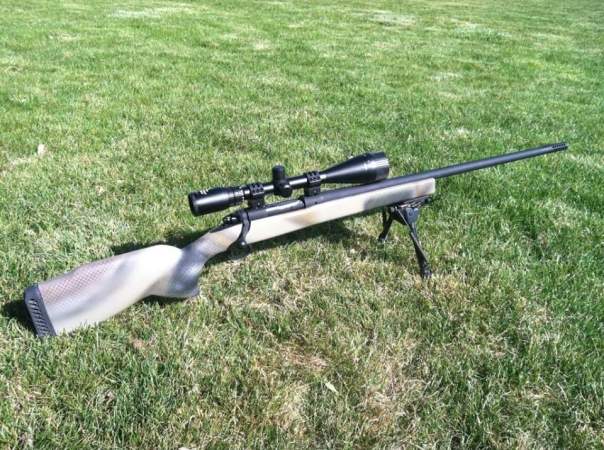
I asked him if I could play with it for a while to see if I could get it to shoot. I wasted no time, and had a  Douglas  barrel blank  shipped out. A 5A contour eight-and-a-half twist, 6.5 barrel was just what the timeless Winchester needed. I had a friend cut it at 24 inches, and had the muzzle threaded and a fine brake installed. While he worked on that, I went to town on the old piece of walnut that had lost most of it’s finish.

6F5E5C9D-9CEB-477A-A220-5ADAFF154F5C

Dad continued to keep up on his regimen of healthy living, with a healthy balance of trips to the gun club mixed in. He had his stability under pretty good control by this point, and as I had done for the last two years, I put him in for the Utah hunts we would go on that year.

My Dad was of the old school, not a trophy hunter exactly, but not the kind of guy who would shoot little bucks. He liked to let them get bigger, although I never knew what ‘big enough’ was.

My brothers and I hunt the same mountain Dad did, and Grandpa did, and Great Grandpa did, but times have changed and its not as easy to find those big deer anymore. But we knew they were there, and that’s all the motivation a guy needs.

A10E11E3-4BED-486A-9CBE-65B533802733

Though old school is one way to describe my Father, he also has a thing for high performance and advanced technology. So I decided to improve on Winchester’s original design. The old walnut needed a modern touch, so I started carving. A more vertical pistol grip was needed, the stock was shortened, and a soft recoil pad replaced the original butt plate. A beaver tail-ish front end was added to the stock, and the channel was opened up to receive the new, heavier barrel.

All this plus a glass bedding job, texturing of the grip areas, and some Duracoat in a desert camo pattern brought this relic into a more modern age. I topped it off with one of Dad’s scopes mounted in some  Weaver  Tactical rings, added a bi-pod, and off to the range I went with a handful of different test loads.

D5ABBFFA-42F7-4DC3-95B4-019052D523F3

My goal for this gun was to be a deer and elk hammer on anything inside half a mile, and to do so, I needed to shoot high BC bullets at .264WM speeds. I tried both the Berger140 VLD and the Barnes 140 Match burner. Both gave good results at 3100fps, but the Barnes a little better, and the price point was a plus. So I loaded up a couple boxes of what shot best (easily sub MOA) .

On the first trip into the field, using a chart I’d calculated, I made easy first round hits at 500 and 850 yards. I knew I had a winner in my hands, and couldn’t wait to hand it back to Dad, who had no idea what had transpired since he turned it over to me. A man of reserved speech, his reaction was priceless. Wide eyes and smiles and he kept repeating all day: “what a sharp looking rifle!”

Since the original overhaul, Dad’s .264 has had several optics upgrades, better optics help older eyes. Dad used the rifle to take his first mature bull at 500 yards, you can read that amazing story here

Return to the Hunt

As the deer hunt started that cold October morning, I had very high hopes. We had spotted several bucks in our little canyon last night, and here it was just moments before shooting light. Dad had worked his way down a ridge line with us, and we sat atop some large rocks, overlooking a spectacular view of the high Rockies.
The deer were moving, and we spotted several, but none of them had impressed me as a shooter for Dad. And they didn’t give us a shot anyway, so we kept glassing.
After several shots were heard nearby, and hunters moving about, my hopes were waning. But fate had plans for us that morning.
As the light crept over the top of the mountain peaks, my brother suddenly spotted a deer right below us. The steep angle of the mountain made it feel as though were directly above him. I looked through my rangefinder and all I saw was the antlers, at 264 yards it was surely the biggest deer we’d seen that morning. Dad quickly moved into a position on the rock’s edge, and steadied his new rifle over his pack. We all stood there, silently waiting for the shot.

I watched through my spotter as the sharp crack of the rifle went off, the intense silence broken by the sound of the bullet ripping through the cold and thin mountain air. As we all watched in suspense, the bullet struck the deer just behind the left shoulder and exited behind the right. The downward force knocked the deer right to the ground, and with punctured lungs, his life ended right there on the brushy hillside.

F2A7FBF0-63CB-4606-A9B0-50084B98F305

Overcome with excitement and joy for what had been a long time coming, we exchanged high fives and shoulder punches. I knew the stars had to align for my dream to come true that day, but I’d had been feeling our luck building as the pieces fell into place. It was the first deer Dad had killed in 21 years, it may not have been the biggest deer, but for us it was the most memorable. Sharing the excitement with three generations of family that morning, we will never forget that rebuilt hunter and his rebuilt gun.

We’ll be putting in for this year’s hunt soon.
-CBM

15D07301-DBE9-408A-90E4-9317865A59AD
Dad with his two oldest grandsons

D2A5AA16-1095-434D-ABB9-7E8FF6469A4C
My Father, myself, and my son the morning he shot his first buck