Category Archives: Optics

Eotech Vudu 1-8×24 Review

INTRODUCTION

For the better part of the last twenty years, you could hardly talk about tactical weapon sights with EOtech coming up.

The brand has grown quickly to become an industry stalwart. In much more recent times, the company has released its own line of optical rifle scopes under the Vudu brand.

Today we will look at a model from the Vudu line, the EOTech Vudu 1-8X24 precision rifle scope. This model features a thirty-millimeter tube and the typical twenty-four millimeter ocular lens.

Variable power swings between one and eight times magnification with the reticle in the second focal plane. The reticle itself is the HC3, which features an illuminated center dot and several hold-over points for shooting further distances. The capped turrets are graduated in quarter minutes of angle adjustments.

Low Power Variable Optics (LPVOs) have become increasingly more popular for modern sporting rifles and tactical-style rifles. When rapidly engaging targets at dangerously close distances, a rifle scope can be extremely valuable over red dots or holographic sights, particularly if those targets could range from fifty to three hundred yards away.

Shop EOtech optics

LPVO’s have become a valued option for that kind of shooting scenario, and our subject today appears to fit that purpose quite well.

I enjoy shooting sports a great deal and have spent a good deal of time behind many riflescopes. I was thrilled to see how the Vudu scope would perform. I am a total fanboy for quality rifle scopes, and if this Vudu lived up to my expectations, I couldn’t wait to add it to my collection.

After unboxing the Vudu and playing around with it in just a few minutes, it has already got me excited to shoot with it.

VUDU 1-8×24 PRECISION RIFLE SCOPE REVIEW

The LPVO market has become quite crowded over the past ten or so years, so I was curious to see what Vudu had to offer that others weren’t already selling. We’ve heard good stories about optical quality, and so far, glancing over the features, it appears to tick all the boxes I want in an LPVO. So I wasted no time getting the Vudu mounted and ready for the range.

With a market this crowded there is undoubtedly room for quality optics at every price and quality point. There are inexpensive LPVOs in the three to five-hundred range, and even more at the thousand dollar price point.  Even at the fourteen to fifteen-hundred price point, there is still a lot of competition.

The Vudu mounted to one of my Aero Precision uppers

Eotech’s  Vudu fits right into that area for those who can’t or won’t jump to the two-thousand-dollar-plus price range. Nevertheless it is still a great place to select a high-quality and well-performing LPVO. A good scope like this deserves a good mount that will allow proper positioning on the rifle, so make sure you research before mounting your scope.

Let’s Shoot

Keeping all that in mind, I set out to shoot a selection of different scenarios using the Vudu.

Varying shots from near to far and using both the variable power of the scope and the holdover points on the reticle. The one to eight-power magnification gives a great deal of versatility for a wide field of view on close-up shots with both eyes open.

And it also allows you to zoom it into eight power to take more precise shots at targets further out. Depending on your activity I have found eight power suitable for shots as far as one thousand yards at times. So with a great deal of space at my disposal, I prepared to give the Vudu a good workout.

SPECIFICATIONS

Tube 30 mm
Length 10.9 inches
Weight 20.8 ounces
Magnification 1-8x
Objective lens 24 mm
Reticle HC3
Illumination Green center dot
Battery CR2032
Elevation travel 100 MOA @.25 per click

PROS & CONS

PROS
  • High quality Japanese optical lenses
  • Capped hand-adjustable turrets
  • Illuminated reticle
  • Push-button illumination change
  • Throw lever included
  • Hold-over HC3 reticle
CONS
  • Wish it was the 1-10
  • Would like a little more reticle detail
  • Would also like an MRAD option
My Desert Tech MDRX with the EOtech Vudu, and YHM Turbo suppressor

RANGE TESTING

We had a hard time coming up with cons for the Vudu, as you might have noticed. It looks like I will have to get my hands on their 1-10×28 model as well, as it fits my wishes to a T.

Getting the Vudu on the range was my priority now. I mounted it up to one of my favorite carbines, my Desert Tech MDRX. I do a LOT of shooting with this rifle, so it seemed an excellent fit to compare to a bunch of other LPVOs I have run on the rifle over the years.

With the Vudu in a cantilevered mount, I installed it on the pic rail of the rifle at the proper distance for good eye relief.  It felt right at home there, so I grabbed some ammunition and headed out the door.

Upon arrival at my spot, I set the rifle on a bipod and did a quick boresight job to ensure it would be on paper. After just a few shots, it was zeroed.

Typically I zero my rifles at one hundred yards, mainly because that’s where I do a lot of shooting. It would also make sense to zero a scope like this at seventy-five or fifty yards. It depends entirely on your shooting activities.

After zeroing the scope, I started with some quick transitional shooting between a couple of different targets. The straight one-power allows you to shoot with both eyes open, something I appreciate very much. I also really like the bright green dot in the reticle. It allows the scope to be used almost like a red dot sight.

Shop LPVO’s from Scopelist.com 
Desert Tech Quattro-15, Eotech Vudu, Aero Precision
The Area 419 scope mount allowed me to piggy-back the Eotech EFLX

Shooting with the Vudu 1-8X24

Push-button on and off makes it much easier to power up than the typical rotational rheostats. Added simplicity like push buttons to increase or decrease brightness are also convenient and easily understood when you’re moving fast.

For shooting IPSC-sized targets from standing and improvised positions, I found that zooming the scope in a few X’s was helpful. I had several targets between fifty and one-hundred-fifty yards. The two to three power settings helped get those targets bracketed and shot.

This rifle is very handy for shots out to five or six hundred yards and even twice that when I switch out barrels for another caliber.

So I wanted to see how targets looked through the Vudu at much further distances. I couldn’t find any information on the parallax setting for this Vudu, but I assumed it is likely at a hundred yards like many others. Not a huge deal but something you should know.

Checking the estimated drop for my 223 ammunition at four hundred yards, I held about twelve MOA.

Conveniently for me, the Vudu’s HC3 reticle has holdovers for 2, 5, 8.5, and 12.5 MOA. So my holdover for the four hundred-yard shot was pretty easy to line up. Holding into the breeze a little bit resulted in a perfect hit. I watched the bullet splash through the eight-power with great clarity and definition.

RELIABILITY

Over the course of several days the Vudu 1-8×24 worked great for me. Through all my zooming in and out, as well as dialing the scope all over, it never lost zero or gave me any grief.

Looking at the small scope size makes me think it is less likely to get smacked around like full-sized scopes often do. But I see no reason why this scope wouldn’t live up to EOTech’s famously robust no-BS warranty.

ACCURACY

Accuracy of a riflescope is mainly based on its ability to hold proper zero and track well in its internal movement. Precision shooters like to measure these movements by bolting the scope down and seeing if it actually moves the amount it says.

In my testing, the Vudu 1-8×24 was as accurate as I could have hoped, with precise corrections and matching the reticle values.

OVERALL FEEL

Outstanding is one way to describe the Vudu, I like the texturing on the grip areas, and the included throw-lever is very handy, especially in the cold.

Clear optics and rubberized push-button controls make it look and feel outstanding. Gripping the large turrets are easily adjusted with gloves on, as are the other controls.Eotech Vudu 1-8x24, Area 419 scope mount

FEATURES

THROW LEVER

Included with the Vudu comes is a thread-in throw lever or cat-tail, as some call it. Ideally its to give additional purchase to adjust the magnification of the optic, as gripping the ocular housing from some positions can be challenging. Using the throw lever gives a better ability to pivot the input force as the housing rotates in many shooting positions.

ILLUMINATION

This Vudu features an illuminated green dot at the center of the reticle. It is powered by a battery housed in the left-hand turret.

There are three buttons on that turret at the twelve, three, and nine o’clock positions. The top button is the on/off switch; the other two buttons are for increasing or decreasing the brightness level of the dot.

Shooters will really like this ability to quickly turn the reticle on or off without having to rotate the turret, particularly those that don’t have off settings in between brightness settings. And it is easy to adjust the brightness from the shooting position using the buttons.

20 MOA TURRETS

Twenty MOA turrets on the Vudu allow for a good deal of corrective adjustment. In the event that you need to adjust for elevation at further distances, the turrets allow for precise adjustment in ¼ MOA increments.

HOW WE TESTED

We ran the Vudu 1-8 through a whole bunch of shooting at my range. Fast shooting between target transitions as well as slow fire at much further targets, was a great way to get familiarized with the Vudu and its weak spots.

One of the only things I might have found as far as weakness was that at 1X, there is a tiny bit of deformation around the circumference of the image. This is not uncommon in my experience, nor is it a huge deal. It didn’t affect my ability to see and hit my targets.

We also noticed at some of the higher power settings that the eye relief seems a little touchier than I would have wanted; again not a big deal but something I did notice.

Hold-over points on the reticle were quite handy, though if you were going to do more medium to long-range shooting, you would likely want more points. Luckily, Vudu makes another scope for those who are looking for just that.

As it is, this scope makes a great choice for fifty to four-hundred-yard shooting. And when doing up-close shooting, I ran the scope on 1X with the dot turned all the way up and used it just like a red dot.

As I typically do with most optics I test, I also ran the turrets and reticle against a yardstick to see how well and accurately the erector tracks. Most of the time, they are all pretty close to their advertised graduations, and the Vudu 1-8×24 was one of those.

SCORE CARD

RELIABILITY (9/10)

The Vudu 1-8×24 functioned flawlessly for me during my testing. Surely this hasn’t been long enough to truly test its abilities, but only time will tell how that plays out. Follow me to see how the Vudu does over time.

OPTICAL QUALITY (8/10)

Optical quality of the Vudu was great. There was a tiny bit of optical aberration around the edges at 1X. Still, it was certainly something I could live with.

Clarity of targets was superb, and it performed well for my eyes even at low light near dusk. I won’t lie and say that I haven’t seen better, but I think the Vudu is right in line with its best competitors for this price.

FEATURES (7/10)

Things like illuminated reticle and throw lever were nice things to have when I opened the box, but I was kind of hopeful that Vudu would have brought just a little something extra to the game.

Longer-range shooters would have liked a slightly more detailed reticle option and an MRAD option. Of course, more options like these would only add to the Vudu line.

VALUE (8/10)

The Vudu brings a significant level of performance and quality for its price point. Competitors in the comparable price range make it a very challenging market. You could almost select based on pure appearance and still get a great scope.

 Finish Reading here…

CONCLUSION

EOTech Vudu 1-8x24 Review mounted on desert tech mdrx on bench

If you are looking for a quality rifle scope to use on your short to medium-range carbine.  This EOTech Vudu 1-8×24 is a great choice that will allow you to use your rifle to its full capability. That also allows you to see clearly what you are shooting at and look good simultaneously.

Eotech’s  Vudu does what a good LPVO should. It gives you the ease of a red dot or holographic sight up close while leaving you options for magnifying those targets further out. And it comes with the necessary tools to engage those targets if you wish to.

I am really looking forward to shooting more with this scope. I’ll leave it on my MDRX for now unless I find a better home for it. No doubt, I will use it extensively for shooting and hunting this spring.

-CBM

Burris Veracity PH 4-20X50 riflescope

Introduction

Being a sucker for nice optics, I enjoy exceptional riflescopes from both American and European manufacturers. But I really want to buy American-made optics as much as I can.

burris veracity ph review mounted on desert tech srs m2

Burris is a well-known American optics manufacturer that has recently teamed up with optics stalwart Steiner Optics. Being a fan of both, I was excited to review the new Burris Veracity PH 4-20X50.

The Veracity is Burris’s premier hunting scope line, and the PH model is at the top of that line.

The Veracity PH incorporates Burris’s PĒK elevation turret, an electronic programmable and mechanical hybrid adjustment turret. Housed inside the 30mm tube of the PH, you will also find a digital Heads-up-display (HUD) that gives you all the information as you look through the scope.

The reticle is in the first focal plane, which always represents the indicated values regardless of magnification.
A traditional side-focus/parallax adjustment is on the scope’s left side; on the right, you will find a capped windage knob. Since hunters typically utilize the MOA scale instead of the MRAD one, it makes sense to have built the Veracity PH in MOA.

The reticle inside the Veracity was built for holding wind corrections with graduated windage marks.

The Veracity PH promises to give hunters a rapid and accurate firing solution for long-range hunting scenarios. Often when pursuing animals, there is little time to make corrections for distance. The PH allows users to use either MOA come-ups or have the actual distance shown rapidly in the internal HUD.

I can think of several scenarios over the past couple decades of hunting where that would have been very helpful. Hunting open country and long-range has been my bread and butter for at least that long, so I figured it would be a good place to put this scope to the test.

My initial impressions of the Veracity PH are pretty positive, it looks good, feels solid, and the optical quality seemed on par for its price.

I was pleased with the simplicity of the Bluetooth intercourse and integration with the Burris Connect app used to control the Veracity PH.

burris veracity ph review unboxing

BURRIS VERACITY PH REVIEW

As a hunting scope for long-range hunters, the Veracity PH provides fast information for making quick shots.

Technology like rangefinders and ballistic computers have greatly increased the potential for making longer shots with predictability. The Burris Veracity PH was made to capitalize on those advances, and bring some of this technology aboard your riflescope.

With uploadable ballistic profiles, you can put the data right into your scope. These profiles carry bullet drop and windage deflection rates.

This is necessary when making longer shots to correct for distance and atmospheric changes around you. Having this data in your scope is a great advantage for long-range hunters in wide-open country.

If you are more of a bean-field hunter, where shots may not exceed two to three hundred yards, it’s probably more of a novelty than a necessity.

SPECIFICATIONS

Power 5X
Magnification 4-20
Objective 50mm
Tube Diameter 30mm
Reticle PTC Wind MOA reticle
Illumination yes
Turret Graduation ¼ MOA
Focal Plane First focal
Length 15 inches
Weight 27.2 ounces

PROS & CONS

PROS
  • Made in America by Americans
  • Aggressively priced
  • Good optical quality
  • First focal plane
  • Heads up display (I mean C’mon!)
  • Internal level
  • Bluetooth connection with free downloadable app
  • Includes sunshade and flip caps
  • Zero stop elevation turret
CONS
  • Elevation PĒK turret is stiffer than I would like
  • I really wish there was an MRAD version
  • Wouldn’t mind a few more elevation subtensions on the reticle
jeff wood burris veracity ph test long range shooting

FIELDING THE VERACITY PH

I’ve had a few experiences with Burris optics over the years, and they have all been good ones. So I was eager to open up the Veracity PH package and get it into shooting condition as soon as possible.

My plan was to replace the Steiner T6X that I was currently running on my Desert Tech SRS M2. It is essentially the big brother to the Veracity, made in the same Colorado factory.

I mounted the Veracity in a Nightforce scope mount and leveled it on the rifle. It was during this process that I discovered one of the technological gadgets on the Burris scope; the internal level was not showing level compared to my bubble level, or my eye for that matter.

I assumed something was wrong, but after booting up the Burris connect app, I found the calibration procedure for the internal bubble level. You can zero the level on the scope physically using traditional procedures and then zero the internal digital level.

Before I’d even done that, I of course installed the two CR2450 lithium batteries that power the Veracity by loosening the battery cap on the side of the scope.

With the scope leveled and torqued down, I bore-sighted it looking out the window at the mountains above. Like most scopes, the PH turrets have three allen screws around the top to loosen the turret and reset them back to zero after getting the rifle sighted in.

I appreciated the capped windage turret since I rarely dial wind; I prefer to hold it instead. The Wind MOA reticle inside the scope was perfect for that.

Once I was on my range, I fired a few shots to adjust the zero of the rifle, and then it was time to see how this thing performed.

Before leaving the house, I had downloaded the ballistic profile of the ammunition I planned on shooting. It was easily added to the PH’s heads-up display, and using the app, I could select to have the HUD show either the actual MOA correction or the equivalent distance to the MOA dialed.

Again this seems like a very handy tool for hunters since you can upload your data, and after proofing it with the scope, it’s as easy as dialing the distance.

I’m not always a fan of “just dial the number” systems such as caliber/ballistic custom turrets because, typically, they do not allow for atmospheric changes and other common variations. The Veracity PH system, however, when used with the Connect App, allows you to update density altitude (DA) and other important factors to increase the accuracy of the firing solution.

It was time to stretch the rifle and scope combo out and see how all this tech lined up in an actual shot. The first thing I noticed when dialing the scope out for a longer shot was how stiff the elevation turret was.

I might have blamed it on the extreme cold that day, but it was just as stiff sitting on my kitchen table earlier that morning. I guess you could consider this a positive in some ways because the turret is unlikely to get accidentally turned before you make a shot. But even if it did, as you looked through the scope to make the shot, you could see if the elevation had been moved via the HUD inside.

I also noticed, to my surprise, that there were no clicks on the turret, a feature so common on riflescopes that it startled me. But due to the 1/10 MOA sensitivity of the turret, the clicks are unnecessary. You can see either on the turret housing or by the HUD inside what the turret is set to.

The focus/parallax adjustment on the side of the scope on the other hand is very smooth and easy to adjust. The variable 4-20 power magnification is an excellent choice for hunting and long-range hunting in my opinion, allowing for close up shots under one hundred yards or long shots as far as you have the skill to make.

Twenty power magnification is plenty for making shots as far as a thousand yards in my opinion, and it wasn’t long before we were doing just that with the Veracity PH.

The magnification adjustment ring was also easy to adjust, adding to my ability to zoom out to find targets, and right back in to engage them. With the scoped zoomed out to the four power setting, the reticle detail became quite fine, almost fine enough to lose its value.

Not a huge concern in my opinion because chances are if you are shooting at an animal at four power, it is likely going to be quite close and won’t require using reticle subtensions. The tapered reticle posts that thin as they approach the center also create a very natural point of aim that also reduces the importance of the center reticle details.

We fired a bunch of shots that afternoon, closely mimicking the same kinds of shots we would have taken on deer in these very same canyons. The Veracity PH made it very easy to move from one target to the next, and not much was getting away from me at that point.

Click here to continue reading

RELIABILITY

The Veracity PH was quite reliable during my tests.

If I were to anticipate a failure it would likely be of the electronic portions of the scope simply because it is new technology being used for the first time. It’s good to know that even if the electronic features of the scope were to fail completely from something like a dead battery, everything you need to make a good shot is still there.

And should something fail, it’s nice to know that Burris stands behind their product with an excellent warranty.

ACCURACY

The PĒK elevation turret measures movement of the turret down to 1/10th of an MOA, making it much more sensitive to movement than what we are used to.

I mounted the scope to a solid base, and measured the actual movement vs. what it said it was moving and it was quite accurate in its movement.

OVERALL FEEL

The Veracity PH feels like a great little scope. It keeps the handsome looks of a classic riflescope while incorporating some really cool technology inside.

Other scopes that have incorporated electronics like this have resulted in a turd looking finished product. I applaud Burris for not making that mistake here.

FEATURES

PĒK TURRET

burris veracity ph test scoped in

Probably the most defining feature of the Veracity PH, I found the turret to be very handy other than the resistance mentioned earlier.

The ability to use the solid zero-stop is very handy for those in stressful shooting situations like hunting. Connected to the HUD inside, these features can make shooting far on the fly quite doable.

HEADS UP DISPLAY

The internal Heads Up Display is an outstanding little feature, allowing you to see all the pertinent data from the shooting position without taking your eyes off your target which will likely be moving.

You can get an estimated wind hold, the elevation or distance setting to hit the target, and level up your rifle all without taking your eyes off the scope. The only outside information needed would come from a rangefinder.

BURRIS CONNECT APP

The Burris Connect App allows you to connect to and update data within your Veracity PH riflescope.

It is easily downloaded for free, and I found it pretty easy to navigate and update information with the app. Ballistic profiles for various bullets could be selected and adjusted with real data after shooting, and you could true the data by adjusting data points in the app.
Once you had a good profile for your ammunition, it was as easy as turning on the bluetooth connection on the Veracity PH and tapping the “upload settings” button in the app. This uploads that profile to the scope which then lines up perfectly with the displayed information in the HUD.

burris veracity ph app

You can also use the connect app to adjust other settings like zeroing the level indicator once installed. Other functions like selecting incline compensation, zeroing the elevation turret, the timeout for the HUD, and the auto-off time for the scope to save battery life.

HOW WE TESTED

After uploading my ammunition profile to the Veracity PH, it was easy to shoot the rifle at various distances.

I’m typically a guy who simply dials corrections for distance, but with the ability to true the drop-chart in the app, I actually found it quite pleasant to use the scope in the impact distance setting.

Much like the custom turrets were sold to us years ago as a; just dial the distance and shoot, you actually can just dial the distance and shoot with this scope.

After truing up the ballistic data in the app, it was deadly close at most ranges I shot. I could simply hit the target with my rangefinder and dial the distance it came back with.

While this might be a change for some of us and our practices, it is an easy change in practice and will surely speed up the process for many people. For several hours I found myself simply picking out different targets all across the deep snowy canyon and engaging them individually.

The Wind MOA reticle has plenty of good hold points for offsetting the wind, which I found to be very helpful as the wind and distance changed during the day. But I found that the reticle’s elevation holdover points were significantly fewer. This makes sense, though, as theoretically, most if not all elevation will be counted for with the turret.

Maybe I’m just old school, but I like to have options; when measuring targets with the reticle, I found myself having to use the horizontal windage marks to try and measure vertical targets since there weren’t enough vertical marks to do so. Again, this is not a huge deal, just something I noticed.

burris veracity ph test on desert tech srs m2

SCORE CARD

RELIABILITY (10/10)

I experienced no failures during testing

ERGONOMICS (8/10)

Everything felt great except for the elevation turret

CUSTOMIZATION (9/10)

Some very cool features with the connect app. I wish there was an MRAD version and perhaps the connectivity to allow drop tables from other ballistic apps

APPEARANCE (10/10)

Good looking scope with all the right curves.

VALUE (10/10)

I was actually blown away that this scope was priced at $1200 MSRP, but even more seeing it go for $999 in the market. I figured any scope with an internal digital display was going to cost at least $1500 or more.

ACCESSORIES

BURRIS SIGNATURE 2000 LASER RF

Burris rangefinder

I got to use the Burris Signature 2000 laser rangefinder, which worked out to be a great companion to the Veracity PH. The 7X Signature 2000 rangefinder is rated to reach 2400 yards, which is pretty good for most hunters as they will not need that much range.

Whether you use this one or another rangefinder, you definitely want one to fully take advantage of the Veracity’s capabilities.

Shop Burris Optics Here

CONCLUSION

I must say I was very pleased with the Burris Veracity PH. It was one pleasant surprise after another. The scope was optically excellent, or at least better than its price-point, I would say.

The features were outstanding, even though I would have changed some slightly to suit my personal taste better. I think the Veracity PH is designed with the average long-range hunter in mind, and I think it’s a perfect fit for them.

It brings a pretty impressive technology suite to a good riflescope that is competitively priced. And so far as I can tell, it seems to do everything it claims to do. Most notably, reducing the activities between spotting my game and hitting it.

This scope gets me even more excited than normal for hunting season to come back around. With technology creeping into everything we do, what are your thoughts on the Burris Veracity PH?

-CBM

Steiner Optics T6Xi 5-30×56 riflescope

Introduction

Being an absolute precision rifle junkie, there are a few things that get my excitement up. Besides precision rifles themselves, riflescopes are probably my biggest affinity. Today we are looking at the Steiner Optics T6Xi 5-30X56 riflescope, an American-made riflescope by the international optics giant.
Steiner started mid-last century on the American side of post-war Germany, and has since been working on making the highest quality riflescopes and other optics they can. I have long been a fan of Steiner’s optics, though I have only recently been able to take one home for my own use. I was excited for the chance to shoot behind one of these scopes that I had fawned over for so long.

The Steiner mounted to my Desert Tech SRS M2

The Steiner T6Xi 5-30×56

The T6Xi is a variable scope based on a thirty-four millimeter tube, and up front is the industry standard fifty-six millimeter objective lens. The power of six-times magnification is where the T6 gets it five to thirty power range, which is no insignificant thing. The all important erector housing carries a great deal of additional features, twelve MRAD per revolution turrets with an intuitive turret lock. The elevation turret also incorporates a very interesting rotating number scroll to prevent you from ever being off a revolution on the turret. A typical side parallax adjustment knob, with the illumination rheostat stacked on top. Inside the erector itself sits the MSR2 MRAD reticle, after just a few trips I was quite pleased with this reticle and its subtensions. At the back of the scope there is the magnification ring to adjust the zoom from five to thirty power. In addition to the great features of this scope, it also came with a few extras I wasn’t expecting. Including a factory made throw-lever (or cattail) to make adjusting the magnification faster to execute, as well as a sun-shade, and Tenebraex scope-caps.

T6Xi Features

The Steiner mounted to my SRS M2 over an Atlas Bipod

-6x Zoom Range
-Locking windage and elevation turrets
-Low-profile never-lost turrets
-Second rotation indicator
-Locking diopter ring
-Optional throw lever
-Tenebraex cover
-Illumination – 4 night / 7 day levels
-Waterproof / Fogproof / Shockproof

Mounting the T6Xi

I planned on installing the Steiner on my Desert Tech SRS M2, wherein I do most of my precision shooting. I have used a plethora of excellent riflescopes on this rifle, so I figured it would be a great match to see how it compared to the others I’ve used.
I mounted the T6Xi into a 40 MOA canted scope base, and leveled in on the rifle. My very first impressions were regarding the size of the scope, I prefer scopes that don’t come across as “dainty”. The Steiner was in my opinion just the right size, smaller than some but big and robust enough to stand beside most competitors.
With the scope mounted to the rifle, I set it on a bench and put myself to bore-sighting the scope. I grabbed the hex-key wrenches from the box to zero the turret once I had the rifle zeroed properly, all that remained was grabbing the rest of my kit and ammunition and heading into the hills.

Shop all Steiner optics at Scopelist
Euro Optics also has the full Steiner line

On the range

In a short time, I found myself in my fortress of solitude. The silent and vacant white canyons of the Rocky Mountains are where I spend my free time, and this time of year the blanket of sound soaking snow are spectacular for shooting.
I had brought two barrels for my SRS, the first was a .223 Remington match barrel I planned on zeroing the scope with. Even though I get paid to shoot, I still try to save money where I can. Once the rifle was zeroed with the .223 barrel, I would switch over to my 7mm SAUM barrel for shooting at more significant distances that would actually test this Steiner’s abilities.
I was immediately enamored with the view through this scope, it was crystal clear and a beautiful image to behold. I typically avoid running scopes at maximum magnification due to the fact that many of them seem to darken or lose clarity, but the T6Xi was still an excellent view even at 30X. The MSR2 reticle was an instant hit for me, I love the tiny center dot. It made perfect aim-point definition easy, and in just a few shots I had confirmed a good zero, after shooting a quick five-shot group to ensure I hadn’t lost my touch.

After zeroing the turrets on the T6, it was time to run both rifle and scope out to some distance. In less than a minute I’d switched barrels to the 7mm SAUM, and I turned my attention to the distant ridge across the canyon from me. Snow had covered most of my targets, but I could still pick out what I needed to see.
My density altitude and the cartridges I shoot typically keep me from needing the second rotation of most scopes. Many of the cartridges I shoot will reach beyond 3/4 of a mile without even cracking the second rotation, and my 7 SAUM was certainly in that group. I was going to have to shoot beyond fifteen-hundred yards to dial past the 12MRAD mark on the turret.
But before I did that, I wanted to see how the turret values lined up with the known dope for this rifle. I tried a few shots at targets from five-hundred to seven-hundred yards, with very predictable impacts. Spotting impacts at those distances is important, which is why I typically use lower power settings on my rifle scopes when shooting long range. With the power set at about half I was easily watching the 150 grain Cayuga solid bullets impact, and they were hitting with good authority as well.
Increasing the distance to the target made spotting impacts even easier, giving me additional time to get settled back on target before my bullet got there. Watching through the Steiner I was also able to see the trace of the bullet as it arched up over the target one it’s way there. The MSR2 reticle was very useful at measuring and holding corrections, in my opinion it is a perfect hybrid of substantial subtensions, but thin enough not to become cumbersome. Continue Reading Here…

I have other scopes in the same price bracket as this one, and it performs optically better than some and as well as others. The scope’s mechanical function was flawless, which should be expected at this level of the game. Optically, the scope is fantastic, and my eyes always felt comfortable and in charge when looking through the T6Xi. Even in low-light conditions, it had a great light transmission producing a clean image.

Pros:

  • MSR2 reticle
  • Great precision-shooting reticle
  • Flawless mechanical function
  • Excellent optical performance
  • Solid optics brand name
  • Quality machined aluminum throw lever
  • Good price compared to the competition
  • Tenebraex scope caps
  • Made in the USA

Cons:

  • It’s not cheap, but comparable to its competition

I do love the well-known quality that comes from European optics companies like Steiner, but the fact that this one is made right here in the U.S. almost makes it a slam dunk for me. The little things like the quality scope caps and throw lever are also very nice additions.

FINAL THOUGHTS

When you get to this price point in the optics market, it’s more about preference than a direct comparison. What I mean by that is most comparable riflescopes have very similar features and performance, which basically leaves you to choose the one that has the features you prefer the most.

The precision-rifle junkie in me is more than satisfied with this little scope. I often judge products based on their ability to sustain my addiction for the duration of my shooting career. I’m quite confident – even if the Steiner T6Xi 5-30×56 was the very last scope I ever bought – I could rock it for the rest of my time in these mountains. While that’s not the case, I still look forward to every outing with it.

CBM

ATN THOR 4 640 2.2-25X thermal riflescope

Thermal Optics

Being in control, or at least feeling like you’re in control of a situation seems to give us satisfaction in our outdoor adventures. Being prepared with weapons and the tools needed to go where we want, and do what we chose are a large portion of that feeling of authority over our immediate surroundings. Until the sun sets, when much of our dominance goes out the window. Today we are going to take a look at some equipment you can add to your arsenal that will keep you on top of things in pure darkness. ATN Corp has been in the business of manufacturing low light sport optics for nearly 30 years now. They have been innovating night vision and thermal devices in every imaginable way. Today we are going to speak about one product in particular, ATN’s THOR 4 640 2.2-25X thermal riflescope.

The THOR

The ATN THOR 4 is much more than just a low light thermal imaging optical sight. It also has an incredible array of smart functions like built in GPS, blue-tooth connection to apple and android devices, video and photo recording, and even ballistic solver built into the riflescope.
There are other more simple features that will enhance your experience with this scope as well. Rings to mount it come included with the scope, low battery consumption make the power last longer than anticipated. And you can even get it in one of your favorite camouflage coatings. There is much more to get into on the features, so I’ll move along.

Unboxing

When I opened the box to see the scope inside, I was a bit surprised. The THOR appeared to be a complete unit, sealed and ready to go. I pulled out the instructions because I’m an idiot when it comes to tech. The directions were easy enough to figure out, but for added help for those of us who struggle they even added some stickers in various locations indicating the purpose and function of each control.

Control panel on top of the housing, note charging port and SD card slot

There was also things such as a charging adaptor and the mounting rings to install the scope on your rifle. After a few hours good charging time, I took the THOR outside to see what I was missing in the darkness. I have used other thermal optics before, and I was perhaps expecting a little bit more because of my previous experience. But to be fair, the units I was comparing to this ATN cost three to four times as much. So there is certainly a grain of salt to take with my expectation.

Browse ATN Riflescopes here, because you’re already this far…

The THOR was excellent for identifying small animals around the neighborhood inside 300 yards. I zoomed the power in and out using the power wheel on the left side of the housing, and then focused using the rotating objective housing. The resolution was more than adequate for identifying and targeting potential animals.

In the field

I wanted to get this scope mounted and into action as soon as possible. Using the provided rings, I mounted it up on my Desert Tech MDRX 308 winchester.
It took some getting used to, but after a bit I had the THOR figured out. I managed to get it zeroed, though it took me more shots than it should have. The “Nuc” feature was an important one to figure out quickly. As far as I can tell, it seems to calibrate the sensor according to the current field of view. I found that significantly changing your field of view would cause some of the resolution to vary some, and by cycling the Nuc feature on the new viewing area would bring back the image. There is also an “Auto-Nuc” that you can set in the controls to have the device re-Nuc itself every so often.
The display was full of information, possibly more than some folks may want to see. It kinda made me feel like I was looking through the heads up display of an F-18. Angles on both vertical and horizontal plans are displayed, as well as a compass heading. There are an assortment of reticle choices you can choose depending on your needs, as well as a simple menu that can be cycled through quickly using the buttons on top of the housing. I had already installed a micro SD card that is used to store images and video clips recorded through the scope.

The Obsidian 4 Application

It was time to get the Obsidian 4 application connected and running, this app is made and offered by ATN for the owners of their products. It allows details entry and customization for some of the more tedious bits of data you definitely want right.
It took a minute to figure out how to properly get it connected to my phone, but after watching a helpful video on ATN’s website I was in business.

The Obsidian 4 app allows you to customize the data used in the ballistic solver that comes in the scope. You can change calibers, bullet weights, velocities and other pertinent information used to calculate the corrections for distance. You can also watch through the scope remotely which is also pretty cool, there is a slight delay in transmission but you can see everything you need to see and record it to your phone if you like.

The app was easy to navigate, and update the information. To be completely honest I found it to be an incredible amount of customization, I am barely smarter than most primates and I was beginning to worry I was going to screw something up faster than anything. But in a short time I had it setup to my liking, and ready to shoot. Continue Reading Here…

THE THERMAL DIFFERENCE

As far as thermals go, I was quite pleased with this one. I could see myself using it quite a bit more now that I am familiar with its functions and features, which are far more than I had anticipated.
Battery life was impressive, even in the ice-cold Rocky Mountains. I could leave the Thor powered up for hours at a time for most of the day’s shooting activities. With a full charge after leaving it in the cold garage for two weeks, it still powered right up to about 90%. The actual optical controls (focus, zoom, etc.) were a little more sensitive than I’d have liked, but I guess I can live with it given the thermal advantage the scope offers.

I didn’t use the ballistic calculator much, but I don’t really use them much inside of 300 yards anyway. The pictures and video taken from the Thor were fantastic and easy to get and upload where I wanted them.

CONCLUSION

Thermal and night vision products are not for the faint of heart. Companies like ATN are doing their best to bring the price down and present options to the general consumer. Nonetheless, it will take a level of dedication and funds outside the normal gun enthusiast. Think of it like NFA items. The added cost and a little more diligence are needed, but the results are too cool to not have. I certainly don’t mean to put you off getting into thermal sight like the Thor, just want to make sure you know what you’re getting into.

My only concern with this scope is about longevity, it does come with a 3-year warranty, which certainly assuages some of that concern. I do look forward to spending some more time with this scope and hopefully getting some good video of coyote hunting.

-CBM

ATN BinoX 4T 2.5-25X thermal binoculars

Thermal Weapon Sights

Thermal weapon sights have become extremely popular over the last decade or so, I’ve had the good fortune to play with a few of them. Today we are going to talk about a supplemental thermal device, one I think is just as useful as a weapon sight; the ATN BinoX 4T 2.5-25X thermal binoculars.
I say just as useful because whenever I find myself in the dark looking for potential animals to hunt, looking around through my riflescope is not only cumbersome but dangerous. The BinoX binoculars allow the user to safely scan the surrounding environment to identify potential targets, and it also gives you additional information that will help you make a better shot when the time comes.
The ATN Binox incorporate a rangefinder, variable power settings, video recording and image capture, and even GPS location that can be used to keep track of fellow hunters in the area. An IR illuminator is also part of the device, which allows you to illuminate targets when using in conjunction with night vision optics. It also incorporates wifi that can be paired to your ATN riflescope through the ATN Ballistic Information Exchange (BIX). Using the connection you can also stream to a paired device for additional viewing while recording the stream to the SD card inside the unit.
The ATN Binox uses an armored housing with a control pad on the top with various buttons to cycle through the menus and activate the different functions of the binoculars. At the rear of the binos you have an adjustable diopter to focus the image of the display inside. The front of the sensor lens can be rotated to focus the thermal image of the target, the right side is for the thermal sensor, the left side houses other sensors and needn’t be adjusted for image focusing.
The Center button doubles as a “Nuc” button that resets the sensitivity of the sensor based on the current field of view, as far as I can tell anyway. You can adjust the power magnification of the binoculars by using the arrows on the control pad, and the power button doubles as a rangefinder trigger when the unit is powered on.
The display inside gives you quite a bit of information, with actual readouts of both incline and cant as well as a compass bearing. You can select to use different widgets such as compass and angle displays, or if you like you can keep it simple and see just the image. There are many different settings that you can adjust to better fit your needs such as different shades for showing heat, you can select different colors or shades of black and white. There are different reticles you can use for measuring targets and distances and such, and of course you can change the units from yards to meters and MOA to MRAD if you like.

Curious already? Check for you new thermal optic here.

The Binox come with an extended life battery, which I was happy to hear. Most thermal devices I have used in the past burn through batteries far too fast. There was also a neck band to carry the BinoX with, it was also easy to adjust the two ocular lenses to fit your particular eye width.

Into the darkness

After confirming a bunch of settings around the yard and making my dog uncomfortable with shouting commands into the dark corners of the yard, I decided it was time to take the BinoX into the hills and see what I could find. It took a few minutes to find a contrast setting that I preferred, but I settled on the “Glowbow” setting. As you’ll see from my pictures I neglected to set the time and date.

a deer as seen at around 20X magnification from approximately 250 yards

Once I got into the mountains I began scanning where I figured I would be able to find a deer or two, or perhaps even a unsuspecting hiker. I did find something that quickly became frustrating. There were plenty of rocks in the hills that appeared to retain a bunch of heat, this inevitably gave me too many false ID’s of potential life. When I actually did see something that was clearly alive and warm, it was pretty clear. But often times I would have to watch at some of the more distant targets to see if they moved before I could confirm their identity.
I spent some time getting used to the imagery through the binos, and testing out the different functions. It did take me a minute to get used to some of the controls and understand everything, but soon enough I was finding things and measuring their distance with the rangefinder and even snapping pictures and videos of them. Much like properly viewing an ultrasound image, it seems there is a bit of a learning curve with looking at images like this. Oftentimes it is easy enough to make out trees, rocks and so forth. You can even make out sunny spots and shadows in the images taken during daylight. I have seen better imagery from other thermal units, but to be fair they cost significantly more than this one.
Finding animals in complete darkness turned out be be everything I hoped it would be, it reduced the eeriness of the darkness. Thermal optics have the benefit of being useful in the daylight just as complete darkness, which is a leg up over night vision optics. I found that using the BinoX during the daytime was also helpful in finding things that were alive in a sea of ambient temperature trees and hills. Continue Reading Here…

SOME DRAWBACKS

I’ll go over the negative things first, as I’ve mentioned I have used other high-dollar units so take my opinion with a grain of salt. One of the most significant things I didn’t like with the BinoX was that things that weren’t warm showed up as if they were. This is likely technological ignorance on my part, it appears that the sensor shows differences in temperature more than anything. For example, the deer I was looking at are surely warmer than anything else on a sub-freezing mountainside with scattered snow at 6:00 AM, but even so many of the rocks on that hillside looked as if they were warm in the BinoX.

The rocks were a whole other color/shade than the ground and trees but were clearly discernible as well. I guess I was just hoping that only warm things would show up as such on the display, but to be fair I got used to it fairly quick, and it ceased to be as difficult.

The rangefinder works, and I tested its accuracy alongside another comparably priced unit. I like rangefinders that reach the two kilometers or more, but for use in the darkness it’s probably better to stay fairly close. Ranging targets inside 1,000 yards seemed to be easy with the Binox, but I didn’t care for the large opening in the ranging reticle, I think it could use a more precise aiming point.

I am not sure what the laser divergence is for the rangefinder, but perhaps the reticle size is based on the beam divergence.

I was unfortunately unable to try the Obsidian APP that I downloaded to view images from the BinoX, I wasn’t able to pair the device and the live chat support on ATN’s website was unable to help me as I wandered around in the darkness.

WHAT I LOVE ABOUT THE BINOX

Now for the good news. I was very excited to be able to see so many things in the dark that were previously unknown. These Binoculars are an awesome tool if you are trying to locate animals in the darkness, or very low light. I suppose you could even use them in the daylight to locate animals. The zoom function is pretty easy and quick to increase your ability to identify targets, and I was pleasantly surprised that resolution wasn’t lost as I zoomed them in.

I was certainly impressed by the battery life, particularly in the cold sub-freezing temperatures in the high Rocky Mountains. The unit has a standby/sleep mode to help conserve the battery, but I wanted to see how long it would last without it. On multiple occasions I would fire the unit up an hour or so before daylight, and I would use it until the deer would begin to bed down around 10-11 at night and the battery was still chuggin’ along!

The photo/video feature is very handy, it was as simple as tapping the button to get saved images of the animals I was watching. Almost too easy in fact, as on several occasions I found I had bumped the video record button and had filled my card up with videos of my feet.

The image quality was as good as I had expected it to be and it gave me an incredible feeling of dominion over the darkness before me.

CONCLUSION

Thermal imaging is definitely not for the penny pinchers out there, there are a variety of BinoX models available but the most affordable chimes in with an MSRP of $2,699. Needless to say, it can be a hard pill to swallow for most. Though you might find it extremely fun to prowl the darkness, you won’t be able to occult such a purchase from your spouse without risking your own body heat. But if you have the ability to buy products like this, then you will surely enjoy them as I have.

The ATN 640 4T BinoX will take your hunting to a whole new level, and the features make it a pleasure to use. Watch for my next article about the ATN THOR 4T HD Riflescope.

-CBM

Sig Sauer Tango MSR 1-6×24 riflescope

Introduction

I’ve been on an LVPO kick for a while now, I find them to be very useful for a great many purposes. Despite my focus on precision and long range shooting, LVPO’s still make up a good portion of my optics selection. Today I want to take a look at a new to me LVPO, the Sig Sauer Tango MSR 1-6×24 riflescope

Having had a couple different experiences with Sig Sauer Optics starting with the Tango series of scopes as well as another LVPO the Tango 6T. I have really enjoyed these different scopes and largely I have had few problems with them. So when the opportunity to check out this Tango MSR I was very excited to get hands on it.

Buy your own Tango MSR right here!

Out of the box

As I opened the box, I was glad to see that Sig even includes a quality ALPHA-MSR scope mount in the box. That easily narrowed down my mounting decisions.
I will say I was surprised with everything included with the scope, and I’ll be honest that going in I had only a vague idea of the price of this scope. The mount, the typical tools that come with it, battery for the illuminated reticle, and some quality flip caps were also included. They are branded Sig but look to be either Tenebrex or a really close knockoff.

Either way they are very nice and lay flat against the scope when open. The MSR also includes a throw lever or “cattail” as its often called, this is handy for quick adjustments of the magnification.
Sig’s Tango MSR is a second focal plane scope, that means the reticle stays the same regardless of magnification setting. The scope adjustment turrets are MOA and have .5 MOA clicks. And the scope body has a centerline painted on the exterior of the tube, to help ensure level mounting I believe and it surely did that. In a very short time I had the scope married to it’s mount and ready to install on a rifle.

The Tango MSR was a perfect fit for the Sig Sauer MCX

First Shots

Luckily I happened to have a Sig Sauer MCX rifle in hand at the time, it seemed like a perfect fit for the MSR. I was more correct than I could have known.

After installing the scope onto the pic rail of the MCX, off to the range we went. The MSR seemed to be made for the MCX as I didnt even need to adjust the scope for a good zero. Once I started shooting everything lined up like they came from the factory that way.
We spent some time shooting the rifle at fairly close distances inside two-hundred yards, but I also utilized the reticle for a few extended distances. The reticle features a typical upside down horseshoe type reticle, with several drop points and wind holds. Its name suggests that the MSR is designed specifically for Modern Sporting Rifles (MSR), and the BDC6 reticle is calibrated for the most popular MSR cartridge the 5.56 Nato.

As I mentioned earlier, I purposely didn’t look at the price of this scope before reviewing it. I was previously very pleased with the optical quality of the Tango 6T. This Tango MSR is not quite as high quality, but still very clean and clear. I was surprised to see the price point after playing with it. One would have expected it to come in the 600-800 dollar range. But for the MSRP of $422.99 I think this scope is a great value.

Shop Sig Sauer Tactical optics

Testing turret values

I also bolted down the mounted scope to a bench, and measured the turret values against the reticle values which all checked out. The reticle values are handy to keep in mind, or you can refer to the owners manual where they are listed.

It may not line up perfectly with the drop of your particular ammunition and atmosphere. This is why I typically don’t care for calibrated reticles. That said, if you know what value they represent you can use them for all kinds of shots and hold overs.

note MOA values of the BDC6 Reticle

Pros & Cons

In my opinion, the Tango MSR is a great little scope for its intended purpose. Optical clarity is great, the magnification ring is quick to adjust and its throw lever helps make it even better. The 1X power setting allows for easy both eyes open aiming, without straining to focus. The quality accessories that are included also greatly add to the value of this scope. Including the mount is a perfect match for the scope as are the the scope caps.
Perhaps one thing I would change about the scope is probably the reticle. I’m not a big fan of the horseshoe type reticles. Though it does have lots of detail to allow holdovers and windage etc. Which makes it certainly a very useable reticle. I also wouldn’t mind having an MRAD version of the MSR. But to be perfectly fair it’s not the type of scope you’ll be dialing all over with so it’s probably fine.

Conclusion

The Sig Sauer Tango MSR is a great little scope. I would highly recommend it for anyone who is looking for an LVPO in this price range.  It has a great deal of value added as well as performance capability.

-CBM

Sig Sauer Kilo 10K Binoculars

Introduction

glassing with the sig sauer kilo 10k

I’ve been severely hooked on both hunting and long range shooting for more than a few decades, so laser rangefinders are nothing new to me. I still remember saving up what seemed like an eternity to purchase my first one, an LRF I could barely afford but would actually hit a thousand yards and beyond reliably. All these years later my laser has migrated into a good pair of bino’s which are a must have for spotting animals in these Rocky Mountains. But the me from twenty years ago would never believe just how much else has migrated into the binoculars I carry. Today we are looking at the Sig Sauer Kilo 10K Binoculars.

Sig Sauer Optics

Sig Sauer jumped into the optics market with both feet, and like their products or not they have been innovating all over the optics world. They worked hard enough to earn my business a few years back when I bought one of their Tango 6 5-30 riflescopes.

I have had the good fortune to sample a broad spectrum of Sig Sauer’s Electro-optics. Enough so to become quite confident in giving them more hard earned money. The Kilo 10K is that latest purchase, a pair of consumer grade binoculars that feature arguably military grade functions. I decided that I was due an upgrade, and spent the money.

The Kilo 10K Binoculars

I have been using another pair of 10X42’s for the last few years, but a friend bought a pair of the Kilo 3000 binoculars and I quickly noticed they seemed better to my eyes than the binos I was using. The Kilo 10K is a significant upgrade from the 3000 model, with so many features I’ll have to keep it short to avoid this page taking all day to load.
Besides Sig’s standard features such as their Ballistic Data Exchange (BDX) and their various lens coatings and armor, the real juicy details are all encoded inside. The Kilo utilizes second generation Lightwave DSP ranging engine that has various ranging functions that allow you to range reflective targets as far as 10,000 yards away. I was dang sure gonna try that out.

sig sauer kilo 10k
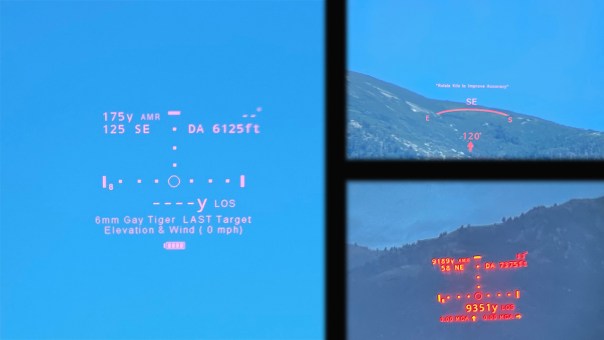
Some of the data displayed in the Kilo 10K Heads up display

The onboard system also has all the sensors needed to calculate real time ballistics via Applied Ballistics Elite ballistic calculator. Instead of pairing to your phone application the Kilo does it all inside. Spoiling you with an incredible array of information right in front of your eyes. All this without ever taking your eyes off the target.
The internal systems of the Kilo also have compass and GPS functions. You can see compass headings and such right in the binocular heads up display, angles of incline are also displayed. And you can mark waypoints in your travels using the Basemap application.
The aforementioned Applied Ballistics (AB) software allows you to store up to 25 different profiles in the binoculars using their complete bullet library. So you can always have you favorite load cued up. The Kilo 10K reads all the relevant atmosphere information to give you a corrected firing solution.  Including current density altitude conditions, and even a wind meter for accurate wind speed measurement.

Figuring out the Sig Sauer Kilo 10K

I was a bit apprehensive about having the brainpower to figure out and run everything the Kilo 10K offered. After reading through the manual a few times, I was less so.
sig sauer kilo 10k
The Kilo can be configured using the buttons controlling it, or using the BDX phone application. I went about changing a few of the settings to better fit what I thought I would like, it didn’t take long to figure out. The menu allows easy switching from meters and yards, as well as MOA to MRAD. Using the onboard sensors, the Kilo provides the air pressure, temperature and humidity. You can configure the system to automatically measure the temperature or you can input the temp manually if selected. You can also select manual input of other atmospheric data using the app on your phone.
The heads up display on the Kilo 10K is incredibly informative. it gives you distance (both actual and angle corrected) shooting angles, and wind corrections as dictated by the bluetooth connected wind meter. I was very please to see that even a milling reticle can be chosen to aid in spotting for corrections.

Ballistic data is displayed both through the binoculars as well as on the phone display, this could enhance a fire teams ability to make quick shots

After several trips into the hills to simply play with and look through the Kilo 10K, I decided it was time to get serious.

Data Input

I replaced the factory preset data that came set for a .308 175gr SMK, and entered in all the data for the 6mm GT I was planning on shooting. All the data is easily entered via the BDX app, and no sooner had I input my data, the Kilo synced everything up with the tap of a button.

The AB calculator uses a bluetooth wind-speed anemometer to capture the speed of the wind. As well as temperature, humidity, angles, and all the other pertinent information is captured and fed into the system.

sig sauer kilo 10k
the whole kit

One slight complaint I had was from the wind meter itself, it measures the wind just fine. But the direction of the wind has to be put in either through the app on your phone (fastest way). Or you can also do it through a quick access menu on the Kilo itself. The quick switching nature of the wind makes me wonder how challenging that data point might be to maintain accurate. I was hoping there was a way to index the wind direction using the compass heading from the GPS.

There are a great deal of customizable options to change how the data is conjured before your eye. The heads up display menu was clear and quick to cycle through despite having to do everything using only the two external buttons on the binos. I have used AB for some time, so my confidence in the ballistic calculations were good. I wanted to see how the interface with the Kilo lined up, to see if it was as simple as point, laze, and shoot.

Hunting Country

On a blustery summer evening, I made my way into the Wasatch Mountains to do some additional testing of the Kilo’s capabilities. The storm front threatened to bring rain, but for the most part all I got was gloomy cloud cover. The high winds carried a visible amount of dust and debris. This had me concerned at how well the laser would reach. But I was quite surprised to see the Kilo light up with just over five-thousand yards, over two-point-eight miles away.

I decided to hit something even further still away, from my perch at over six-thousand feet (9,189 DA according to the Kilo) I could see my house below. I figured the siding would be reflective enough to hit at significant distance. So I pressed the button until it came back with a reading, and it did several times. Nine-thousand three hundred and fifty-one yards it read, that’s five point three miles away as the crow flies.

The Kilo 10K sitting on top of my Field Optics Research tripod

I checked my Basemap app, to see that the waypoint popped up marking my house. Had I needed to I could have just walked home in the dark using the Basemap as a guide.

Ballistic Data

I did some truing of the data in AB for my 6GT load to see that it lined up with confirmed data I already had saved. It was absolutely brilliant to see a firing solution populate in a second or so. With nearly all the data I needed to make the shot. The  Desert Tech SRS M2 6GT shoots very well out to fifteen hundred yards or so. I wanted to see how quick I could go from spotting targets to seeing impacts at various distances. So I played my mock hunting game where a suitable sized target is picked out, and I engaged it as fast as possible as if it were escaping. The trued data from AB via the Kilo lined up beautifully. This allowed me to make hit after hit with minimal delays between shots.
If the system was utilized between a shooter and spotter team, you could put an amazing rate of fire on targets. With a spotter using the Kilo, you could range targets and have the firing solution show up on the shooters phone screen without so much as saying a word. Both could see the live data displayed. And as soon as the next target is identified that data would pop up on the shooter’s screen. You can even actuate the rangefinder from your phone through the app. Once paired, you can touch the range button on your phone screen to activate the rangefinder remotely.
I created a second profile for my favorite twenty-two inch 6.5 Creedmoor, just to see how to cycle between profiles. As with other operations inside the Kilo, it was quick to pull up the menu and switch between profiles and other settings. As I used the internal menu of the Kilo I got much better at changing rapidly the settings. Continue Reading Here…

PROS & CONS

Cons

Today, I’ll start out with the cons, just to get them out of the way. The Sig Sauer Kilo 10k is as much a system as it is a single product. And the system relies on its multiple components for maximum performance.

That said, I don’t think they could have chosen better partners. AB is an extremely well-known ballistic-solver system. And Basemaps also has a great reputation and provides very valuable information. One downside that I found was that the Basemaps’ App required a Pro upgrade in order to use the Kilo as an add-on tool. This isn’t a huge deal, but it’s one worth mentioning.

I did have one apparent malfunction while testing the Kilo, where it did get quite warm from sitting in the sun. It was a hot July day, but I wouldn’t have considered it too hot for the Kilo to work. Much like an iPhone left in a hot car, the Kilo just stopped working, as though the battery was dead. I even replaced the battery thinking maybe I had overused it. But after sitting in the house for a few hours, it fired right back up with the battery showing full power. I haven’t been able to reproduce the problem, so I hope it was simply a fluke.

Pros

The pros of the Kilo10k system are many and hard to list. If you’ve read this far, you have already been over all the functions that I consider beneficial. So, I’ll keep it short by naming my favorites.

First off, there are the ranging capabilities. The Kilo ranges much farther than almost any of us will ever be shooting outside military applications using artillery. It is still nice to have the ranging ability. And the Kilo makes a good navigation tool as well because of its broad capabilities. The Terrapin X has long been considered top of the heap as a rangefinder. Though I have heard from several people that they have had better luck at extreme distances using the Kilo 10k.

Sig Sauer Kilo10k Binoculars
The lens coating and armor are great, but the real money is inside this compact computer of an optic

Heads Up Display

The heads-up display is very intuitive and gives you almost everything you need quickly. Important information appears larger than less pertinent information. But everything you want from a rangefinder is there. And the HUD reticle gives your spotter some reference as well.

The Kilo’s carry case is very nice and well thought out. There are two pockets for carrying small accessories, and a pigtail lanyard to keep the wind meter attached and close. The multiple profile options and quick syncing features make the Kilo incredibly useful for a guy on the move between one hunt or another. Especially if you are switching between multiple calibers or spotting for multiple shooters.

Conclusion

Sig has once again knocked it out of the park with this pair of binoculars. Admittedly, I have never been a big optics snob. But I find them optically superior to most comparable options, that is if you can find something close to the Kilo as far as its capabilities are concerned.

The Kilo does what it says, and I intend on taking full advantage of its well-thought-out features in the years to come. The only thing left to test is that of time and durability. Follow me to keep tabs on how the Kilo 10k performs in the future.

-CBM

The Kilo 10k has gotten plenty of use these past few years. Alongside my Desert Tech SRS, its US Optics FDN25X, and suppressed by the YHM R9

2023 Update:

Last year I did have to send the Kilo back to Sig for some kind of apparent malfunction with the HUD. It was repaired quickly, and returned. I have used it for two hard hunting seasons since without any issues at all. In fact I have come to love these binos even more several years later.

Kahles K318i Ultrashort precision rifle scope

Introduction

When I was a child, I spent a good amount of time under the tutelage of my Grandfather. One of the many things I spent time doing with grandpa was shooting, he always made it fun and ensured that I came away having learned something. The very first time I heard the name Kahles, it was uttered my my grandpa, and probably like most Americans in the early eighties he pronounced it wrong. He said it just like you’d expect a cowboy raised in the desert would: Kales.
All these years later, I’ve managed to become quite familiar with Kahles and their high-quality riflescopes. Something I think grandpa would have enjoyed.

Shopping for Kahles 318i?

The K318 mounted on a Surgeon Scalpel 300WM

The K318i riflescope

Kahles is one of the oldest riflescope manufacturers in the world, so it should come as no surprise that they make a good product. They have taken over the competitive rifle circuit like a storm over the last ten years or so, and with good reason. The Kahles K318i is a more recent development from Kahles, its short length I can only assume was designed to be competitive with other short scopes from several other manufacturers. The short length of the scope makes it a perfect match for a rifle you may want to keep a little more compact. This without giving up much if any performance.

The K318i is a 6X variable zoom optic, it utilizes a thirty-four millimeter tube with a fifty millimeter objective. The K318i utilizes many of the same features found in other top-tier Kahles scopes; features like first-focal-plane reticles, MOA & MRAD models, an illuminated reticle, and the ability to choose which side of the scope you want the windage turret on. And the choice of which direction you want said turret to rotate. Quite a few options there if you are a finicky shooter, I myself am pretty easy going, so however it comes to me is perfectly suitable.
The reticle itself is also an option you can select, mine came with the SKMR2 which I think is just about as good as you can get. But there are other options as well if this one doesn’t meet your fancy.

Details of the SKMR2 reticle

Perhaps the most curious feature of this an other Kahles scopes is the position of the parallax adjustment. The adjustment knob is at the twelve o’clock position underneath the elevation turret itself. A larger knob with clear printed settings makes it very easy to set the parallax for whatever shot you might need to make.

Other features like a zero-stop and turret rotation indicator are also very handy, the indicator is a small red pin that pops up on the top of the turret giving the shooter both a visible and tactile indication of which rotation of the turret you are on. The elevation turret itself is a boastful sixteen MRAD per turn, which decreases the likelihood of missing your rotation anyways. It also allows the majority of practical shooting to be done without ever going into the second rotation of the turret.

There is one last cunning feature, which is Kahles’ Twist-Guard windage turret. A free-spinning end to the turret prevents the turret from being inadvertently turned when rubbing or pushed into something such as a barricade.

In the Field 

I’ve run many a Kahles scopes over the years, but I was just a little excited to see how this newer model looked. I have always been impressed with the optical clarity of Kahles scopes, and I was curious to see what this little 318 had in store for me. I’ve lost track of how many different rifles this scope has ridden in the last year, but they were not just a few. Like any good scope should, the Kahles was easily transferred back and forth, rezeroed, bore-sighted, torqued, over and over again. And it has never skipped a beat.


For a time the scope directed fire for my 257 Blackjack, a mostly carbon fiber rifle with a sharp recoil impulse that is lightning on animals. It also spent some time on my Desert Tech SRS M2, getting a large variety of testing on various calibers like 300 and 338 Norma. In more recent adventures the chubby little Kahles was the scope of choice for my Tikka T3 TACT A1 in .260 Remington, which made an unstoppable combination. At the moment the scope is mounted on a Bergara BMP 6.5 Creedmoor where it has been for the last month or two. Wherever I put the K318 it seems to shine, I love the moderate magnification range. I rarely set my scopes above 16X unless I am looking at or shooting something really far out there. For average everyday shooting inside a thousand yards I find the 3-18X range to be ideal.

Picking out small targets on distant hillsides is not hard with the bright and clear image from this scope. The impressive transfer of the image from across the canyon to my retina comes with great ease. The eye-box is plenty forgiving for my taste, I’ve only used it on one rifle that didn’t have an adjustable comb. Nevertheless I always found the scope easy to get behind, and very quick to ascertain a good full image.
Shooting the K318 in the field I was quickly enamored with the turret tension and detents, just easy enough to turn without becoming a problem. And the clicks are crisp and audible, I can almost feel it in my cheek-bone as I look through the scope. The zero-stop on Kahles scopes has always befuddled me, there is always four clicks under zero. Perhaps there is a reason to which I’m not privy, but it seems like it would be better to just stop at zero.
The illumination turret is opposite the windage turret on the erector housing, it is a variable rheostat so there are no numbered settings like many other brands. The brightness of the reticle increases as the knob is turned. The SKMR2 reticle is particularly useful for field shooting, where corrections and holdovers are needed. With .1, .2, .5, and 1.0 MRAD subtensions to use for various measuring purposes, and even-numbered graduations for those significant hold-points.

The 318 at home on a Tikka T1X .17HMR

Pros & Cons

I know it says pros & cons just now, but I have had a hard time finding anything to hold against this scope. With a street price around $3350.00 I guess you could say the cost is a bit of a challenge for many people, but if you are in the market for a scope like this you probably were ready for that price before you got here. Being that the 5-25X sibling to this scope is only an additional $200, it almost seems a premium to pay this much for “less” scope, but again I think prospective shoppers for these scopes know what they are getting into. The K318 is no lightweight, at just over 33 ounces it is heavier than many of its competitors. But said competitors also don’t boast as many feathers in their cap either.
Pretty much everything else about the scope is as advertised, the very robust turrets are accurate and repeatable. The optical clarity is as good as any scope I’ve ever used, particularly with lower light conditions. Granted, the lower power range tends to give the appearance of brighter image than comparable larger magnification scopes. Generous adjustments and solid construction just seem to make this scope feel bulletproof.

Final comments

If you haven’t gotten on the Kahles train, its worth your time even if it’s just for a few stops. I think there is good reason and evidence as to why so many competitors and pro’s use the Kahles line of precision optics, I’ve run this scope all over the mountains, and I’m not easy on equipment. The scopes perform like a professional scope should, I think that whether you are engaging steel targets in world class competition or shooting with lives on the line, you will be happy with this one. The short and compact K318i will likely never leave my collection, its just that good.

-CBM