Category Archives: Product review

Products and equipment

Field Optics Research Carbon Fiber Tripods

Introduction

If you’ve followed me for very long, you’ve surely seen me shooting from a tripod. I am rarely without one, as I find them infinitely useful in building shooting positions, and supporting equipment. You may have read my previous article about tripods, but today I am writing specifically about the Field Optics Research tripods.

Field Optics

Field Optics Research fills the void between the 100-200 dollar tripods, and the carbon fiber 800 plus dollar tripods. That said, Field Optics makes both sub 200 dollar tripods, as well as carbon fiber models, but they are very affordable. They are not photography tripods adapted for shooting, this makes them an ideal candidate for those who wish to spend just a bit more on their field equipment and expect good returns on their investment.

The BT Precision FBT5436C Bowl Top Tripod seen here with the FBH-44DT ball head, which together give the user two pivot points.

The first and bigger of the two models I’ve fielded is the BT Precision FBT5436C Bowl Top Tripod, It can be used from a prone position, all the way up to a standing position. With carbon fiber telescoping legs, several locking positions, and a bowl top. The bowl top gives the user the ability to loosen the top of the tripod, and articulate the rifle (or scope, binos, etc.) to the angle needed.

Here you can see the Field Optics Gunpod FM-500B which clamps your rifle into a firm position atop the tripod.

Field Optics also sells a saddle-type gun vise that mounts on their tripods, so that any rifle (or anything for that matter) can be clamped into the top of the tripod. The clamp also features a pic rail clamp at the bottom of it, so that your rifle can be fixed firmly to the tripod with the quick turn of a screw. In addition to that, they make many different heads to go on the tripod for using Arca Swiss rails, cameras, spotting optics and more.

Another handy feature of the tripod is that the legs screw off, and can be used as a light-weight trekking pole, they even sell thread on handles to make it more convenient. With different ball heads and rifle interface options, there is no reason you can’t find an ideal setup for your needs.

Arca Rail mounting solutions are available in various configurations

The legs of the tripod are easily extended by turning the rubber gripped cap at the end of each segment. This is almost the best way of doing it, but certainly better than most. The large diameter of the legs make it easy to grab and wrap your hand around, and the whole unit is surprisingly lighter than you would expect after noting its size.
All three legs can articulate by unlocking them at the base of the head, there is a small sliding lock in the hinge itself that allows the legs to be lifted. They can come all the way up to make the tripod rest flat on the ground if needs be. The legs re-lock as you lower them back down at different angles.

Here you can see the ball head, and related controls. Tension clutches for every axis make it easy to hold your rifle in position.

I also got to try out one of their BT Precision Ground Tripod, a smaller tripod meant to work from the ground. It also features a bowl-top, and can use all of the same accessories and mounting solutions. The small and lightweight tripod makes it very stout, even heavy precision rifles will stay steady on this robust little unit.

I’ve used both models extensively in these rocky mountains, and have found them extremely handy. They were both well built and felt very sturdy when extended. My only complaint might be the size, despite being very light-weight they are still fairly large and more weight than one would want to carry if hunting back-country on foot. However, for competition shooting and all-around shooting, they leave almost nothing to be desired. Moving stage to stage they are easily folded up and carried, and they give the user all the stability of much more expensive units. With such a firm foundation to shoot from, the only excuse for a miss would be user error.


I certainly wouldn’t exclude them from hunting use though, if you hunt from ATV’s, horses or any other fashion that doesn’t require you to carry all your own gear, you would do very well to have one of these tripods under your hunting rifle.

Conclusion

The Field Optics Research series of tripods is a very affordable way to get into a professional-grade shooting tripod. Yes, there are nicer ones, and perhaps some with better features, but the price is also much higher. These tripods give an average everyday shooter a great option without having to take out a second mortgage. I can assure you there are many cheaper options out there as well, but as far as performance for the dollar, I’d put my rifle on top of a Field Optics Research any day.
CBM

Graham Brothers Rifleworks MARC Sport Chassis for the Remington 700

Precision Rifles & chassis

Precision Rifles are just my cup of tea, and watching the technology around them progress over the years has been exciting. While they are still relevant, and in many cases beautiful, traditional and wooden rifle stocks are being overtaken by modern chassis systems.

A chassis system essentially serves the same purpose as a rifle stock, but the difference between them is quite stark. Stocks are generally made of wood or a synthetic material like glass filled nylon. Rifle chassis are almost uniformly manufactured from non-organic materials, such as aluminum, plastics, and more and more often from cutting edge composites like carbon fiber. Today we will be looking at the Graham Brother Rifleworks MARC Sport rifle chassis for the Remington 700.

Rifle chassis bring modularity, customizable options, and other modern conveniences to the user’s rifle. As well as providing one of the most important foundations for precise shooting, a rigid and firm structure from which successive shots can be launched with meticulous control. Naturally, modular rifles like the AR-15 have been gleaned over, and some of their best features have been merged into precision rifle chassis.

The Graham Brothers MARC Sport Chassis

And that brings us to the current subject, the Yankee Hill Machine MARC Sport  Rifle Chassis is one of the latest to join my fold. Yankee Hill has long manufactured AR-15’s and their components, so it seemed a natural progression to build the similar parts of a precision rifle chassis.
YHM has a new division specifically geared towards the precision rifle market, suitably named Graham Brothers Rifleworks, I look forward to see what else they bring to the shooting bench.

The MARC Sport chassis on the tripod

The Remington Model 700 has long enjoyed a position as the one to use for custom rifle builds. As such, most rifle chassis are built to accept the 700’s footprint and its many clones, the MARC Sport is no different. Other footprints such as Savage Long and Short actions are also available as well. And I wouldn’t expect it to end there, surely others like Howa, Tikka, and other popular models will follow.

The MARC Sport comes as just the heart of the chassis, it uses an AR-15 style buffer tube in the back. The simple reasoning behind this is that you can easily attach any buttstock made for the AR-15 family of rifles. The modular design allows the end user to configure the chassis to their liking, an ownership feature that many gun enthusiasts are quick to take advantage of. The chassis also uses AR-15 patterned pistol grips, so you can pick and choose from the bountiful variety of grips to fit your hand and shooting needs.

The handguard of the MARC Sport is similar to an AR-15 freefloat handguard, obviously it attaches differently, but it shares familiar features. The handguard has MLOK slots on all eight facets, this allows the user to add accessories such as bipod mounts, cartridge quivers, support bags, or tripod interfaces, all great accesories for competition shooting.

The handguard attaches via four screws along the center of the chassis, steel thread inserts assure durable strength over time. It also features QD sling cups at the front and rear of the handguard tube. The chassis also has a series of threaded mounting holes along the bottom of the fore-grip area, to attach likely a tripod mount, or the available YHM Arca Swiss rail.

The chassis accepts AICS pattern magazines, I have tried several different manufacturers magazines and they all work perfectly. One suggestion I would give YHM would be perhaps a slightly longer mag release bar, or a wider one. Either option would give the user a better purchase when trying to strip a magazine from it. And if you twisted my arm for another complaint, it might be that the handguard is a little too intrusive in the objective area of the scope. This didn’t allow me to install the sunshade on my scope, not a huge deal, but one you may want to know about.
The MARC Sport chassis will accept both right or left handed actions, it comes with a small adapter plate that uses a screw to hold it in place. The plate is mounted over the unused bolt handle recess on either the right or left side.

The MARC Sport shown with optional Arca Swiss rail, mounted on the tripod.

In the very rear of the chassis is the buffer tube adapter, there are two different options when purchasing the MARC Sport. These are to accept the different types of buffer tubes and the buttstocks that go with them.

My little 16 inch 260 Remington was a perfect fit, the aftermarket trigger also had no issue fitting into the chassis

The chassis is built intuitively, a thumbshelf comfortably bedded in the right place. A comfortable contoured grip area under the center of gravity for carrying, and rounded edges in all the right places. And it comes with screws of the appropriate length to mount your Remington barreled action.

I used one of the many Magpul buttstocks available, mainly because I had them. It was very convenient to have the collapsable buttstock, it made the overall rifle more compact and easy to store. But with so many great options out there, you can surely find one to fit your needs.

Final thoughts

The MARC Sport chassis system is a perfect addition for a good rifle. Most of us love to customize our guns and this chassis allows you to do it at a great price without giving up any quality. It does exactly what a rifle chassis should do, it gives the rifle a solid platform, that the user can adjust and customize to fit his skill level and needs. It has rekindled my love with my custom Remington’s, I have another one finishing up at the gunsmith now, and it too will soon be paired up to the MARC Sport chassis for a little match shooting.

-CBM

Elornis Industry Back Pack/Drag Bag

Introduction

I frequently get the chance to check out some cool new gear, and this is about just such a thing. Elornis Industry is a manufacturer in the Czech Republic, they make steel targets, hardware, textiles, Kydex, and many other great products for shooters. I managed to get my hands on one of their BackPack/ Drag bags, and I was very impressed.

The rifle case

The bag is a smaller one, for carbines and bullpups like my  Desert Tech SRS. It serves as either a simple soft case for transporting your rifle to the range, or as a backpack to carry the rifle and accessories all over creation. It also works as a traditional snipers drag bag, to tow a marksman’s kit safely.

First I must say, the quality of Elornis Industry products is second to none. Quality materials, stitched firmly with good quality fasteners present a top notch case. The extra large zippers used in the case are smooth and strong, almost feels like you could zip a finger up in them.

The backpack straps are well padded, and adjust to fit the user. They also can be stowed inside the pack if not used as a backpack, as can the waist belt and chest strap.

There are additional storage compartments both inside and outside the case. Allowing for gear organization, there are even different colored zipper tabs to help distinguish. Inside the case, there are three zippered pouches made of mesh. On the back outside of the pack there are also three pouches accessed by opening the three way zipper.

The rifle compartment itself has a soft interior lining, a couple straps can be added to help support and stabilize the rifle inside.

Shop other backpacks

The pack also has a built in rainfly that deploys from the top. It fits over the pack with a small bungee around its circumference to keep it tight.

Other handy little things like well positioned handles for carrying, velcro strip for adding patches (you know the ones, so that everybody at the range knows your blood type), these features round this pack out as just a great bag. I think it is ideal for a full day deployment for something like a shooting match, or a day chasing rock chucks in the Rockies.

Conclusion


If Elornis Industry makes all their products like they did this one, then I need to order more of them. Definitely intuitive products built for shooters by shooters.

-CBM

Watch the video here

Nikon Black FX 1000 4-16X50 Riflescope

What a time to be alive! Shooters have so many good options to choose from these days, the variety makes this fat kid feel like he’s in a candy shop. Today I’d like to tell you about another great product that followed me home, it wouldnt be as significant if it hadn’t kicked out a long time inhabitant of my safe.

Ive said it before, the optics game is a vigorous one, but thats good for consumers like us. With so many great companies fighting for our dollars, there is almost without question a good option for every budget and application.

I bought my first Nikon Rifle scope many years ago, it was a slightly used Buckmaster 4-14. I mounted it on my old 25-06 and used it to kill both my first deer and my first elk. I hope your sitting down, but in my humble and true opinion, Nikon has always made some great optics. There have been times where they were behind, and they may not have had the best offerings, but for the most part what they made was of good quality. For a long time, Nikon was the best I could afford, and I made do with what I had.
Thank goodness times have changed, and like the times, Nikon has stepped up their line of scopes. I was introduced to the newest Nikon tactical scopes (the Black line) a year or so ago. It was an event for writers to see some of the new products. Nikon showed up with the Black FX 1000 line of scopes, they feature a 30mm tube, first or second focal plane reticles, and they are also available in either MOA or MRAD subtensions. Not only did they have these more modern features, they also brought the always high quality Nikon glass lenses that they are so famous for. That day we shot and killed steel at 1800 yards with the Black 6-24 mounted to a .375 Cheytac.
I could barely wait to get my hands on one, the scopes had everything I wanted in a sub $1000 price range. And even better than that, they were priced well below comparable scopes from other trusted names.

Setting the zero-stop

When I got my FX 1000 4-16 in the mail (after chasing down the UPS driver) I hastily opened up the package to get this party started. I already had a rifle and rings ready to go, it was a Winchester Model 70 chambered in 7 WSM, it’s sole purpose in life is to make elk into elk steaks. Within a few minutes I had the scope mounted, and I took it outside to bore-sight it.
Another great feature of the FX 1000 is the zero-stop, if your not familiar with a zero-stop, you need to be. After zeroing your elevation turret for whatever your zero distance is, you set the zero-stop. This is accomplished by loosening the three allen screws around the turret grip area, and lifting the turret itself off the top. Underneath you will find another knurled ring with another three allen screws holding it tight over a threaded stud. All that is required is to loosen the screws, and then turn the knurled ring down until it stops. Once you’ve done that, you retighten the allen screws and re-install the turret aligning it at the zero mark.

This feature makes it simple and reliable to return your scope to zero after dialing elevation for distance. The Nikon zero-stop is fast, strong, and clean. I say clean because it doesnt use shims or blocks like other scopes. These types sometimes can cause a slow buildup of friction as they lockup, causing a mushy zero, and unessesary effort to start or stop turning. The Nikon is completely opposite of that, it turns until it stops, exactly on zero, every time.

This young moose made good eye candy while testing my scope.

The FX-MRAD reticle is much simpler than many of the hottest reticles on the market today, and thats just fine. The reticle has plenty of detail for real use, without getting too busy or complicated. Subtensions with .2 MIL and a hollow spot on the half MIL marks is very handy when doing holdovers or wind doping. Numbered marks on the even MIL marks are also handy when you start getting further away from the centerline. Reticle’s have advanced just like scopes, many shooters like the “Christmas tree” type reticles that are popular these days. While I personally prefer them, I dont mind using a standard milling reticle such as this either. And for those who like an uncluttered perspective they are probably better.

With the scope now mounted, I was ready to hit the range, which for me is up into the snowy and clouded Wasatch Mountains.
My bore sight job was close enough to get us on paper, and with a couple quick reticle measurements, I had the rifle zeroed. Even with a zero cant scope base, the rifle still had 18 MRAD of its 25 available MRAD to correct up. On this rifle 18 MRAD will get me out to approximately 1600 yards, which is beyond where I would ever anticipate using it, so no worries there.


With ten MRAD per revolution turrets, its easy to keep track of which rev of the turret you are on. Even so, the turret base has markings for you to keep track of, something all manufacturers should do.
Speaking of the turrets, they are just stiff enough, and have a crisp and audible click. With a rifle as flat shooting as this, the scope will likely never dial more than seven or eight MRAD, but it’s nice to have more if you need it.

I also tested the turret values, I did this by measuring out 100 yards exactly, and bolting the scope into a vise. Then measured the click value against a yard-stick. The results were very pleasing, especially since I am so bad at math. The turrets were very consistent and repeatable, always returning to the same spot when I hit the zero-stop. And over the course of the 18 MRAD from zero to topped out, there was as little as 0.3 MRAD of disparity between what was dialed, and what the reticle actually moved. I’m no Galileo, but thats close enough for what we do around here.

The parralax adjustment was pretty close to the aligning numbers on the focus knob. I usually disregard the numbers and just turn it to where the image is clearest, and minimum parralax, so its pretty nice when they are at least close.

Lens quality is exactly what you would expect from Nikon. All images were bright and clear, even in lower light conditions as the sun faded. Very minimal aberration around the edge of the sight picture regardless of magnification setting.
And despite the cold blowing snow of the high Rocky Mountains, the scope never fogged up on me, though I did need to blow the accumulation off the glass now and then.

A great companion to any good rifle is the Nikon RangeX laser rangefinder, you can read more about it here.

Shooting with the FX 1000 was what you would expect from a good scope. Targets are easily identified, and the reticle was very useful for measuring corrections at distance. The texture of the magnification ring and turrets was a very agressive, I like the firm purchase it gives to your hands. And the firm audible clicks would make it easy to use even when wearing gloves.

I took the rifle all the way out to 1150 yards, I was hitting a little high at that distance, but using the reticle to measure the deviation, it was easily corrected. The 4-16 magnification range is great for these distances, enough to clearly see targets, trace, and impacts. While not being so magnified as to darken the image, and exacerbate every small movement.

I’ve tried to come up with something about this scope that I dont like, and to be honest I’m having a hard time doing it. The price point of this scope puts it in prime position for guys who want a reliable and tough riflescope, but who dont want to spend four digits. It comes with the prestige of Nikon, and their no fault lifetime repair/replacement warranty.

If you are working on your next rifle build, and your optics budget is around $600, you’d be ill-advised to not check out the offerings of the Nikon Black FX 1000 in either 4-16 or 6-24. I told you at the beginning that this Nikon replaced an old standby scope, the particulars aren’t as important, but I paid significantly less for the Nikon, and I feel its superior in every way.

I have used and played with many high end scopes, and it’s very refreshing to find such satisfaction at this price, for that I give Nikon a near perfect score.
That old Buckmaster was the best I could afford at the time, but the new FX 1000 will serve on many of my rifles because it is a perfect fit, irrespective of its cost.

-CBM

Nikon Black RangeX 4K Rangefinder

A good laser rangefinder is an essential tool for any marksman who regularly shoots any significant distance. Personally I learned the value of a good laser many years ago, and have carried one ever since. I’ve had a chance to use many of the most popular models, and today another one joins my collection.

Nikon Sport Optics has long provided quality optics to the hunting and shooting community, so I was happy to see one of their newest product show up at my door, the Black RangeX 4K rangefinder.

The RangeX features an OLED display, it has several brightness settings which include an auto adjust for surrounding light conditions. Simliar to many of its competitors, the RangeX also will give the user an angle compensated distance should it be selected. The RangeX has an available Arca Swiss compatible tripod mount, allowing the rangefinder to be quickly mounted and used from the sturdy perch of a tripod.
The response time of the display is very fast, not quite as fast as the laser itself, but .3 seconds is close enough for me. It uses a single CR2 lithium battery for approximately 9000 uses.

The display as seen through the RangeX, the X around the crosshair shows when the laser is activated.

Perhaps the most celebrated feature of the Nikon RangeX, is its distance capabilities. For some time, ranging beyond 1200 yards or so was relegated to higher priced LRF’s. But as the market has grown, there are more and more great options that will go well beyond what folks are used to. The RangeX is advertised as a 4000 yard maximum range, that is a very impressive statement, and one I planned on testing.

In my experience, the lower the price point on a rangefinder, the less likely it was to hit its maximum advertised distance. Unless you spent upwards of six or seven hundred dollars, you basically had a thousand yard rangefinder, and sometimes not even that. The best rangefinders are the ones that will range not only their advertised distance, but even beyond it sometimes.

To be completely fair though, once a rangefinder hits the two thousand yard mark reliably, I dont really care if it goes beyond. At least not for civilian use.
The vast majority of recreational shooting takes place inside two thousand yards, and those few that need more range know how and where to get it.

I started out the RangeX with basic simple ranging tasks, shooting down the road, across town etc. The simple stuff like inside a thousand yards was lightning fast, and targeting was easy. The narrow beam divergence of the RangeX (Vertical 1.8MRAD by .25MRAD horizontal) allows the user to shoot through gaps in trees, and between closer obstacles. This is a very handy feature for those like me who hunt in wooded forests and mountainous terrain.

The first time I took the RangeX into the mountains to shoot, I decided to stretch it out a little further. It was a cold February afternoon, heavy clouds hung tight against the Wasatch Mountains. Snow was falling at about 6500 ft, which wasn’t too far above my shooting spot that was tucked back into a deep and jagged canyon. Therein was plenty of real world ranging opportunities, rocks, trees, deer, etc. And all at whatever distance you wanted to try and hit them at.

I tried out the angle correcting feature of the RangeX, first measuring the distance to a target, then again with an angle corrected distance. Regardless of how far the target, the display popped up faster than I expected. The furthest I was able to range that day was 1978 yards, which was pretty impressive considering how much precipitation was in the air. Looking back down into town from my Rocky Mountain post, I ranged some buildings that were 2240 yards away.

Ive tried it several other times since, and have been able to reach out even further. The best I can do on rocks and trees is still about two thousand yards, but good reflective targets like cars, windows, and especially road signs, I have hit as far as three thousand eight hundred yards.

The tripod mount made the RangeX very stable, and easy to focus the reticle on targets. And with the various mounting solutions it could be configured however you want it.

The Nikon RangeX is a fantastic buy for the committed shooter, it gives outstanding performance at a very reasonable price. It is lightweight, waterproof, compact, and it gives accurate range readings very quickly. I haven’t hit the magic 4000 yards with it yet, but I’m at least several thousand yards from the park that Nikon knocked it out of.

-CBM

Riton Optics RTS Mod 5 6-24X50 Riflescope

The optics race is a nonstop fight to get the attention of prospective shooters. It has been exciting if nothing else to watch some of the developments over the past decade or so, particularly from a consumer’s point of view. But have there been any real game changers? Today we will look at one of the contenders, the Riton Optics RTS Mod 5 6-24X50 Riflescope.

I am always on the lookout for good optics, as I am frequently approached by friends and others looking for good shooting options. And optics is one of those heavily fielded questions.
So when I had the opportunity to try out one of Riton Optics scopes, I jumped at it.

Riton is a fairly new manufacturer, I had hardly noticed them before getting hands on one of their scopes. That scope is the RTS Mod5 6-24X50, it is a first focal plane scope, which is a must for me anymore. It has a traditional configuration with a side focus/parralax adjustment, an illuminated proprietary reticle with the rheostat on top of the eye box, and a focus ring at the back.

First Focal Plane reticle

The reticle and turrets are both MOA, I’m more of an MRAD fan, but at least they both match. It wasn’t that long ago that many scopes were a hybrid mix of MOA and MRAD, thank goodness those days are gone.
I like the reticle, I found it very useful for measuring corrections and holdovers. Being an FFP reticle was also very handy, avoiding any kind of field math is a plus for my slow processor.

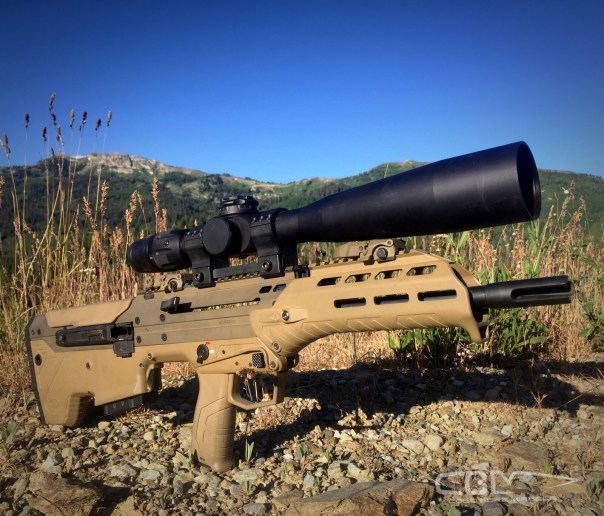
The turrets feature a push pull locking system, to keep them from being turned unintentionally. There are fifteen minutes per revolution of the turret with a total of 70 MOA internal adjustment, that is plenty of adjustment for the kind of shooting I do. I ran the scope on two different rifles, first on my 6.5CM MDR, a bullpup semi auto multicaliber, and then on my brand new 25Creedmoor, a custom built bolt rifle in an impressive new caliber. Both rifles shoot well beyond a kilometer, and the Mod 5 had all the elevation and power I needed for such shots. (Scope was mounted in a 20 MOA cant on both rifles)

the suppressed MDRX and Riton combo worked great

While shooting the MDRX I became quite familiar with the features of the Riton scope, though it took me a second to revert back to MOA.
Engaging targets as far as twelve hundred yards was no problem with the Mod 5. I am not a large magnification shooter, I usually have about five to ten more X’s than I need, but most of the time I shoot between eight and sixteen power.

I think that is where the Mod 5 shines, as with most scopes, you loose some clarity and brightness at the higher magnification. And in my experience, the lower the price point on the scope, the higher the disparity in sharpness at high magnification.
The Mod 5 was no different, I did find that at twenty four power it was a little difficult to pick out little details out past the grand mark. I solved the problem by backing off to eighteen or twenty power for those long observations. I also wish I’d had a sunshade for it, most of my scopes use one, and it is very apparent when even a little bit of sunlight hits the objective. Luckily, Riton has me covered, and Ive got a shade on the way.

I also ran a test on the click values, they were consistent, but slightly off. Over the course of the forty nine minutes of available elevation from my zero, the click value was on average 0.262 MOA. Again, thats a little off, but it was consistent. The good part was it returned to zero perfectly every time, and no significant reticle wandering or cant.
There was a time that I wouldn’t have trusted a sub 1000$ optic to be precise for repeatable turret travel in serious long range shooting, but technology has caught up it seems. And now scopes like this one are showing that not only can it be done, it can be done well.

The Mod 5 weighs in at thirty ounces, which isn’t necessarily light when compared to it’s competition, but its not particularly heavy either. For my taste, it’ll do just fine. I am used to hauling heavy guns all over these mountains, so switching to something this light was very refreshing.

I ran the Riton pretty hard, up and down, zooming in and out, hiking across mountains and riding up dirt roads in the bed of a truck, semi auto fire,  mounting, re-mounting, etc. No issues with it so far, it keeps right up with me.
All Riton scopes are guaranteed for life, with no hoops to jump, or rules to follow. Thats good to know, becasue we all know about Murphy’s Law.

desert tech mdrx with riton scope
the Riton made a good companion to my Desert Tech MDRX

There was plenty of things to like about the Mod 5. I like the reticle, and the the glass is inline with the price point, the internals appear to be robust and repeatable, with simple turret rezeroing. I will also say this, according to the medical practitioner, my eyes are in pretty good shape. So I tend to second guess my own approval of some optics, mainly because what looks fine to me, is usually pretty crummy when someone with anything less than great vision tries it out. I was happy that the Riton RTS Mod 5 got more than just my own approval. The clarity and quality of the imagery seen through the scope was exactly what I would have expected for a scope in this price range.

If I had to pick out the things I dont like about it, I guess that wouldn’t hurt either;
-MRAD for starters, its not 1987 anymore. I know there are some misguided souls out there still addicted to minutes, but the rest of us have graduated to MRAD. Having both options would greatly improve this scopes desirability to a larger audience.
-Turret rotation graduations, would be very helpful to see what rev your on.
-Parrallax, seemed a little off at times, not bad, but requiring frequent adjustment and checking.
-Magnification ring, the texturing was counterintuitive, making it slightly uncomfortable from the shooting position to zoom in or out. This is a very small gripe, and could simply be preference.

tikka t3x with riton scope
Here you can see the Riton mounted to my Tikka T3X

I dont want to sound too hard on this scope, because I actually do like it very much. Hunting season is here, and Junior and I have a date with several deer, and elk. I have all the confidence in this scope to get us on target, whether it be a head shot on a cow elk at four hundrd yards, or a high shoulder shot on a big cross canyon buck at eight hundred and fifty yards.

I look forward to a long future with this scope, and Im sure it wont be long till Riton Optics brings something new. They obviously have the drive, adapting newer and better optics is inevitable. I’ll be waiting to see what that is, and I’ll make sure to have an empty set of rings available until it does.

-CBM

US Optics B25

Introduction

The craziness of youth has somewhat subsided in me, I used to haul all kinds of garbage with me all over the mountains. To some degree I still do, but the wisdom that comes with age has also taught me when to say enough. There was a time when I would carry in my pack a days worth of snacks, water, lots of ammo, shooting mat, tools and who knows how many other things. All this for a quick couple-hour hike around the steep Rocky Mountains that tower over the valley I call home, the Scout motto was never lost on me. Perhaps it was experience that assuaged the contents of my backpack, maybe it was the tired back and legs that carried all my gear that convinced me to lighten up. But like it always does, it seems that technology has snuck in and played a big part in lightening the load. Good gear tends to be heavy, light good gear tends to be expensive, today I want to discuss how I have applied all this to my backcountry recreating. Today I bring you a review of the US Optics B25 rifle scope.

Many of you may remember that for quite some time I carried a US Optics ER-25 scope, it was a spectacular optic. It carried almost every option I could have dreamed up when I first got into this business, and it was tougher than I could have ever imagined. US Optics scopes are famous for their robust construction, and they stand up to abuse that would make a safe queen owner toss their lunch. Hardly a gimmick, I can attest that my USO took several spills, many of which I thought for sure would end up costing me money, a trip back to the factory, and some serious downtime. But to my surprise and delight, my scope never lost zero, or required re calibration. Even falling onto concrete mounted to a twenty pound rifle landing on the scope itself wasn’t enough to damage the scope beyond a few dings.

A young buck seen through the B25 and Gen2 XR Reticle

With experience like that, countless trips into the wild, constantly dialing and working the scope, you might imagine my discomposure when I first saw and lusted over US Optics new line of scopes. The B series of scopes have what I would consider smooth and more modern lines, I know that some people don’t care about looks, but I am a sucker for performance when it meets precision and beauty. When I first got my hands on one, I couldn’t help but be impressed. Clean and bright were the images I saw through the glass, and the always ample selection of reticles leaves no excuse to even the pickiest of reticle snobs. Simple and strong turrets, with improved features like locks, and a quick tooless rezero for the elevation only increased my desire to run these scopes through the paces of my alpine shooting adventures. But one of the significant improvements of the B series of scope was the weight. The robustness of US Optics scopes has always translated into significant weight, something I was okay with because I knew it going in. The B 25 weighs six ounces less than my old ER 25, yet boasts all these improvements. The scope may feel light because I’m used to something heavier, but it sure felt like a bonus to me.us optics

Giving up weight isn’t a bad thing, as long as you don’t loose the benefits of strength and durability. Which the B25 certainly seems to have retained. I still wouldn’t say I am anywhere near having a lightweight rig, but it still goes with me everywhere. Reducing the weight certainly helps, but having what some might call excessive scope can pay huge dividends in these mountains. Glassing a nice buck from a mile away usually requires a spotting scope, and a good one too. And while I wouldn’t compare a riflescope to a good spotter, I don’t have to worry about carrying them both.

The EREK 2 Turret Lock

The B25 is very clear, regardless of magnification I found my eye was quite comfortable focusing on my target, and the parallax adjustment made both downrange and reticle very clean. Any scope looses much of its brightness as you zoom in, but even at dusk I had no problem seeing and holding perfectly on very distant deer. It was also very handy in picking out Marmots from their hides in and around the boulders.

The new EREK 2 elevation turret is one of my favorite features of the scopes. The turret has a lock ring that you simply pull up on, and it engages the turret keeping it from being rotated. I like the idea a lot more than the pull-up/push-down turrets, it seems like a much stronger design, and less likely to be damaged or messed with. The turret lock is also used when re-zeroing the scope (see video below). The EREK 2 turret has a tool-less zeroing feature that allows you with your bare hands to quickly reset your scope’s zero, I found this feature incredibly useful. On any given day, my density altitude can vary from 4000 ft up to 11,000 ft depending on atmospheric conditions. With drastic changes like that, its nice to be able to quickly adjust my zero, without needing to break out my tool bag. The windage turret also locks, it is much simpler, and of the push pull design. I have no problem with that since I rarely dial wind, due to its fickle and switchy nature.

With so many options today, there is literally something for everybody. The new lighter weight of the US Optics B25 is a great excuse to re-scope my rifle, as I have become quite accustomed to having more scope than some would deem needed. I think there is plenty of room for larger tactical style optics in the hunting realm, obviously they will only appeal to those willing to carry it. I for one have seen the value of these scopes, and the advantage they give me.

I hit the field with the B25 in earnest, after some range time which consisted of a couple rifles chambered in 308win, 300wm, and also a big one chambered in 408 Cheytac. I figured if the big calibers didn’t hurt the B25, then surely my Desert Tech SRS A1 Covert wouldn’t do it any harm. Most of my shooting was using my little Short Action Customs 223 Remington barrrel, but I also shot 6.5CM, 308win, and 338LM with it. Again, the quick re-zeroing of the turrets made these transitions very easy. The high magnification of the scope was also very handy when trying to shoot tiny groups on paper, something I am not very good at, so I avoid it whenever possible. It also proved valuable when shooting at distances beyond what most routine shots are taken at, I managed to shoot an 18 inchish group at 1133yds with my little 223 Rem. Through the clear 25X I could see my trace coming down on the target, and the impacts and voids left by my bullets. Switching from one target to another I dialed back and forth, the audible clicks were also crisp, allowing me to count them even if I wasn’t looking up at the turret. I also noticed the magnification ring was not as stiff as many other scopes I have used, I don’t think a cattail would be needed on these scopes but for serious competition.

Shop the full line of US Optics riflescopes
Too much scope? Never!

Shooting with this scope felt like a chat with an old friend, everything where it was and as it should be. Dope lined up meticulously where I expected it to, and nothing ever surprised me. I found it difficult to find a downside to the B25. Of course for a scope mounted to a mountain rifle such as mine, you could always wish for something lighter, or more compact. But I fear until new manufacturing and materials become available, it will be hard to make them much lighter, or smaller. But I am sure that when it happens, companies like US Optics will be the first to bring them to market.

-CBM

Check out our other rifle scope reviews here

Yankee Hill Machine Resonator Suppressor

Introduction

A long time ago, on a dry desert plain, the boys and I were shooting at a distant prairie dog town. After producing the very first suppressor to the group, we all became addicted to suppressed shooting. Since then I have been adding to my collection, and today we will be taking a look at the Yankee Hill Machine Resonator suppressor.

We all ran muzzle brakes back then, because who wants recoil? Spotting your own hits is always handy sure, but muzzle brakes require good hearing protection. This lead to a firing line of yelling back and forth because we were all to cheap to buy electronic hearing protection. It didn’t take me long to see the value of a good suppressor.

unrepentantly stolen from YHM.net

Yankee Hill Machine from the start

My first can (as they are commonly referred to) was a Yankee Hill Machine.  It was a YHM Phantom that graced my muzzle. And I still use it frequently to this day.

There was no looking back after that, it seemed almost ridiculous to shoot without suppression anymore. It didn’t take long for my shooting buddies to catch on. Soon we were all running quite a spread of suppressors.

After multiple begrudging transactions with the ATF, I’ve got cans to outfit everything from rimfires up to forty-fives. I cant seem to get enough of them, like most people, once I shot suppressed I never wanted anything more.

the desert tech srs M2 with us optics FDN25X and yankee hill machine r9 suppressor
Another YHM suppresor, the R9 mounted to my Desert Tech SRS M2 featuring the US Optics FDN25X

The new Resonator from Yankee Hill Machine just happened to cross my path recently, and much like it’s little brother the Turbo 5.56 I was immediately hooked. The Resonator is a QD mount suppressor. It threads onto a muzzle brake that is attached to the muzzle.

It is quickly spun on, and held captive by a spring loaded ratchet to keep it from coming loose under fire. The gas is sealed by a conical shoulder on the brake, keeping carbon buildup away from the threads. The construction of the Resonator is stainless steel and inconel, and again like the smaller Turbo 556, the simple structure makes the can both light and cost effective.

yankee hill machine muzzle device
The muzzle device that came with the Resonator

The muzzle brake comes with the Resonator.  There are an assortment of brakes and thread pitches available from YHM allowing you to purchase extras to fit any applicable hosts.

the Desert Tech SRSA1 covert with yankee hill machine resonator
The Desert Tech SRS A1 Covert with the Yankee Hill Machine Resonator

Shooting with the Yankee Hill Machine Resonator

I started out shooting the Resonator on a Desert Tech SRS A1 Covert.  The rifle was currently setup with a 308 barrel. But I could have dropped in a 300WM barrel as well, the Resonator is rated for up to 300RUM.
Suppressors almost always add a point of impact shift, its almost impossible to add weight and length to the barrel without doing so. The Resonator was no different, I re-zeroed the rifle, which was now hitting several inches high at 100yds after installing the YHM. Shooting the sixteen inch 308 was much more pleasant with a suppressor on the end. And as usual the rifle seamed to shoot better suppressed. The added weight of the can, and the buffering of the report I feel are both beneficial to accuracy.

the desert tech mdrx with the yankee hill machine resonator suppressor
Shooting the 308 Win MDR with the Resonator

We also tried the Resonator on a Desert Tech MDR, a short stroke piston 308 auto-loader. The Resonator worked great on the rifle, keeping recoil and noise down to a reasonable level. And the YHM 4302 brake did an OK job at mitigating the recoil all by itself. Any time you put a can on a gas operated semi auto, you’ll find more gas coming out of the rifle. Turning the gas settings down on the rifle made it quite tolerable.

Switching Host Rifles

Many times I went back and forth from rifle to rifle, letting it cool down to keep from burning myself. I couldn’t find anything about the Resonator to complain about. Sure, you can always say they should be lighter, that’s a given. But the Resonator 30 at 16 ounces is still quite light considering the price point of its competitors. I suppose if I had one request to the folks at YHM, it could be a direct thread option of the resonator. That would probably make a few precision rifle shooters happy, and maybe dip the price point a little further, who knows…

Shop Yankee Hill Machine Suppressors at Silencer Central

Final Thoughts

The Resonator is a great option I think for anyone looking to get into the class III market. It would work great on any AR variant, small or large frame. It works great as a companion to a precision rifle too, the price point of the Resonator makes it ideal as a first can, or as another one to add to your NFA collection. Go to YHM.net for more info.

-CBM

yankee hill machine resonator suppressor

And of course, here is a video