Preface
One of the companies that is flooding the optics market with dozens of different great optic products is Athlon Optics. I have been fortunate to use several different products from the company, and I must say I haven’t been let down. So it is my pleasure to bring you another riflescope review from Athlon; this time it’s the Athlon Midas HMR Gen2 2-12×42.

The Athlon Midas HMR Gen2 2-12×42
The Midas HMR 2-12 is a compact rifles scope optimized for precise shooting, and lending itself heavily to hunters. The Midas is built on a 30mm tube, which offers a larger range of internal travel. Up front you will find a 42mm objective lens that captures your image without being oversized and heavy.

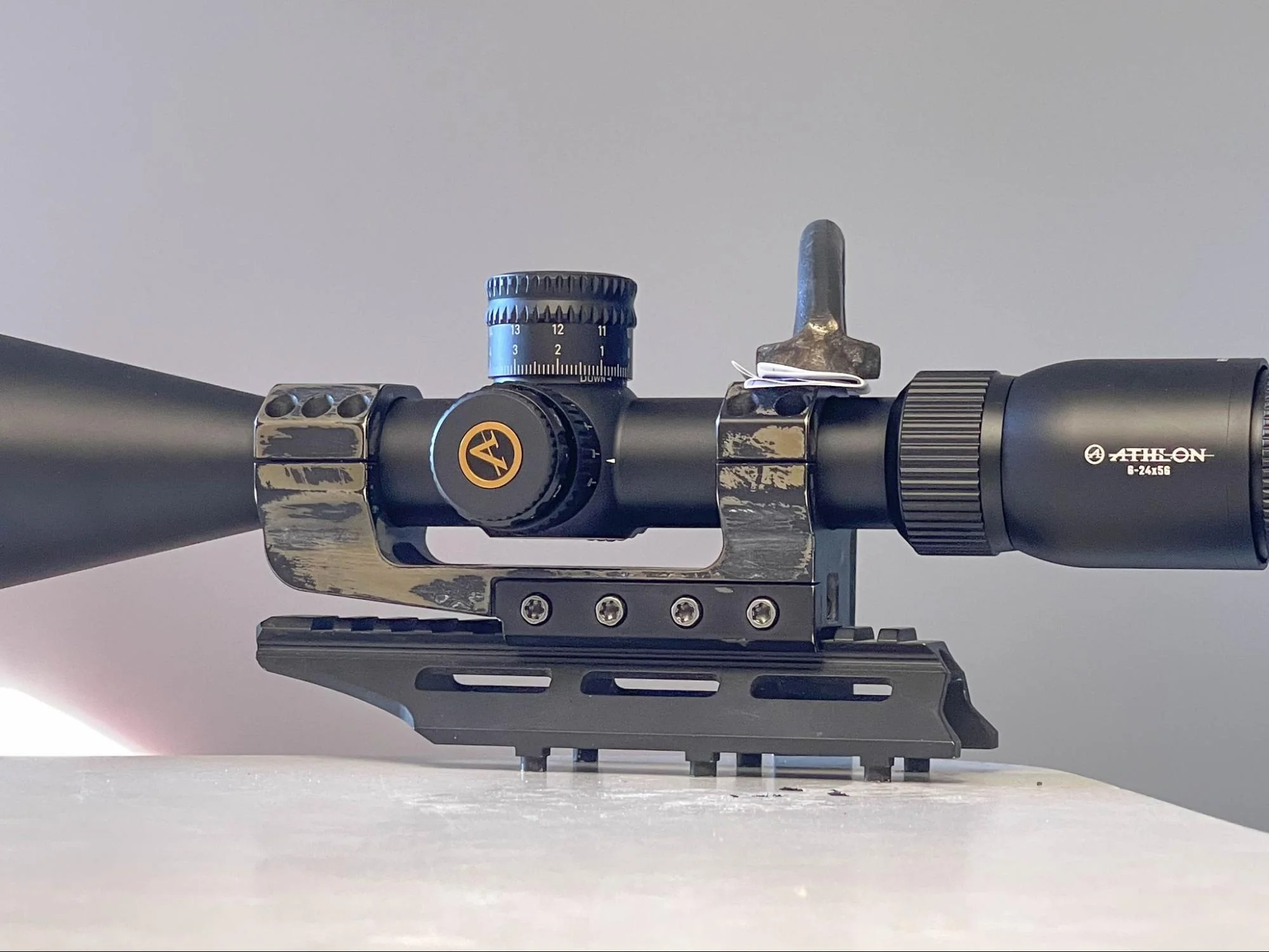
In the middle of the scope is the erector housing that features an exposed elevation turret, a capped windage turret, as well as a parallax adjustment and illumination control. Pretty standard setup for todays market. The elevation turret has 10 MRAD per rotation with a total of 29 MRAD of turret travel.
Athlon makes several first focal plane (FFP) 2-12 scopes, but the Midas HMR Gen 2 is not one of them. Second focal plane (SFP) scopes are usually more affordable, I expect they are simpler to make as well. As such, the Midas’s APRS-H2 reticle stays the same regardless of magnification, which some folks prefer.
The occular housing of the Midas has a ring to adjust the magnification range of the scope, with the number 12 highlighted in red. This indicates where the reticle values are accurate for measuring use. Also on the magnification ring there is a removable throw lever that threads into the ring. This gives better purchase when cranking quickly on the magnification adjustment.

Inside, the reticle itself also offers some great features. With MRAD subtensions marked in whole and half MIL’s out to 4, and .2 and whole MIL’s out to 10. Windage is similar but ending at 6 MIL instead of 10. This gives you the shooter some dexterity in your aiming and correction plans. The center dot illuminates when powered up, giving an almost red dot feel to the scope.
Specifications
| Manufacturer | Athlon Optics |
| Model | Midas HMR Gen2 |
| SKU | 213057 |
| Magnification | 2-12× |
| Objective Lens | 42 mm |
| Tube Diameter | 30 mm |
| Reticle | APRS-H2 SFP IR MIL |
| Focal Plane | Second Focal Plane (SFP) |
| Illumination | Illuminated |
| Adjustment Type | MIL / MRAD |
| Click Value | 0.1 MIL |
| Parallax | Side focus, 10 yards–∞ |
| Field of View @ 100 yd | 55.7–9.6 ft |
| Eye Relief | 3.62 in |
| Length | 12 in |
| Weight | 19 oz |
| Tube Construction | One-piece aircraft-grade aluminum |
| Lens Coating | Fully multi-coated |
| Purging | Argon |
| Waterproof | Yes |
| Fogproof | Yes |
| Shockproof | Yes |
| Turret Style | Exposed |
| Precision Zero Stop | Yes |
| Battery | CR2032 |
| Finish | Black / hard-anodized |
| Ideal Application | Hunting / long-range shooting |
Mounting the Midas 2-12
I would end up using the Midas on a couple different host rifles, but first up I would put it on my CVA Cascade SB. This is a short barreled 18-inch 6.5 Creedmoor, which is real handy for hunting. And with the Midas on top, it would be a perfect little combination.

I settled the Midas into a set of Wheeler 30mm rings and torqued everything down evenly. I adjusted the diopter at the rear of the ocular housing for the best image of the reticle, before bore-sighting the scope and heading to the range.

First Shots on the Range
I must start by saying; I am huge fan of rifle scopes. And some people might think that high power rifle scopes are the bee’s knees. I myself quite enjoy lower power scopes like this 2-12. One advantage to lower power scopes is their simplicity, they may not make your target look as big, but they also don’t magnify flaws. Your flaws or the flaws of the scope itself.

At 2X the Midas is wide-open, meaning you can see everything including the muzzle of your rifle. This might be very handy for a close range rifle where things could be close, like something you might shoot at a charging animal. And at 12X you have enough power to make shots that are out there a lil’ bit. My son for example took his first Mule Deer at 480 yards last year using 12X.
Zero
I boresighted the scope to the host rifle, using my tool-less technique. After which I sat down behind the rifle to shoot a few shots on paper. After a couple shots and adjustments, I was hitting where I wanted it to. It was then time to zero the turret. I was a little irritated because it seemed the Allen wrench included was not the right size for the tiny set screws. But once I’d found the right one it was pretty straightforward.

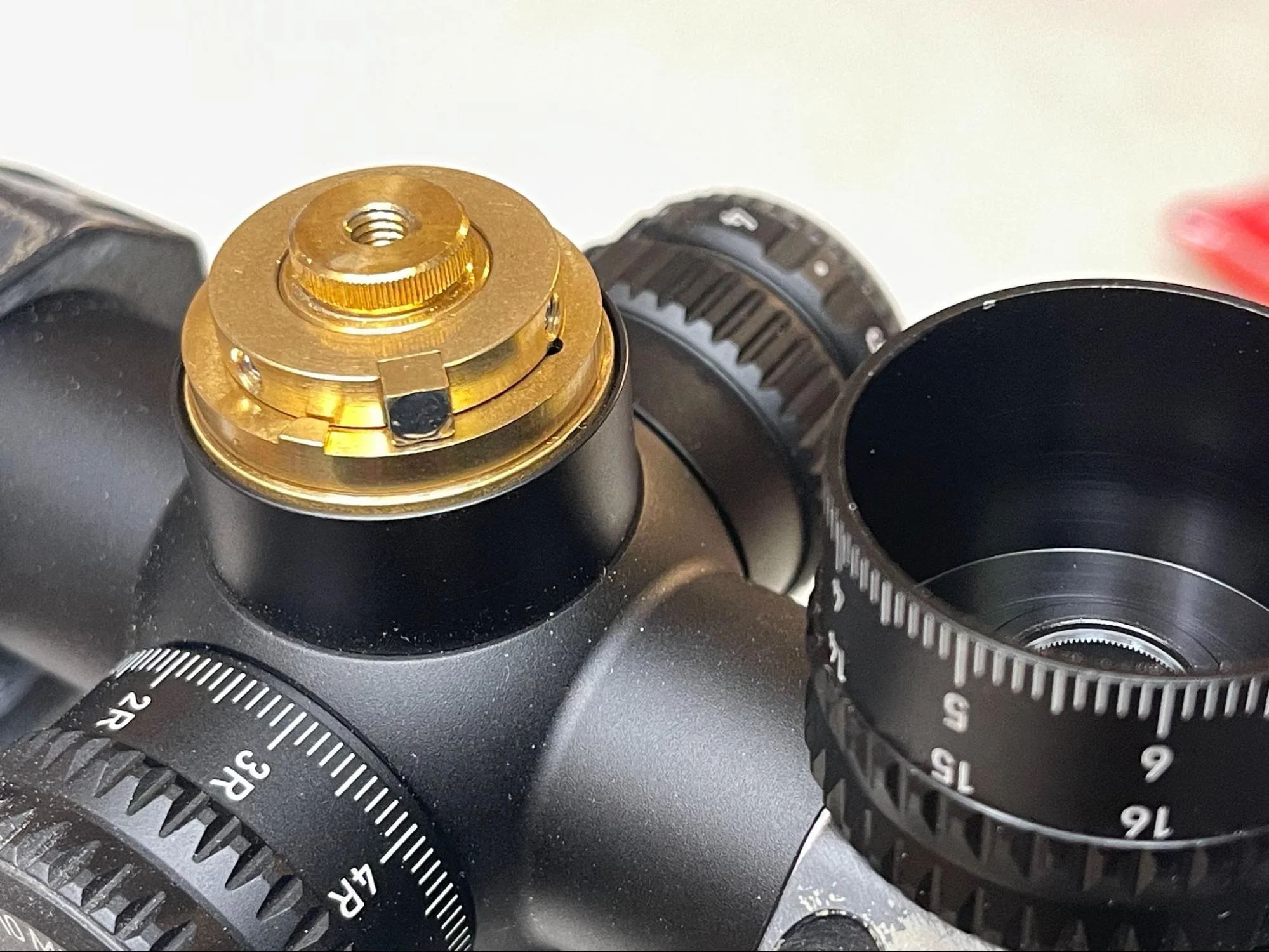
With the turret unlocked (lifted) I unscrewed the single screw in the top of the turret so the turret itself could be lifted off. Underneath there is an interesting little star piece that looks similar to a WWI iron cross. Its four corners are cut to interface with a tooth on the ring of the elevation turret. One of its corners is cut to prevent turning past it, so when you set that corner against the tooth at zero, you cannot dial below that point. When dialing up, the tooth hits the iron cross, and rotates it allowing you to continue dialing upwards.

From there it was pretty easy, once reassembled. The turret would not rotate below the 100-yard zero of the rifle, but would go up to the mechanical maximum of the scopes erector. Which depending on the scope setup could vary greatly. Adding a 20 or 30 MOA canted based would give additional room more mechanical movement.
Adjustments
Adjusting the turrets to their high and low extremes with the rifle clamped in a vise allowed me to see how consistently the reticle moved. Dialing up, right, down and back to the left seeing how it returns to its zero location is a good way to evaluate a scopes reliability.
In the Field

Optical Clarity
At only 12X, the Athlon Midas HMR isn’t a particularly high power scope. But it does very well at clearly magnifying the image from downrange. I enjoyed the sharp contrast of the reticle against the clearly focused target area. This is easier to do I suppose with a second focal plane scope with relatively low magnification, but it is great to have none the less.

Early mornings and right before sunset are always the challenge for best performance, and the image of Midas HMR was surprisingly good. Comparable to scopes that cost significantly more.
Reliability
During our testing, the Athlon Optics Midas HMR functioned perfectly. Never noticed any skips or hangups in reticle or turret movement. All the controls worked as expected, and the only unpredictable issue was the reticle illumination coming on during transport.

Controls
The turrets of the Midas HMR are just right; perfect resistance, clean crisp clicks. Conversely, the parallax adjustment is a bit stiffer than I would like but still quite serviceable. With parallax adjustable down to 10 yards there is some great dexterity in use as well.

I was unsure if I’d like the push-button reticle illumination or not. Changing the brightness settings and on/off feature of the reticle are all done by pushing the button on the center of the parallax turret. On at least one occasion I did find the reticle was on without my doing, I can only assume that it got pressed somehow in the rifle case while maneuvering. In the end I think I’m ok with the push button, its simple and I don’t need it often.
I like the addition of the throw lever on the magnification ring, it makes it quick to adjust. And if you don’t need it, it can be threaded out.
Value
I have always found Athlon Optics to be a good value. Their quality and features are often above average when compared to similarly priced scope from other manufacturers. They have a great warranty also should you ever need to use it.

Pros and Cons
| Great Lens Quality | Inadvertent Illumination issue I mentioned |
| Simple Second Focal Plane Design | Zero-Stop could be easier |
| Great Turret Quality | |
| Reliable, Repeatable Turret Operation | |
| Great Reticle for Corrections | |
| Compact and Lightweight | |
| Removable Throw-lever | |
| Available in both MRAD and MOA |
Why Should you Pick The Midas 2-12
If you are looking for a low power variable scope for a rifle that you anticipate shooting some distance, this scope would be a good option. I imagine myself hunting bears where shots might be up close and personal or perhaps five-hundred yards away. This scope would do well in that scenario. It has a relatively small footprint for a hunting rifle, and its 42mm objective allows mounting it low to the barrel. And its 10 MRAD turrets give plenty of room for corrective long-range shooting. All this with good quality lenses and a crisp, clear sight picture. In a field of scopes that vary greatly in price, the Athlon Midas HMR Gen II is worth taking a look at.