Tag Archives: ruger precision rifle

Ruger Precision Rifle’s

Introduction

If you’ve ever built or configured a precision rifle, you may be familiar with an undiagnosed condition that has afflicted me for some time. The symptoms are broad but almost invariably it is the feverish desire to build another rifle. And it begins to foment as soon as the previous one is broken in.
One way I have managed to regulate this terrible disorder of mine is to embrace rifle systems over individual rifles. It may sound a bit like a weak defense, but let me explain. Rifle systems with similar chassis and features are easier to become proficient. They can be easier on your bank account depending on what you choose. Today our topic is regarding a series of rifles that much like a system keep many features in common; the Ruger Precision Rifle family.

Just a Ruger?

You may have read my article about the Ruger RPR 22Lr, or the piece I wrote about the 6.5 Creedmoor RPR. And in both of those pieces I mentioned the phenomenon that was the arrival of the RPR to the precision rifle world. Until Ruger introduced their rifle, the precision rifle world was dominated by custom built rifles. The cost of admittance was high, usually to the tune of three or four thousand dollars just for the rifle itself.
Ruger managed to squeeze right into the vacant market of less-expensive production precision rifles at what seemed like the beginning of the PRS craze. And in a cunning move they swept up a massive share of the market which continues to grow like wildfire. The RPR has changed the way the PRS community looks at production rifles from mainstream manufacturers. What once was looked down upon is now commonplace even at the podium.

Start Small

The NRL 22 matches have proven that the precision shooting craze isn’t limited to centerfire rifles. Whether you are an adult or a youth shooter there is much that can be learned from rimfire shooting. The RPR 22LR is the smallest of the RPR family, and an excellent place to learn the basics of marksmanship. It is a bolt action box fed rifle, built into a chassis system just like the entire RPR family. As with every member of the family it features a fully adjustable buttstock. And it’s modular chassis is made to be accessorized. Great controls that are well thought round out these rifles as excellent for training or for competition.

Shop 22 LR ammo for your RPR

The RPR 22LR can be used as a tool to perfect your processes and techniques if you plan on competing. And if you just like shooting it can provide a lifetime of inexpensive plinking fun for both children and adults.
One of my kids just recently used the RPR 22LR to pass his hunter safety program here in our state. He even managed to get an honorable mention for marksmanship. The easily customized rifle was a perfect fit for what he needed, and he continues to shoot it still. And should he choose to keep with it, his experience from the wee 22 will carry right over to the next rifle.

The OG

The original RPR came out as a short action chambered in 308 and 6.5cm.  It is probably still the most popular RPR of the whole family.
Utilizing SR25 patterned magazines and compatible components already available in the flooded AR market made the rifle both appealing and familiar to the AR crowd. The controls my kids learned on the rimfire RPR will have them pre-familiarized with this larger version of the rifle.
The medium to long-range capabilities that came with the RPR opened the long-range shooting craze to folks who before then couldn’t or wouldn’t spend the money for a custom. The RPR produces incredible accuracy patterns, it punches above its weight I guess you could say.

Shop Ruger Precision Rifles

Another appealing benefit is the similarities of the RPR to America’s favorite rifle, the AR 15. It doesn’t just feel similar, it also looks like one. And as much as we often pretend looks are secondary, the similar looks and aesthetics to the AR have certainly affected the RPR’s popularity. The RPR created a space, that quickly started getting crowded with other manufacturer options like Savage, Howa, and even Mossberg.

All Grown Up

The RPR has even been produced in the larger calibers, like 300 PRC, Winchester Magnum, and 338 Lapua Magnum. With chamberings such as those, there are few things out of reasonable distance for the RPR family. I’ve shot a few Lapua’s in my day, and I was impressed with the way the Ruger performed. Just like it’s smaller siblings, the rifle flat out performed. Making hits beyond one-thousand yards was like shooting five hundred yards with a 308. Running the longer bolt and magazines were flawless. And the massive muzzle brake tamed the 338 to be quite manageable.

As I mentioned at the beginning, a series of rifle systems can add value to your purchase. Learning to shoot long-range on the 6.5 Creedmoor RPR makes it an easy step up to the magnum version of the rifle for even more distance. And if you want to train on the cheap for a competition, the little rimfire RPR can help you work out the kinks in your game without spending as much.

The RPR is still a production rifle, and you can tell the difference between a custom built competition gun and the humble RPR. But once the timer starts it depends a lot more on the nut behind the trigger than comparing the price tags of the rifles being shot.

Conclusion

Both young and old can benefit from the Ruger Precision Rifle family. Graduating from one rifle to the next can increase familiarity and comfort for all. And the modularity of the rifles can allow everyone to customize the rifle to their own purposes whether that be competitive or otherwise.

The obvious popularity of the RPR family could be a result of some brilliant marketing over at Ruger. But I think thousands of happy and religiously loyal RPR owners cant be wrong. I think it’s more a combination of a good product. Marketed well to a customer-base that was ripe with desire for just such a product. If you are looking into the precision shooting game, you’d be well served by looking at the RPR family.

-CBM

The Ruger Precision Rifle 6.5 Creedmoor

Introduction

The Ruger Precision rifle 6.5 Creedmoor took the precision rifle world for quite a ride when it first came out. Ruger made an excellent move by introducing an affordable rifle into an arena that was dominated by expensive custom-built rifles and actual sniper rifles. And in another stroke of genius they managed to make a rifle that appealed to the AR-15 crowd at the same time, which brought even more customers into their fold.
Ruger Precision rifle 6.5 creedmoor

The RPR

The Ruger Precision Rifle utilizes a bolt action receiver that is built into a chassis. It is fed by SR-25 pattern 308 sized P-mags for the 308, 6mm, and 6.5 chambered rifles. This rifle seems to almost clone the aesthetics of the extremely popular AR 15. Using the same pistol grip, and similar operation for the safety. Today’s test model also includes a folding butt stock for shortening the footprint of the rifle when transporting.

A twenty-four inch hammer forged barrel uses 5R rifling which if you ask the internet is the only good kind of rifling.  Long-range shooters prefer things like the one-in-eight twist barrel as it is ideal for launching the heavy for caliber bullets.  Weighing in at ten and a half pounds, the rifle is about forty-five inches long unless you fold it, in which case it is thirty-five inches long.

Check out my review of the Ruger RPR .22LR as well

Try It

Having been one of those in the community with a preference for the custom built rifle, it took me some time to actually give the Ruger a try. To be honest I did look down at it a bit, perhaps like many others I was angry that it shot just as good as rifles that cost twice as much or more.

But it didn’t take long for the RPR to prove its worth to those in the community, and now a days its common to see them shooting at top PRS events. I shot in the Hornady Precision Rifle Challenge this past summer. There we saw several RPR’s including Doug Koenig who did extremely well shooting with significantly more expensive competitors, taking home the top Production Rifle trophy.
Ruger Precision Rifle 6.5 Creedmoor
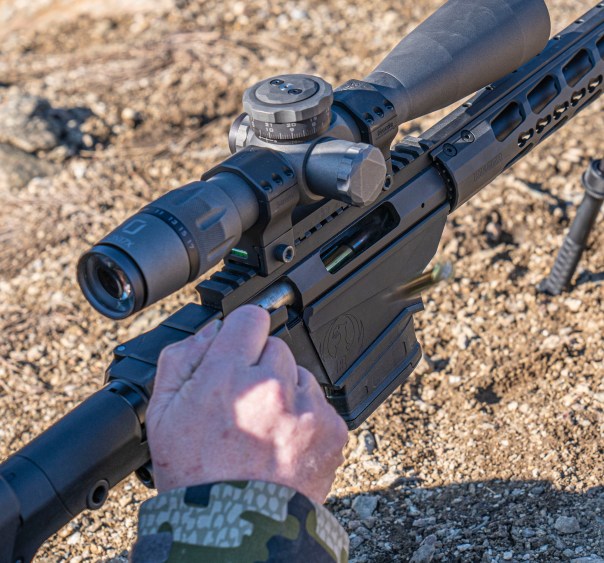
After all this time I figured it was time for me to open up to the Ruger, so I took the opportunity when it came. Opening up the box, I found the all black rifle complete with a magazine, bipod and a few other items. It took a few minutes to familiarize myself with the rifle, and get a feel for the controls and such. For me there are couple things that stand out when first handling a rifle, the first one is throwing the bolt. Quickly I shouldered the rifle and ran the bolt a few times, you can tell a lot about a rifle by the feel of the bolt-throw.

More Ruger Precision Rifle features

Bolt manipulation of the Ruger Precision Rifle was smooth and had a positive lockup feel when closed into battery. You could also feel a metal on plastic sensation a little bit which I assumed to be the piece at the rear of the bolt. Not that there was anything negative about it, as plastic on metal frequently gives a low-friction feeling which I do like. Bolt lift was not bad, but did take a little bit of getting used to. Not bad, obviously not as good as some of the other rifle actions frequently used today.

Among the features that seal the deal for me is the trigger pull. While I don’t consider myself a trigger snob, I do enjoy a perfect trigger whenever I can. Ruger’s trigger on the RPR was a good one, clean and without the abrasive skipping often felt on triggers of lower tiered firearms. I’ve never been a big fan of blade safeties. When they first came out many years ago, the first thing I did was figure out how to remove them. That being said I wasn’t so hateful of this one to look for a way to remove it.

Shop ruger Precision Rifles here

The main safety was in the same place your traditional AR style rifle safety goes, which made it very convenient and familiar to use. It wouldn’t hurt my feelings if they put it on both sides like AR’s often do, but certainly not a deal breaker.

This RPR runs on 308 sized P-Mags, and it came with a ten-round magazine. After some range time I would try the twenty-round ones as well, just in case you ever needed to do some long strings of fire.
Including a folding buttstock of the rifle made it much shorter for transportation, and doubled as a quick way to remove the bolt for inspection, lube, or cleaning. Up front we had the hammer-forged twenty-four inch barrel inside a free-floated handguard. Cut into the muzzle of the barrel are 5/8-24 threads. Which was great because I planned on mounting some stuff there.

The handguard on my particular rifle uses KeyMod for accessory attachment. But they are also available in the more modern and useful M-Lok. I secured the Atlas bipod to the pic rail underneath, and then I was ready to mount up a riflescope. Continue Reading Here…

A good rifle deserves an even better scope, like the US Optics FDN17x

FIRST SHOTS

Running the bolt forward on a cartridge felt smooth and controlled. I could often feel the slightest bind as the bolt closed the last few degrees. Almost like the extractor was having trouble snapping over the cartridge rims. As I brought the reticle to rest on my point of aim, I took up the slack in the trigger and gave it a steady press.

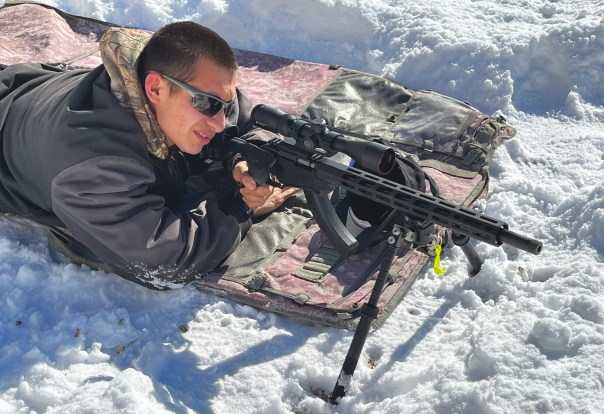
Repeating the process another four times and made a nice little vertically strung group. I have noticed this tendency during this cold time of year. Particularly when both rifle and ammo are below freezing temperatures.

As the bore warms and each round is chambered into a progressively warmer chamber. Velocity increases slightly and brings the point of impact up a touch with each shot. Horizontal dispersion was minimal, and the overall group size was just under an inch.

That’s not too shabby using what most would consider plinking ammo, and the results were even better when shooting 140-grain match ammunition. I pushed the RPR out to half a mile to see how it performed. As I suspected, it was easy impacts. Recoil on the rifle wasn’t terrible, allowing me to spot my impacts at those extended ranges.

federal 6.5 creedmoor ammunition american eagle
Even the inexpensive American Eagle 120 grain ammo shot well

Suppressed

Shooting this rifle go without seeing how it does with a suppressor wasn’t an option to me. To that end, I pulled out my Yankee Hill Machine Nitro N20 suppressor. During my range time I noticed only a small change in point of impact. Likely due to the light weight of the Nitro.

It was beautiful to shoot in the open country of the mountains and listen to the long journey of the bullets. They hissed through the sky before they thumped into the target. I think the RPR deserves a good suppressor, it makes a great little rifle even better.

POSSIBLE DOWNSIDES?

At first, I wondered why they made it a 24-inch barrel versus a 26-inch barrel. After running around with this thing, I understand why.  If I had the ability to order the RPR from the factory, I would have done so with a shorter barrel length that was more like 20 inches.

Ruger Precision rifle 6.5 Creedmoor
rifle details; notice QD sling cup behind the grip, and locking mechanism for folding stock just above it

Adding a folding stock is great for reducing the length of the rifle, at least when you are trying to transport it. But another one of my complaints has to do with the folding mechanism, mainly that it only locks in the shooting position.

While it’s not a deal-breaker for me,  it would be really easy to get something pinched in the pivot point. Especially when the stock inevitably comes swinging back as you try and maneuver it.

The magazine release was also a touch tough for my taste. It was easy to falsely engage the magazine on this rifle to where it looked like it was in. Making you think it was secure, but was not really secured.

Ruger’s magazine release also seemed to require a touch more force than I would expect for such a simple and common motion. This is likely something that can be adjusted or corrected by the user, so don’t worry too much about it.

MY CONCLUSION

As I suspected, the Ruger Precision Rifle 6.5 Creedmoor is just what I thought it would be – a great-shooting production rifle with an entry-level price tag but professional results. Sure, it’s not as nice as the custom precision rifles out there.

And you can feel that it has been mass-produced. But nonetheless, the rifle performs very well in its capacity. It gives the user accurate shots, a familiar manual of arms, and pleasing aesthetics.

Above and beyond that, there are countless ways to customize and improve the rifle with excellent aftermarket support. I have some nice rifles in my safe. I wouldn’t trade any of them for a Ruger RPR, but I wouldn’t mind having a couple RPRs in the safe to give them company.

-CBM

Ruger RPR 6.5
The Atlas bipod makes an excellent addition to the rifle

Ruger 22LR Precision Rifle

Intro to the Ruger RPR 22

Steal his look with a jacket from KUIU

Sometimes we get the cart before the horse, and I’ll admit that I’ve done a few things out of order over the years. One instance where I think I started at the wrong end was a few years back, when I first put my hands on a Ruger Precision Rifle (RPR). Normally I like to start with a light recoiling rifle, get comfortable and proficient with its function, and then step up to the next bigger platform.
The first RPR I ever shot was the big one, in 338 Lapua Magnum. I later was able to shoot one chambered in 308 Winchester, which was obviously a little softer. And finally today, I have reached the small end of the RPR family, chambered in .22 Long Rifle.

A Natural Evolution

I remember when the first RPR hit the market, it started gaining fans immediately due to its many features and benefits. Ruger’s design quickly caught on to several large groups of rifle shooters, and in the process helped open new shooting activities to those shooters. The RPR at a glance could be mistaken for a Modern Sporting Rifle (MSR) or an AR type rifle, it’s simple yet handsome aesthetics appeal to the Black Rifle crowd just as much as it does to the precision rifle shooting crowd. Ruger was clever in the way the gun was made and marketed, the price-point of the RPR brought affordability to a shooting class that before then had been reserved to expensive custom rifles, or actual sniper rifles.
As the popularity and success of the RPR soared, additional models and calibers were introduced using the same basic idea, and it was only proper to have a rimfire version.

The Ruger Precision Rifle .22LR

The RPR .22LR is a bolt action magazine fed rifle, built in a chassis with fully adjustable comb and recoil pad. The rifle uses an eighteen-inch hammer forged steel barrel which is threaded 1/2-28 at the muzzle to install your favorite muzzle furnishings. The chassis utilizes a free-floating handguard with M-Lok slots for adding accessories, and also uses standard AR type pistol grips so you can install whatever model you desire. The rifle has a built in optics mounting rail atop the receiver and in a brilliant stroke of genius, it was designed to use the incredibly popular Ruger 10/22 magazines, with fifteen and twenty-five round magazines shown in this article. All these intuitive features come with an MSRP of $579.00.

Getting Started

I’m currently on a rimfire kick, so this rifle couldn’t have fallen into a better lap. Upon receiving the rifle, I promptly started the process of fiddling and figuring it out. The rifle came to me with a Vortex scope already mounted in a one-piece scope mount, and a few extra magazines. All I needed was a bipod and my Yankee Hill Machine Phantom 22 suppressor  and an Atlas Bipod to make this rifle complete.

Luckily for me, I had several great options for ammunition testing. Plenty of the cheap bulk-packed ammo from manufacturers like Federal and Winchester, as well as match grade ammo from companies like Aguila and CCI. I was excited to see how it all came together in the little RPR. Once I had rifle, ammo, and everything else I needed, I headed to my shooting line to get it warmed up.

Shop .22LR Ammo at Wideners.com

Once there, I bore-sighted the scope and started loading magazines. I started with some of the Winchester bulk packed ammo, just to get a close zero. At one-hundred yards it was not particularly impressive, with shots dodging between two and four inches across a five-shot spread.
Running the bolt on the RPR was just a tiny bit glitchy, which I believe is simply getting used to it, and breaking in the action. One thing that I’ve noticed on most bolt action rimfires is that the shorter bolt is more susceptible to binding in the short action, I believe this is due to distribution of force being focused on just a few small surfaces. I have run the bolt on other RPR’s and found the bolts to be perfectly smooth, so it could simply be that this gun is new and needs some working.
I usually don’t use safeties much, I prefer to simply keep it empty until ready to fire. But when talking about 22’s, there will almost invariably be children around. In fact I used the RPR 22 for one of my kids hunter safety course, as it was a perfect fit for him. The safety on the RPR was a little stiffer than I would have liked, the kids actually thought there was something wrong with it. But this again could just be needed to be broken in, not a deal breaker for me.

Continue Reading Here…

Still, the adjustments of the buttstock of the rifle made it easy to match it to other shooters like my kids, making their shooting experience even more enjoyable. Though, one other small concern I had was mag feeding. Particularly when loaded to a full 25 rounds, the first few rounds were a little finicky when feeding. This also varied with different ammunition, so it could have had something to do with that as well.

ACCURACY

After trying four different types of ammo, there was clearly a winner. The cheap bulk-packed ammo worked fine but didn’t produce the best results as you might imagine. Both the Winchester and Federal produced groups around 3 to 4 inches at 100 yards, and the CCI was a little better but not much.

Get you some high quality Lapua 22lr Match ammo here

As you might imagine, the Aguila Match ammo was superior, producing 10-shot patterns around 1.5 inches. Five-shot groups were even better, some of them even shooting 1/2-inch groups. I was happy with the results, but I would have preferred better accuracy with the cheap stuff. At least I know what to use should I need to head-shoot squirrels from across the creek.

.22 Aguila Ammo and a target
With the right ammo, you can achieve some very nice groupings. 

SUPPRESSED

Bolt-action .22 LR Ruger Precision Rifle

Nowadays, suppressors are becoming more and more popular, so I had to shoot the rifle with a couple of different suppressors just to satisfy my curiosity. First was the Dead Air Mask, followed by my favorite Yankee Hill Machine Phantom 22. Both of them worked perfectly, making the report of the little rifle comparable to the BB gun I got when I turned 10.

In the open Rocky Mountains, it is hard to discern the difference between two rimfire suppressors, but the YHM wins because of it weighs a third less. Shooting suppressed rimfires is addicting, and the Ruger RPR makes it even better with great accuracy and the ability to adapt to each member of the family.

CONCLUSION

It should come as no surprise that the RPR 22 is an excellent choice for a good shooting rimfire rifle. Ruger has near-legendary experience in the rimfire market and adding a .22 LR rifle to the Precision Rifle family was exactly the right move. Despite the few hiccups I had with the rifle, I can hardly see a reason to own a different .22. Unless you have an extremely small budget, or desperately need a semi-automatic .22, you will love the Ruger Precision rifle in .22 Long Rifle.

-CBM