Tag Archives: long range shooting

Top Five Cartridges For Long-Range Shooting

Top five you say? What kind of maniac could narrow it down to just five of the best cartridges? I mean the world is littered with spent casings from countless different cartridges that offered something that another didn’t. So to avoid being labeled as that guy, I am instead going to go over the process by which anyone can select their top performers as it applies to their shooting. And how I did it for myself. Today we will discuss my top five cartridges for long-range shooting.

The first step in this process would be to know and set your limits. Unless you’re Elon Musk you probably can’t afford or build a rail gun for your weekend shooting exchanges, so obviously there is a budget to keep. And if you live in flat country where the furthest you can see on a clear day is five-hundred yards. You will have very different needs than someone who lives in mountains ranges where one-thousand yards is just to the next turn in the trail. Another important consideration is the target. Hitting paper or steel is much different than meat and bone. So it’s very important to define your needs properly, both ballistically and financially.

Extremist Need Apply

If your goal is extreme distance competitions like King of 2 Miles, then you are going to want something big. My experience here is minimal. However there are many marksman shooting these distances with a cartridge I am quite fond of and my choice for extreme distance. The 375 Chey-tac, or something similar to it. The cartridge is perhaps the most common in big-bore ELR shooting, as the ammunition and components are plentiful. Not only that, it is an outstanding performer.
With high performance bullets like the Cutting Edge MTAC or the Warner Tool Flat-line, you can shoot distances that most people have never considered possible. Of course all this comes with significant cost. And perhaps an above average level of dedication, but how else could you call yourself an extreme shooter?
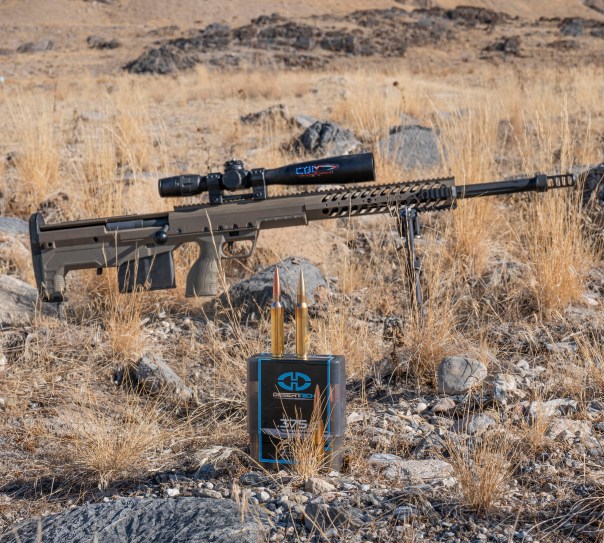
The Desert Tech HTI in 375 Cheytac is an excellent ELR rifle, matched here with a US Optics 25X scope

Okay, Maybe not that extreme

If your goals are perhaps a little more mainstream, and you don’t feel like spending $10-$20 every time you pull the trigger. Let’s talk about a better fit for you. Shooting a mile or less is much more common than it was even ten years ago. One of the reasons it has become so commonplace is the proliferation of the venerable 338 Lapua to so many affordable rifle platforms. But that’s not the cartridge I was about to recommend, I was about to say the 300 Norma Magnum. Why the 300 over the 338 you might ask? I’ll explain.

Click here to see the 300 Norma in elk hunting action

300 Norma ballistics when using high ballistic coefficient like those available today, will rival those of the 338 Lapua. There are pros and cons either way between the two, as far as barrel life, recoil, and even suppressors if that’s your thing. High quality bullets loaded in the 300 Norma make it a devastating long-range performer. Whether you are shooting targets, big-game hunting, or anything else. I prefer the more slender and faster fired bullets in the thirty-caliber as compared to the heavier and a bit slower thirty-three caliber bullets of the 338LM.

The 300 Norma will easily shoot to a mile and beyond, handily take down any North American animal. Additionally it has a huge selection of bullets and ammunition selections of the highest quality.

A Poor-Man’s 338 Lapua

Many years ago, before I had experienced both the 338 LM and 300 NM, I found myself in quite a quagmire. I wanted a new barrel for my Desert Tech SRS that would allow me to shoot comparable ranges to those cartridges (1700-2000 yards) , but I was but a common man.

I had nowhere near the money to feed a Lapua or a Norma, which is no small cost. Buying a barrel is one thing. But coming up with all the ammunition components needed to become proficient and shoot as frequently as I do is another entirely.  So I began a study to find a suitable replacement, a champaign cartridge on a beer cartridge budget so to speak. 

What precipitated from my numbers evaluation, was this; a very high BC bullet in the 7mm (.284) caliber is comparable to the BC of the bullets commonly loaded in the 338LM. So if I could get them up to comparable or better speeds, I would find myself shooting Lapua distances on  Remington resources. 

The 7mm SAUM

After some careful market evaluation, I was quoted a build for a 24″ 1-8 twist barrel chambered in the mighty 7mm Short Action Ultra Magnum (7SAUM). And before I knew it, my poor-man’s Lapua was in my hands.  I had done all my prep work before-hand, and I had loading components ready to go.

I ended up shooting the Sierra Bullets 183 Match King, which has a very high BC. My new barrel would launch them at a magnificent 3050 feet per second (FPS).  After spending a few seasons hunting with the 7SAUM, I was completely convinced I had made a good choice for the times. My SAUM shooting the 183’s actually shot flatter than the mighty 338 out to around a mile. The energy on impact wasn’t as high obviously but I wasn’t planning on hitting anything besides steel at those ranges. Even so, the SAUM retained more than enough energy to take down an animal as far away as 1000 yards, so I was certainly in good company.

The popularity of the 7 SAUM has waned some with the passage of time, another more popular choice with many of the same qualities is the 7 PRC

Two elk taken down by a single shot from the 7SAUM, at 900 and 500 yards respectively

Lets Get Common

Nothing I’ve mentioned above is particularly common, or very cost effective for your average shooter. Sharp marksmen have been shooting significant distances for a very long time with everyday cartridges like the .308 and 30 06. And with proper bullet selection and load development, you could certainly continue on that fine tradition. Or you could embrace something more contemporary.

Go ahead and light your torches, sharpen the pitchforks, and prepare your best effeminate insults because we’re about to use the “C” word. Just prior to the current ammo crisis, the 6.5 Creedmoor has infiltrated nearly every little ammo shelf across the country. And for good reason.

The 6.5 Creedmoor

The 6.5 CM offers 300WM ballistics with recoil and cost subordinate to even the 308 Winchester. There is an extremely high-quality components and ammunition selection for the 6.5, and its easy to load and shoot. There is so much to like about the cartridge, it begs the question why it is the subject of every sophomoric and unsophisticated insult the internet has to offer.

excellent Creedmoor performance can be had from a simple setup like this Ruger American Gen2 and Maven Scope

Personally I believe it to be its own worst enemy, unfledged shooters are easily tired of hearing how great the Creedmoor is. Especially since what they choose to shoot is obviously better because they chose it, at least that’s how they feel.
Do not discount the Creedmoor, it is what it was built to be; a great shooting cartridge for those first thousand yards. A great deer hunting cartridge, and anything similar to those two disciplines. It can be found nearly anywhere ammunition is sold, making it a strong contender on this list.

These 129 grain Cayuga bullets perform exceptionally in the Creedmoor, read more about them here

Out of Left Field

My tastes have changed, and my budgets matured, so I’d be remiss to omit my latest favorite. I wasn’t sure whether to put it in my list or not, due to the obscurity, but this is my list so I’ll do it my way.

Wildcats are a little different, like fingerless gloves at the range, or guys who wear fedoras. Wildcats if you didn’t know, are illegitimate children of the cartridge world, derived from other cartridges. They are either “necked up” or “necked down” and usually “blown out” to create a whole new cartridge. Many of our best cartridges were born this way, and to that list I add this one of my personal favorites.

The 257 Blackjack

The 257 Blackjack is a cartridge formed by shortening the SAUM case. Changing the shoulder geometry, and necking it down to twenty-five caliber. Simple enough, but the crown jewel of the cartridge is another very high BC bullet built by Blackjack Bullets (designer of the cartridge). The 131 grain bullet has a .340 BC, which is nearly untouchable by anything comparable in size and price. Nearly none of the 6.5 and 6mm bullets that would give the Blackjack a run for the money can. Especially when shot from the 257 Blackjack cartridge.

Blackjack has since closed, but the 131gr bullet is still made by Sierra.

From my 24” barrel the muzzle velocity is 3270 FPS, and with that impressive .340 BC you can imagine the extremely flat trajectory. There are also other high BC bullets available from Berger andHornady that have a predictably outstanding performance

This little short action cartridge will reach a thousand yards with less than 5 MRAD of elevation. And when it gets there it will still be packing well over a thousand pounds of energy and more than 2200 fps. It doesn’t go subsonic till well beyond two-thousand yards. Making it very competitive in the same ranges as the 338LM and 300 NM mentioned above.

My wife took this pronghorn doe with the 257 Blackjack, seen here with the US Optics FDN25X

Would I recommend the 257 Blackjack for long-range shooting? Not at the moment. The tediousness and dedication it takes to run a wildcat cartridge like this is probably more than most would care for. But should factory made brass become available, this would be a shoo-in for anyone interested. It is truly an amazing little cartridge.

Conclusion

So there you have it, my list of my top five long range shooting cartridges. You may take them or leave them, and you wont get any argument from me. Every shooter can decide what works best for his/her needs, and create their own top five.
The good news is that there are so many great choices. Despite my little list of cartridges, I could probably make due for the rest of my life with just a plain jane 308.

-CBM

Let us know in the comment section what your top five cartridges are

The Ruger Precision Rifle 6.5 Creedmoor

Introduction

The Ruger Precision rifle 6.5 Creedmoor took the precision rifle world for quite a ride when it first came out. Ruger made an excellent move by introducing an affordable rifle into an arena that was dominated by expensive custom-built rifles and actual sniper rifles. And in another stroke of genius they managed to make a rifle that appealed to the AR-15 crowd at the same time, which brought even more customers into their fold.
Ruger Precision rifle 6.5 creedmoor

The RPR

The Ruger Precision Rifle utilizes a bolt action receiver that is built into a chassis. It is fed by SR-25 pattern 308 sized P-mags for the 308, 6mm, and 6.5 chambered rifles. This rifle seems to almost clone the aesthetics of the extremely popular AR 15. Using the same pistol grip, and similar operation for the safety. Today’s test model also includes a folding butt stock for shortening the footprint of the rifle when transporting.

A twenty-four inch hammer forged barrel uses 5R rifling which if you ask the internet is the only good kind of rifling.  Long-range shooters prefer things like the one-in-eight twist barrel as it is ideal for launching the heavy for caliber bullets.  Weighing in at ten and a half pounds, the rifle is about forty-five inches long unless you fold it, in which case it is thirty-five inches long.

Check out my review of the Ruger RPR .22LR as well

Try It

Having been one of those in the community with a preference for the custom built rifle, it took me some time to actually give the Ruger a try. To be honest I did look down at it a bit, perhaps like many others I was angry that it shot just as good as rifles that cost twice as much or more.

But it didn’t take long for the RPR to prove its worth to those in the community, and now a days its common to see them shooting at top PRS events. I shot in the Hornady Precision Rifle Challenge this past summer. There we saw several RPR’s including Doug Koenig who did extremely well shooting with significantly more expensive competitors, taking home the top Production Rifle trophy.
Ruger Precision Rifle 6.5 Creedmoor
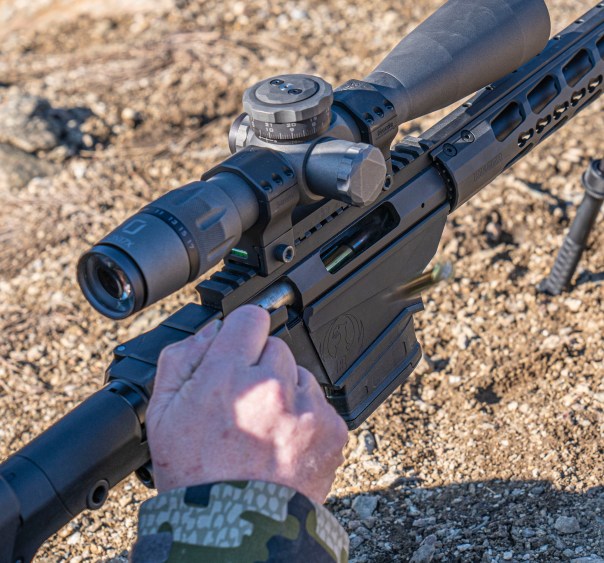
After all this time I figured it was time for me to open up to the Ruger, so I took the opportunity when it came. Opening up the box, I found the all black rifle complete with a magazine, bipod and a few other items. It took a few minutes to familiarize myself with the rifle, and get a feel for the controls and such. For me there are couple things that stand out when first handling a rifle, the first one is throwing the bolt. Quickly I shouldered the rifle and ran the bolt a few times, you can tell a lot about a rifle by the feel of the bolt-throw.

More Ruger Precision Rifle features

Bolt manipulation of the Ruger Precision Rifle was smooth and had a positive lockup feel when closed into battery. You could also feel a metal on plastic sensation a little bit which I assumed to be the piece at the rear of the bolt. Not that there was anything negative about it, as plastic on metal frequently gives a low-friction feeling which I do like. Bolt lift was not bad, but did take a little bit of getting used to. Not bad, obviously not as good as some of the other rifle actions frequently used today.

Among the features that seal the deal for me is the trigger pull. While I don’t consider myself a trigger snob, I do enjoy a perfect trigger whenever I can. Ruger’s trigger on the RPR was a good one, clean and without the abrasive skipping often felt on triggers of lower tiered firearms. I’ve never been a big fan of blade safeties. When they first came out many years ago, the first thing I did was figure out how to remove them. That being said I wasn’t so hateful of this one to look for a way to remove it.

Shop ruger Precision Rifles here

The main safety was in the same place your traditional AR style rifle safety goes, which made it very convenient and familiar to use. It wouldn’t hurt my feelings if they put it on both sides like AR’s often do, but certainly not a deal breaker.

This RPR runs on 308 sized P-Mags, and it came with a ten-round magazine. After some range time I would try the twenty-round ones as well, just in case you ever needed to do some long strings of fire.
Including a folding buttstock of the rifle made it much shorter for transportation, and doubled as a quick way to remove the bolt for inspection, lube, or cleaning. Up front we had the hammer-forged twenty-four inch barrel inside a free-floated handguard. Cut into the muzzle of the barrel are 5/8-24 threads. Which was great because I planned on mounting some stuff there.

The handguard on my particular rifle uses KeyMod for accessory attachment. But they are also available in the more modern and useful M-Lok. I secured the Atlas bipod to the pic rail underneath, and then I was ready to mount up a riflescope. Continue Reading Here…

A good rifle deserves an even better scope, like the US Optics FDN17x

FIRST SHOTS

Running the bolt forward on a cartridge felt smooth and controlled. I could often feel the slightest bind as the bolt closed the last few degrees. Almost like the extractor was having trouble snapping over the cartridge rims. As I brought the reticle to rest on my point of aim, I took up the slack in the trigger and gave it a steady press.

Repeating the process another four times and made a nice little vertically strung group. I have noticed this tendency during this cold time of year. Particularly when both rifle and ammo are below freezing temperatures.

As the bore warms and each round is chambered into a progressively warmer chamber. Velocity increases slightly and brings the point of impact up a touch with each shot. Horizontal dispersion was minimal, and the overall group size was just under an inch.

That’s not too shabby using what most would consider plinking ammo, and the results were even better when shooting 140-grain match ammunition. I pushed the RPR out to half a mile to see how it performed. As I suspected, it was easy impacts. Recoil on the rifle wasn’t terrible, allowing me to spot my impacts at those extended ranges.

federal 6.5 creedmoor ammunition american eagle
Even the inexpensive American Eagle 120 grain ammo shot well

Suppressed

Shooting this rifle go without seeing how it does with a suppressor wasn’t an option to me. To that end, I pulled out my Yankee Hill Machine Nitro N20 suppressor. During my range time I noticed only a small change in point of impact. Likely due to the light weight of the Nitro.

It was beautiful to shoot in the open country of the mountains and listen to the long journey of the bullets. They hissed through the sky before they thumped into the target. I think the RPR deserves a good suppressor, it makes a great little rifle even better.

POSSIBLE DOWNSIDES?

At first, I wondered why they made it a 24-inch barrel versus a 26-inch barrel. After running around with this thing, I understand why.  If I had the ability to order the RPR from the factory, I would have done so with a shorter barrel length that was more like 20 inches.

Ruger Precision rifle 6.5 Creedmoor
rifle details; notice QD sling cup behind the grip, and locking mechanism for folding stock just above it

Adding a folding stock is great for reducing the length of the rifle, at least when you are trying to transport it. But another one of my complaints has to do with the folding mechanism, mainly that it only locks in the shooting position.

While it’s not a deal-breaker for me,  it would be really easy to get something pinched in the pivot point. Especially when the stock inevitably comes swinging back as you try and maneuver it.

The magazine release was also a touch tough for my taste. It was easy to falsely engage the magazine on this rifle to where it looked like it was in. Making you think it was secure, but was not really secured.

Ruger’s magazine release also seemed to require a touch more force than I would expect for such a simple and common motion. This is likely something that can be adjusted or corrected by the user, so don’t worry too much about it.

MY CONCLUSION

As I suspected, the Ruger Precision Rifle 6.5 Creedmoor is just what I thought it would be – a great-shooting production rifle with an entry-level price tag but professional results. Sure, it’s not as nice as the custom precision rifles out there.

And you can feel that it has been mass-produced. But nonetheless, the rifle performs very well in its capacity. It gives the user accurate shots, a familiar manual of arms, and pleasing aesthetics.

Above and beyond that, there are countless ways to customize and improve the rifle with excellent aftermarket support. I have some nice rifles in my safe. I wouldn’t trade any of them for a Ruger RPR, but I wouldn’t mind having a couple RPRs in the safe to give them company.

-CBM

Ruger RPR 6.5
The Atlas bipod makes an excellent addition to the rifle

What is Windage and Why/When to adjust for it

Introduction

Anyone who has shot in the wide-open spaces of the plains states knows what wind is. It’s an old nemesis for marksmen and one that has likely ruined more than a few shots over the years. But could a better understanding of this gusty adversary put more hits on your scorecard?
Wind deflection is the physical effect of air currents that your bullet is forced to combat as it travels towards your targets. Wind can come from any direction, and the effect it has on your bullet can vary greatly depending on air density, humidity, temperature, and other atmospheric conditions. In this article we’ll address those effects, and what you can do to counter them.

Windage corrections align your point of aim and your (altered by wind) point of impact.

What is windage:

Windage is the correction for the effect of the wind. Your rifle should be zeroed to the center of your point of aim (POA), and the wind is that obnoxious character that blows your bullets away from that point of aim. You adjust your windage according to how far away from your point of aim it pushes the bullet. If the wind blows your bullet three inches right of POA, then you can aim three inches left of where you want to hit.
Shooting in the wind can be intimidating, but as with most other disciplines, it is simply a matter of familiarity. Instead of fair weather shooting, you’d be better off forcing yourself to get out there in the breeze and learn from it.
The effects of wind and other air currents are exacerbated with more exposure time, the longer your bullet is flying in the wind, the more the wind will affect it. And a wind blowing you off target up close will stray your shot farther than a wind downrange. A simple way to look at that is the further distance your bullet travels, the longer time the wind will have to affect its trajectory. It’s important to note then that bullets traveling faster will be less affected than a slower one all else being equal.
Regardless of velocity, the further away from your target, the more you will have to account for the wind.
Bullets drift with the air they are flying through. If the wind is blowing from your nine o’clock your bullet will impact right from your point of aim and so on. Your job as a marksman is to know how much that deviation will be at whatever given distance or angle you may be shooting.

A wind meter such as this Kestrel can be a valuable tool when shooting in wind.

There are many ways to calculate or estimate those offsets, and you are probably looking at one of the easiest ones as you read this. Ballistic computing apps that you can download to your phone do a great job of predicting how far you need to correct for wind in most scenarios. You will need to have input data to get what you want from it, which could require additional hardware such as a wind-meter like a Kestrel.
There are also plenty of wind charts you can research that will give you good estimates for particular bullets in a given set of conditions. Keep in mind they are estimates, and your results may vary some.

There are a couple of ways to correct windage, the first and probably more common is to hold for it. If the wind is blowing from your right to your left, then you hold your aim right of the target, and the wind will carry it into the target. The other common way to correct is to dial a wind offset into your riflescope. If the wind blows you a foot left of the target, then you dial the equivalent of a foot to the right, and then you can aim dead on.

burris srsm2 atlas bipod
this Burris riflescope gives me plenty of holding points to correct for the breeze. The bipod extender and Atlas bipod make for a solid and stable shooting position

Much the same way you have to lead a shot on a bird when you shoot a shotgun, you must aim your shot into the wind if your target is in a cross-wind.

When to adjust your windage:

With an understanding then of what windage is, when do we need to apply it to our shooting?
In my opinion, windage should be taken into account in almost every shot you take. I say almost because a slight breeze will barely affect most center-fire rifles inside one hundred yards, so in that case, you are probably safe to disregard the breeze. But if you are shooting a 22LR, even a light breeze can blow your shot off the target sometimes. Distant shots are especially subject to the wind as I mentioned above, even a slight breeze can blow your magnum rifle off the point of aim at significant distances.

This Riton riflescope is easily adjusted for different windage needs

Before you shoot, you can take a good look at the conditions downrange. If you see signs of wind, such as blowing grass, or by reading the mirage on the ground, it is good practice to analyze it before shooting. This would be when you pull out your wind meter and ballistic app to determine how much windage you will have to correct. Or if you are an old hand at it, you might just lick your finger, or toss a pinch of dust into the breeze.

Know your Wind:

An important thing to keep in mind is not just the speed of the wind, but the direction. A wind coming at 90 degrees will have a greater wind deflection on your bullet than one that comes at a 45-degree angle. A wind coming from straight behind you will actually cause your shot to hit high, and one coming head-on will cause it to hit low. When you compound the effects by the wind coming from strange angles, it can get a little tricky, and to be honest the best way to get better at it is to just shoot and see. You will soon realize that some shots require both a windage and elevation (up & down) corrections.

crimson trace cva cascade
long shots require a good evaluation of the atmosphere conditions, this CVA Cascade topped with a Crimson Trace riflescope was a good combo for hunting scenarios

Another thing to watch for is multiple wind affects. The wind blowing from your shooting position might be different than one downrange. The wind up close could be blowing right to left, whereas four hundred yards away it may be blowing left to right, and both of them at different speeds. Again, sometimes the only way to know for sure is to take your best estimation and shoot. Then be ready for a quick followup that includes a better wind correction.

Wind holds VS. Dialing:

Some people like to hold wind corrections using the reticle in their scope, while others like to dial the wind correction into the turrets of their scope. I am more of a wind holder myself, and I’ll tell you why. The wind is fickle, and always changing, even between shots there can be significant switches in the wind.

Using a good reticle with wind offset marks, allows you to hold a precise value into the wind. Should that wind slow down, or change, you can adjust your hold on the fly by simply holding a different point on your reticle. Whereas if you dial the wind into the scope turret, you will have to redial every time you see a shift. I find it a little simpler to just hold for what the wind currently is.

reticle
Using a good riflescope with a reticle like this will help you make estimates and wind holds

Whether you holdover, or dial, whether you dope the wind with dirt and grass, or use the tech gadgets, get out in the wind and let it teach you something. Keep your brain turned on and pay attention if you miss a shot and don’t know why, you are wasting time and ammo. Pay attention to the conditions and learn from every shot, hit or miss.

-CBM