Few firearms enjoy so much use as those chambered in the time-honored .22 long rifle. Inexpensive and fun shooting can be had, and every fundamental part of shooting can be applied and practiced save only perhaps recoil management. The Ruger 10/22 is one of the many firearms thus chambered, and over many decades it has become one a many stalwarts setting a bar for others to be measured against. The natural progression of design and advancement have created many different variants, and today’s subject is one of those.
The Ruger 10/22 Charger Pistol
The Ruger Charger pistol is a 10/22 variant, some of which incorporates Ruger’s takedown technology, among others. The Charger was designed as a pistol, likely to take advantage of the pistol brace craze that is determined to rewrite the SBR tenet held by everyone’s favorite three letter agency. The pistol utilizes a polymer chassis, much like the rifle versions of the 10/22. The differences include using a pic rail at the back for installing any kind of implement akin to, but without being a buttstock. It also has a sling stud up front for utilizing a bipod or other support device.
The model I tested is the 22 Charger Lite, I assume this is achieved with the lighter barrel contour and vented shroud. The muzzle of the ten-inch barrel is threaded 1/2-28 which is an excellent thing to do nowadays. The overall length of the pistol is nineteen-inches, and weighs in at 57 ounces. A picatinny scope mount is also included with the Charger for the bargain price of $719.00 MSRP.
Upon opening the case of the Charger, I started thinking and evaluating just what such a gun would be used for. The takedown feature made it extremely easy to store in a backpack, which would make it an obvious choice for a camping gun. The threaded barrel made it a good choice for a suppressor host, which I intended to do a few minutes later. I decided I would reserve my judgement until further experience with the Charger deemed it worthy of my praise.
The Charger came in a handy soft carrying case, which was handy for heading to the range, but I avoid that place like a TSA checkpoint. After mounting a scope on top of the rifle, I disassembled the rifle using the takedown feature. I was quite impressed with the simplicity of the mechanism, simply lock the bolt back and use the thumb of one hand to depress the takedown release, and twist the two halves of the gun a part. And just as quickly it went right back together, “pretty slick” I mumbled to myself as I finished prepping some ancillary equipment for my shooting trip.
Range Testing
With a few boxes of ammo, I made my way into the mountains above my house to see what the Charger could do. With a full magazine I set to zeroing the scope, which turned out to be a little tougher than I expected. This is likely due to using a riflescope on a pistol with no stock or brace to stabilize it with, something that would show up again later.
My initial impression of the gun was quite positive, it was easy to get on targets and functioned as good as one would expect with a 10/22. I installed my Yankee Hill Machine Phantom 22 suppressor, which is a must-have if you are a serious rimfire shooter. You can read more about the suppressor here.
With the report of the little Charger now suppressed, it became even more fun. Once I figured out how to hold it steady the Charger made for brilliant fun, plinking at targets all over the hillside. It chewed through a very expensive pile of cartridges, most of which seemed to work great. I did have a couple malfunctions using some Federal ammunition, but I’m not entirely sure that was the ammunitions fault. I believe it had more to do with the gun resting on magazine while shooting, it seemed to create additional friction that reduced bolt inertia and caused it to stovepipe or something similar. Obviously using a bipod will eliminate this issue, or using shorter magazines.
WHY I LIKE IT
The takedown feature is very handy when your main mode of transport is on foot. It allows you to easily stow the Charger in whatever space you may have available in your pack. It’s so quick to reassemble that you can even get the drop on a squirrel if needed.
The Charger was accurate enough for a rifle of this size, shooting small game and cans was predictable. I can only assume the trigger is a standard 10/22 trigger set, but here is an easy BX Upgrade. It’s nothing fancy but very serviceable. Little things like the extended mag release and an included scope mount make this pistol a very user-friendly and range-ready option. That’s a common trait for the 10/22 family of firearms in general.
There are only a few things about the Charger I didn’t like, and they may or may not be of concern to you. First of all, I hate the ridiculous rules around SBRs. But we will have to deal with it until brighter minds are installed. That said, I find the Charger a little awkward to align and shoot without a rear support like a brace or buttstock.
I rather despise the rules around SBRs, but the little charger does have the ability to add on other features like a brace or bipod.
It is very easy to misalign your shooting eye with a scope when you don’t have anything to keep your face centered behind it. So, as much as I don’t like the idea of an arm brace, I would recommend getting one as it will likely improve both your accuracy and shooting experience. Or, if you choose to be a victim of the ATF, go ahead and register this little fella as an SBR and mount a stock.
The other thing I didn’t like was the slight wobble between the front and rear pieces of the rifle when assembled. This is obviously a result of the takedown feature of the rifle. I have no idea how much this wiggle affected the accuracy capability of the Charger, but I must think it had some effect.
I believe both of these gripes had something to do with the overall accuracy of the pistol. For me, only accurate firearms are interesting. So, even though the Charger was only acceptable in my estimation, it may be more than accurate enough for your purposes.
It’s fair to say I enjoyed shooting the Ruger 22 Charger despite my few complaints. I found it to be a very fun little gun for plinking. If you like to backpack, camp, or anything else that dictates having a compact firearm that is easily taken down and stowed, this one is for you. The 22 Charger Lite gives legendary 10/22 function in a small pistol that the whole family can enjoy.
The Ruger Precision rifle 6.5 Creedmoortook the precision rifle world for quite a ride when it first came out. Ruger made an excellent move by introducing an affordable rifle into an arena that was dominated by expensive custom-built rifles and actual sniper rifles. And in another stroke of genius they managed to make a rifle that appealed to the AR-15 crowd at the same time, which brought even more customers into their fold.
The RPR
The Ruger Precision Rifle utilizes a bolt action receiver that is built into a chassis. It is fed by SR-25 pattern 308 sized P-mags for the 308, 6mm, and 6.5 chambered rifles. This rifle seems to almost clone the aesthetics of the extremely popular AR 15. Using the same pistol grip, and similar operation for the safety. Today’s test model also includes a folding butt stock for shortening the footprint of the rifle when transporting.
A twenty-four inch hammer forged barrel uses 5R rifling which if you ask the internet is the only good kind of rifling. Long-range shooters prefer things like the one-in-eight twist barrel as it is ideal for launching the heavy for caliber bullets. Weighing in at ten and a half pounds, the rifle is about forty-five inches long unless you fold it, in which case it is thirty-five inches long.
Having been one of those in the community with a preference for the custom built rifle, it took me some time to actually give the Ruger a try. To be honest I did look down at it a bit, perhaps like many others I was angry that it shot just as good as rifles that cost twice as much or more.
But it didn’t take long for the RPR to prove its worth to those in the community, and now a days its common to see them shooting at top PRS events. I shot in the Hornady Precision Rifle Challenge this past summer. There we saw several RPR’s including Doug Koenig who did extremely well shooting with significantly more expensive competitors, taking home the top Production Rifle trophy.
After all this time I figured it was time for me to open up to the Ruger, so I took the opportunity when it came. Opening up the box, I found the all black rifle complete with a magazine, bipod and a few other items. It took a few minutes to familiarize myself with the rifle, and get a feel for the controls and such. For me there are couple things that stand out when first handling a rifle, the first one is throwing the bolt. Quickly I shouldered the rifle and ran the bolt a few times, you can tell a lot about a rifle by the feel of the bolt-throw.
More Ruger Precision Rifle features
Bolt manipulation of the Ruger Precision Rifle was smooth and had a positive lockup feel when closed into battery. You could also feel a metal on plastic sensation a little bit which I assumed to be the piece at the rear of the bolt. Not that there was anything negative about it, as plastic on metal frequently gives a low-friction feeling which I do like. Bolt lift was not bad, but did take a little bit of getting used to. Not bad, obviously not as good as some of the other rifle actions frequently used today.
Among the features that seal the deal for me is the trigger pull. While I don’t consider myself a trigger snob, I do enjoy a perfect trigger whenever I can. Ruger’s trigger on the RPR was a good one, clean and without the abrasive skipping often felt on triggers of lower tiered firearms. I’ve never been a big fan of blade safeties. When they first came out many years ago, the first thing I did was figure out how to remove them. That being said I wasn’t so hateful of this one to look for a way to remove it.
The main safety was in the same place your traditional AR style rifle safety goes, which made it very convenient and familiar to use. It wouldn’t hurt my feelings if they put it on both sides like AR’s often do, but certainly not a deal breaker.
This RPR runs on 308 sized P-Mags, and it came with a ten-round magazine. After some range time I would try the twenty-round ones as well, just in case you ever needed to do some long strings of fire.
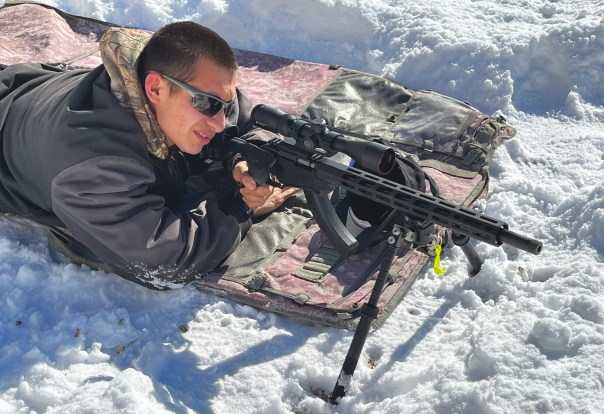
Including a folding buttstock of the rifle made it much shorter for transportation, and doubled as a quick way to remove the bolt for inspection, lube, or cleaning. Up front we had the hammer-forged twenty-four inch barrel inside a free-floated handguard. Cut into the muzzle of the barrel are 5/8-24 threads. Which was great because I planned on mounting some stuff there.
The handguard on my particular rifle uses KeyMod for accessory attachment. But they are also available in the more modern and useful M-Lok. I secured the Atlas bipod to the pic rail underneath, and then I was ready to mount up a riflescope. Continue Reading Here…
A good rifle deserves an even better scope, like the US Optics FDN17x
FIRST SHOTS
Running the bolt forward on a cartridge felt smooth and controlled. I could often feel the slightest bind as the bolt closed the last few degrees. Almost like the extractor was having trouble snapping over the cartridge rims. As I brought the reticle to rest on my point of aim, I took up the slack in the trigger and gave it a steady press.
Repeating the process another four times and made a nice little vertically strung group. I have noticed this tendency during this cold time of year. Particularly when both rifle and ammo are below freezing temperatures.
As the bore warms and each round is chambered into a progressively warmer chamber. Velocity increases slightly and brings the point of impact up a touch with each shot. Horizontal dispersion was minimal, and the overall group size was just under an inch.
That’s not too shabby using what most would consider plinking ammo, and the results were even better when shooting 140-grain match ammunition. I pushed the RPR out to half a mile to see how it performed. As I suspected, it was easy impacts. Recoil on the rifle wasn’t terrible, allowing me to spot my impacts at those extended ranges.
Shooting this rifle go without seeing how it does with a suppressor wasn’t an option to me. To that end, I pulled out my Yankee Hill Machine Nitro N20 suppressor. During my range time I noticed only a small change in point of impact. Likely due to the light weight of the Nitro.
It was beautiful to shoot in the open country of the mountains and listen to the long journey of the bullets. They hissed through the sky before they thumped into the target. I think the RPR deserves a good suppressor, it makes a great little rifle even better.
POSSIBLE DOWNSIDES?
At first, I wondered why they made it a 24-inch barrel versus a 26-inch barrel. After running around with this thing, I understand why. If I had the ability to order the RPR from the factory, I would have done so with a shorter barrel length that was more like 20 inches.
rifle details; notice QD sling cup behind the grip, and locking mechanism for folding stock just above it
Adding a folding stock is great for reducing the length of the rifle, at least when you are trying to transport it. But another one of my complaints has to do with the folding mechanism, mainly that it only locks in the shooting position.
While it’s not a deal-breaker for me, it would be really easy to get something pinched in the pivot point. Especially when the stock inevitably comes swinging back as you try and maneuver it.
The magazine release was also a touch tough for my taste. It was easy to falsely engage the magazine on this rifle to where it looked like it was in. Making you think it was secure, but was not really secured.
Ruger’s magazine release also seemed to require a touch more force than I would expect for such a simple and common motion. This is likely something that can be adjusted or corrected by the user, so don’t worry too much about it.
MY CONCLUSION
As I suspected, the RugerPrecision Rifle 6.5 Creedmoor is just what I thought it would be – a great-shooting production rifle with an entry-level price tag but professional results. Sure, it’s not as nice as the custom precision rifles out there.
And you can feel that it has been mass-produced. But nonetheless, the rifle performs very well in its capacity. It gives the user accurate shots, a familiar manual of arms, and pleasing aesthetics.
Above and beyond that, there are countless ways to customize and improve the rifle with excellent aftermarket support. I have some nice rifles in my safe. I wouldn’t trade any of them for a Ruger RPR, but I wouldn’t mind having a couple RPRs in the safe to give them company.
-CBM
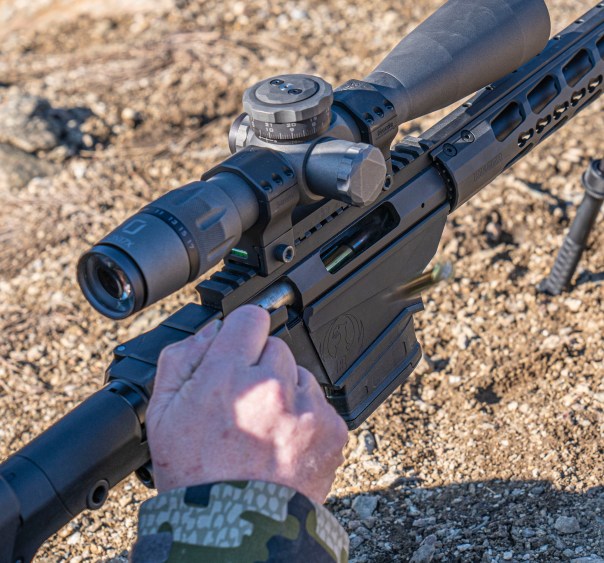
The Atlas bipod makes an excellent addition to the rifle
Sometimes we get the cart before the horse, and I’ll admit that I’ve done a few things out of order over the years. One instance where I think I started at the wrong end was a few years back, when I first put my hands on a Ruger Precision Rifle (RPR). Normally I like to start with a light recoiling rifle, get comfortable and proficient with its function, and then step up to the next bigger platform.
The first RPR I ever shot was the big one, in 338 Lapua Magnum. I later was able to shoot one chambered in 308 Winchester, which was obviously a little softer. And finally today, I have reached the small end of the RPR family, chambered in .22 Long Rifle.
A Natural Evolution
I remember when the first RPR hit the market, it started gaining fans immediately due to its many features and benefits. Ruger’s design quickly caught on to several large groups of rifle shooters, and in the process helped open new shooting activities to those shooters. The RPR at a glance could be mistaken for a Modern Sporting Rifle (MSR) or an AR type rifle, it’s simple yet handsome aesthetics appeal to the Black Rifle crowd just as much as it does to the precision rifle shooting crowd. Ruger was clever in the way the gun was made and marketed, the price-point of the RPR brought affordability to a shooting class that before then had been reserved to expensive custom rifles, or actual sniper rifles.
As the popularity and success of the RPR soared, additional models and calibers were introduced using the same basic idea, and it was only proper to have a rimfire version.
The Ruger Precision Rifle .22LR
The RPR .22LR is a bolt action magazine fed rifle, built in a chassis with fully adjustable comb and recoil pad. The rifle uses an eighteen-inch hammer forged steel barrel which is threaded 1/2-28 at the muzzle to install your favorite muzzle furnishings. The chassis utilizes a free-floating handguard with M-Lok slots for adding accessories, and also uses standard AR type pistol grips so you can install whatever model you desire. The rifle has a built in optics mounting rail atop the receiver and in a brilliant stroke of genius, it was designed to use the incredibly popular Ruger 10/22 magazines, with fifteen and twenty-five round magazines shown in this article. All these intuitive features come with an MSRP of $579.00.
Getting Started
I’m currently on a rimfire kick, so this rifle couldn’t have fallen into a better lap. Upon receiving the rifle, I promptly started the process of fiddling and figuring it out. The rifle came to me with aVortex scope already mounted in a one-piece scope mount, and a few extra magazines. All I needed was a bipod and my Yankee Hill Machine Phantom 22 suppressor and an Atlas Bipod to make this rifle complete.
Luckily for me, I had several great options for ammunition testing. Plenty of the cheap bulk-packed ammo frommanufacturers like Federal and Winchester, as well as match grade ammo from companies like Aguila and CCI. I was excited to see how it all came together in the little RPR. Once I had rifle, ammo, and everything else I needed, I headed to my shooting line to get it warmed up.
Once there, I bore-sighted the scope and started loading magazines. I started with some of the Winchester bulk packed ammo, just to get a close zero. At one-hundred yards it was not particularly impressive, with shots dodging between two and four inches across a five-shot spread.
Running the bolt on the RPR was just a tiny bit glitchy, which I believe is simply getting used to it, and breaking in the action. One thing that I’ve noticed on most bolt action rimfires is that the shorter bolt is more susceptible to binding in the short action, I believe this is due to distribution of force being focused on just a few small surfaces. I have run the bolt on other RPR’s and found the bolts to be perfectly smooth, so it could simply be that this gun is new and needs some working.
I usually don’t use safeties much, I prefer to simply keep it empty until ready to fire. But when talking about 22’s, there will almost invariably be children around. In fact I used the RPR 22 for one of my kids hunter safety course, as it was a perfect fit for him. The safety on the RPR was a little stiffer than I would have liked, the kids actually thought there was something wrong with it. But this again could just be needed to be broken in, not a deal breaker for me.
Still, the adjustments of the buttstock of the rifle made it easy to match it to other shooters like my kids, making their shooting experience even more enjoyable. Though, one other small concern I had was mag feeding. Particularly when loaded to a full 25 rounds, the first few rounds were a little finicky when feeding. This also varied with different ammunition, so it could have had something to do with that as well.
ACCURACY
After trying four different types of ammo, there was clearly a winner. The cheap bulk-packed ammo worked fine but didn’t produce the best results as you might imagine. Both the Winchester and Federal produced groups around 3 to 4 inches at 100 yards, and the CCI was a little better but not much.
As you might imagine, the Aguila Match ammo was superior, producing 10-shot patterns around 1.5 inches. Five-shot groups were even better, some of them even shooting 1/2-inch groups. I was happy with the results, but I would have preferred better accuracy with the cheap stuff. At least I know what to use should I need to head-shoot squirrels from across the creek.
With the right ammo, you can achieve some very nice groupings.
SUPPRESSED
Nowadays, suppressors are becoming more and more popular, so I had to shoot the rifle with a couple of different suppressors just to satisfy my curiosity. First was the Dead Air Mask, followed by my favorite Yankee Hill Machine Phantom 22. Both of them worked perfectly, making the report of the little rifle comparable to the BB gun I got when I turned 10.
In the open Rocky Mountains, it is hard to discern the difference between two rimfire suppressors, but the YHM wins because of it weighs a third less. Shooting suppressed rimfires is addicting, and the Ruger RPR makes it even better with great accuracy and the ability to adapt to each member of the family.
CONCLUSION
It should come as no surprise that the RPR 22 is an excellent choice for a good shooting rimfire rifle. Ruger has near-legendary experience in the rimfire market and adding a .22 LR rifle to the Precision Rifle family was exactly the right move. Despite the few hiccups I had with the rifle, I can hardly see a reason to own a different .22. Unless you have an extremely small budget, or desperately need a semi-automatic .22, you will love the Ruger Precision rifle in .22 Long Rifle.
Ruger joined the AR 15market some time ago, and I’d been meaning to see how well they had done on their initial offerings. But life being what it is, I only just recently got the opportunity. Always a glutton for shooting, I jumped in with both feet.
The Legend
No not the Will Smith movie where he takes poorly aimed shots at post apocalyptic deer of some kind as they run through the city with his M4 variant. Im referring to the 350 Legend, and Will Smith would have probably done a little better against deer sized game had he been shooting 180 grain Federal blue box 350 Legend. But hey, zombie apocalypse makes for strange hunting practices.
The .350 Legend came from Winchester Ammunition. They tout it as the fastest straight-walled cartridge available today. The Legend looks like a straight-walled .223 case with a .35 caliber bullet at the front instead of a bottleneck. Legend ammo can be had from 140 grains all the way up to 255-grain sub-sonics, making it very adaptable to your purposes.
THE RUGER MPR
TheRuger MPRis like most AR-styled rifles, and it has all the familiar controls and features. The only difference between this and many others I’ve shot (besides the obvious .35 bore) was the use of a .350 legend magazine and a shorter gas tube.
As tested here, the rifle featured a 16-inch barrel, taking up just half of the overall length of 33 inches when the buttstock is collapsed. The rifle weighs in at 6.5 pounds and comes with Ruger’s Elite 452 two-stage trigger. The muzzle is threaded at 1/2-28 and comes with Ruger’s own radial ported muzzle brake.
I installed just a couple of accessories to the rifle prior to testing. First was one of my standby optics, an LVPO fromU.S. Optics. Second, I added a bipod to the hand guard for better stability when needed. Lastly, I ran the rifle with two of my newest 9mm suppressors from Yankee Hill Machine, the Nitro N20 and the R9.
Before I had even made it to the range though, the rifle was quickly gaining my favor. Just basic handling of the gun proved it to be lighter than I was used to – a welcome feature that made it quick to shoulder and point. Fairly standard collapsible Magpul MOE stock and pistol grip felt like a perfect match to the rest of the rifle. The trigger that Ruger put in this rifle felt very serviceable at 4.5 pounds. It was great for almost any situation I would use this gun. A 45-degree safety was another nice feature I hadn’t expected.
PACKING LIGHT IN THE MOUNTAINS
After some playing around in my basement for a bit with the rifle, I decided to take it for a hike into the mountains. I purposely left without a sling because the lightness of the rifle impressed me. I wanted to see if that impression remained after hauling it around for a mile. Before leaving, I stuffed a box of Winchester 145-grain FMJ ammo into my back pocket.
The Ruger MPR proved to be an easy rifle to haul up the mountain
As I walked up the partially icy trail, it was immediately evident that this lighter rifle was far more pleasant to pack than what I was used to carrying. It was easily carried around in one hand either by the grip or around the handguard.
In what seemed like a shorter time than normal, I found myself at my shooting spot. I surveyed the landscape as I caught my breath. A bit of movement caught my eye just across the canyon from where I was perched, a young deer made its way up the opposite ridge, perhaps having heard or seen me.
PRACTICAL ACCURACY TESTING
I had previously bore-sighted the scope before leaving the house, so my plan was to see how close I was by shooting into a small dirt pile clearing approximately 100 yards in front of me. With my U.S. Optics scope zoomed into 6x, I took a few preliminary shots. Hitting just a few inches high and right. After a few minor adjustments, it was on target.
I wasn’t expecting a significant amount of recoil, as I’d shot plenty of .350 Legend in the past through my Desert Tech MDRX. But this Ruger was a significant amount lighter, so I thought this might increase the recoil I felt. Whether it was the muzzle brake or the suppressors I mounted, this rifle was a smooth and soft shooter. It was easily something I could put my 12-year-old daughter behind.
The Ruger MPR is a capable deer rifle.
After a few rounds getting comfortable with the rifle, I decided to see just how useful the rifle would be had the deer I saw been a buck. I looked back to the spot where I had seen the deer, and there in the game trail was a patch of wet dirt. Likely, it had been snow only hours earlier before the sun had its way. The wet patch appeared to measure eight or so inches, and I figured it was as good a test as any. This was deer country at deer ranges, and the scenario could have easily played out during deer season. But was the rifle up to it?
I fired a few shots at the wet patch of earth, easily hitting it and sending mud splattering across the clean white rocks nearby. The distance was just over 180 yards. With the ability to make hits on vital-sized targets at that range, it seems like a no-brainer. This rifle would make an excellent deer rifle within the envelope of the Legend’s capabilities. With its lightweight and easy manipulation, a person could handily take down a deer inside 250 yards.
I think the six-power scope is a great partner for this rifle. It provides quick target acquisition and engagement for those shorter distances inside 300 yards. The muzzle brake provided by Ruger seems to tame the already light recoil to a very soft impulse, giving you plenty of control for multiple shots should you need them.
ACCURACY
I shot the gun on paper to see how it performed concerning accuracy, and the results seemed to be on par with what I had seen in the field. Groups averaged just under an inch at 100 yards, certainly good enough for smacking deer and hog-sized game within a reasonable distance. This gun seemed to prefer the heavier ammunition, like the 170 and 180 grain from Federaland Hornady. That is fine by me, as that seems like the appropriate proportions for the above-mentioned animals.
The Ruger MPR proved to be very accurate in formal testing as well
CONCLUSION
I was pleasantly surprised by this little package. It was light, handy, and very functional. The great benefits of the AR platform are exemplified here in what would make a perfect little ranch gun, swamp shooter, or even apocalyptic urban deer slayer.