I’ve been on an LVPO kick for a while now, I find them to be very useful for a great many purposes. Despite my focus on precision and long range shooting, LVPO’s still make up a good portion of my optics selection. Today I want to take a look at a new to me LVPO, the Sig Sauer Tango MSR 1-6×24 riflescope
Having had a couple different experiences with Sig Sauer Optics starting with the Tango series of scopes as well as another LVPO the Tango 6T. I have really enjoyed these different scopes and largely I have had few problems with them. So when the opportunity to check out this Tango MSR I was very excited to get hands on it.
As I opened the box, I was glad to see that Sig even includes a quality ALPHA-MSR scope mount in the box. That easily narrowed down my mounting decisions. I will say I was surprised with everything included with the scope, and I’ll be honest that going in I had only a vague idea of the price of this scope. The mount, the typical tools that come with it, battery for the illuminated reticle, and some quality flip caps were also included. They are branded Sig but look to be either Tenebrex or a really close knockoff.
Either way they are very nice and lay flat against the scope when open. The MSR also includes a throw lever or “cattail” as its often called, this is handy for quick adjustments of the magnification. Sig’s Tango MSR is a second focal plane scope, that means the reticle stays the same regardless of magnification setting. The scope adjustment turrets are MOA and have .5 MOA clicks. And the scope body has a centerline painted on the exterior of the tube, to help ensure level mounting I believe and it surely did that. In a very short time I had the scope married to it’s mount and ready to install on a rifle.
The Tango MSR was a perfect fit for the Sig Sauer MCX
First Shots
Luckily I happened to have a Sig Sauer MCX rifle in hand at the time, it seemed like a perfect fit for the MSR. I was more correct than I could have known.
After installing the scope onto the pic rail of the MCX, off to the range we went. The MSR seemed to be made for the MCX as I didnt even need to adjust the scope for a good zero. Once I started shooting everything lined up like they came from the factory that way. We spent some time shooting the rifle at fairly close distances inside two-hundred yards, but I also utilized the reticle for a few extended distances. The reticle features a typical upside down horseshoe type reticle, with several drop points and wind holds. Its name suggests that the MSR is designed specifically for Modern Sporting Rifles (MSR), and the BDC6 reticle is calibrated for the most popular MSR cartridge the 5.56 Nato. As I mentioned earlier, I purposely didn’t look at the price of this scope before reviewing it. I was previously very pleased with the optical quality of the Tango 6T. This Tango MSR is not quite as high quality, but still very clean and clear. I was surprised to see the price point after playing with it. One would have expected it to come in the 600-800 dollar range. But for the MSRP of $422.99 I think this scope is a great value.
I also bolted down the mounted scope to a bench, and measured the turret values against the reticle values which all checked out. The reticle values are handy to keep in mind, or you can refer to the owners manual where they are listed.
It may not line up perfectly with the drop of your particular ammunition and atmosphere. This is why I typically don’t care for calibrated reticles. That said, if you know what value they represent you can use them for all kinds of shots and hold overs.
note MOA values of the BDC6 Reticle
Pros & Cons
In my opinion, the Tango MSR is a great little scope for its intended purpose. Optical clarity is great, the magnification ring is quick to adjust and its throw lever helps make it even better. The 1X power setting allows for easy both eyes open aiming, without straining to focus. The quality accessories that are included also greatly add to the value of this scope. Including the mount is a perfect match for the scope as are the the scope caps. Perhaps one thing I would change about the scope is probably the reticle. I’m not a big fan of the horseshoe type reticles. Though it does have lots of detail to allow holdovers and windage etc. Which makes it certainly a very useable reticle. I also wouldn’t mind having an MRAD version of the MSR. But to be perfectly fair it’s not the type of scope you’ll be dialing all over with so it’s probably fine.
Conclusion
The Sig Sauer Tango MSR is a great little scope. I would highly recommend it for anyone who is looking for an LVPO in this price range. It has a great deal of value added as well as performance capability.
I’ve been severely hooked on both hunting and long range shooting for more than a few decades, so laser rangefinders are nothing new to me. I still remember saving up what seemed like an eternity to purchase my first one, an LRF I could barely afford but would actually hit a thousand yards and beyond reliably. All these years later my laser has migrated into a good pair of bino’s which are a must have for spotting animals in these Rocky Mountains. But the me from twenty years ago would never believe just how much else has migrated into the binoculars I carry. Today we are looking at the Sig Sauer Kilo 10K Binoculars.
Sig Sauer Optics
Sig Sauer jumped into the optics market with both feet, and like their products or not they have been innovating all over the optics world. They worked hard enough to earn my business a few years back when I bought one of their Tango 6 5-30 riflescopes.
I have had the good fortune to sample a broad spectrum of Sig Sauer’s Electro-optics. Enough so to become quite confident in giving them more hard earned money. The Kilo 10K is that latest purchase, a pair of consumer grade binoculars that feature arguably military grade functions. I decided that I was due an upgrade, and spent the money.
The Kilo 10K Binoculars
I have been using another pair of 10X42’s for the last few years, but a friend bought a pair of the Kilo 3000 binoculars and I quickly noticed they seemed better to my eyes than the binos I was using. The Kilo 10K is a significant upgrade from the 3000 model, with so many features I’ll have to keep it short to avoid this page taking all day to load.
Besides Sig’s standard features such as their Ballistic Data Exchange (BDX) and their various lens coatings and armor, the real juicy details are all encoded inside. The Kilo utilizes second generation Lightwave DSP ranging engine that has various ranging functions that allow you to range reflective targets as far as 10,000 yards away. I was dang sure gonna try that out.
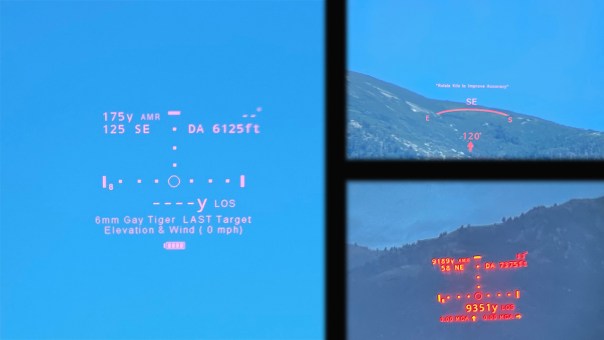
Some of the data displayed in the Kilo 10K Heads up display
The onboard system also has all the sensors needed to calculate real time ballistics via Applied Ballistics Elite ballistic calculator. Instead of pairing to your phone application the Kilo does it all inside. Spoiling you with an incredible array of information right in front of your eyes. All this without ever taking your eyes off the target.
The internal systems of the Kilo also have compass and GPS functions. You can see compass headings and such right in the binocular heads up display, angles of incline are also displayed. And you can mark waypoints in your travels using the Basemap application.
The aforementioned Applied Ballistics (AB) software allows you to store up to 25 different profiles in the binoculars using their complete bullet library. So you can always have you favorite load cued up. The Kilo 10K reads all the relevant atmosphere information to give you a corrected firing solution. Including current density altitude conditions, and even a wind meter for accurate wind speed measurement.
Figuring out the Sig Sauer Kilo 10K
I was a bit apprehensive about having the brainpower to figure out and run everything the Kilo 10K offered. After reading through the manual a few times, I was less so.
The Kilo can be configured using the buttons controlling it, or using the BDX phone application. I went about changing a few of the settings to better fit what I thought I would like, it didn’t take long to figure out. The menu allows easy switching from meters and yards, as well as MOA to MRAD. Using the onboard sensors, the Kilo provides the air pressure, temperature and humidity. You can configure the system to automatically measure the temperature or you can input the temp manually if selected. You can also select manual input of other atmospheric data using the app on your phone.
The heads up display on the Kilo 10K is incredibly informative. it gives you distance (both actual and angle corrected) shooting angles, and wind corrections as dictated by the bluetooth connected wind meter. I was very please to see that even a milling reticle can be chosen to aid in spotting for corrections.
Ballistic data is displayed both through the binoculars as well as on the phone display, this could enhance a fire teams ability to make quick shots
After several trips into the hills to simply play with and look through the Kilo 10K, I decided it was time to get serious.
Data Input
I replaced the factory preset data that came set for a .308 175gr SMK, and entered in all the data for the 6mm GT I was planning on shooting. All the data is easily entered via the BDX app, and no sooner had I input my data, the Kilo synced everything up with the tap of a button.
The AB calculator uses a bluetooth wind-speed anemometer to capture the speed of the wind. As well as temperature, humidity, angles, and all the other pertinent information is captured and fed into the system.
the whole kit
One slight complaint I had was from the wind meter itself, it measures the wind just fine. But the direction of the wind has to be put in either through the app on your phone (fastest way). Or you can also do it through a quick access menu on the Kilo itself. The quick switching nature of the wind makes me wonder how challenging that data point might be to maintain accurate. I was hoping there was a way to index the wind direction using the compass heading from the GPS.
There are a great deal of customizable options to change how the data is conjured before your eye. The heads up display menu was clear and quick to cycle through despite having to do everything using only the two external buttons on the binos. I have used AB for some time, so my confidence in the ballistic calculations were good. I wanted to see how the interface with the Kilo lined up, to see if it was as simple as point, laze, and shoot.
Hunting Country
On a blustery summer evening, I made my way into the Wasatch Mountains to do some additional testing of the Kilo’s capabilities. The storm front threatened to bring rain, but for the most part all I got was gloomy cloud cover. The high winds carried a visible amount of dust and debris. This had me concerned at how well the laser would reach. But I was quite surprised to see the Kilo light up with just over five-thousand yards, over two-point-eight miles away.
I decided to hit something even further still away, from my perch at over six-thousand feet (9,189 DA according to the Kilo) I could see my house below. I figured the siding would be reflective enough to hit at significant distance. So I pressed the button until it came back with a reading, and it did several times. Nine-thousand three hundred and fifty-one yards it read, that’s five point three miles away as the crow flies.
I checked my Basemap app, to see that the waypoint popped up marking my house. Had I needed to I could have just walked home in the dark using the Basemap as a guide.
Ballistic Data
I did some truing of the data in AB for my 6GT load to see that it lined up with confirmed data I already had saved. It was absolutely brilliant to see a firing solution populate in a second or so. With nearly all the data I needed to make the shot. The Desert Tech SRS M2 6GT shoots very well out to fifteen hundred yards or so. I wanted to see how quick I could go from spotting targets to seeing impacts at various distances. So I played my mock hunting game where a suitable sized target is picked out, and I engaged it as fast as possible as if it were escaping. The trued data from AB via the Kilo lined up beautifully. This allowed me to make hit after hit with minimal delays between shots.
If the system was utilized between a shooter and spotter team, you could put an amazing rate of fire on targets. With a spotter using the Kilo, you could range targets and have the firing solution show up on the shooters phone screen without so much as saying a word. Both could see the live data displayed. And as soon as the next target is identified that data would pop up on the shooter’s screen. You can even actuate the rangefinder from your phone through the app. Once paired, you can touch the range button on your phone screen to activate the rangefinder remotely.
I created a second profile for my favorite twenty-two inch 6.5 Creedmoor, just to see how to cycle between profiles. As with other operations inside the Kilo, it was quick to pull up the menu and switch between profiles and other settings. As I used the internal menu of the Kilo I got much better at changing rapidly the settings. Continue Reading Here…
PROS & CONS
Cons
Today, I’ll start out with the cons, just to get them out of the way. The Sig Sauer Kilo 10k is as much a system as it is a single product. And the system relies on its multiple components for maximum performance.
That said, I don’t think they could have chosen better partners. AB is an extremely well-known ballistic-solver system. And Basemaps also has a great reputation and provides very valuable information. One downside that I found was that the Basemaps’ App required a Pro upgrade in order to use the Kilo as an add-on tool. This isn’t a huge deal, but it’s one worth mentioning.
I did have one apparent malfunction while testing the Kilo, where it did get quite warm from sitting in the sun. It was a hot July day, but I wouldn’t have considered it too hot for the Kilo to work. Much like an iPhone left in a hot car, the Kilo just stopped working, as though the battery was dead. I even replaced the battery thinking maybe I had overused it. But after sitting in the house for a few hours, it fired right back up with the battery showing full power. I haven’t been able to reproduce the problem, so I hope it was simply a fluke.
Pros
The pros of the Kilo10k system are many and hard to list. If you’ve read this far, you have already been over all the functions that I consider beneficial. So, I’ll keep it short by naming my favorites.
First off, there are the ranging capabilities. The Kilo ranges much farther than almost any of us will ever be shooting outside military applications using artillery. It is still nice to have the ranging ability. And the Kilo makes a good navigation tool as well because of its broad capabilities. The Terrapin Xhas long been considered top of the heap as a rangefinder. Though I have heard from several people that they have had better luck at extreme distances using the Kilo 10k.
The lens coating and armor are great, but the real money is inside this compact computer of an optic
Heads Up Display
The heads-up display is very intuitive and gives you almost everything you need quickly. Important information appears larger than less pertinent information. But everything you want from a rangefinder is there. And the HUD reticle gives your spotter some reference as well.
The Kilo’s carry case is very nice and well thought out. There are two pockets for carrying small accessories, and a pigtail lanyard to keep the wind meter attached and close. The multiple profile options and quick syncing features make the Kilo incredibly useful for a guy on the move between one hunt or another. Especially if you are switching between multiple calibers or spotting for multiple shooters.
Conclusion
Sig has once again knocked it out of the park with this pair of binoculars. Admittedly, I have never been a big optics snob. But I find them optically superior to most comparable options, that is if you can find something close to the Kilo as far as its capabilities are concerned.
The Kilo does what it says, and I intend on taking full advantage of its well-thought-out features in the years to come. The only thing left to test is that of time and durability. Follow me to keep tabs on how the Kilo 10k performs in the future.
Last year I did have to send the Kilo back to Sig for some kind of apparent malfunction with the HUD. It was repaired quickly, and returned. I have used it for two hard hunting seasons since without any issues at all. In fact I have come to love these binos even more several years later.
Sig Sauer perhaps leads the market with a plethora of new firearm products every year, and of course among those many items are their always popular pistols like the Legion series and the countless models of the Sig P320. With all these hot releases and choices, it can be easy to forget some of the old standby pistols that Sig has made in the past. At the risk of sounding like the old guy trying to convince you to trade your Glock for a 1911, today I’m here to tell you about a few classic Sig pistols and why they deserve your time.
The P220
The P220 is an aluminum framed single stack pistol, chambered in the Automatic Colt Pistol caliber .45. It uses a double action (DA) trigger and an magazine with room for eight rounds. As with many of the older Sig pistols, this P220 is safety-less. The controls are extremely simple using only a trigger, slide-lock, and a de-cocking lever to safely lower the hammer. The mag release is in the traditional spot, all these controls are comprehensive and easily manipulated. It also has a low-slung accessory rail up front for installing weapon lights.
This P220 happens to be one of the fancy German made ones, and it also features a threaded barrel for installing a suppressor. I intended on running my Silencerco Octane 45 to see how they played together. With a few boxes of 230 grain ball ammo, the 220 and the Octane in hand I hit one of my shooting spots.
I don’t shoot much .45ACP very often, but it sure felt powerful coming out of this Sig. The full-size pistol felt perfect in my hands, its grip and angle match my natural point of aim. Hitting targets with the heavy and slow bullets was very enjoyable, even more so once I installed the suppressor. The naturally subsonic bullets of the 45 made shooting the suppressed P220 pure joy, I could have perhaps benefitted from taller sights but had no problem hitting what I aimed at.
The P220 has everything from classic firepower to the iconic looks of a service grade pistol. The trigger still feels fantastic all these years later, and the pistol’s function was flawless. The gun is obviously a little heavier than more modern pistols, and everyone but the old 1911 guy would probably like more magazine capacity. But despite those few things, I absolutely love this pistol. The heavy weight tames the movement of the gun significantly, making it smooth and deliberate in every motion.
The P239
One of the reasons that the P220 was so easy and familiar to me, was that it has the identical controls and design as my P239. I bought this pistol shortly after Y2K for those old people out there who remember phones with cords, though none of that had anything to do with my purchase. I bought the P239 because I was a freshly minted CCW carrier, and my taste then was just as good as it is now. Years later I found while reading that the P239 was frequently used as a concealable or backup pistol by agents and SEALs.
Much like the P220, the P239 is a single-stack aluminum framed DA pistol. The aforementioned identical controls are easily manipulated, and the only changes made over the last two decades has been a Hogue grip. The soft edges of the pistol and its low profile sights make it an easy option to conceal and draw.
I’ve carried the P239 for nearly half of my life, so nothing could feel more comfortable to me when shooting. And like it always does, the 239 functioned flawlessly during my latest trip afield. Shooting both 115 and 124 grain ammo, the P239 was right at home hammering targets. The eight-round magazines are solid and easily changed, and having several of them made reloads and multiple engagements quite fun. My wife who is significantly more petite than I also found the P239 to be easily handled and fun to shoot.
I typically carry this gun with the hammer down, which is easily done using these pistols. One need only pull the trigger whilst whistling Dixie. Both the 239 and 220 proved to be quite accurate, but the P239 and I have pulled off some near unbelievable shots over the years. Including the decapitation of a rodent on the first shot from sixty-nine yards, whether you believe that or not, you can certainly count on this gun shooting accurately.
The Mosquito
Before the Sig P322, there was a Mosquito. The Mosquito is a .22LR chambered pistol that basically mimics the P series of pistols. It does use a polymer frame however, with an alloy slide and this one does have a safety. Not sure why, perhaps due to the idea that it may be used by young shooters. Other than the safety, the Mosquito is again identical in its controls and function to the other two pistols mentioned here. It does feature a pic rail for adding your favorite accessories under the front. The single-stack ten-round magazine is familiar and simple, much like every other 22 pistol from that era. Continue Reading Here…
The Mosquito has been known for being finicky about ammo. I have found this to be true as well. In order to keep the little pistol popping, I always run high-velocity ammo through it. Ammo like Velocitors or other rounds that run at 1200+ fps offer reliable loading. Other than that, and the limited 10-round magazine capacity, the Mosquito is a great little pistol.
CLASSICS STICK AROUND
These are just three of the older Sig pistols that can be found all over the world. So, while you may be fawning over the latest Spectre Comp or P320X, keep in mind that there are some truly classic pistols out there that can really make you appreciate what a pistol can be.
It’s true that they sure don’t make them like they used to, so it may not be a bad idea to grab one of these older pistols while they are still relatively easy to find. Regardless, I can guarantee you that these three aren’t going anywhere soon.
Low Power Variable Optics (LVPO’s) have been flooding through the firearm market for years now. This is likely due to the proliferation of medium-range carbines. It didn’t take long for shooters to realize the value of variable low power optics, but what makes an LVPO shine over another?
Sig Sauer has long been a big name in the firearms industry. I’ve been a big fan as long as I’ve been a gun owner. So it came as no surprise several years ago when Sig brought their own line of optics to market. What was a surprise, at least to me, was how invested I would get.
Sig Sauer Tango Riflescopes
My first Sig Sauer optic was a Tango 6 5-30. A high powered riflescope with all of Sig Sauer’s bells and whistles. It has been a great scope for several years, and still enjoys its place on one of my favorite rifles.
The 6T features Sig’s high quality, clear lenses for which they are well known. The 1-6 power 6T features a 30mm tube and a front focal plane 5.56/7.62mm/300 Blackout Horseshoe Dot ballistic reticle with illumination. There are a couple of different configurations for the 6T, the one I ordered came in Flat Dark Earth only. It also features a line lengthwise down the side of the tube. Which eases the scope’s mounting by giving a reference point. This allows users to evenly seat the scope in the rings. A “cattail,” or clamp-on handle, gives the user better purchase when adjusting the magnification setting. I mounted the Tango 6T in the Strike Industries ASM mount, an adjustable scope mount that can cantilever the optic out to several different positions. After mounting the scope, it was time to zero it — an easy task using the finger adjustable turrets. When not in use, the turrets are capped. I installed the CR2032 battery into the illumination turret and lit up the Horseshoe reticle. The 8-position rheostat has an off setting between each number and a push-pull lock to avoid accidental adjustment.
On the Range
My first impression on the range was the image. My eyes were swept from their sockets by the crystal clear and bright image. I am more of a 1-8 fan than a 1-6, but this 1-6 is so beautiful I would have a hard time turning it down for more magnification. The Tango 6T has parallax set to 150-meters, so shooting targets further out isn’t a problem. This was very convenient because I ran the Tango 6T on two different rifles, both capable downrange performers. I first mounted the scope on the Armalite M-15 Comp Rifle, a match-grade competition rifle built specifically for 3-Gun. I found the M-15 to be very accurate, and with the Tango 6T mounted, it was a nearly unstoppable setup. The low power setting of the Sig made closer targets easy to engage accurately with both eyes open. Zooming in to 6X gave me enough magnification to pick out distant targets, while the Horseshoe reticle offered handy hold points for those distances.
I never expect ballistic reticles to match perfectly. It’s nearly impossible unless you are shooting the same ammunition in the same conditions as those who designed the reticle — the same goes for custom scope turrets. The good news is that it’s pretty close. Modern flat-shooting cartridges have a fairly similar trajectory so drop points on the reticle are close enough to be useful.
After testing the Tango 6T on the Armalite, I moved it over to theDesert Tech MDRX. The MDRX is a multi-caliber rifle, and I shot it with both .223 Remington and 6mm ARC barrels. The Tango 6T felt right at home on top of my MDRX, a much more compact rifle than the Armalite. Maneuvering around obstacles for shooting positions was much easier, and regardless of how close or far away the targets were, the Sig provided a beautiful sight picture with bright images.
I keep bringing that up, but the optical clarity may be the part I like the most about this scope. There is more to the Tango 6T than just optical clarity, though. The engineers at Sig paid attention to so many little details like the texturing of control surfaces, high visibility green fiber optics markers around the magnification ring, and other little features that make you feel good about purchasing this scope.
The turrets of the Tango 6T are 0.2 MRAD per click, which matches the MRAD reticle inside. The clicks are very clean and audible, and the grip surfaces inside the turrets are rubberized for easier grip, whether using gloves or your bare fingers.
As far as the reticle itself, this might be one place where I wish they had put just a tiny bit more effort into it. Some people like a simple and clean reticle, while others like a reticle with many hold points to use. Being that I am a bit of a distance junkie, I find myself in the second camp. I like a reticle with plenty of hold-over positions, and accompanying wind holds as well.
While the reticle in the Tango 6T is plenty useful, it wouldn’t have hurt my feelings to see a bit more detail to the reticle. That said, Sig also offers the 7.62 Extended Range reticle in this scope, which is better for that kind of shooting. I completely understand that most people might not need or care about this, and if you like just a few simple hold-over points, you will more than likely love this reticle.
Concluding Thoughts
In a market flush with many great options across nearly every price range, the Sig Sauer Tango 6T stands out as a spectacular LVPO. You would have to spend significantly more money to get a noticeably better scope with the same features. Not to mention, the Tango 6T is significantly better looking than scopes that are only 10 to 20 percent less on the market. At least, in my opinion, it would be worth spending a little bit more to step up to the Sig Sauer Tango 6T.
Every hunting or shooting trip has a list of essentials, and at the very top of that gear list you’ll find things such as guns and bullets. But for many of us, it’s not very far down that list that you’ll find binoculars and rangefinder. Today we are discussing the Sig Sauer Kilo 3000 binoculars, which bring the laser rangefinder and binoculars onto the same line.
Built on a 10x42mm body, the Kilo 3000 BDX offers an integrated laser rangefinder that claims up to a 5,000-yard range. Using Sig Sauer’s BDX tech, the Kilo communicates with other smartphones and tablets via Bluetooth. BDX pulls data from weather stations like the Kestrel Weather Meter to offer accurate ballistic solutions. The system also uses the Applied Ballistics solver to give shooters the best prediction for a hit. The BDX system can be used in conjunction with Sig Sauer’s BDX equipped riflescopes to show holdover and wind holds in live time with illuminative points on the reticle.
The Kilo uses a single CR2 lithium battery for powers and, according to Sig, grants approximately 4,000 chances to measure the distance to your targets before the battery needs a change. The Kilo weighs in at 31-ounces, which is almost the exact same weight as is nearest competitor.
ON THE RANGE
The vast expanse of the Rocky Mountains is the perfect place to put a rangefinder/bino combo to the test. I spend a couple of days each week shooting in these beautiful landscapes; so, I headed up to one of my favorite trails to test the Kilo. Before I left, I suited up with the chest harness that ships with the Kilo so I could hike hands-free.
The Kilo rides securely in a case around the wearer’s neck for easy access.
Having used quite a few different binocular chest-carry outfits, I think comfort is subjective. This one, for me, wasn’t too bad. Both the case itself and the binoculars are suspended from the shoulder straps individually. The bino straps are easily snapped free should you need to disconnect them to lend a fellow hiker. Overall, I liked how quick it was to bring the binos out of the case.
Hiking into the mountains
After a good sweat from the hot August sun, I found myself looking out across a steep canyon that worked its way back into the rocky and cavernous mountain range. It was a place I frequent fairly often so I already knew a lot of the distances available to me. I sat down and began to scan with the Kilo. My very first impression of the image quality was positive.
After using many LRF binos over the years, I would put the optical quality of the Sig Kilo right near the top of its price point class. It is similar to models from Vortex, Nikon, and Leupold in the same price range. Perhaps a little better than some, but not quite as nice as the top-quality optics we are accustomed to seeing from European manufacturers like Swarovski or Leica.
One thing I did find more convenient was the focus. Using other binos, I find I must frequently adjust the focus between my eyes to get a uniform image. With the Kilo, though, I only adjusted once and never touched it again. A small issue for some, but for me it’s almost reason enough to sell my other bino models and stick with the Sig Kilo. Like most modern binoculars, the Kilo 3000 features adjustable eyecups. Like the entire exterior of the binoculars, these are rubberized for easy gripping and the control surfaces of the binoculars have an added texture as well for better manipulation.
Ranging in the wild touched to 3,000-yards, though Sig boasts a range up to 5,000-yards.
Rangefinder Performance
A good rangefinder is only as good as its ability to precisely confirm distance, so I was eager to investigate the Kilo’s laser dispersion. Laser dispersion becomes important when ranging a target with obstructions. Such as a tree branch or ridge between you and the target. Keeping the Kilo firmly fixed to a tripod, I measured the distance to several targets with surrounding obstructions.
Most targets inside the reticle of the Kilo registered the actual distance. But even something as insignificant as a leaf 380-yards away obstructing the view of a 950-yard target was picked up by the laser. All things considered, the Kilo’s laser gives a very accurate and predictable measurement. I used the Kilo both in its range-only setting as well as the incline output setting.
Shop Sig Sauer Optics at EuroOptic for a complete lineup
The rangefinding capabilities of the Kilo were more than adequate for my purposes. I’ve found most rangefinders are rated for distances at the extreme envelope of their capabilities. Sig claims the Kilo can hit 5,000-yards. But I couldn’t find a target reflective enough to read that far during my testing. The Kilo did work great inside of 2,000-yards giving quick and repeatable readings for trees and even rocks in shadowed or sunny positions. I aimed it in town from my 6,000-foot perch and found that cars and buildings were ranged out to 3,000-yards.
CONCLUSION
The Sig Sauer Kilo 3000 rounds out any gear list this hunting season.
The Kilo 3000 is yet another awesome product from the electro-optic branch of Sig Sauer. Outdoorsmen and women looking for a good pair of hunting binos would do very well with the Kilo 3000 in-hand. Having used many of its closest peers, I’d pick the Kilo.
When a company like Sig Sauer jumps into the optics market, paying attention is a must. I was more than happy to get my hands on a couple specimens early on, and I was very happy with my purchase. The Sig Sauer Tango line of optics is marketed towards precision shooters, long-range shooters, and hunters, as well as tactical marksmen in the LE/MIL community. I’ve been exposed to quite a few good optics in that realm, so I wanted to see how Sig stacked up.
For the purpose of this article, I will be comparing two of the Tango series of riflescopes. One is the Tango 4 which is a 4-16X44, the other is a Tango 6 5-30X56. The comparison will simply be an evaluation as these scopes are peers of different levels and price points.
For starters, let’s look at the features they share, then we will look at them individually. All Tango series scopes feature Sig’s HDX coated lenses for optimal light transfer, waterproofing, Lock-Down turrets, and one free laser-etched turret that is matched to your custom load data and atmospheric conditions. Both the T4 and T6 are Front Focal Plane (FFP) optics, which means the reticle is placed after the magnifier inside the scope. This means the reticle will grow and shrink with the magnification setting. I prefer this configuration as it makes reticle usage more uniform, regardless of the power ring setting. Both scopes are available with the MRAD/Moa milling reticle, or the Mrad/Moa DEV-L reticle, for those that prefer one system over the other. The T4 and T6 also have the available MOTAC™ (Motion Activated Illumination) that initiates when motion is detected and shuts off when motionless.
The differences between the two scope are probably where most people are going to make a choice. The T4 is a 4X scope, and the T6 is a 6X, the T6 allows a wider choice of magnification from 5X all the way up to 30X. The T6 also has a larger diameter tube, it’s 34MM tube allows the T6 a greater internal adjustment range. To this larger tube is owed the 12 MRAD (30 MOA) per revolution of the turret. The slightly smaller T4 has a 10 MRAD (25 MOA) of adjustment per revolution of the turret. The 4X magnification on the T4 also gives it a shorter magnification range of 4-14, depending on your application these two different ranges of adjustment could make your choice for you.
The T6 that I purchased, also features Sig’s Level-Plex anti-cant system. It is a digital system that uses internal sensors to tell you when the scope is level or not. When engaged (by pushing the outer end of the parallax turret) there are two small illuminated arrows visible through the reticle. You simply adjust the cant of your rifle following the indicators, and when the rifle is level the indicators go dark, showing that the rifle is level. It is a simple and very quick to use system.
On the Range
Turret and other control detail on the Tango 6
Shooting the Tango 4 and 6 made me like them even more. The overall clarity of both Sig Sauer Tango riflescopes was very good, and the bright images made target acquisition and spotting hits and misses a piece of cake. Whether in the bright midday sun or in the waning light of evening, I found the scopes presented more than a satisfactory image. I did find that for shooting groups that I really appreciated the 30 power magnification of the T6, and the DEV-L reticle provided very precise measurements for both corrections and wind holds. The simpler MRAD Milling reticle in the T4 was also very useful for those who might want a reticle that isn’t so busy. And the lower magnification of the T4 made it a great option for my hunting rifle. Lighter, smaller, and easier to quickly bring onto target. The process of zeroing the scopes, and setting the zero stop was simple, quick, and effective. In no time I had them zeroed, and was dialing them up and down for distant shots. The Level-Plex system on the T6 proved to be very handy in the field, a simple push of a button engages it, and I never had to take my eye off the target. And it turns itself off after a few minutes. I also like the locking turrets on the scopes, raising them unlocks the turret for smooth rotation, and once set, you can push them back down to lock them in place and avoid accidental adjustments. If I had to say I didn’t like anything about the scopes, it would probably be regarding the sliding up and down of the turret. I have no basis to prove this theory other than feel, but it seems that when the turret is raised it is not as firmly supported. It feels as if you were to knock it against something hard in the up/unlocked position it could be easily broken. Again, I have no evidence to prove that, it is just a simple observation. To be fair it feels rock-solid when it is down in the locked position. Perhaps the only other gripe I have is likely a simple defect that is easily repaired. The two fiber optic illuminators that indicate the setting on the power ring seemed to be poorly mounted on my T6. One of them came out and was lost, not a big deal, but something worth noting. I usually don’t focus too hard on the actual setting of the magnification ring anyways, I just adjust it till it looks right to my eye, and shoot.
Conclusion
I think that both of these Sig Sauer Tango riflescopes are fantastic scopes, they definitely come in at two different price points so you can pick one the one that best fits your budget. The T4 at its $719.99 MSRP is a great competitor for the sub $1000 FFP Milling reticle scope market, I think it would compete very well against any scope in that group. The larger and much more expensive T6 MSRP $3,119.99 (as tested) is in another group altogether. I would say pending a few more hard trips into the rugged mountains, and it surviving the beating therein, I would put it against any scope in the 2k to 3k dollar range. The quality is there for sure, the only concern I have yet is with durability over time, but so far I have no reason to think it won’t clear that hurdle as well. It is quite clear that the engineers at Sig Sauer took great care in every little feature, whether it is the griping surfaces of adjustment knobs, or something as simple as aesthetic angles and accessories. And with an unlimited lifetime warranty, you can confidently put one of these scopes to work today.
I am a sucker for optical doodads, and usually anything that is heavy and comes in a small package. That said, I’ve never been a huge proponent of large or bulky spotting equipment. Sure, there are advantages to them, but for the kind of shooting I usually do and am involved in, they are a bit more than necessary. Most times, another rifle scope of similar magnification and quality will do, especially if it is mounted to someone else’s rifle, who can tell what I’m doing wrong.
I do have a small field spotter, it works very well for what I need, and it has a handy reticle for making corrective calls a “breeze”. Other than that, the scope on my rifle, and a good rangefinder, I have never felt much of a need for more. Once again I was forced to challenge my own prejudice regarding equipment, when a friend handed me a small package with the instructions to “try it out”.
As I opened up the box which I had been told contained a spotting scope from Sig Sauer Electro-Optics,I thought for sure that I had the wrong package. But further investigation revealed it was indeed a spotter, just a more compact one than I had expected. It was the new Oscar 3, which is a handheld 10-20X image stabilizing scope.
Perhaps some of you are thinking the same as I did, “what good is a handheld spotter at 20X?” but having been surprised by Sig Sauer on more than one occasion, I decided to save my judgement until after a good field testing. I took it straight to the roof, and began scanning the neighborhood for hostile looking deviants. Like many other quality optics, the view and resolution through the Oscar were very clean, and bright. The warm sunshine that bathed the neighborhood made for crystal clear recognition of tiny minutia on a wide variety of prospective targets. There was of course, one pending issue. The problem that I had first imagined the second I heard “20X handheld spotter” and that of course was the inability for a wobbly twerp like me to hold still long enough to do any good while spotting. Even with my best efforts, it was difficult to hold still enough to read license plates at the end of the street, I could see the characters, and almost tell what they were. But the shaking caused by the slightest breeze, or perhaps even the beating of my heart, made it just barely beyond the grasp of my eyes.
The time had come to test the core function of this handy little scope, I reached with my index finger across the top of the Oscar, and engaged the stabilization function. I was amazed as the auto induced jitters quickly disappeared, and the picture I had struggled to see just a second earlier, suddenly became a floating image. A clear image, centered between my eye and the object that reflected it. No longer did I have to concentrate on holding still, instead I could focus my attention on interpreting the images. The license plates that I couldn’t read, were now steady and clean, not only could I read the plate numbers, but the state identified on it.
I had quickly become less skeptical about this little scope, and couldn’t wait to get it into a real field shooting position to see what it can really do. Easily operated, the Oscar has an adjustable zoom from 10-20X on the ocular end, and the focus is done by turning the objective end of the scope. The switch on top of the unit turns on the stabilization.
Fast forward a few days, and I found myself surrounded by hundreds of miles of Utah’s west desert. Myself and a few friends had made our way up the steep edge of a rocky ridge, overlooking a seemingly unending sage brush flat. Our quarry that day was any number of jackrabbits who called the sagebrush home. We had already spotted several, and knew they were out there, hiding among the brush. Their color matching almost perfectly the plants and ground that they inhabited. So many times one would spot a rabbit, and until it moved, you could never be sure what exactly it was.
It was time to put the Oscar to work, laying down in tumbleweeds and rocks to look through my rifle scope was just too cumbersome, at least to spot the rabbits. My rangefinder was handy, but with only 8X, it made target investigation a little tedious. The Oscar’s ability to zoom in to as much as 20X, and its image stabilization would be perfect for picking out the slightest movement. The quick nature of engaging rabbits made for some challenging transitions from a spotting to a shooting position. But one after another, we found the jackrabbits, sneaking about through the brush. Some of them were quite close, others were as far as three or four hundred yards away. The fate of the former was quite “dispersed” no thanks to my SRS, who has grown quite a taste for large rodents.
As the rabbit population either “aired out”, or burrowed furiously out of sight, and I sat there picking the rocks and tumbleweed stickers from my elbows, I continued to test the Oscar. Taking pictures of a nearby cattle herd through it, as well as scanning the surrounding area. The only gripe if any I might have about this little scope, is that when engaged, if you look really hard at some things, you can almost see a “boiling” impression. An effect I assume must come from whatever tech Sig uses to stabilize the image, I didn’t find it to be a detrimental factor, nor did it impede my ability to spot my targets.
I’ve taken the Oscar from the hot dry desert, and its mirage laden plains, to the snow covered tops of the rocky mountain’s peaks. The Oscar 3 from Sig Sauer has certainly proven itself to be very valuable in my opinion. I think I would even trade a good set of binoculars for it. As a hunter, I think it would be a very valuable tool to inspect potential targets. And also as a hunter, I can greatly appreciate the compact size and weight it comes in. Giving me an on the go kind of spotter, quick to deploy and keep tabs on a moving target. All while providing an outstanding image with which to judge by.
I wonder if, even with the image stabilization, would it be worth it to add a coarse reticle to the Oscar. To provide corrective calls and range/size estimations. I suppose that would be a question for the engineers at Sig.
As for me, I plan on keeping this little handful of help as close as possible, for as long as I can. It has already proved to be a valuable tool to keep in my pack, and I intend on using it thoroughly as this season comes in. -CBM