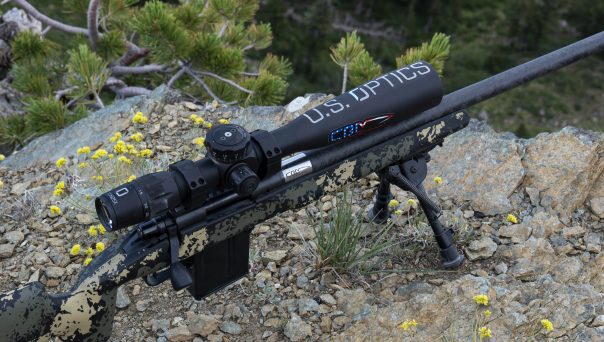
Tag Archives: us optics

US Optics SXR 1-6 LPVO

Introduction

I have grown quite fond of low power variable optics (LPVO’s), and they have worked their way into my gun collection nicely. Today I am taking a fresh look at a relatively new LPVO from US Optics, it’s called the US Optics SXR 1-6. I have had several US Optics LPVO’s over the years and have been very happy with them, you can read about the TS Series of LPVO’s here. But today its more about the new stuff, and the newest line of scopes from US Optics is the X-Series of scopes. The SXR 1-6 is the smallest member of that family, but does this scope punch above its weight?

fresh out of the box

US Optics SXR 1-6

Upon inspecting the US Optics SXR I was very pleased with its presentation. The scope is available in either a second focal plane option or a first focal plane. The option we are testing today is the FFP version, with the SRM MRAD reticle. I like this version a little more than the other alternative as I’m not a big horseshoe reticle kinda guy.

US Optics, SXR, 1-6, lpvo, USO, low power variable optic, desert tech, WLVRN
the SXR made a perfect companion optics to my 20″ 5.56 Desert Tech WLVRN

The first thing to stand out to me was the robust 34mm tube which is bigger than most LPVO’s. Typically I prefer 34mm tubed scopes, but for LPVO’s I am still deciding if I prefer them over 30mm. The larger 28mm objective lens certainly does offer more collection of imagery.

With capped turrets you can use the reticle of the SXR to hold over for any distant shooting. Though the turrets do appear to be quite useful uncapped as well. The finger adjustable turrets are 1/10 MRAD per click, and have a total of 10 MRAD per rotation. This is great on many scopes, so I found it particularly welcome on this little scope.

US Optics, SXR, 1-6, lpvo, USO, low power variable optic,
If you like the Desert Tech WLVRN, you can read more about it here

Adjusting the power magnification is done at the rear, I was glad that US Optics had incorporated a removeable throw lever to the magnification ring as well. This makes it easy to blindly grab for and adjust your scope in a quick shooting scenario.

Specifications

Magnification:1-6X
Focal Plane:First Focal Plane (BDR5556, SRM) | SFP (SFP MIL)
Eye Relief:3.5 in
FOV @ 1x:119.16ft @ 100y
FOV @ 6X:19.86ft @ 100y
Parallax:Fixed @ 100y
Illumination:Red
Tube Size:34 MM
Objective Diameter:28 MM
Ocular Diameter:39.92 MM
Elevation Adjustments:1/10 MIL
Windage Adjustments:1/10 MIL
Length:11.835”
Weight:22.265 oz

For mounting the SXR to a rifle, I used the ZRO Delta 34mm cantilever mount. This would make it easy to mount on most rifles with the proper amount of eye relief. The first rifle I would mount the scope to would be my Desert Tech WLVRN chambered in .223. It was a great companion for this rifle, as it does very well at short and medium ranges.

US Optics, SXR, 1-6, lpvo, USO, low power variable optic, ar15, ar

On the Range

My first trip to the range was to zero the SXR on my WLVRN. I zeroed the rifle at 100 yards, which was quite easy using the finger adjustable turrets. After confirming a good zero, I set to zeroing the turret. This was easily done using a coin to loosen the turret cap, then setting the turret to zero and reinstalling the cap.

US Optics, SXR, 1-6, lpvo, USO, low power variable optic, turret,
resetting the turret to zero after pairing with the rifle

After zeroing the scope, I did some additional shooting at both 100 and 200 yards using the reticle to hold over. I found the reticle to be perfectly serviceable for precise shooting within the limits of the six power magnification. And at lower magnification particularly with the reticle illuminated it gave a great field of view. Bracketing targets in red made shooting fast up close.

US Optics, SXR, 1-6, lpvo, USO, low power variable optic, desert tech, WLVRN
the WLVRN shot very well with the SXR and YHM Turbo T3 suppressor

Quality

This is the highest quality US Optics LPVO I’ve used, at least recently, it reminds me of the old SN and SR scopes they made. The optics are top notch, giving and incredibly clear picture at all power settings. The sharp reticle is great for hold overs, and isn’t overbearing for a short range optic.
The Turrets are also fantastic, whether you choose to run them exposed or cap them. They feel very tactile, and you can hear each click. they are also low profile to keep them from snagging on everything.

Durability

While I believe durability is best tested over the course of a year or so, I feel this scope is very robust in structure. And based on my experience with other similar scopes from US Optics, I expect it will stand up to my typical routine. Switching the scope from rifle to rifle, and mount to mount. Be sure to follow along, as I will update this article in the future with additional feedback on durability.

US Optics, SXR, 1-6, lpvo, USO, low power variable optic, ar15, banish speed k
the SXR mounted to an AR with a Banish Speed K suppressor

Value

In a market flooded with LPVO scopes, it might be hard to stand out. The under $500 market is packed, and there are plenty of good options. The $500-$1000 market is a little more competitive, and the SXR is on the lower end of that spectrum.

The US Optics SXR 1-6 is in good company, comparing to other brands like Eotech and Trijicon. And available for less depending on where you buy it, of course if you use my %15 promo code shown here you can get the best price.

us optics

My Summation

Having spent some time shooting with the SXR scope, I have become quite a fan. It is a big step up over previous LPVO’s in the TS line from US Optics, and it gives users a high quality product for a good price. The large lenses give fantastic clarity and high definition of targets and their surroundings. The overbuilt turrets are great for dialing if you choose to use them so. The SXR SRM reticle is a great dual-use reticle, it can be used for fast target bracketing up close or for more precise work. Using its graduations allows you to make accurate holdovers and corrections should you use the scope for precision shooting.

US Optics, SXR, 1-6, lpvo, USO, low power variable optic, ar15, banish speed k
I also used the SXR on a pieced together AR seen here

I am a big fan of 34mm tubes, especially on precision optics. It makes sense that for some folks the 34mm tube may be a bit much, and adds both bulk and weight. But so far it hasn’t bothered me at all.

US Optics, SXR, 1-6, lpvo, USO, low power variable optic, desert tech, WLVRN

Little add-ons like the built-in throw lever and the easy to adjust turrets add more value and usability to the scope. It may be a step up in cost, but I think the scope punches above its weight. And it compares well to scopes that cost more. I would love to see another variant of the SXR in a 1-10 with adjustable parallax.

-CBM

us optics RISE red dot

US Optics RISE Red Dot

Red Dot sights

The past few years have spawned an incredible surplus of red sot sights (RDS) and new technologies around them. Red dots offer a parallax free aiming option, meaning you needn’t focus back and forth between the sights and target. I’ve spent a great deal of time using various red dots over the last few years, and today I am bringing you another brand new option. Our subject in today’s review is the US Optics RISE red dot.

us optics rise red dot sight

The US Optics RISE Red Dot

From US Optics, the Red dot Integrated Sight Enhancer (RISE) is a compact battery operated sight. Built for precise aiming in high-speed situations. The RISE uses a 3 MOA dot, which is big enough to pick up quickly, but small enough to still offer precise shot-placement.

us optics RISE red dot, shadow systems dr920
The USO RISE RDS on the Shadow Systems DR920 with a Surefire X300 weapon light

The RISE has 10 brightness settings include 2 for night-vision use. The brightness and other features are easily controlled using the two buttons on either side of the housing. Like most RDS, the RISE is adjusted using a small blade screwdriver to adjust the windage and elevation for zeroing the sight. It also incorporates some really handy features like a sleep mode where it shuts down after two minutes of motionlessness. It instantly resumes the previous brightness setting as soon as the host firearm is moved.

us optics rise red dot sight, sig sauer p320 x5 legion

This feature helps maintain battery life, which is anticipated to last some 75,000 hours with a single CR2032 lithium cell. The battery is easily changed through the RISE’s top loading battery lid using common tools or the included tools that come with the optic. Mounting the RISE RDS is easily done using the supplied fasteners, and it is built to fit Delta Point Pro footprints. One of the more common patterns.

Specifications

Window Size:24x20MM
Footprint:DeltaPoint Pro
Magnification:1X
Dot Color:Red
Dot Size:3 MOA
Light Source:LED
Adjustment Type:Manual, (+, -)
Sleep Mode:Auto-off after 2 mins; Auto-Revive with movement
Brightness Settings:10 (8 Daylight, 2 NV)
Click Value:1 MOA per click
Elevation Travel:80 MOA
Windage Travel:80 MOA
OA Length:47.98 MM/ 1.889 IN
OA Width31.20 MM/ 1.228 IN
OA Height28.80 MM/ 1.134 IN
Rear Deck Height:7.60 MM/ .300 IN
Weight:37.54 G / 1.32 OZ
Material:6061 T6 aluminum
Coating:Black Hard Anodized
Waterproof Rating:IP67
Battery:CR2032
Battery Load:Top
Battery Life:75000 hrs at setting 1, 26087 hrs @ setting 5, 600 hrs @ setting 10

Mounting the US Optics RISE RDS

Initial testing of the RISE RDS was done on my Sig Sauer P320 X5 Legion 9mm pistol. This was an easy fit as the pistol comes ready for Delta Point optics. Using the supplied screws, I set the RISE in place, and kept it as close to zero as possible while I torqued down the fasteners with a wrench. The fit was perfect, and it looked as though the RISE was made for it. In just a few moments I had adjusted the dot to co-witness with the iron sights. I found that the small notch built into the back of the RISE worked as a rear sight that would work in the event the battery died.

us optics rise red dot sight, sig sauer p320 x5 legion
the Sig P320 X5 Legion with the USO RISE and Surefire X300 weapon light

I also mounted the USO RISE RDS to my Shadow Systems DR920. The pre-cut slide makes it an easy host for a variety of optics, and the RISE was a perfect match as well. The lower cut slide of the pistol made it the perfect height for seeing both front and rear sights through the window.

Shooting with the US Optics RISE

I have pretty extensive shooting experience with this pistol (hasn’t gone off by itself yet) so it was a great gun to test it on. I already had the US Optics DRS enhanced red dot on the pistol, but this was definitely an upgrade.

us optics RISE red dot sight, safariland holster, shadow systems dr920
another added benefit was the RISE fit in all my Safariland holsters

My immediate first impression was the much bigger window, the RISE uses a larger lens than its predecessor. I have become accustomed to these larger windowed red dots, and I like them quite a bit. You can read more about that here. The RISE is a nice compromise, its bigger than many standard RDS windows, but not quite as obtrusive as the XL sized competition sights. It might be a touch large for a CCW pistol, but thats obviously a bit subjective.

US optics RISE  rds, sig sauer p320 X5 Legion

I did find the big window great for finding targets quickly, and the 3MOA dot was very precise for putting shots on conspicuous places on the target. The parallax free targeting I mentioned at the top makes for faster shooting, you never have to take your eyes off the target. You simply bring the pistol to bear on the target and the dot comes into your field of view, only slight adjustments are needed before pulling the trigger.

Shootability

The big lens is one of the great features of this dot, but the controls are very nice, and simple as well. I’m not a huge fan of complication, so I like the no-nonsense two button operation. If you don’t like the auto-off feature it can be easily locked into the ON or OFF position using the buttons.

us optics rise red dot, shadow systems dr920

Its a simple system for folks who don’t want to wonder. I leave the dot in the recall mode, that way every time I grab my pistol the dot is on and ready for action. Finding the bright red dot is easy and comforting when you are looking for a target.

Like most RDS, if you have the dot set on a brighter than necessary setting you might find the dot blooming. Or bleeding out across the lens, I found that simply turning it down a bump or two takes care of the issue. The brightest setting was easily seen in full sunlight, so while I found it unnecessary, you can adjust it how you like.

Reliability

During our testing, we had zero issues with the RISE red dot. It never came loose or lost zero, and I never had to make any adjustments other than the brightness settings based on our surrounding conditions.

us optics RISE rds, sig sauer p320 x5 legion

I like the robust construction of the RISE, it is thicker than the hood on other RDS which makes me think it will stand up to more abuse. Additionally the RISE is rated IP67 for dust and water protection, just incase you drop your CCW into a pool or something. And like all US Optics products, the RISE has a no bullshit warranty covering; function, quality, workmanship and material.

us optics

Value Comparison

With an MSRP of $279.99 the US Optics RISE is a great option if you are looking for a bigger windowed RDS. While other sights like the Delta Point Pro, and Vortex XL have a little bit bigger windows they are $75 to $125 more in their street price. The Romeo 3 MAX and the Holosun 507 Comp are two other popular RDS and they too cost about $100 more than the RISE. To be fair some of those sight offer enhanced reticle options as well so keep that in mind.

us optics RISE, sig sauer p320 x5 legion

Conclusion

Like many other US Optics products, I have found the RISE RDS to be a great option for my purposes. If there was one thing I would change about it, I think it would be cool to add some reticle options like some of the other companies have done. But if you like the simplicity of a dot, then you’ll need look no further.

The US Optics RISE red dot is a quality sight for your pistol or carbine. It brings a durable no-nonsense performance with compatibility from a quality brand you can trust. I look forward to shooting more with this sight, perhaps I’ll mount it to my ZRO Delta FKS 9 CCW pistol to see how it performs there.

-CBM

US Optics TXH 3-18X50

US Optics TXH 3-18X50 Riflescope

Preface

I’ve been using riflescopes since my first BB gun, I’ve always preferred them as a sight device. In more recent years I started using riflescopes from US Optics, my first one almost a decade ago was a 25x SN3 TPAL. An amazing scope that I literally abused and it never lost zero. I’ve also since had several other US Optics scopes of all kinds, you can read more about my experience with other US Optics scopes here. But today I am bringing you a brand new US Optic riflescope, and I am quite excited about it. Today’s subject is the US Optics TXH 3-18×50 riflescope.

us optics TXH 3-18x50, desert tech wlvrn bullpup

I initially saw the TXH at SHOT Show 2024, as I met with the US Optics team we nerded out over this new scope. Its hard to tell everything about a scope indoors, but I could tell enough about it to know that I needed to get it into my mountain shooting country as soon as possible.

Specifications & Features

Power3-18X
Tube Diameter34mm
Objective 50mm
Turret Values1/10 MRAD
MRAD per rotation10 MRAD
Parallax 10Yard to Infinty
IlluminationSix Red settings with off in between
Turret LocksPush/Pull
Reticle MHR2 First focal plane
Zero StopAdjustable
Magnification ring180 degree throw with removable throw lever
Weight35 ounces
The TXH is anticipated to hit shelves this fall, stay tuned for more info

Like most US Optics scopes, the TXH is full of great features. First off I really like the 34mm tube, as it gives maximum internal travel for shooting long-range. The popular 34mm tube is coupled with 10 MRAD turrets, which is much better than 5 or 6 MRAD turrets that are common in this price range. Smaller turret values mean you have more rotations, and its easy to get lost on which rotation of the scope you are on.

us optics txh 3-18x50
removing the elevation turret to set the zero-stop ring (right)

Zero-stops are another feature that are meant to combat loosing track of which rotation you’re currently on. The TXH also has a zero-stop feature which makes it even easier to stay aware of your elevation settings.

Parallax and focus are done on the left side turret, with a parallax setting as low as 10 Yards. This is very nice for those that intend on using this scope for things like shooting precision rimfire. Illumination is controlled by a rheostat stacked on-top of the parallax turret. It has six power settings with an off setting in between each one.

us optics txh 3-18x50
magnification ring and throw lever, note parallax and illumination controls left

Adjusting magnification is easily done with the included throw lever, and the ring turns 180 degrees needing only a single motion to go from three to eighteen power. This 3-18x size scope is excellent for a medium range carbine or a light precision rifle. I would feel more than adequate for engaging anything inside a kilometer with ease. The first focal plane MHR2 reticle changes size with power setting, but always gives you accurate options for measuring targets and holds.

Mounting and zeroing the TXH

Mounting the TXH was done using a ZRO Delta 34mm cantilever scope mount. I like the hand tightening fasteners, making it easy to swap from one gun to another. I torqued down the oversized screws securing the TXH into the mount. This scope was destined to end up on my Desert Tech WLVRN, so I used it for the initial host. With the scope mounted properly, I set the rifle up so I could boresight it using my tool less method.

In just a few minutes, I was shooting with the TXH. After getting the rifle and scope zeroed, it was time to set the TXH turret to zero. This was done by using the plastic tool that came with the scope, it has several flat edges similar in shape to a coin-edge. But since they are plastic, you wont damage the turret caps, or over-tighten them either.

us optics txh 3-18x50
the included tool is helpful in adjusting turrets

Setting the zero-stop is done by loosening the three set-screws of the black inner ring under the turret. Rotating the ring counterclockwise until it touches the stop. Snugging the three screws back down will cause the turret to stop on that fixed point.

Shooting in the Field

With my rifle and scope combination ready for action, it was time to put it to work. Much of the shooting I planned on doing with this rifle would be part of my varmint hunting adventures. Shooting at small rodents in the high Rocky Mountains would be an excellent way to test the TXH. Picking out furry little marmots hiding in and around rocks and trees requires a sharp eye.

desert tech wlvrn, us optics txh 3-18x50
field shooting with the TXH

As I expected, the TXH looked fantastic in the clean mountain air. The bright images were just what I expected to see, and one of the better parts of scopes in this power range. Its ability to focus on targets as close as 10-20 yards away was impressive.

As is the case with most every scope I’ve ever used, the image suffers a bit at max power. The TXH looses some of its brightness, but I find that as usual when I back the scope off slightly, I find a sweet spot.

HMR2 reticle, US Optics TXH 3-18x50
the MHR2 reticle seen at 18X

Parallax adjustment seemed to be easy to correct, and with the image focused there was almost no aberration’s around the edges. I think I would have preferred the available EMCR reticle, as there are a couple things I would change with the MHR2 reticle. Mainly even out the spacing of sub-tensions, but I like the open center.

US Optics TXH Turrets

I have always liked US Optics turrets, more-so their domestically produced scopes. The turret design of the TXH definitely has a better design than the TS line of scopes. The turret outer ring snaps up and down to lock the setting. But the inner part of the turret only rotates. this is a much more robust design than having the whole assembly pop up and down to lock. That robust feeling translates into incredibly crisp clicks on the turret. They are so clean that you can feel and count them audibly without even looking. Furthermore, the last click as you hit zero has a different sound to it.

desert tech wlvrn, us optics TXH 3-18x50
the TXH scope made a great companion to the WLVRN and the YHM suppressor

Speaking of the zero-stop, this one feels amazing. No sensation of compressing or tension building as you approach it. It is simply a solid stop, like a hammer hitting a rock it stops perfectly on zero every time. The internal ring of the zero-stop allows for two rotations of the turret when installed. If you remove the zero-stop, you will get full range of motion which gives a full 35-ish MRAD range.

The windage turret has five MRAD either right or left once you set it at zero. I rarely use anywhere near that much while shooting, so its more than enough for me.

Tracking the TXH

All the best scopes have accurate tracking, meaning that they actually move the amount they say they do. I’ve checked quite a few scopes over the years, and most of them have been pretty close to their actual value.

us optics

My process involves bolting the scope down to an immovable object, and then measuring the actual movement according to the turret value. Finding fixed points downrange allow you to dial the scope up and down, left and right making boxes until the crosshair returns back to the same starting point.

Dialing several box tests two revolutions from the zero-stop to max elevation and back. Additionally ten MIL’s of windage and back, the TXH rendered the same return to zero every time. And measuring the click value against a ruler proved the movements to track well within a small percent of actual. For example; if you dial 7.8 MRAD of elevation for a shot, and the actual movement is 7.791 MRAD. You probably can’t shoot well enough to notice the difference. Especially at a distance needing 7.8 MRAD of correction.

US Optics TXH 3-18x50 MHR2 reticle
testing the tracking of the US Optics TXH 3-18×50

Pros & Cons

Pros

Today we’ll start with the things I like about this scope, which are many. I don’t normally start with price, but today I will. I have a couple other scopes that are comparable in both size and performance, I recently got into a PA GLx3-18×44 for example. After heavily shooting through that scope for a season, I was very impressed particularly with the price. So when I found out that the US Optics TXH would sell for around a hundred dollars less I was astounded. While I like both of these scopes the little TXH easily walks away with the win at that price point, and not just because of the price point.

The optical performance of the TXH is fantastic. I have recently started to notice my eye’s acting their age, but even still I find the clarity of this scope to be well above its punching weight. Its clarity is partially due to the great focusability and immaculate parallax adjustment.

US Optics TXH 3-18x50

The design of the TXH turrets are very user friendly, and they are built for strength and apparent heavy use. Extra points for ten MIL turrets and a great zero-stop mechanism, a step up from previous versions that restricted overall turret travel. The throw-lever is a nice touch as well, making this scope very quick and controllable.

Cons

I mentioned earlier that I might prefer the EMCR reticle, I like that option over the MHR2. Not that the MHR2 reticle isn’t useful or anything, it just a preference. I doubt it will inhibit my shooting much in real world scenario.

us optics txh 3-18x50, desert tech wlvrn

Another thing I would change if I had the ability is the illumination. Scopes in the sub-thousand price range seem to all suffer from a bit of flooded reticle illumination. What I mean by that is with the whole reticle illuminated there seems to be too much. You can combat it by using a lower brightness setting, but I wish the reticle was only partially illuminated. Either way this is a small complaint, as I rarely use illumination, and if I did need it this would certainly work.

Lastly is something perhaps a little more subjective. As much as I love the turrets on this scope, I feel the control surface textures don’t match up. I wish they had made them more similar to the FDN series, just for looks I think it would have strengthened the whole brand look.

desert tech WLVRN, us optics TXH 3-18x50
the BLK LBL bipod and Silencer Central Banish also matched the rifle well

Final Thoughts on the TXH

There is no getting around imported optics these days below a certain price point. The optics market has been flooded with many good rifle scope options that are made overseas. It comes as no surprise that most optics companies are offering additional lines that are more competitively priced. This scope does an excellent job bridging the gap between the US Optics high-end domestically produced models, and less expensive imported riflescopes.

us optics TXH MHR2 reticle
I will for sure be using the US Optics TXH later this year for hunting season

The US Optics TXH 3-18×50 is from what I can tell a great option for those looking for a solid precision rifle scope for under $700. Something crazy to imagine a decade or two ago. And coming from a well-known manufacturer like US Optics makes me confident that it has been well thought out and tested. I have heard it’s likely we will see these scopes on shelves later this year, probably just in time for hunting season.

mule deer, Patriot Valley Arms Modus rifle, 6.5 PRC, US Optics TXH 3-18x50
deer season from 2024, the TXH worked perfectly on this PVA Modus 6.5 PRC rifle

I will continue to use this scope aggressively and frequently to see how it continues to perform. If my experience with other US Optics scopes is any indicator it will have no problem doing that. Follow me to see how that journey goes, I will continue to update here with more info as time passes.

-CBM

2025 Update: I’ve spent well over a year shooting this scope now, I’ve lost track of how many different guns I have mounted this scope on, re-zeroing, and running the typical cycle of shooting. This scope has done a great job, hasn’t skipped a beat , lost zero, or mis-tracked.

desert tech WLVRN, us Optics TXH 3-18

US Optics TS25X Precision rifle scope

Introduction

You have probably seen some of my opinions on other US Optics rifle scopes, but today we are going to talk about another one. The Tactical Sport line of optics from US Optics is a more affordable line of optics. And in my opinion, they are a great choice for someone who needs a good repeatable riflescope without going broke. Today we test one of those scopes, the US Optics TS25X .

The TS25X

Solid scope mounts like this one are outstanding

Today’s subject is the TS25X, it is a 5-25 power riflescope built on a 30mm tube. The 25X is the highest magnification scope in the TS line, but the TS20X scope has a 34mm tube. While I think I prefer the 34mm tube the TS25X is still a great option for various applications. The objective of the 25X is a 50mm to gather enough light to present a clear image, and the side-focus parallax adjustment is on the left side of the turret housing as we have come to expect.

The TS25X mounted on the Bergara HMR 6.5CM

Most of the controls and features will be very familiar to most shooters, the ocular lens adjustment can be focused by turning the rubberized ring at the back of the scope. The five MRAD turrets have a locking feature, they must be popped up to rotate. This helps avoid accidental turning of the turrets when moving. I prefer turrets that use at least ten MRAD per rotation, but considering the size and price of this scope its not a big deal to me.  Inside the erector of the 25X sits the JVCR reticle, this has become my favorite US Optics reticle and I use it in all my US Optics scopes. It gives plenty of holdover and windage points to use for corrections, and not so much as to become cluttered like many other can. The reticle is illuminated red by rotating the rheostat on the outside of the side-focus knob with six brightness settings.

Purposes for the TS25X

The TS25X in the hunting field mounted to a Ruger American

I’ve been running this scope for over a year now, and I’ve gotten a good feel for what its capabilities are. I love shooting, and I’ve found that this little scope can be an excellent tool in various shooting applications. Whether you are going to use it for long-range target shooting, competitive shooting, or more traditional purposes like hunting.

I mounted the TS25X in both Warne and Vortex rings

I have used the TS25X for all of the above and it has served me well. In fact I have used the 25X as sort of a gap-filling scope, one that I have swapped back and forth from one rifle to another. Mounting and dismounting from an assortment of rings and mounts, zeroing and re-zeroing it over and over again. It has done very well in this role, and has performed as well as I could have hoped.

us optics

Field Use

The 5-25 power of the TS25X is an excellent range for multipurpose use in the shooting field. Like most scopes the maximum power tends to be a little darker and some resolution is lost, but that is easily remedied by maxing out at something like 21 or 22X. The 25X went on many hunts with us over the past year, as well as many different rifle reviews. The five MRAD turrets work great, but they can be easier to accidentally be off by a revolution. I’ve had that happen before with this and other similar scopes, it’s just something that happens. I ended up putting a piece of tape under the elevation turret to show where actual zero is to avoid it happening again. I can simply look to see if the bottom of the turret is flush with the tape, and if I see a gap then I’m one turn off.
The JVCR reticle in the scope is very handy for measuring your misses, there are just the right amount of subtensions to be able to measure a correction.
I have been impressed by the durability of this little scope, it has been dialed up and down as much any scope has rights to, clamped in rings over and over again and at least one time too hard. And after all the swapping and dialing it just keeps on ticking, and the hits keep coming.

Shop US Optics riflescope at Scopelist
Euro Optics also has the full line of US Optics

Hunting

The twenty-seven ounce scope is a great option for a hunting rifle, and it has spent a good deal of time mounted to hunting rifles in my time with it. We have used it to take several mule deer here in the Rocky Mountains, and I would have felt every confidence that it would continue to perform in the ice cold weather of winter too.

After having spent a whole year using this scope across multiple different semi-auto and bolt action rifles, I can tell you with confidence that it is a great little scope. I wouldn’t go as far as to say I have abused it, but I have certainly used it harder than many folks will. So if you are looking for a riflescope with features like these, I can recommend the TS25X to you with confidence.

-CBM

The TS25X did some time on my TIkka T3 as well

The US Optics Foundation 17X precision rifle scope

I love a good riflescope, one of the great things about having so many guns is getting riflescopes to go with them. The challenging optics market continues to push for the perfect scope, the one that has everything. Despite their best efforts, there are just too many eyes to please which leaves consumers to pick and choose the features that they find most useful. I say most useful, but there is also an associated cost with all these features. It is not uncommon to spend two to three times the cost of a rifle on the scope that goes with it. So there is a great deal of settling for when it comes to general consumers, for example choosing scopes in the 1000-1500 dollar range with similar features to a scope that costs twice that much.
I find myself lucky to live and work in a world that can help justify some of the best equipment available. And being a bit of a scope junkie, one place I enjoy some of the finest products is on the glass that sits on my rifles. I have used many of the best brands, but today as you might have guessed from the title we are looking at my latest purchase from US Optics.

Perfectly at home on an MPA competition rifle

The US Optics Foundation 17X

The Foundation series of riflescopes is US Optics premier line of US made sights. I’ve had several US Optics scopes over the years, last year was my first dip into the Foundation series with my Foundation 25X. And after running that scope hard for over a year now, swapping it between multiple rifles, and packing it all over the Rocky Mountains from here to nearly Canada. It has hit the top of my list, always keeping zero, and precise adjustments have kept me always on target. I’ve used it hunting everything from antelope on the plains of Wyoming, to the dark bears of Montana’s Kootenai Forest, and the elusive elk of the Uinta Mountains.
I’ve also been running 5-25’s for some years now, and I wanted to try something different. Particularly because I rarely use them on maximum power for anything other than inspecting potential targets, so the next obvious choice for me was the US Optics Foundation 17X.

us optics fdn17x
The FDN17X mounted to a Ruger RPR 6.5CM

The FDN17x uses the same 34mm tube as the other Foundation scopes, and at its heart is the ER3K turret above the erector. The third generation of the EREK system allows the erector to be adjusted with a center screw to the rifles zero, without moving the turret itself from its zero. This allows full turret rotation, and it also keeps all turret movement in the up direction from its stop. Unless of course I’m lost and barmy, in which case someone will be along to correct me in a few seconds.

The FDN17X has since ended up on this handsome Ruger M77, read more about that here

The objective lens on the FDN17x is a modest 50mm, slightly smaller than its bigger sibling. The windage is controlled with a capped US #1 windage knob, and it stays capped for the most part as I rarely dial any wind once I have a zero. Another standard feature of the Foundation series is the illumination, using a simple and single button to power up and select brightness settings. I can count on my fingers the times I’ve really needed illumination, but I can also tell you I never would have made those shots without it. Everybody has red illumination, so last time I ordered my FDN25X I selected green illumination. And this time around just to be different, I chose the blue illumination. I’ve yet to decide which of the three colors I like the best, but its nice to be given the choice. Other improvements of the Foundation line is a shorter throw on the magnification ring, where one-hundred-eighty degrees of rotation takes you from minimum to maximum magnification.

us optics
Another great option I added on to both of my Foundation scopes was the internal bubble level. It is cunningly placed in the eyepiece just out of the way enough that you need to look for it to see it. From the shooting position you can simply adjust the focus of your eye and see the bubble and its markings to ensure your rifle is level without ever breaking your eye from the target in the scope.

Perhaps one of my favorite options with the Foundation series is the reticle choices, and I usually choose the JVCR. It is a Christmas tree style reticle, with just enough going on to not distract my brain from doing its thing. Subtensions as small as .1 MRAD are part of the reticle, but much more prevalent are the .2 and .5 subtensions.
The JVCR like most modern reticles gives the user a superior ability to spot misses and correct for them. The FDN17X and its siblings are first focal plane scopes, which I prefer over the alternative. The reticle always reads true regardless of the magnification setting, which allows you to easily measure and correct for a miss. Whether you dial or hold for that miss depends entirely on your preference, depending on the size of the correction I will often do either. Good reticles like the JVCR allow you to do exactly that without getting so much information in front of your eye that you can’t focus, or worse yet you lose your impact in the noise around the reticle.
Before mounting the scope to an actual rifle, I ran it through a few scope tracking tests to double check turret values and repeatability.

Mounted up!

I mounted the FDN17X into one of my 34mm scope-mounts, and leveled everything up. Bubble levels aren’t perfect, but they certainly can give you a very close to level mark. I carefully torqued down the scope rings checking the internal bubble level on the scope to see that it matched the bubble on the scope-mount, and triple checked them both against another level.

adjusting the zero of the ER3K turret

Then it was time to get it mounted up on a rifle, or a series of rifles better said. This scope was likely going to be one of my switch-around scopes, jumping from one rifle to another (I go through a lot of rifles). The first rifle I mounted the scope to was a Ruger RPR 6.5 Creedmoor, a great little rifle to wring out this scope and ensure it functions properly. Using the provided tools, I adjusted the ER3K knob to zero using my bore-sighting method. And after firing a few shots to confirm, I reset the zero according to impacts. Aside from this very convenient method, there are other things to like about the ER3K turret. I love the firm stop at zero, unlike the mushy stops from cheaper scopes achieved by shims, this thing stops on a dime. The large size of the knob gives you a very precise grip, and as you turn the turret to zero it stops hard. The turret has twelve MRAD per rotation, which for most of my rifles will take them out to their usable limits.
Today I was only able to take this little Ruger out to nine-hundred and fifty-yards, plenty far for sure, but not even into the second rotation of the FDN17X. As I am accustomed, I made corrections using the JVCR reticle, and using it to measure target sizes.
The clarity and brightness of this scope is superb, watching leaves flutter on the distant ridge made wind estimating more simple. Even at nine-hundred and fifty-yards picking out the soil rolling downhill from my misses was visible, as was the occasional snow flurry floating between my target and I.

us optics fdn17x desert Tech MDRX
The FDN17X mounted to my Desert Tech MDRX

Another day brought another rifle, the FDN17X was destined to end up on one of my MDRX rifles. This one has just received the 6.5 Creedmoor conversion kit in it, with a twenty-inch barrel and the new Blk Lbl Bipod twenty-inch handguard installed. The beautiful Tungsten Cerakote of this scope didn’t exactly match the black of the rifle, but I’m okay with that.
I quickly reset the zero on the ER3K turret using the Allen wrenches, and in no time I was ready to go. The 6.5CM MDRX is not quite as accurate as the RPR was, but still plenty accurate for many purposes. In the snowy and cold desert of the Great basin, I picked out a small white rock across a long draw. It was five-hundred and fifty yards according to my rangefinder, so after consulting my drop chart for this rifle I dialed 3.7 MRAD elevation and began evaluating the cold wind. My estimates put my wind-hold right at .6 MRAD, which is real convenient to hold with the JVCR. To me there are few things more satisfying than first round hits, and watching that first round pulverize the rock into a bright dust-cloud was exactly that. I spent an entire afternoon picking out little targets at varying distances out to seven-hundred forty-five and nine-hundred yards. I find the offset two-tenths sub tensions of the JVCR very handy and quick to make sense, this is particularly handy when you shoot in wide open spaces and mountains where the wind switches direction faster than a politician.

note bubble level at bottom of scope

Am I wrong?

As I said in the beginning, it’s hard to make a perfect scope that fits everyone’s needs. But I’ve found that for my purposes, these Foundation scopes seem to fit me perfectly. I don’t know if that means US Optics just nailed it, or if I’m past my prime and simply content with what I’m used to. The ease of use with the ER3K elevation turret, the clear and bright clean images through the glass, and no need for an external anti-cant level make this scope very user friendly. And though I haven’t abused this one just yet other than smacking it into a few rocks, I have no doubt it will be as robust as the other USO scopes that I have abused thoroughly.

another custom Remington used with the FDN17X

This scope is already lined up to go on several other rifles, I look forward to a bright future shooting with it. The moderate magnification and size will fit perfectly into a well used portion of my gun collection, and more than likely it will see some killing come this fall.

-CBM

Three Red Dots

Pistol shooting, like most shooting disciplines has benefitted greatly from technological advancements. Incredible improvements have made todays handguns lighter, faster, more accurate, and reliable. One of these many improvement is in the sight market, pistols have long relied on the simple task of lining up a front and rear sight as you press the trigger. But today we will discuss the hot and competitive red dot sight options that are frequently replacing traditional iron sights. We’ll also look at it from the perspective of home defense use.

The three sights we will specifically look at today are the Vortex Viper Red Dot, the US Optics DRS 2.0 Enhanced, and the Riton Optics X3 Tactix PRD. To give the three sights all a fair rattling, I ran all three of them on the same pistol. The Canik TP9 EC is a poly framed pistol featuring a SAI barrel and trigger, its very accurate and its cut slide makes a perfect host for this trio of optics. To read more about the pistol click here.

The Vortex Viper MSRP $349.99

With a well known name like Vortex, I was sure I was going to like this optic. It was the first of the three in this article that I got my hands on, it wasn’t long at all before I had it mounted up and ready to shoot. The tools provided made zeroing the optic a snap, I was blown away at how quick I went from adjusting the zero, to stacking a whole magazine into a small hole.

The US Optics DRS 2.0 Enhanced MSRP $349.00

US Optics has long been part of the optics game, though they are a relative newcomer to the electronic sight realm. As soon as I opened the box, I was as impressed as ever with USO’s quality and presentation. But more importantly was the impression on the range.

I was a bit confused at first, because the DRS 2.0 didn’t appear to have a button or control to adjust the brightness as did the Viper and the Tactix X3. But in perhaps my favorite discovery of the whole project, I read the owners manual to find that the DRS 2.0 is always on, and has a built in photo-eye to automatically adjust to ambient light. Another beneficial feature I was happy to see, was the side-loaded battery compartment, which doesn’t require the user to remove the sight to change the battery as the Viper required.

As with the Vortex, the USO was easily and quickly zeroed, and in no time I was back to banging targets.

The Riton Optics X3 Tactix PRD MSRP $299.99

Riton is a relatively new company, but persistently bringing out more products. The X3 came to me before the USO and after the Vortex, it did require changing the Viper type baseplate to the RMR type, as it doesn’t share the same plate as the other two.
Similar to the Vortex, the X3 has armored up/down rubber buttons to adjust the six level brightness settings of the reticle. It also has a four hour auto shutoff. It features a 3 MOA dot for some very precise shooting, at least for red dot shooting.
It wasn’t until after I had it mounted that I noticed the X3 features a rear sight cut, something you can use in the event your reticle goes out. This is something the other two lacked, and while not likely to be used often, it is still handy. The X3 features a top loaded battery, so you wont need to remove the sight for battery changes.

All three red dots took a bit of getting used to, as the reticle appeared higher than expected as compared to the iron sights. But once I grew accustomed to the hold and sight picture, I was addicted to it. One of the many pros of using red dot pistol sights that is often mentioned is the shooter’s point of focus. When using iron sights you have to focus to some degree or another on the sights that are at arms length. Shooting with a red dot sight gives a great advantage because you never have to take your eyes off the target.
For example, if there is a threat approaching you, simply bring the pistol into the plane between you and the threat. The glowing reticle is naturally brought into place without ever having to change focus from the target. Obviously after much practice and training, it becomes second nature. That is one thing less you’ll need to focus on in a defensive situation.
And even if its not a dangerous target, shots can be made faster as can target transitions because you never have to take your eyes off the target[s].

Also, if you are shopping on a budget, UUQOptics makes some great budget pistol red dots — great value without sacrificing reliability or usability

UUQ optics, red dot sights

As it pertains to home and/or self defense, I think a red dot sight could be a valuable asset. The bright red reticle makes a very easy focal point when tension is high, and the precise nature of its aim is very useful in a life or death situation. The aforementioned point about keeping your eyes on the threat is also a strong reason, especially in a low light or no light scenario.

I was surprised by this experience, it wasn’t that I liked the USO the most, it was actually that the Vortex was at the bottom for me. After much shooting with the Viper, I found the Riton X3 to be a preferred fit for my eyes. And perhaps the finer reticle also helped. The sight picture of all three was more than satisfactory, they all got dirty and dusty just the same. But what really won this comparison for me was the reticle on the DRS 2.0, I never had to turn it on, or up or down. Every time I jerked my pistol from the holster, regardless of time of day, indoor or out, the reticle was lit, and nearly perfect brightness. I only say near perfect because it occasionally might have been a smidge dimmer than I would have set it, but surely not enough to be a concern. All three of these red dots are great pistol sights, I would feel very confident shooting any one of them in a competitive situation.

I have shot pistols without red dots for many years, so I was a bit apprehensive about trading my iron sights for a red dot. But I’m happy to say that after some practice I feel just as if not more confident with one of these three sights than the iron sights I always used before. Give one of these three a try, you will very likely be surprised how much you like it.

-CBM

The US Optics Foundation FDN 25X

Introduction

Many years ago, when I first stumbled down this rifled rabbit hole. I would daydream about the high-end and prestigious rifles I saw in magazines and movies. The internet had not yet become the superhighway it was destined to be. But as it developed I could also visit websites and court those beautiful works of art. Not only was it the rifles, but the impressive optical sights that accompanied them. My dreams of owning such a piece of artisanship seemed unattainable at the time, but I never could have foreseen just how far down this hole I would go. Today we are looking at the US Optics Foundation FDN 25X.

Years would pass, more than a decade. Before I found myself the proud owner of what I had always considered a dream scope. US Optics had always been one of the brands I was smitten with. Maybe it was the incredibly robust design that seemed overbuilt for what many would consider standard use. On top of their strength, US Optics scopes had a mechanical attractive flair. It was like looking at top-fuel race engine, you could see all the little things that made it work its magic, and that enticed me even further.

The US Optics Foundation 25X

That first US Optics scope was an ER-25, it was the first but far from the last. I’ve since had four more. With the latest being the newest offering from US Optics, the Foundation Series 25X. The Foundation series is USO’s latest line of top tier telescopic sights, made here in the US. The FDN25X boasts some impressive features. Some you would expect, and others you might miss if you didn’t pay close attention.

The 25X uses a fairly standard 34mm tube and 52mm objective, manufactured from 6061 T6 aluminum, it shares a nearly identical body with its predecessor the B25. But there is more, the FDN25X has the new EREK3 elevation turret with 11 MRAD per revolution. As well as a 180-degree throw magnification ring, the new JVCR reticle (my favorite) with illumination available in red, blue, or green, smooth parallax adjustment, and an internal bubble level.

257 Blackjck
The Blackjack featuring a Proof Research carbon fiber barrel

Unboxing

As I opened the box of the 25X and first picked it up, I was surprised at the weight. At thirty-four and a half ounces, it’s not exactly light but it seemed light for its size. Perhaps I was expecting it to weigh more. I surely wasn’t going to waste much time, I wanted to get this scope mounted and get shooting with it.

In no time I mounted it on the rifle it was ordered for, my custom built 257 Blackjack. It is a lightweight carbon fiber hunting rifle to haul all over these Rocky Mountains for Mule Deer, Elk, and likely a few Antelope as well. The 25X makes a great companion optic for the Blackjack. It stays supersonic beyond two thousand yards, and its energy, drop, and wind deflection makes it ideal for long-range shooting. The 25X has been designed and built for just such shooting. With high-quality lenses to give a clear picture of distant targets. The JVCR reticle gives fine wind holds and holdovers, with .1, .2, and .5 subtensions.

JVCR Reticle detail, and green illumination

Rangetime with the FDN25X

So with the 25X mounted in rings on a 20 MOA scope base, I wandered off into the hills to get it zeroed and to put it to the test. Zeroing the scope was simple, the new EREK3 elevation turret was easy to figure out with a brief revision of the manual. I removed the center screw on top of the turret and adjusted my reticle with the provided hex wrench. After a couple adjustments, it was zeroed perfectly and my elevation set to zero.

Normally I slowly work my way out from closer targets to more distant ones, but that day, I went straight for the long shots. The first shots after zero were 1230 yards, I dialed 6.5 MRAD on the EREK3, and fired a few shots. After getting the wind call right, they were hammering the steel. The EREK3 turret is a good combination of stiff, and crisp. Not too hard to turn, but firm enough to avoid accidental movement.

As it happens, my first trip out with the FDN25X was a shoot with Donald Trump Jr. He was impressed by performance of the 257 Blackjack, and the FDN25X

Turret clicks are both audible and tactile, adjustments are easily made from the shooting position by simply counting the clicks either felt or heard. The magnification ring is also a welcome improvement, with only 180 degrees of rotation, you can go from 5x all the way up to 25x with one movement. Instead of having to release and turn again like other scopes. It’ also easier to turn than previous models.us optics

Refinement

After zeroing my scope, I swapped out the scope base for a 30MOA, to get the scope closer to an internal mechanical zero (to avoid the extremities of erector movement). And with it freshly zeroed, the turret had a full twenty-one MRAD of elevation available. It is highly unlikely I will ever use that much elevation, according to my ballistic computer, twenty-one MRAD will take the supersonic Blackjack to 2159 yards.

The EREK3 elevation, and US #1 windage turrets

US Optics’ JVCR reticle is one of my favorite reticles, I’ve got another one in another US Optics scope. The .2 MRAD marks are all over the reticle, giving a quick and easy reference for adjustments. An open center floating dot makes a perfect reference point when trying to shoot tiny groups on paper. And the open space around it will make it easy to hold center on any of the animals I plan on hunting this fall.

I ordered green illumination on the scope. Mainly because I’ve had red on every other scope I’ve ever had and wanted to see something different. I’m not overly worried about it, as illumination has rarely been used in most hunting scenarios I’ve been in. But for that occasional need, it is sure nice to have.

One little thing that I found that did bug me perhaps, is an abnormal crescent shaped shadow when the scope is dialed to either of its extremities. This is normal as US Optics has it listed under their FAQ’s on their website. To be fair, it is only visible at low power (less than 8x), and only when the EREK3 turret is almost all the way up or down. I think it is very unlikely that it will ever be an issue. Because if Im dialed all the way up, I’ll very likely be zoomed in at least to 12x or more. And if it is an issue bottoming out the scope, then you’ll need to use an additionally canted base. Like I said, a small issue, but one you may want to know about.

Beneficial features

The anti-cant bubble inside. When looking thru the scope and focusing on the target, the highlight of the bubble is seen at the bottom of the reticle

Another very cool feature of the Foundation 25X is the internal level or anti-cant device as it’s often called. I always loved the idea of having it inside the scope, but so many times its been done poorly. Not that I have anything against it being external, especially good ones you can see from the shooting position.

But it is so much nicer to see in real-time, through your aiming eye without taking it off the target. The way US Optics executed this level is very nice, I ordered the internal level. But it is so subtle that I didn’t even notice it the first time I looked through it. It is tucked neatly at the bottom of the field of view, and like I said, its so low profile that you actually have to make an effort to see it. I’m not sure if the engineers at USO want you to look at the actual bubble itself. Or if you are meant to see the highlight reflecting on the bubble as your reference point, either way, it is very handy when you’re in the shooting position.

Accuracy Testing

I also tested the scope for actual click value, which can vary greatly in rifle scopes. I tested the click value by measuring the turret movements against the values of the reticle, as well as against a ruler at a set distance. By doing this you can tell if the clicks actually represent the value claimed. I’ve never tested one that came out perfect, but this one is close enough for my purposes. Under 10 MRAD of adjustment, the actual value was no more than .02 MRAD off of claimed value. And at 20 MRAD, it was just over a tenth MRAD from claimed value. I am not a rocket surgeon, but I think it’s safe to assume that the difference between claimed and actual is spread progressively across the curve as elevation increases.
In addition to testing click value, while I had the scope clamped down solid I also checked the tracking and for reticle cant. Cranking the turrets up down and left and right shew no inconsistency. They always returned back to the exact same spot as I counted the clicks. No noticeable movement in the reticle either, as I zoomed from one magnification to another.

If 25X is a bit much for you, check out my review of the USO FDN17X

Final thoughts

The only thing I haven’t been able to test so far with the Foundation 25X, is its durability over time. My First US Optics scope took such a beating I was sure it would break, banging into rocks, falling off the tailgate onto concrete attached to a twenty-pound rifle, stuff like that. But I was blown away when not only did it survive these events, but didn’t even lose zero. That is a pretty hefty standard to live up to, and I hope that the Foundation scopes are up to it. Time will tell, I certainly don’t plan on dropping it, or bashing it against rocks, but who knows what the future holds?

There is no way this rifle and scope aren’t coming with me for hunting season this year. The 257 Blackjack will light up anything I intend to hunt. And coupled with the impressive view from the Foundation 25X, it should be unstoppable. I am extremely anxious to get up into the high country, and get comfortable and effective with this rifle and scope. You will no doubt be hearing from and seeing more pictures of us in the fall.
-CBM

US Optics TS8X

Low Power Variable Optics (LVPO’s) have been flooding through the firearm market for years now, likely due to the proliferation of medium-range carbines. It didn’t take long for shooters to realize the value of variable low power optics, but what makes an LVPO shine over another?

I’ve had several different models from a wide range of manufacturers, and today we will discuss in depth the US Optics TS8X.

The Tactical Sport 8 power LVPO is one of several great scopes I’ve been able to shoot in the offshore line of scopes from USO. So far they have proven to be a great option for shooters in my opinion. I have been shooting USO scopes for many years now, and to be completely honest I was a bit worried when I saw they were releasing a more affordable line of scopes. My concerns were quality and performance, for which USO’s are well known. My concerns were assuaged with the TS20x, which quickly became one of my favorites. The TS8X has so far been just as good an experience.

Why an LVPO?
I also have the TS6X, which is the little brother to the TS8x. I wanted the 8X because having used several 1-4’s and 1-6’s, I wanted just a little bit more power for seeing those downrange targets. Again in my opinion, a 1-8 or 1-10 is about perfect for a medium range rifle, for distances around six to eight hundred yards. The TS8X fit that spot perfectly in my estimation, and with the RBR Reticle, it would give me plenty of holdover points for shooting at those further distances.

Features
The TS8X features a 30mm tube, with adjustable diopter eyepiece, covered turrets, and an illuminated front focal plane reticle.
Many manufacturers have moved to the 30 or 34mm scope tube now, it gives a larger tube to pass light through, as well as allow a larger erector to increase the internal mechanical movement of the scope. The parallax is fixed for 100 yards, which leaves the diopter eyepiece focus the only adjustment for the image seen. This is common in most LVPO’s, particularly in this price range. If I had one wish for the TS8 it would be adjustable parallax, I frequently shoot well beyond 500 yards with this scope and others like it. The ability to adjust parallax for those distance targets would be very welcome.
Another feature that thankfully is becoming more commonplace, is the reticle placed in the front focal plane (second focal plane models are also available at a lower cost). This means the reticle is magnified with the power setting of the optic, keeping the reticle values always the same regardless of power setting.

The RBR reticle is illuminated red, with an adjustable rheostat for brightness. It also features both MRAD hash marks (both whole and half) as well as range based holdover points, including wind holds at five and ten MPH.

With the stiff competition in the LVPO market, the TS8X fits in the middle ground of price range. There are many options that are far less in price, and many others that cost double, triple, or more.
My initial concerns about quality were more based on mechanical performance and robust construction. I knew that due to its price point, it would likely not have the same optical quality as scopes costing more, which I was okay with.
Speaking of optical quality, I found the image to be bright, and clean. Not much to complain about there, but don’t expect to see the same image as a $1600-$2400 scope.
I found the RBR reticle to be very useful at distances out to nearly 1000 yards, at 8X it could possibly be a little thick for tiny targets, but I don’t expect many people will be doing benchrest or squirrel hunting at that range. For real world shooting, such as echo targets inside 600 yds, it is perfect. The rifle its currently mounted on will be doing some coyote hunting, and I’m very confident that anything inside 800 yards will be easily identified, targeted, and engaged using the RBR.
As I mentioned above, the reticle features both MRAD marks, as well as estimated drop and wind marks. This is handy, because if you need an honest elevation or wind call, you have the actual MRAD values. Whereas if your shooting at the aforementioned coyote, you can use the drop values according to how far away he is.

I mounted the TS8X on my Desert Tech MDR, which at the time was a sixteen-inch 223. The scope was easily zeroed with no tools, and in no time I was shooting steel all over the range.

The MDRX with the TS8X and YHM Turbo suppressor

I love using the scope at 1X, with the reticle lit up, it is just like using a red dot scope. Up close shooting at steel, animals, or whatever else is easily done with both eyes open. Cover the target with red as you break the trigger will give you sure hits.
I then switched out the barrel for the new Hornady 6mm ARC barrel, to see how the TS8X would match up to its ballistic curve.
Without even rezeroing the scope, I was in business, perhaps more a testament to the rifle than the scope. I later made a few corrective adjustments, and the rifle was punching centers very consistently. The click values of the turrets seemed to be close enough to values marked, but to be honest, I hardly had to move them.

us optics
Stretching the rifle out would require using the drop points indicated on the RBR reticle, I figured they would be close since the 6 ARC is not too far off of the 223 trajectory it is based on.
It was close enough to be dangerous that is for sure, at 960 yds I shot over the target. The 6 ARC has less drop than a 223 at that distance, so I held a corrected hold (7MRAD) and a bit of left wind for a perfect center punch hit.
I followed it up with a few more shots to confirm, inside I was giggling like a child watching the trace of my bullets on the way to the target.

I’m not sure if its the TS8X or just better optics that we are spoiled with today. When I first started shooting these farther distances, it seemed like 10X was barely enough, and 15-25 was more like what you needed for shooting long range. But I found shooting almost everything inside a kilometer to be relatively easy with the 8X of this little USO.
I recently took a LE Carbine LVPO course and was extremely happy with the way this little scope ran on the range. We engaged targets all over from 50 to 600 yards in every position you can imagine, I was able to use the wind holds to get some great hits on windswept targets boiling in mirage.
I guess the technology is catching up, soon one thousand yards will no longer be a long range benchmark. It will be more like medium range for drills at a beginners carbine class. If you find yourself on that spectrum, the US Optics TS8X will fill the need for a medium range optic. And it will do it without needing a signature loan to checkout, and you’ll still have the quality and guarantee US Optics has always put on their scopes.
-CBM