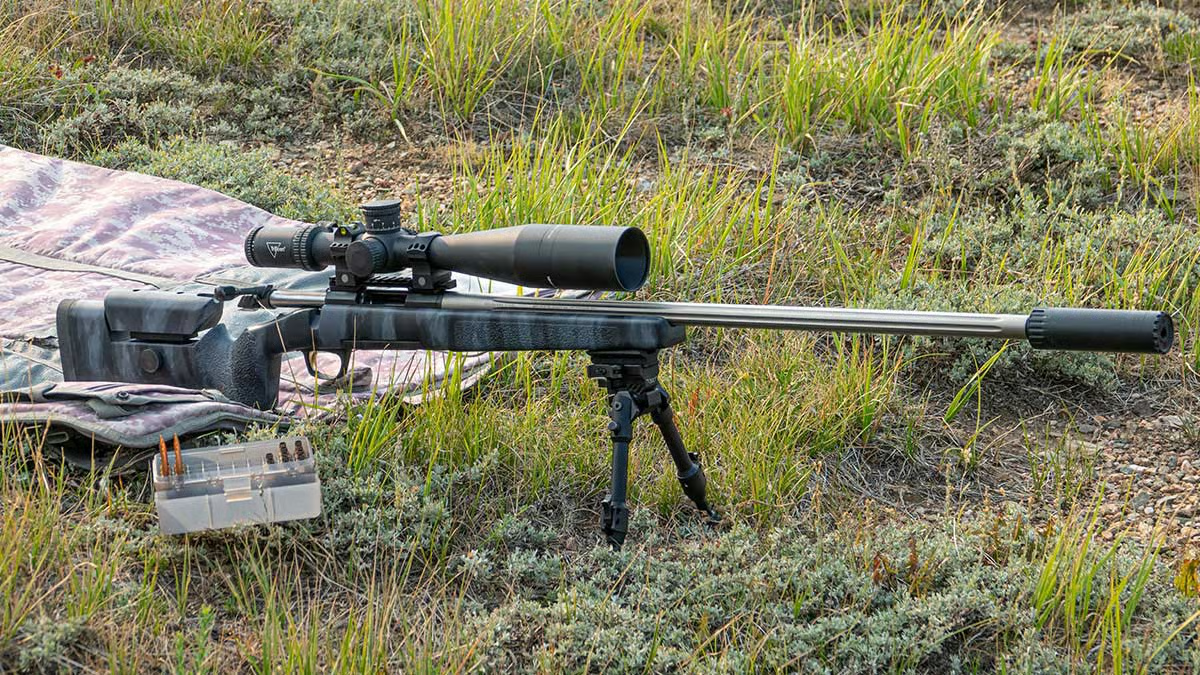
Long-range hunting like it or not has become big business, and growing in popularity. Everybody seems to have a coarse opinion on the subject, but we aren’t going to debate that subject here. Today we are going to discuss some good rifle and cartridge combinations for getting effective results in long-range hunting.
Cartridges like the 7 SAUM loaded with heavy bullets are devastating on game animals
Purpose
When most people think of long-range hunting, they think of shooting a big bull elk from across a canyon. While that is certainly a likely scenario, people often overlook other long-range hunting activities. I for example spend the spring months in the melting Rocky Mountains chasing groundhogs from great distances. So whether you are after coyotes or whitetail deer, we’ll go over a few options that will help you be successful at long-range hunting.
Long-range cartridges typically employ heavy for caliber bullets. An easy example of heavy for caliber would be a .223 Remington with a 75 grain or heavier bullet. Most .223 ammunition uses bullets in the 55-grain class. Another easy example would be a 308 Winchester, which typically uses 150 to 180 grain bullets. Both of these cartridges do much better at further distances when they are loaded on the heavier side. Heavier bullets typically have better ballistic coefficients (BC) which makes them more efficient. More efficient bullets retain their velocity and energy, for less drop and wind deflection.
even small cartridges like the .223 Remington can be used for long-range service when loaded right
Good long-range cartridges are also often magnum cartridges. A 308 might do well at 500-yards, but a 300 Winchester Magnum will do much better using the same bullet. Especially when loaded heavy. The large capacity of magnum cartridges gives them the horsepower to push bullets faster.
big magnums like the 300NM and 338LM have excellent long-range performance
Retaining speed and energy are key to long-range hunting. Because even a good hit on an animal might not be sufficient if the bullet has slowed down enough to be ineffective.
Big Game Cartridges
There is no lack of options for big game cartridges suitable for long-range hunting. Though it might be just as important to ensure the barrel twist is adequate for the bullet you’d like to shoot. A 300 Winchester Magnum with a 1:10 twist is pretty common, and will likely do what you need for taking down deer and elk sized animals at longer ranges.
Some of the more recent cartridges already account for this trend in long-range. The PRC family from Hornady specify fast twist-rates for high BC bullets. And whether you choose the 6.5mm, the 7mm or 300 PRC, they can be used very successfully for long-range big game hunting.
The further out you want to push your limits, the bigger the cartridge you’ll want to use. We have used the 338 Lapua Magnum and the 300 Norma Magnum very effectively on the largest of the deer family out to ranges like seven and eight-hundred yards.
this cow elk fell to a single impact at 700 yards from a 300 Norma Magnum, you can tell Iain is happy with it
Small Game Cartridges
Selecting an effective long-range cartridge for hunting smaller animals can be much easier. Because often it can be the same rifle and cartridge as your big game rifle. But also because there are so many good options, especially if they are set up to shoot high BC bullets.
One of the first ones that comes to mind is a fast twist 220 Swift like the one I built for my Dad. It pushes 75 grain ELDM bullets over 3300 FPS and will split a groundhog in twain from half a mile away. Another option would be the 6mm Creedmoor, Hornady’s 108grain ELDM match ammunition carries over a thousand pounds of energy beyond 500 yards. More than enough to take down a coyote or other pests.
long-range varmint rifles might still be your deer rifle, this coyote fell to my 6.5PRC PVA Modus
There are other fantastic choices typically in the .224 and .243 bore size. The 22 ARC is another good option, it has the horsepower to keep high BC bullets like the 88-grain ELDM above 2000FPS even at 500 yards.
Picking a Long-Range Rifle
Since most manufacturers today offer both short and long-action rifles in the same series, its pretty easy to recommend one. For example, I like the Ruger American Gen 2 as an entry level rifle that most folks can justify. The rifle offers good accuracy and customization which long-range shooters thrive on. And it can be had in most any popular caliber from 22 ARC up to 7 PRC.
A step up in both quality and price would be the Tikka CTR. Also available in a variety of good long-range calibers like the .243 Winchester, and with an upgraded 1:8 barrel twist. Or you could go with the 6.5 PRC option for more range and power. Tikka’s have excellent aftermarket support for those looking to customize their long-range hunting rifle.
I love Tikkas, and they are a step up in quality. And they make an excellent choice for precision shooting. You can read more about my custom Tikka here
Another step toward the pinnacle would be the Seekins Havak PH3 series of rifles. With exceptional quality and guaranteed accuracy, as well as long-range heritage these rifles offer a great value. Built by folks who know what long-range hunters are after, you can buy the rifles in any number of great long-range calibers. And select different barrel lengths to optimize your experience.
Cartridge families have been a thing since shortly after the first cartridges were made. A family refers to a group of cartridges based on the same parent cartridge, and it’s how some of our best cartridges came into being. A well-known family would be the 30-06 Springfield clan, with the .270 Winchester and the 25-06 Remington being some of its popular kin. Today we are taking a look at the Creedmoor Family Tree, on their ascent to being one of the great dynasties in the cartridge world.
Creedmoor cartridges enjoy flawless function from various magazine systems
6.5 Creedmoor History
Back in the early 2000’s, the Creedmoor was developed by a group of folks looking to design a perfect cartridge. Their goal was a flat-shooting, low-recoil cartridge with high ballistic coefficient (BC) bullets that would feed well from a magazine. They based the cartridge from the 30 Thompson Center, another cartridge looking for fame. The case was shouldered at thirty-degrees and necked down to .264 and the Creedmoor was born.
Since then, the cartridge has been adopted widely by nearly every corner of the shooting market. Much to the chagrin of Creedmoor haters, whose sophomoric insults are blind to the obvious performance of the cartridge.
PRS rifles like these are very often chambered in 6.5CM, though these days they are switching to 6mm cartridges.
The 6.5 Creedmoor has also spawned a whole family of descendants that have become well-known titans in their own bore-size. There is no free lunch however, so the advantages of each come with their liabilities as well. Today we’ll look at some of them and evaluate their attributes and how they might best fit into your next rifle purchase.
22 Creedmoor
Barrel Life Estimate: 800-1100 rounds
Bullet Weights: 50-80 grains
Max Effective Supersonic Range Estimate: Approximately 1500yds
Let’s start at the bottom of the pile, with the 22 Creedmoor. Necking is the process of narrowing the case mouth of a cartridge to hold a different caliber bullet. The 22 Creedmoor is the result of necking the 6.5 down to .224 caliber, I understand there is some thinning of the neck during this process as well to make it work.
The result is a hot-rod overbore 22 centerfire cartridge, similar to the extremely popular 22-250. The 22 Creedmoor has done very well in the hunting and target shooting arenas. Mainly because it has large displacement and the horsepower to push even the large .224 caliber bullets fast. Typically made with a 1:8 twist, the 22CM can push big 75 and 80 grain bullets well over 3200 FPS. This leaves cartridges like the 22-250 and 220 Swift in the dust. And makes the 22CM an obvious choice for varmint hunting and long-range target shooting.
Feeding the 22CM is easily done from popular magazine systems, and it cycles well from all the popular actions. Handloading is fairly easily done with support from companies like Hornady and Redding. You can buy ammunition and components from Hornady, Alpha Munitions and others. The scorching performance of the 22CM come at a cost, as it has an appetite for barrel throats. Making this cartridge a choice for the bold shooters out there.
6mm Creedmoor
Barrel Life Estimate: 1500-2200 rounds
Bullet Weights: 58-115 grains
Max Effective Supersonic Range Estimate: Approximately 1700yds
The next step up in the necking process is the 6 Creedmoor. Very comparable to the venerable .243 Winchester, the 6CM offers high speed 6mm/.243 bullets for either sport or hunting. The 6CM uses a faster twist than the older .243 design, typically 1:7 to 1:8 twist. This gives the 6CM the ability to shoot more modern bullets, many of which were basically designed for this cartridge. The longer high BC bullets of today won’t fly from the 1:10 or 1:9 twist rates of decades passed. This gives the 6CM a leg up over cartridges like the .243 and 6mm Remington.
The 6CM offers the same performance as those older cartridges when shooting comparable bullets. And its optimal for use in the same types of hunting situations, arguably better due to efficiency. Getting similar velocities from the Creedmoor with less powder and bore erosion than the other cartridges mentioned. It would be an excellent choice for a light big game hunting cartridge, or as a competition cartridge as it has been used extensively over the years.
6 Creedmoor fits into rifles and other common accessories like this Cole-TAC ammo novel
Whether you wish to shoot 58-grain bullets at coyotes or 115 grain match bullets in a PRS match the 6mm Creedmoor has a diverse hand of talents. It has been pushed aside somewhat by smaller 6mm cartridges in the competition circuit, due to its lower barrel life and recoil. But still has quite a following of dedicated loaders and shooters, thanks to the support from the companies I mentioned above.
25 Creedmoor
Barrel Life Estimate: 2000-3000 rounds
Bullet Weights: 86-135 grains
Max Effective Supersonic Range Estimate: Approximately 1900yds
Coming out of nowhere, the 25 Creedmoor is one of my favorites, likely because I was part of it’s renaissance. The 25CM came about because of new bullet designs that made the 25 caliber a better option than the original 6.5CM. Bullets with higher BC and lower weight meant that the 25CM could shoot faster than the 6.5, and enjoy flatter-still trajectories and more energy on target.
All of the Creedmoor family have excellent components available
This made the 25CM an outstanding choice for many shooters. Hunters and competition shooters alike have adopted the 25CM, and once again the aftermarket has stepped in to support it as well. Hornady only recently legitimized the 25CM, but Alpha Munitions and Petersen Cartridge Company have been making brass for it for some time. This is one Creedmoor that has actually gotten more love from companies besides Hornady, at least till now. With excellent components available from Sierra and Berger.
Using the 25CM in competition like the NRL Hunter matches has become very popular due to its power and low recoil. It might be one of my favorite hunting cartridges as well, the incredible consistency has allowed me to make many one-shot kills on deer and elk. Some of which were so far out that it’s better to leave unsaid.
6.5 Creedmoor
Barrel Life Estimate: 3000-4000 rounds
Bullet Weights: 90-150 grains
Max Effective Supersonic Range Estimate: Approximately 1800yds
Component Suppliers: Hornady, Alpha Munitions, Petersen, Lapua, Nosler, Everyone at this point
The OG Creedmoor, a cartridge that stormed the precision rifle shooting circuit when it came out. At the time (2006-ish maybe) there were three 6.5 cartridges fighting for dominance. Besides the Creedmoor, the 6.5×47 Lapua and .260 Remington were all extremely popular. But likely due to support from Big Red and others, the 6.5 Creedmoor quickly became the dominant 6.5.
Still an excellent choice for many competitors, the 6.5CM might be the only cartridge today that has a shot at taking the place of the 308 Winchester in popularity. The 6.5CM does everything the 308 does, and it often does it better. The narrow 6.5 bullets have a higher ballistic performance and speed than the old Winchester, making it an excellent successor. The 6.5CM is the easy-button of sharpshooting, and because of that it enjoys support from nearly every corner of the shooting world. Whether you are looking for semi-auto rifles or bolt-action there is a great option in 6.5CM. And ammunition options are as deep and diverse as any other cartridge.
This year appears to be the year of the sound suppressor. With the tax on transfers removed, and support for the NFA reduced to only the boot-licking tyrants in government. It would seem the market has responded in turn with an unbelievable bloom in production. It seems everyone is making suppressors (or silencers if you prefer), with countless new models coming out every day. Companies who were never known for such products are now releasing entire families of suppressors. With such a massive increase in options it the market, it can be very intimidating when you wish to choose one. Today we are going to discuss the process of selecting a suppressor. What is the Best Suppressor? How to choose the right silencer for you is about what you need to know, and what to avoid; almost like a friend walking you through the process.
the right suppressor makes shooting better in nearly every way, this Banish Meateater is one of my favorites
The Law
Many of us have been infringed upon by the National Firearms Act (NFA) for decades. If you are new to it, we should make a few clarifications. The NFA was passed in 1934 to establish an excise tax and registration on various firearms configurations. Perhaps at the time people were more naive about such things, but today they are simply arrogant tyrants for continuing its enforcement.
The NFA required a government sanctioned approval and a two-hundred dollar tax to be paid before a person or entity could legally own the following; Suppressors/silencers, Machine Guns, Short-Barreled Rifles (SBR’s) and Shotguns (SBS’s), Destructive Devices, and Any Other Weapons (AOW). The last one there to allow them the ability of classifying anything they deem scary or too dangerous to be regulated.
The How
All this is overseen and enforced by exactly who you wouldn’t want to; the Bureau of Alcohol Tobacco Firearms and Explosives (ATF). The very same group of people responsible for such travesties as Waco and Ruby Ridge. If you are unfamiliar with the ATF and their policies and actions, you should look into it.
Transfers of NFA regulated items are done using a variety of different forms from the ATF, much like tax forms from the IRS. Depending on a few particulars, you might use one of these different forms to transfer an item.
Basically you go to a dealer of NFA items, whether it be a local class 3 firearms dealer or one of the various online vendors like Silencer Central. After picking out a particular item you like, you pay the vendor for it and they have you fill out the appropriate paperwork or online forms. These are then submitted with photographs and fingerprints to the ATF for approval. And like any government agency it has traditionally been a painful wait. Particularly for a suppressor which by itself isn’t even dangerous.
Selecting a Suppressor
“Let’s talk about suppressors already” you are probably saying, you didn’t come here for a bunch of legal talk. But if you did come for additional recommendations on how to do it, I’ll add some more recommendations at the bottom.
Budget
Like any purchase, you’ll want to have a budget when you start. Now that the two-hundred dollar infringement fee has been removed, you no longer need to account for that in your budget. There are cans from anywhere as little as 150$ up to many thousands of dollars. So decide what you are willing to invest in your suppressor, and then count on another 10-20 percent. Why?
rimfire suppressors like this Anechoic Pipsqueek are nice for my 22’s and 17HMR, this combo with my Taurus TX 22 is a ton of fun for the whole family
For the most part, a suppressor is a lifetime purchase. The bureaucracy required to transfer them means most folks keep a can for its lifetime. So if you are potentially going be stuck with something for life, you may as well splurge a little and get the better one. If the six-hundred dollar model will suit your needs, maybe get the eight-hundred dollar model.
Host Firearms
Considering which firearm hosts you intend to use the suppressor with has a great impact on what model you choose. And keep in mind that over a lifetime things can change. You might only want a 30-caliber suppressor today, but ten years from now you might have a .35 caliber.
Chode cans like this YHM Fat Cat 5.56 add minimal length and still do a great job keeping down the noise
So evaluate the hosts you have and might potentially have in the future when looking at suppressors. This is particularly important if this is your first and only suppressor. Whereas if you plan on becoming an NFA stamp collector like the rest of us, you might just buy a variety of suppressors.
Different suppressors work better for different types of host firearms. Semi-auto firearms for example tend to suffer from back-pressure when suppressed. While single shot firearms are essentially unaffected by the issue. There are different suppressor designs to optimize use with all the different host types. You also need to keep in mind bore-size as well as pressure. A 30-30 and a 30 Nosler will both go through a 30-caliber suppressor, but larger magnum pressure and volume cartridges might be too much for some suppressors.
Suppressor Types
Suppressors have been affected by technology just like everything else today. Traditional suppressors were made using a stack of baffles within a tube. Resulting in a stack of chambers with a central hole through each. The bullet could pass from the muzzle of the rifle through each chamber and out the muzzle of the can. But the expansive gases rushing from the barrel would get progressively trapped and slowed as they go through each chamber.
the YHM Phantom 22 is disassembled here, and you can see the sections and baffles that slow escaping gas
More modern designs use all different kinds of ways to capture and slow the gas flow from the host. But the idea is the same, reducing the exit speed of the gas greatly reduces the sound signature from the host.
Modern manufacturing methods like direct metal laser sintering (DMLS) or 3D-printing as many people call it have changed the game. These technologies have made unprecedented designs possible to make, and it’s pretty cool.
Function
Suppressors work by reducing high pressure expelled from their muzzle which removed the supersonic report. Energy cannot be destroyed, only converted, so you can turn high pressure into either heat or noise. Some suppressors are very quiet and they tend to get pretty warm because they capture so much energy. Flow-thru style cans tend to be a little louder in my experience, but the trade off is less back pressure and heat. Different designs reduce report in different ways. Flow-thru style cans typically redirect gases slowing their escape to a reasonable volume.
these Huxwrx Flow DMLS suppressors have some wild internals only possible through 3D printing
Materials
Carbon steel has traditionally been used for suppressors. But modern metal alloys have made them even more robust and resistant to erosion. Erosion takes place when very high temperature gasses with included burning powder residues are blasted through the suppressor. The heat, pressure and debris cause wear on the internal surfaces of the suppressor. Better materials like inconel, stainless steel and cobalt are being used to improve durability of suppressors.
Mounting Solutions
Each suppressor manufacturer has typically come up with their own suppressor mount. These muzzle devices typically incorporate a muzzle brake design or flash hider for use when the suppressor is absent. These are often used as a quick and secure way to install the can to its host firearm.
But again, American ingenuity has upped this game as well. In recent years US suppressor manufacturers have began making their cans using a uniform industry standard hub system. The hub system uses a 1.375×24 thread, and it allows the user to quickly change out the mounting solution. You can use any number of thread patterns or muzzle devices to mount your suppressor.
Overbore
While there are plenty of different options, one thing you should keep in mind is that bore size isn’t everything. For example, there are plenty of 6.5 caliber suppressor options. But most 30 caliber suppressors will work just fine for 6.5’s. So if you are buying your first can, don’t limit yourself to that 6.5 suppressor if you have other firearms that could also benefit from a 30-caliber can.
This Banish Meateater uses interchangeable muzzle sizes for various caliber
A couple examples from my collection; the YHM R9 is a 9mm bore suppressor, and can be used on my 9mm pistols and carbines. But it is also rated for up to 308 Winchester, so I can also use it on my 5.56, 6.5CM and 308 Win rifles. That is a huge leg up for that suppressor, allowing some folks to suppress their entire gun collection with a single can.
the YHM R9 is at home on 9mm Pistols like this Canik TP9, or on centerfire rifles
Another option is my Silencer Co Omega 36M, this suppressor can be reduced in both bore diameter and length. You can change the muzzle-cap for different calibers, and remove a section of the baffles to reduce overall length. So long as you have enough bore clearance, you can use oversized suppressors. Undersized suppressors on the other hand have a very short life when used on larger calibers (usually no more than a single round before turning into range debris). Do not try it.
here you can see the dexterity of the Omega 36M, short and small on the right, and long and open on the left for my 8.6Blk
Choosing Your Next Suppressor
So with all that information at your attention, let’s look at individual selection. Let’s say you have a typical AR style rifle chambered in 5.56, something you want to be quiet but for high volume shooting.
Semi-Autos
If you shoot outdoors and aren’t as worried about getting gas blown back from the action, you could use a traditional can like the YHM Turbo. I have several of these cans and I love the sound suppression and the gas blowback isn’t bad. They are also very affordable and rated for heavy strings of fire.
Or perhaps you want something a little tougher, and with lower back pressure? I also have a Banish Speed K, a 3D printed inconel suppressor. It couples some flow through technology to reduce back pressure and increase durability.
You could also spend the money buying one of the flow-thru type suppressors that greatly reduce the blow back. Something like the Huxwrx Flow 5.56 or the Wolf Pack Armory Romulus 5.56 suppressor. While they may cost more than traditional cans, the payoff is significant.
Pistols
Semi-auto pistols often require a booster assembly to function. The booster is a necessary part that allows the barrel and slide of your pistol to function properly with the added mass of the suppressor.
These boosters are’t always included with the suppressor itself, and you’ll probably have to also purchase the appropriate piston that will integrate the booster with your barrel.
the booster assembly allows the barrel and slide to move and unlock without having to move the suppressor assembly with it. This allows guns like this Canik METE to function flawlessly suppressed.
Bolt-Action/Single Shot
But what if you are just a deer hunter looking for a can to make your hunting experience more pleasant? There are countless cans at your reach that do a great job on bolt-action rifles. Bolt guns are barely affected by blow back, and so going with a traditionally-manufactured less-expensive suppressor is an easy choice.
My Kids; the youngest used this Browning X-Bolt 2 in 308 Winchester to take his first deer. For suppression we used the Banish Backcountry titanium suppressor, it was an excellent choice.
There are just a few things that I consider when looking at cans for this purpose. Weight is a big one if you are roaming the Rockies like me, and the caliber or cartridges you plan to use with it as well. If you are hunting with a 6.5CM most of the time you don’t need a great big or tough suppressor. Whereas if you hunt with a 300 RUM you probably best look at some magnum rated suppressors.
Something like a Dead Air Nomad will cover most hunting cartridges under 30-caliber. They are reasonably priced, but there is also a titanium model for additional cost and weight savings. If you are looking for something nicer, you might look at the titanium ThunderBeast options.
Flow-thru and semi-flow-thru cans can also work just fine on your single-shot firearms. I use a couple different Anechoic Anechox suppressors with a 35-caliber bore, but they have worked great on everything from semi-auto .223 and 6mm ARC up to the mighty 338 Lapua Magnum.
It’s a Modular World
I mentioned the modular hub mounting system, but there is more modularity to modern cans than just that. Different end caps allow you to optimize your can for the caliber choice of the day.
Here are five suppressors from different manufacturers, all share the same hub design and any number of mounts can be installed in the breech of any of them
As one who dabbles quite a bit in multi-caliber modular rifles, having modular cans that can adapt with its host is convenient. My Desert Tech WLVRN can be a 5.56 one day and a .308 the next, so keeping one can that can do double or even triple duty is handy.
these two cans both feature interchangeable muzzle caps, changing both caliber compatibility as well as functional flow patterns
There is no free lunch however. A suppressor good at many things isn’t likely to be exceptional at more than one. A heavy duty full-auto can will take some serious abuse, but it is likely going to be heavier. And a lightweight titanium can would be great for your hunting rifle, but won’t likely stand up to heavy strings of fire as well.
Prepare Yourself
If you are starting down this road, get ready to accelerate. I know very few people who got one suppressor and said: that’ll do. Everybody I know typically gets one after another because they are too much fun.
the first one is just the beginning, more will come
To that end I would strongly recommend a gun trust. A personal transfer make any NFA item your legal property, whereas a trust can be accessed by multiple people. This allows several people to put their property together (like a family or friends) and more than one person can use the assortment. A trust has both pros and costs, but I’ve found it to be a much better situation. Silencer Central even offers assistance creating your trust. There is also a great list of frequently asked questions here.
Last Words
Read much, and study up. there are many important things you should know as a suppressor owner. It is an addictive habit, just like shooting. Make sure you do it right the first time, and like I said don’t be afraid to splurge a little bit for a lifetime purchase. Hopefully this has been helpful, if you have any questions feel free to reach out. And don’t forget to abolish the NFA and those who enforce it!
-CBM
If you’d like to read more about individual suppressors, click here
The newest member of Hornady’s Advanced Rifle Cartridge family also happens to be the smallest yet. The 22 ARC is the little ARC, made by necking the popular 6 ARC down to .224 caliber. But do we need another centerfire .224 cartridge? Or perhaps the better question is what does the 22 ARC offer that we don’t already have? Today we will dive straight into the subject and get some answers so grab a drink and a notepad.
The Case for the ARC
The 6mm ARC was designed for many of the same reasons as its parent case, the 6.5 Grendel. Both were designed to shoot heavier bullets out of a case that could fit in an AR-15 magazine. The 6 ARC shoots bullets in the 60-110 grain class at velocities much higher than the popular .223/5.56 cartridges that most AR style rifles use. This gives a very big advantage at further distances or up close.
the 22 ARC (left) seen with the 6 ARC and 6.5 Grendel
Shooting heavier bullets has a great effect on power delivered to downrange targets. And it also greatly improves ballistic performance, shooting flatter and preventing deviation from wind. All of this from a cartridge that can fit into most any AR-15 receiver, of course using a different magazine and giving up a few rounds of capacity.
Making the 22 ARC was a natural evolution, as it seems handloaders are fascinated by making new cartridges out of existing ones. But the ARC isn’t just another .224 caliber cartridge, there is more to it than its neck. With it’s short body, and faster specified twist-rate, this chubby little cartridge was also built for pushing bigger bullets.
Cartridge designers made the case shorter than cartridges like the .223 Remington, this helps fit the longer heavier bullets into the case. And also allows these cartridges to cycle in actions when loaded with these long bullets. In order to boost capacity to make it worth the trouble, the cartridge was also enlarged to the case-head size .441. Making it larger in diameter and shorter gave it the capacity and proportions needed to exceed the performance of other cartridges.
As you can see, the 22 ARC has much more seating room than the 22-250 (center) and .223 Remington (right)
For example, when compared to the .223, the 22 ARC case is shorter, allowing longer bullet seating. The popular 22-250 is even longer than the 223, which allows even less room for seating bullets out. Most 22-250’s use slow twist rates like 1:12 or 1:14 which means they can’t shoot heavier bullets anyways. Limiting their use to 40-55 grain bullets for the most part.
22 ARC Specifications
22 Advance Rifle Cartridge Specifications
Max O.A.L.
2.260 inches
Bolt Face
.441 inches
Trim Length
1.525 inches
Shoulder Angle
30 Degrees
Case Capacity (H2O)
34.6 grains
Barrel Twist
1:7 standard
Bullet Weight Range
60- 90 grain (typical)
So why would you want to shoot heavier bullets? I’ve been loading 75-grain BTHP bullets for AR-15 rifles for decades. Because they simply perform better at further distances. Once upon a time, many years ago my brother and I were shooting a steel target at roughly 700 yards if I recall correctly. I was dinging the steel repeatedly using my AR loaded with 75-grain bullets. My brother shooting his 22-250 was having trouble hitting it with 50-grain bullets. This made a lot of sense once we retrieved the target and found his bullets barely sticking into the wooden target hanger like a dart.
The much higher velocity of the 22-250 burns off too fast in a small bullet for long-range shooting. That’s why in this case my .223 chambered AR was superior, and a rifle chambered in 22ARC would have been even more superior. Shooting 70-90 grain bullets at higher velocities than the .223 can hurl.
But what if you don’t wanna shoot far you might be asking? Well, then the 22 ARC still has a lot to offer you. Shooting lighter bullets up close, the 22 ARC gives devastating performance just like the aforementioned 22-250.
Loading the 22 ARC
Rolling your own 22 ARC cartridges is easily done, getting brass from Hornady. You can also get it from Alpha Munitions and Petersen Cartridge Company. Small rifle primer pockets are used in the ARC, and modest charges of powder will get you excellent velocities.
If you find yourself rebarreling a rifle, be it as an upgrade or because it has been worn out, you might be asking yourself a few questions. Today we are going to discuss how to pick the right barrel length and twist rate. Barrel length has a lot to do with performance, and the twist rate inside dictates the bullets you can shoot through it. In our discussion today I hope to illuminate how these topics should be approached and evaluated.
The length of your barrel has a great deal to do with velocity. Typically, longer barrels produce higher velocities all else being equal. A 308 Winchester loaded with 165 grain bullets would likely have a muzzle velocity around 2800 FPS. When you look at test data they usually post the barrel length they used to get that velocity (often a 24-26 inch). So if you have an eighteen-inch barrel on your 308, you are likely going to get a much slower muzzle velocity when using the same 165 grain load.
Various studies have been done showing velocity reductions as barrels are cut down. With most cartridges it seems the drop in velocities become greater past a certain length. For example, cutting from 26 to 24-inch you may only lose 25-50 FPS. But cutting a 20 down to 16-inches, the loss will be much greater.
mant modern bullets require faster twists than previously used, like these Hornady 180 gr 7 PRC
This is important when making your decision, as velocity can be important depending on the purpose of your rifle. For example if you are doing long-range target shooting, you might want as much velocity as possible. While if you are assembling a short-range hunting rifle, it might be more important to have a compact rifle even at the cost of some velocity.
Burning Powder
Big magnum cartridges use a lot of powder, and the barrel length is used to allow all that powder to be burned. This is also why big cartridges use slower burning powder, so it is still burning at the end of the barrel. This keeps the bullet accelerating, whereas if the powder burns up too fast, it can be spent before the bullet leaves the muzzle.
This 20-inch LWRC REPR barrel allows better combustion of powder than a 16-inch version would
Ideally you’d want a long enough barrel to allow all the powder to be used to accelerate your bullet. But there are some considerations to keep in mind, sometimes long barrels are cumbersome. And its more common these days for folks to compromise between a long barrel and one that gives enough velocity without being unwieldly.
Twist Rate
In the same fashion, barrel twist is important to evaluate when deciding on your next barrel. And again for the same reasons. If you goal is shooting long-range, you will probably want to shoot high ballistic coefficient (BC) bullets that require faster barrel twist rates. Whereas if you are rebarreling your favorite varmint rifle, a slower twist rate might be optimal for the bullets you will be shooting.
Faster moving cartridges typically use slower twists, but stepping them up to a faster twist will allow you to shoot bigger bullets faster. My Desert Tech SRS M2 uses a variety of barrels and calibers
If you are of a certain age, you might have played with the ancient toy called a top. Often shaped similar to a bullet, you spin the top and it would stand up and spin until it slowed enough to topple over. You can imagine if a top was taller, shaped like an inverted old Coke bottle, it would be much harder to get it to spin fast enough to stay standing.
So you’ve decided to get into long-range shooting have you? Whether you plan on pushing the limits of your current rifle, or plotting to get another, today’s subject is quite relevant. You’d be surprised at how much difference the right bullet can make. And today we are going to discuss how picking the right bullet for long-range shooting can pay off big time in this game.
Ballistic Performance
The very shape of a bullet is designed to be aerodynamic, cutting through the air with as little resistance as possible. Much like the fairing on a motorcycle or the front of your car, they are designed to reduce drag so they can retain energy and avoid deflection.
Ballisticians have come up with a mathematical formula to assign a score to a bullet’s ability to cheat this drag and deflection. This score is called a ballistic coefficient, there are a few different models for this numerical grade, but mainly folks use either the G1 or G7 drag models. That may be deeper than you wish to look, so to keep it simple lets just stick to the G7 as it seems most popular.
A ballistic coefficient (BC) is shown as a decimal, and an easy way to understand it is that a 1.00 BC is significantly better than a .500 BC. And the .500 BC is still better than a .300 BC. Most bullet manufacturers produce a BC for each bullet they manufacture. And for the most part you can use the manufacturer’s BC with confidence to calculate and theorize a trajectory. Many offer a stepped BC for different velocity ranges.
It would appear, based on the design of most high performance bullets that there seems to be a set of perfect proportions to them. You can put high BC bullets of various calibers together, and you’ll start to see a pattern. They are typically long, and have slender points with uniform tips, and almost always a boat-tail at the back.
Whether you are shooting a .223 or a 300 Winchester there is a selection of bullets out there with higher performance. The question is; Can you shoot them?
Stabilizing Bullets
One of the greatest development in firearms has been the rifling of the barrel. The grooves cut into a barrel are done so with a specified twist rate, the purpose is to cause the bullet to spin as it exits the muzzle. Barrel twists are depicted in a “one rotation in XX inches”, and written like 1:12, meaning one rotation in 12 inches of barrel travel. Spinning bullets stay far more stable than non-spinning ones. Much like a football, when you throw it right it will fly much farther and land closer to you point of aim. But when thrown without the characteristic stabilizing spin, it is bound to fly more unexpectedly.
Testing various bullets and loads in this Bergara rifle identified the best performer
High BC bullets as I mentioned are usually longer than a typical for caliber bullet. For example; A popular 30-06 Springfield bullet might weigh-in between 165 and 180 grains. But you could also load the same cartridge with something like a Berger 210 grain VLD bullet that has a much higher BC than your typical 30-06 bullets.
Most 165 to 180 grain bullets on the market today would shoot acceptably well from a barrel with a twist between 1:12 and 1:10. But the longer 210 grain bullet I mentioned needs at least a 1:10 twist to stabilize, and might do even better in a 1:9 twist barrel.
So How do I Pick a Bullet Already?
You may have figured it out already, but if you know or can figure out the twist of your rifle’s barrel, you can then evaluate the bullets that will best stabilize through it. Once you have that figured out, you can decide which one might give the best velocity.
Speed isn’t everything though. If you start out two bullets at the same speed and measure the speed again 500 yards downrange, the one with the higher BC will be faster. So the only thing better than a higher BC bullet is a high BC bullet going even faster.
Two very similar Hornady bullets with differing performance profiles
The secret: picking a bullet that will stabilize in your barrel twist, has the highest BC, and allows you to get the best velocity from your given chambering. And if you still aren’t seeing the performance you desire either on paper or on range, you might need to step up to a bigger cartridges, or a faster twist for better bullets.
I’ve mentioned many times that I started out with a 25-06 as my first real rifle. So it should come as no surprise that I’m a fan of the caliber. But today is about a more modern project, the 25-06 has been around for a long time, and this one needed a nudge into modernity. Today I bring you a 25-06 worthy of 2025, a modern 25-06 Remington.
This project began as a bone stock Remington 700 Long Range model, chambered in 25-06 Remington. While there was nothing wrong with it, it still featured similar barrel design features to the original. Mainly it used a slow barrel twist rate like a 1:10, and the steel barrel was a little heavy for mountain hunting.
The plan was to rebarrel the rifle, with a new Proof Research carbon barrel with a faster twist to allow use of modern bullets like the Hornady 134 ELDM and the Sierra 131 Match King. Other things like a threaded muzzle and such would also be added to make this rifle a little more appealing to modern culture.
Since the original fiberglass stock wasn’t terrible, I decided to stick with it. It wasn’t overly heavy, and both fit and looked good. Though we did shorten the stock for its future user, to make it even lighter and a better fit.
Fresh Threads
Since this rifle was built to hunt, we cut the barrel at 20-inches. This might be a little short for some folks taste, but with the horsepower of the big ’06 case I expected velocity to be between 2800-2900. More than enough for most of the hunting we would do.
With a Proof Carbon barrel finished at twenty-inches, and a 7.5 twist. This rifle would do fantastic. Most of the machine work was done at my friends shop E.S. Tactical. I did a little machining myself to ensure the barrel channel would fit the large MTU style profile.
Once the barrel had been fitted, and the stock inlet for the new barrel, it was time to assemble the rest. With the trigger adjusted properly, and screws torqued town, it was time to mount a scope.
Range Prep
I ended up mounting a scope from Arken Optics, their affordable quality is matched by quality glass. This would make a good match for this rifle. I installed a Weaver picatinny rail, which was actually a touch longer than would work with my scope and ring selection. So I trimmed about half-an-inch off the front, which made it perfect.
With quite an inventory of 25-06 brass, I grabbed some Remington cases, and began prepping them to be loaded. After various tests, it seemed the 134 liked a charge of Hodgdon Hybrid H100V. Seated about 20-thousands off the lands, they would typically group around half an inch.
In the Field
The rugged Rocky Mountains where this rifle will prowl are home to big spaces. On various occasions now, I’ve taken the rifle into the high country where bears and elk roam. There we stretched the rifle out to see how it would perform in this country.
Shooting at small targets has been a great way for me to evaluate a rifle’s utility. I picked out a small rock surrounded by soft dirt, still damp from the previous nights rain. At 425 yards the rock measured about 6-inches round, a suitable target for a hunting rifle. After punching in some hard numbers to my ballistic solver, it came up with 2 MRAD. I dialed it in and fired several shots, all found their mark. I repeated the process for six-hundred, and nine-hundred yards as well. With predictable accuracy on 1 MOA sized targets. I knew I had a winner in my hands and couldn’t wait to put the hurt on some Mule deer with it.
testing my handloads at the range
The Deer Hunt
All that was left for this rifle was it maiden trip into the deer woods, in this case it would be the deserts of Southern Utah. The open country with sandstone peaks and Cedar trees would make perfect testing ground for this rifle.
This rifle was actually built for my cousin’s oldest daughter, and after practicing a bit with it she was ready for opening morning. Today was that morning, and Harley made a perfect shot, making an accurate double lung shot on a nice four-point Mule Deer from 370 yards.
Final Thoughts
My love for the 25-06 has only gotten better with this project, and Harley seems to be at the beginning the same kind of scenario. This little rifle promises to bring years of accurate shooting, and peak performance in a package that a 100 pound girl can run with authority. Or maybe even a guy like me.
Few things compare to elk camp, and it is the highlight of my year each fall. The perfectly cool weather, in the high Rocky Mountains in the prettiest time of year. And perfected by the sometimes distant song of rutting bulls. This year I changed up my plan a little bit, and hunted a different area than I have been for the last five or so years. Changing your hunting plans can be a roll of the dice, creating potential triumph or bust. It wouldn’t be long before I would find out.
this mature bull spent 30 minutes bugling on this hillside as we watched him
Terrain and Weather
The mountains of Central Utah are a unique collection of geography. Interesting layers of rock, clay, and stone conglomerate you would normally see in the desert, have all been pushed up over millennia to an altitude over eight-thousand feet. And at this altitude, the typical alpine and aspen forests grow. That is where elk thrive, and we had made our way into this country in search of immature spike bulls.
At this high altitude, storm clouds crash into the mountain range and squeeze out all their precipitation. I actually enjoy a little bit of weather, mingled with good. It tends to keep animals active when they otherwise might not. And the weather we encountered had caused the local elk to endure their rutting mating rituals, which was a great help for us.
Junior and I enjoying a bit of sunshine as bulls bugle in the background
Despite the less than ideal weather, my son and I took every opportunity to explore, hunt, and even fish some handsome Cutthroats from the nearby creeks. Until he had to leave halfway through the hunt.
Bonneville Cutthroat filled the tiny creeks
Bull elk had been bugling so frequently during our time in the mountains, that I was beginning to develop elk tinnitus. I was beginning to hear bugles in my sleep and in my thoughts.
An Opportunity
After many days of hunting, I had seen quite a few elk including some mature bulls we couldn’t engage but through the binoculars. I’d even caught a glimpse of a spike running through the forest. But an actual shot opportunity had evaded me.
the beauty of the Rockies is impressive
It was an evening hunt midweek, and three of us were stalking quietly through clearings in the forest. Sagebrush pastures surrounded by Aspen groves and thick pine covered ridges allowed us to move pretty quietly. Thick dark clouds hung overhead licking the tops of the tallest pines, causing the effect of a premature twilight as the sun hung low in the western sky.
With me that day was my old friend Nathan, and his son Jacob. The three of us approached a small open draw buried in the thick forest, hoping to see the brown and tan figures we were after. Moving very slowly to avoid detection, and with the wind in our faces, we crept over the edge looking into the draw below.
I spotted one elk feeding calmly opposite us, down the draw and up the other side. We watched her through binoculars as a calf fed out alongside her from the thick pine trees nearby. We prepared our gear as we watched for additional potential targets. A third elk fed out of the trees, and I was sure it had short antlers. Watching through my scope, I whispered to Jacob who was on the spotting scope, seeking confirmation that the third elk indeed was a unbranched antlered bull. Jacob confirmed what I suspected, and it was time to shoot…
Hardware
The rifle I carried that day was my Patriot Valley Arms Modus rifle, chambered in 6.5 PRC. I had used the rifle several times before for both deer and elk hunting, I’d even managed to have some success the previous season. The Modus wore a brand new US Optics LXR 4-24×56, one of my favorite new scopes. Aside from the typical bipod and sling, I’d also installed my Anechoic Anechox 35 suppressor, to keep things quiet.
The rifle was loaded with my pet handloads, made from Peterson cases loaded with Hodgdon Powder and the Hornady 140 grain BTHP match bullet. Muzzle velocity was just over 3000FPS, and had been tested extensively out to distances well beyond 1000 yards.
As the young bull fed quietly 430 yards away, I rested the rifle atop my upright backpack, sitting behind it. As Nathan and Jacob both watched, we waited for the bull to turn broadside. I’d dialed the 1.6 MRAD elevation correction into the LXR’s elevation turret, and I evaluated the breeze as I tried to calm my elevated heart pace. The killshot came as his broadside show between two pine trees, I confirmed with my spotters that was indeed the bull, and sent one of the handloaded Hornadys through his chest. His shoulder rippled with the impact, and he charged out of sight into the pines.
moments after recovery
Recovery
The centered shot just behind the shoulder looked good, I expected the bull to be dead a few yards away. But as we quickly hiked into the location I didn’t see him, and the increasing rain threatened to wash away any blood sign. So we quickly set to find a blood trail.
As we did, I heard the thrashing sounds of the dying bull. About forty-yards into the pine trees, his legs kicked against the brittle sticks where he’d fallen. We approached the fallen bull as the eerie sound of his last breath escaped from the wound in his side.
the exit wound
I knelt beside him as the rain continued to fall. We quietly revered him in the damp silence, listening only to the sounds of the forest and our thoughts of gratitude.
Food for Thought
After an exhausting extraction through rain and mud, the young bull hangs in a tree a few yards from camp. Using my pocket knife, I cut a tenderloin from his belly. I cleaned it and trimmed it up as I heated a dutch oven and butter. As Nathan, Jake and I sat to eat this fresh piece of our prize, I considered a thought that frequents my inner dialogue. There was a time, where I would hunt like this whether accompanied or not. But as I’ve aged, I find the solitude less entertaining.
I’ve found that without someone I love to share my adventures, they aren’t quite as bright. Without one of my kids to teach something, or a brother or friend who can share in the suffering and triumph, the memories fade faster than those I share with loved ones. Nothing will stop me from pursuing these adventures, but these days I spend as much time including kids and others as I do planning the adventure itself. And those memories are refreshed every time we taste a delicious deer burger, or slice a juicy elk steak.