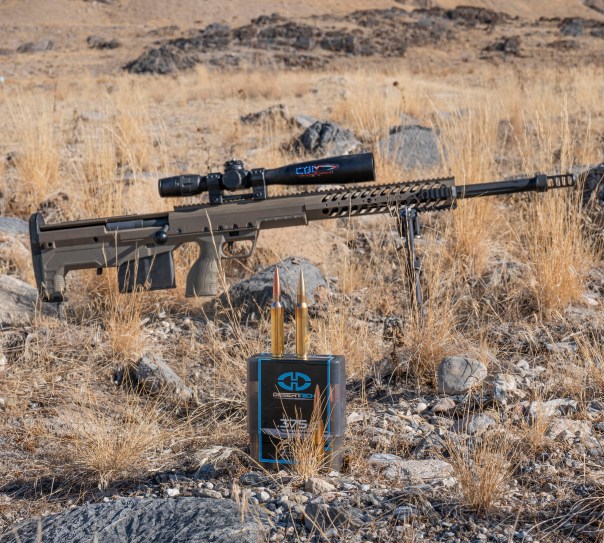
Long-range hunting like it or not has become big business, and growing in popularity. Everybody seems to have a coarse opinion on the subject, but we aren’t going to debate that subject here. Today we are going to discuss some good rifle and cartridge combinations for getting effective results in long-range hunting.
Cartridges like the 7 SAUM loaded with heavy bullets are devastating on game animals
Purpose
When most people think of long-range hunting, they think of shooting a big bull elk from across a canyon. While that is certainly a likely scenario, people often overlook other long-range hunting activities. I for example spend the spring months in the melting Rocky Mountains chasing groundhogs from great distances. So whether you are after coyotes or whitetail deer, we’ll go over a few options that will help you be successful at long-range hunting.
Long-range cartridges typically employ heavy for caliber bullets. An easy example of heavy for caliber would be a .223 Remington with a 75 grain or heavier bullet. Most .223 ammunition uses bullets in the 55-grain class. Another easy example would be a 308 Winchester, which typically uses 150 to 180 grain bullets. Both of these cartridges do much better at further distances when they are loaded on the heavier side. Heavier bullets typically have better ballistic coefficients (BC) which makes them more efficient. More efficient bullets retain their velocity and energy, for less drop and wind deflection.
even small cartridges like the .223 Remington can be used for long-range service when loaded right
Good long-range cartridges are also often magnum cartridges. A 308 might do well at 500-yards, but a 300 Winchester Magnum will do much better using the same bullet. Especially when loaded heavy. The large capacity of magnum cartridges gives them the horsepower to push bullets faster.
big magnums like the 300NM and 338LM have excellent long-range performance
Retaining speed and energy are key to long-range hunting. Because even a good hit on an animal might not be sufficient if the bullet has slowed down enough to be ineffective.
Big Game Cartridges
There is no lack of options for big game cartridges suitable for long-range hunting. Though it might be just as important to ensure the barrel twist is adequate for the bullet you’d like to shoot. A 300 Winchester Magnum with a 1:10 twist is pretty common, and will likely do what you need for taking down deer and elk sized animals at longer ranges.
Some of the more recent cartridges already account for this trend in long-range. The PRC family from Hornady specify fast twist-rates for high BC bullets. And whether you choose the 6.5mm, the 7mm or 300 PRC, they can be used very successfully for long-range big game hunting.
The further out you want to push your limits, the bigger the cartridge you’ll want to use. We have used the 338 Lapua Magnum and the 300 Norma Magnum very effectively on the largest of the deer family out to ranges like seven and eight-hundred yards.
this cow elk fell to a single impact at 700 yards from a 300 Norma Magnum, you can tell Iain is happy with it
Small Game Cartridges
Selecting an effective long-range cartridge for hunting smaller animals can be much easier. Because often it can be the same rifle and cartridge as your big game rifle. But also because there are so many good options, especially if they are set up to shoot high BC bullets.
One of the first ones that comes to mind is a fast twist 220 Swift like the one I built for my Dad. It pushes 75 grain ELDM bullets over 3300 FPS and will split a groundhog in twain from half a mile away. Another option would be the 6mm Creedmoor, Hornady’s 108grain ELDM match ammunition carries over a thousand pounds of energy beyond 500 yards. More than enough to take down a coyote or other pests.
long-range varmint rifles might still be your deer rifle, this coyote fell to my 6.5PRC PVA Modus
There are other fantastic choices typically in the .224 and .243 bore size. The 22 ARC is another good option, it has the horsepower to keep high BC bullets like the 88-grain ELDM above 2000FPS even at 500 yards.
Picking a Long-Range Rifle
Since most manufacturers today offer both short and long-action rifles in the same series, its pretty easy to recommend one. For example, I like the Ruger American Gen 2 as an entry level rifle that most folks can justify. The rifle offers good accuracy and customization which long-range shooters thrive on. And it can be had in most any popular caliber from 22 ARC up to 7 PRC.
A step up in both quality and price would be the Tikka CTR. Also available in a variety of good long-range calibers like the .243 Winchester, and with an upgraded 1:8 barrel twist. Or you could go with the 6.5 PRC option for more range and power. Tikka’s have excellent aftermarket support for those looking to customize their long-range hunting rifle.
I love Tikkas, and they are a step up in quality. And they make an excellent choice for precision shooting. You can read more about my custom Tikka here
Another step toward the pinnacle would be the Seekins Havak PH3 series of rifles. With exceptional quality and guaranteed accuracy, as well as long-range heritage these rifles offer a great value. Built by folks who know what long-range hunters are after, you can buy the rifles in any number of great long-range calibers. And select different barrel lengths to optimize your experience.
Science is a neat thing, especially as it improves our shooting abilities. A long time ago, these very same mountains and valleys were hunted by our ancestors. They were likely using equipment of the time, perhaps the first black powder cartridges or muzzleloaders. I find it fascinating how American rifles have gone from big guns shooting massive projectiles to tiny sharp bullets moving two or three times the speed. Modern bullets have allowed us to do so much more with less, and today we will discuss what has made that possible.
A Revolution
America was born of powder and bullets, so our affinity for shooting runs deep. The weapons our forefathers used like the Brown Bess fired huge projectiles weighing nearly five-hundred grains. And their effectiveness was dismal by comparison to even our modern muzzleloaders. Accuracy and power of OG American’s weapons was somewhat sad, with projectiles that barely achieved supersonic speeds.
Even so, they managed to secure both a country and the food they were after. And it wasn’t long before Americans started hunting everything in sight. Using old Sharps rifles and Remington rolling blocks they hammered away at bison and other game animals. And though they were much better off with the .45 and .50 caliber cartridges, they still had a somewhat limited range and power.
The Advent of Bottleneck Cartridges
As smokeless powder and bottleneck cartridges have reigned over the last century, technology has only made them better. Impressive improvements in powder and bullets have massively changed the game. I remember a time when hitting targets at 1000 yards was something exceptional. But these days I do it frequently with a variety of rifles chambered in as little as .223 Remington.
The cost of the equipment needed to shoot like this has come down significantly. Even manufactures known for more affordable firearms have models capable of performing tasks that were unbelievable 30 years ago. And what’s even more interesting is that folks are doing it with less and less. Even 20 years ago, people shooting 1000 yards were typically using a large 30-caliber magnum. Or perhaps a slippery six-point-five cartridge like a 6.5x.284 or 6.5-06.
even more recent long-range rifles were shooting bigger bullets and cartridges
Velocity
The powders we load our cartridges with these days also have much to do with these advances. Black powder muzzleloaders and cartridges were significantly slower. Our smokeless powders today allow velocities going double or more compared to the cartridges of the past. The increase of velocity drives the energy up significantly, which is part of the reason we can get so much out of small bullets.
A .54 caliber muzzleloader for example, would likely generate around 1500 lbs of energy at the muzzle. This energy would drastically drop as it gets further downrange. By comparison, a lowly 308 Winchester could have the same energy as far away as 500 yards. And even smaller cartridges (like my next example) have even more, at further distances still.
Top five you say? What kind of maniac could narrow it down to just five of the best cartridges? I mean the world is littered with spent casings from countless different cartridges that offered something that another didn’t. So to avoid being labeled as that guy, I am instead going to go over the process by which anyone can select their top performers as it applies to their shooting. And how I did it for myself. Today we will discuss my top five cartridges for long-range shooting.
The first step in this process would be to know and set your limits. Unless you’re Elon Musk you probably can’t afford or build a rail gun for your weekend shooting exchanges, so obviously there is a budget to keep. And if you live in flat country where the furthest you can see on a clear day is five-hundred yards. You will have very different needs than someone who lives in mountains ranges where one-thousand yards is just to the next turn in the trail. Another important consideration is the target. Hitting paper or steel is much different than meat and bone. So it’s very important to define your needs properly, both ballistically and financially.
Extremist Need Apply
If your goal is extreme distance competitions like King of 2 Miles, then you are going to want something big. My experience here is minimal. However there are many marksman shooting these distances with a cartridge I am quite fond of and my choice for extreme distance. The 375 Chey-tac, or something similar to it. The cartridge is perhaps the most common in big-bore ELR shooting, as the ammunition and components are plentiful. Not only that, it is an outstanding performer. With high performance bullets like the Cutting Edge MTAC or the Warner Tool Flat-line, you can shoot distances that most people have never considered possible. Of course all this comes with significant cost. And perhaps an above average level of dedication, but how else could you call yourself an extreme shooter?
If your goals are perhaps a little more mainstream, and you don’t feel like spending $10-$20 every time you pull the trigger. Let’s talk about a better fit for you. Shooting a mile or less is much more common than it was even ten years ago. One of the reasons it has become so commonplace is the proliferation of the venerable 338 Lapua to so many affordable rifle platforms. But that’s not the cartridge I was about to recommend, I was about to say the 300 Norma Magnum. Why the 300 over the 338 you might ask? I’ll explain.
300 Norma ballistics when using high ballistic coefficient like those available today, will rival those of the 338 Lapua. There are pros and cons either way between the two, as far as barrel life, recoil, and even suppressors if that’s your thing. High quality bullets loaded in the 300 Norma make it a devastating long-range performer. Whether you are shooting targets, big-game hunting, or anything else. I prefer the more slender and faster fired bullets in the thirty-caliber as compared to the heavier and a bit slower thirty-three caliber bullets of the 338LM.
The 300 Norma will easily shoot to a mile and beyond, handily take down any North American animal. Additionally it has a huge selection of bullets and ammunition selections of the highest quality.
A Poor-Man’s 338 Lapua
Many years ago, before I had experienced both the 338 LM and 300 NM, I found myself in quite a quagmire. I wanted a new barrel for my Desert Tech SRS that would allow me to shoot comparable ranges to those cartridges (1700-2000 yards) , but I was but a common man.
I had nowhere near the money to feed a Lapua or a Norma, which is no small cost. Buying a barrel is one thing. But coming up with all the ammunition components needed to become proficient and shoot as frequently as I do is another entirely. So I began a study to find a suitable replacement, a champaign cartridge on a beer cartridge budget so to speak.
What precipitated from my numbers evaluation, was this; a very high BC bullet in the 7mm (.284) caliber is comparable to the BC of the bullets commonly loaded in the 338LM. So if I could get them up to comparable or better speeds, I would find myself shooting Lapua distances on Remington resources.
The 7mm SAUM
After some careful market evaluation, I was quoted a build for a 24″ 1-8 twist barrel chambered in the mighty 7mm Short Action Ultra Magnum (7SAUM). And before I knew it, my poor-man’s Lapua was in my hands. I had done all my prep work before-hand, and I had loading components ready to go.
I ended up shooting the Sierra Bullets 183 Match King, which has a very high BC. My new barrel would launch them at a magnificent 3050 feet per second (FPS). After spending a few seasons hunting with the 7SAUM, I was completely convinced I had made a good choice for the times. My SAUM shooting the 183’s actually shot flatter than the mighty 338 out to around a mile. The energy on impact wasn’t as high obviously but I wasn’t planning on hitting anything besides steel at those ranges. Even so, the SAUM retained more than enough energy to take down an animal as far away as 1000 yards, so I was certainly in good company.
The popularity of the 7 SAUM has waned some with the passage of time, another more popular choice with many of the same qualities is the 7 PRC.
Two elk taken down by a single shot from the 7SAUM, at 900 and 500 yards respectively
Lets Get Common
Nothing I’ve mentioned above is particularly common, or very cost effective for your average shooter. Sharp marksmen have been shooting significant distances for a very long time with everyday cartridges like the .308 and 30 06. And with proper bullet selection and load development, you could certainly continue on that fine tradition. Or you could embrace something more contemporary.
Go ahead and light your torches, sharpen the pitchforks, and prepare your best effeminate insults because we’re about to use the “C” word. Just prior to the current ammo crisis, the 6.5 Creedmoorhas infiltrated nearly every little ammo shelf across the country. And for good reason.
The 6.5 Creedmoor
The 6.5 CM offers 300WM ballistics with recoil and cost subordinate to even the 308 Winchester. There is an extremely high-quality components and ammunition selection for the 6.5, and its easy to load and shoot. There is so much to like about the cartridge, it begs the question why it is the subject of every sophomoric and unsophisticated insult the internet has to offer.
Personally I believe it to be its own worst enemy, unfledged shooters are easily tired of hearing how great the Creedmoor is. Especially since what they choose to shoot is obviously better because they chose it, at least that’s how they feel. Do not discount the Creedmoor, it is what it was built to be; a great shooting cartridge for those first thousand yards. A great deer hunting cartridge, and anything similar to those two disciplines. It can be found nearly anywhere ammunition is sold, making it a strong contender on this list.
My tastes have changed, and my budgets matured, so I’d be remiss to omit my latest favorite. I wasn’t sure whether to put it in my list or not, due to the obscurity, but this is my list so I’ll do it my way.
Wildcats are a little different, like fingerless gloves at the range, or guys who wear fedoras. Wildcats if you didn’t know, are illegitimate children of the cartridge world, derived from other cartridges. They are either “necked up” or “necked down” and usually “blown out” to create a whole new cartridge. Many of our best cartridges were born this way, and to that list I add this one of my personal favorites.
The 257 Blackjack
The 257 Blackjack is a cartridge formed by shortening the SAUM case. Changing the shoulder geometry, and necking it down to twenty-five caliber. Simple enough, but the crown jewel of the cartridge is another very high BC bullet built by Blackjack Bullets (designer of the cartridge). The 131 grain bullet has a .340 BC, which is nearly untouchable by anything comparable in size and price. Nearly none of the 6.5 and 6mm bullets that would give the Blackjack a run for the money can. Especially when shot from the 257 Blackjack cartridge.
From my 24” barrel the muzzle velocity is 3270 FPS, and with that impressive .340 BC you can imagine the extremely flat trajectory. There are also other high BC bullets available from Berger andHornady that have a predictably outstanding performance
This little short action cartridge will reach a thousand yards with less than 5 MRAD of elevation. And when it gets there it will still be packing well over a thousand pounds of energy and more than 2200 fps. It doesn’t go subsonic till well beyond two-thousand yards. Making it very competitive in the same ranges as the 338LM and 300 NM mentioned above.
My wife took this pronghorn doe with the 257 Blackjack, seen here with the US Optics FDN25X
Would I recommend the 257 Blackjack for long-range shooting? Not at the moment. The tediousness and dedication it takes to run a wildcat cartridge like this is probably more than most would care for. But should factory made brass become available, this would be a shoo-in for anyone interested. It is truly an amazing little cartridge.
Conclusion
So there you have it, my list of my top five long range shooting cartridges. You may take them or leave them, and you wont get any argument from me. Every shooter can decide what works best for his/her needs, and create their own top five. The good news is that there are so many great choices. Despite my little list of cartridges, I could probably make due for the rest of my life with just a plain jane 308.
-CBM
Let us know in the comment section what your top five cartridges are