Tag Archives: cartridge

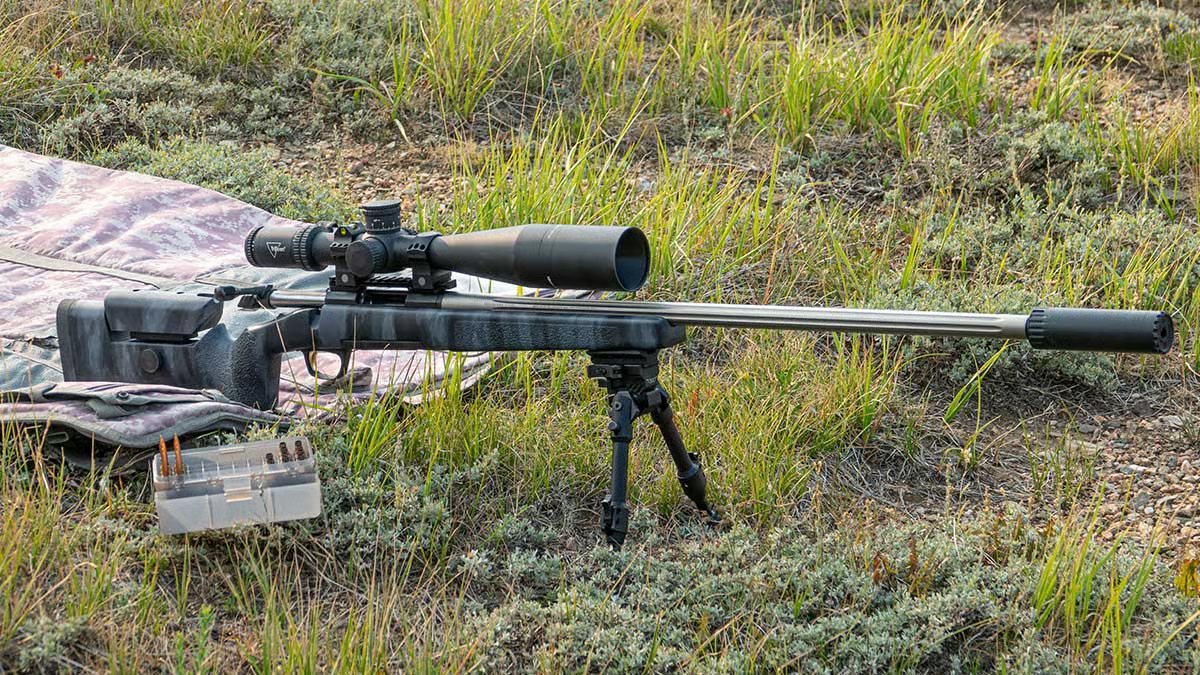
remington 700, 25-06, 25-06 remington, us optics, txh, 3-18, two vets tripod, cole tac, carbon fiber

Rifles and Cartridges for Long-Range Hunting

Preface

Long-range hunting like it or not has become big business, and growing in popularity. Everybody seems to have a coarse opinion on the subject, but we aren’t going to debate that subject here. Today we are going to discuss some good rifle and cartridge combinations for getting effective results in long-range hunting.

long-range, hunting, long-range hunting, rifles, cartridges, caliber, choosing, selection,
Cartridges like the 7 SAUM loaded with heavy bullets are devastating on game animals

Purpose

When most people think of long-range hunting, they think of shooting a big bull elk from across a canyon. While that is certainly a likely scenario, people often overlook other long-range hunting activities. I for example spend the spring months in the melting Rocky Mountains chasing groundhogs from great distances. So whether you are after coyotes or whitetail deer, we’ll go over a few options that will help you be successful at long-range hunting.

my Father took this bull from around 500-yards shooting his .264 Winchester Magnum

What Makes a Long-range Cartridge?

Long-range cartridges typically employ heavy for caliber bullets. An easy example of heavy for caliber would be a .223 Remington with a 75 grain or heavier bullet. Most .223 ammunition uses bullets in the 55-grain class. Another easy example would be a 308 Winchester, which typically uses 150 to 180 grain bullets. Both of these cartridges do much better at further distances when they are loaded on the heavier side. Heavier bullets typically have better ballistic coefficients (BC) which makes them more efficient. More efficient bullets retain their velocity and energy, for less drop and wind deflection.

even small cartridges like the .223 Remington can be used for long-range service when loaded right

Good long-range cartridges are also often magnum cartridges. A 308 might do well at 500-yards, but a 300 Winchester Magnum will do much better using the same bullet. Especially when loaded heavy. The large capacity of magnum cartridges gives them the horsepower to push bullets faster.

big magnums like the 300NM and 338LM have excellent long-range performance

Retaining speed and energy are key to long-range hunting. Because even a good hit on an animal might not be sufficient if the bullet has slowed down enough to be ineffective.

Big Game Cartridges

There is no lack of options for big game cartridges suitable for long-range hunting. Though it might be just as important to ensure the barrel twist is adequate for the bullet you’d like to shoot. A 300 Winchester Magnum with a 1:10 twist is pretty common, and will likely do what you need for taking down deer and elk sized animals at longer ranges.

Some of the more recent cartridges already account for this trend in long-range. The PRC family from Hornady specify fast twist-rates for high BC bullets. And whether you choose the 6.5mm, the 7mm or 300 PRC, they can be used very successfully for long-range big game hunting.

The further out you want to push your limits, the bigger the cartridge you’ll want to use. We have used the 338 Lapua Magnum and the 300 Norma Magnum very effectively on the largest of the deer family out to ranges like seven and eight-hundred yards.

this cow elk fell to a single impact at 700 yards from a 300 Norma Magnum, you can tell Iain is happy with it

Small Game Cartridges

Selecting an effective long-range cartridge for hunting smaller animals can be much easier. Because often it can be the same rifle and cartridge as your big game rifle. But also because there are so many good options, especially if they are set up to shoot high BC bullets.

my Dad’s 220 Swift, you can see more about that one here

One of the first ones that comes to mind is a fast twist 220 Swift like the one I built for my Dad. It pushes 75 grain ELDM bullets over 3300 FPS and will split a groundhog in twain from half a mile away. Another option would be the 6mm Creedmoor, Hornady’s 108grain ELDM match ammunition carries over a thousand pounds of energy beyond 500 yards. More than enough to take down a coyote or other pests.

long-range varmint rifles might still be your deer rifle, this coyote fell to my 6.5PRC PVA Modus

There are other fantastic choices typically in the .224 and .243 bore size. The 22 ARC is another good option, it has the horsepower to keep high BC bullets like the 88-grain ELDM above 2000FPS even at 500 yards.

Picking a Long-Range Rifle

Since most manufacturers today offer both short and long-action rifles in the same series, its pretty easy to recommend one. For example, I like the Ruger American Gen 2 as an entry level rifle that most folks can justify. The rifle offers good accuracy and customization which long-range shooters thrive on. And it can be had in most any popular caliber from 22 ARC up to 7 PRC.

the Ruger American Gen 2 is a great place to start long-range practice

A step up in both quality and price would be the Tikka CTR. Also available in a variety of good long-range calibers like the .243 Winchester, and with an upgraded 1:8 barrel twist. Or you could go with the 6.5 PRC option for more range and power. Tikka’s have excellent aftermarket support for those looking to customize their long-range hunting rifle.

I love Tikkas, and they are a step up in quality. And they make an excellent choice for precision shooting. You can read more about my custom Tikka here

Another step toward the pinnacle would be the Seekins Havak PH3 series of rifles. With exceptional quality and guaranteed accuracy, as well as long-range heritage these rifles offer a great value. Built by folks who know what long-range hunters are after, you can buy the rifles in any number of great long-range calibers. And select different barrel lengths to optimize your experience.

Continue Reading Here

6.5 creedmoor, federal, sierra, hornady, desert tech munitions, ammo, bergara,

Creedmoor Family Tree

Cartridge Families

Cartridge families have been a thing since shortly after the first cartridges were made. A family refers to a group of cartridges based on the same parent cartridge, and it’s how some of our best cartridges came into being. A well-known family would be the 30-06 Springfield clan, with the .270 Winchester and the 25-06 Remington being some of its popular kin. Today we are taking a look at the Creedmoor Family Tree, on their ascent to being one of the great dynasties in the cartridge world.

Creedmoor cartridges enjoy flawless function from various magazine systems

6.5 Creedmoor History

Back in the early 2000’s, the Creedmoor was developed by a group of folks looking to design a perfect cartridge. Their goal was a flat-shooting, low-recoil cartridge with high ballistic coefficient (BC) bullets that would feed well from a magazine. They based the cartridge from the 30 Thompson Center, another cartridge looking for fame. The case was shouldered at thirty-degrees and necked down to .264 and the Creedmoor was born.

Since then, the cartridge has been adopted widely by nearly every corner of the shooting market. Much to the chagrin of Creedmoor haters, whose sophomoric insults are blind to the obvious performance of the cartridge.

6.5 creedmoor, prs, prs rifles, competition rifles, savage, mdt, christensen arms, mpr, mpa,
PRS rifles like these are very often chambered in 6.5CM, though these days they are switching to 6mm cartridges.

The 6.5 Creedmoor has also spawned a whole family of descendants that have become well-known titans in their own bore-size. There is no free lunch however, so the advantages of each come with their liabilities as well. Today we’ll look at some of them and evaluate their attributes and how they might best fit into your next rifle purchase.

22 Creedmoor

Barrel Life Estimate: 800-1100 rounds

Bullet Weights: 50-80 grains

Max Effective Supersonic Range Estimate: Approximately 1500yds

Component Suppliers: Hornady, Alpha Munitions, Petersen, Nosler

Let’s start at the bottom of the pile, with the 22 Creedmoor. Necking is the process of narrowing the case mouth of a cartridge to hold a different caliber bullet. The 22 Creedmoor is the result of necking the 6.5 down to .224 caliber, I understand there is some thinning of the neck during this process as well to make it work.

22 Creedmoor, alpha munitions, hornady,
22 Creedmoor components like Alpha Munitions cases and Hornady Dies provide great performance

The result is a hot-rod overbore 22 centerfire cartridge, similar to the extremely popular 22-250. The 22 Creedmoor has done very well in the hunting and target shooting arenas. Mainly because it has large displacement and the horsepower to push even the large .224 caliber bullets fast. Typically made with a 1:8 twist, the 22CM can push big 75 and 80 grain bullets well over 3200 FPS. This leaves cartridges like the 22-250 and 220 Swift in the dust. And makes the 22CM an obvious choice for varmint hunting and long-range target shooting.

22 Creedmoor, patriot valley arms, barrel,
Using even faster twists like this 1:7 allow use of the heaviest 22 caliber bullets

Feeding the 22CM is easily done from popular magazine systems, and it cycles well from all the popular actions. Handloading is fairly easily done with support from companies like Hornady and Redding. You can buy ammunition and components from Hornady, Alpha Munitions and others. The scorching performance of the 22CM come at a cost, as it has an appetite for barrel throats. Making this cartridge a choice for the bold shooters out there.

6mm Creedmoor

Barrel Life Estimate: 1500-2200 rounds

Bullet Weights: 58-115 grains

Max Effective Supersonic Range Estimate: Approximately 1700yds

Component Suppliers: Hornady, Alpha Munitions, Petersen, Lapua, Nosler, Starline

The next step up in the necking process is the 6 Creedmoor. Very comparable to the venerable .243 Winchester, the 6CM offers high speed 6mm/.243 bullets for either sport or hunting. The 6CM uses a faster twist than the older .243 design, typically 1:7 to 1:8 twist. This gives the 6CM the ability to shoot more modern bullets, many of which were basically designed for this cartridge. The longer high BC bullets of today won’t fly from the 1:10 or 1:9 twist rates of decades passed. This gives the 6CM a leg up over cartridges like the .243 and 6mm Remington.

this Browning X-Bolt chambered in 6mm Creedmoor was a blast, you can read about it here

The 6CM offers the same performance as those older cartridges when shooting comparable bullets. And its optimal for use in the same types of hunting situations, arguably better due to efficiency. Getting similar velocities from the Creedmoor with less powder and bore erosion than the other cartridges mentioned. It would be an excellent choice for a light big game hunting cartridge, or as a competition cartridge as it has been used extensively over the years.

6 Creedmoor fits into rifles and other common accessories like this Cole-TAC ammo novel

Whether you wish to shoot 58-grain bullets at coyotes or 115 grain match bullets in a PRS match the 6mm Creedmoor has a diverse hand of talents. It has been pushed aside somewhat by smaller 6mm cartridges in the competition circuit, due to its lower barrel life and recoil. But still has quite a following of dedicated loaders and shooters, thanks to the support from the companies I mentioned above.

25 Creedmoor

Barrel Life Estimate: 2000-3000 rounds

Bullet Weights: 86-135 grains

Max Effective Supersonic Range Estimate: Approximately 1900yds

Component Suppliers: Hornady, Alpha Munitions, Petersen

Coming out of nowhere, the 25 Creedmoor is one of my favorites, likely because I was part of it’s renaissance. The 25CM came about because of new bullet designs that made the 25 caliber a better option than the original 6.5CM. Bullets with higher BC and lower weight meant that the 25CM could shoot faster than the 6.5, and enjoy flatter-still trajectories and more energy on target.

All of the Creedmoor family have excellent components available

This made the 25CM an outstanding choice for many shooters. Hunters and competition shooters alike have adopted the 25CM, and once again the aftermarket has stepped in to support it as well. Hornady only recently legitimized the 25CM, but Alpha Munitions and Petersen Cartridge Company have been making brass for it for some time. This is one Creedmoor that has actually gotten more love from companies besides Hornady, at least till now. With excellent components available from Sierra and Berger.

the 25 Creedmoor has been a fantastic hunting cartridge, you can read about this hunt here

Using the 25CM in competition like the NRL Hunter matches has become very popular due to its power and low recoil. It might be one of my favorite hunting cartridges as well, the incredible consistency has allowed me to make many one-shot kills on deer and elk. Some of which were so far out that it’s better to leave unsaid.

6.5 Creedmoor

Barrel Life Estimate: 3000-4000 rounds

Bullet Weights: 90-150 grains

Max Effective Supersonic Range Estimate: Approximately 1800yds

Component Suppliers: Hornady, Alpha Munitions, Petersen, Lapua, Nosler, Everyone at this point

The OG Creedmoor, a cartridge that stormed the precision rifle shooting circuit when it came out. At the time (2006-ish maybe) there were three 6.5 cartridges fighting for dominance. Besides the Creedmoor, the 6.5×47 Lapua and .260 Remington were all extremely popular. But likely due to support from Big Red and others, the 6.5 Creedmoor quickly became the dominant 6.5.

Still an excellent choice for many competitors, the 6.5CM might be the only cartridge today that has a shot at taking the place of the 308 Winchester in popularity. The 6.5CM does everything the 308 does, and it often does it better. The narrow 6.5 bullets have a higher ballistic performance and speed than the old Winchester, making it an excellent successor. The 6.5CM is the easy-button of sharpshooting, and because of that it enjoys support from nearly every corner of the shooting world. Whether you are looking for semi-auto rifles or bolt-action there is a great option in 6.5CM. And ammunition options are as deep and diverse as any other cartridge.

Continue Reading here

22 arc, 22, ARC, hornady, ammunition,

22 ARC: The little ARC

Preface

The newest member of Hornady’s Advanced Rifle Cartridge family also happens to be the smallest yet. The 22 ARC is the little ARC, made by necking the popular 6 ARC down to .224 caliber. But do we need another centerfire .224 cartridge? Or perhaps the better question is what does the 22 ARC offer that we don’t already have? Today we will dive straight into the subject and get some answers so grab a drink and a notepad.

The Case for the ARC

The 6mm ARC was designed for many of the same reasons as its parent case, the 6.5 Grendel. Both were designed to shoot heavier bullets out of a case that could fit in an AR-15 magazine. The 6 ARC shoots bullets in the 60-110 grain class at velocities much higher than the popular .223/5.56 cartridges that most AR style rifles use. This gives a very big advantage at further distances or up close.

22 arc, 6 arc, 6.5 Grendel, hornady,
the 22 ARC (left) seen with the 6 ARC and 6.5 Grendel

Shooting heavier bullets has a great effect on power delivered to downrange targets. And it also greatly improves ballistic performance, shooting flatter and preventing deviation from wind. All of this from a cartridge that can fit into most any AR-15 receiver, of course using a different magazine and giving up a few rounds of capacity.

Making the 22 ARC was a natural evolution, as it seems handloaders are fascinated by making new cartridges out of existing ones. But the ARC isn’t just another .224 caliber cartridge, there is more to it than its neck. With it’s short body, and faster specified twist-rate, this chubby little cartridge was also built for pushing bigger bullets.

The 22 ARC feeds well from various magazine systems, you can read more about my Howa Mini 22 ARC here

A Different Approach

Cartridge designers made the case shorter than cartridges like the .223 Remington, this helps fit the longer heavier bullets into the case. And also allows these cartridges to cycle in actions when loaded with these long bullets. In order to boost capacity to make it worth the trouble, the cartridge was also enlarged to the case-head size .441. Making it larger in diameter and shorter gave it the capacity and proportions needed to exceed the performance of other cartridges.

22 arc, 22-250 remington, .223 Remington,
As you can see, the 22 ARC has much more seating room than the 22-250 (center) and .223 Remington (right)

For example, when compared to the .223, the 22 ARC case is shorter, allowing longer bullet seating. The popular 22-250 is even longer than the 223, which allows even less room for seating bullets out. Most 22-250’s use slow twist rates like 1:12 or 1:14 which means they can’t shoot heavier bullets anyways. Limiting their use to 40-55 grain bullets for the most part.

22 ARC Specifications

22 Advance Rifle Cartridge Specifications
Max O.A.L.2.260 inches
Bolt Face.441 inches
Trim Length 1.525 inches
Shoulder Angle30 Degrees
Case Capacity (H2O)34.6 grains
Barrel Twist1:7 standard
Bullet Weight Range60- 90 grain (typical)

So why would you want to shoot heavier bullets? I’ve been loading 75-grain BTHP bullets for AR-15 rifles for decades. Because they simply perform better at further distances. Once upon a time, many years ago my brother and I were shooting a steel target at roughly 700 yards if I recall correctly. I was dinging the steel repeatedly using my AR loaded with 75-grain bullets. My brother shooting his 22-250 was having trouble hitting it with 50-grain bullets. This made a lot of sense once we retrieved the target and found his bullets barely sticking into the wooden target hanger like a dart.

The much higher velocity of the 22-250 burns off too fast in a small bullet for long-range shooting. That’s why in this case my .223 chambered AR was superior, and a rifle chambered in 22ARC would have been even more superior. Shooting 70-90 grain bullets at higher velocities than the .223 can hurl.

my 22 ARC is a Howa Mini, seen here with a Lucid Optics MLX scope

But what if you don’t wanna shoot far you might be asking? Well, then the 22 ARC still has a lot to offer you. Shooting lighter bullets up close, the 22 ARC gives devastating performance just like the aforementioned 22-250.

Loading the 22 ARC

Rolling your own 22 ARC cartridges is easily done, getting brass from Hornady. You can also get it from Alpha Munitions and Petersen Cartridge Company. Small rifle primer pockets are used in the ARC, and modest charges of powder will get you excellent velocities.

Continue Reading here

mule deer, Patriot Valley Arms Modus rifle, 6.5 PRC, US Optics TXH 3-18x50

The 6.5 Cartridge Dilemma

Introduction

Many Americans seem to have been born with a .30 caliber fixation, nothing to be ashamed of believe me. But there is a rivalry coming for America’s top spot, and its coming from the metric system believe it or not. 6.5 caliber cartridges are nothing new, even in North America. Today we are going to discuss a variety of the 6.5 cartridges and why they have such a cult following that continues to grow. Perhaps by the time we are done, you might feel a taste for the 6.5 Koolaid yourself.

the Ruger American Rifle is available in various calibers like 6.5CM and 6.5 PRC

6.5 or .264?

I remember speaking to an old gunsmith who claimed to have trained under P.O. Ackley. He told me that allegedly Ackley believed the 6.5 to be the ideal bore for accuracy. I believe both of them were simply a product of their time, and I also believe there isn’t an “ideal bore”. Instead there are simply perfect proportions, bullet lengths and angles as compared to the bore.

What you cannot deny is that 6.5mm bullets (or .264 inches for the Yanks) typically have excellent ballistic coefficients (BC). And these high BC bullet are usually easy to get up to excellent speeds due to their weights. Most 6.5 bullets fall within the range of 100 to 150 grains.

Whether .264 or 6.5, there is an incredible variety of cartridge cases designed to push them. And choosing which one of these cases is incredibly important as to the performance. A diminutive 6.5 Grendel can shoot the exact same bullet as the massively overbore 26 Nosler, but the performance will be just as distinct.

The Rise of 6.5 Cartridges

Back in the late 19th century, the 6.5 craze had already begun in Scandinavia with the 6.5×55 Swedish. It was used widely for so many purposes and in such numbers that it spilled into other firearm markets. For over a hundred years the Swede’s have been taking moose and reindeer with a 6.5. This might be downright shocking if you are one of those who uses a 300WM to pile up a 110-pound bean field whitetail from a ground blind.

both of these elk were taken with 6.5 cartridges, on the left a .260 Ackley, on the right a 6.5 Creedmoor, both taken from 520 yards. Watch the VIDEO HERE

It took some time for the 6.5’s to catch on across the American heartland. Ballistic tinkerers like the aforementioned Mr. Ackley made wildcats like the 6.5-06 popular. There were others like the 6.5 Remington magnum, but they didn’t catch on like their designers had hoped. It was like trying to sell a bullpup to Americans who love AR15’s.

One of my favorite cartridges for largely sentimental reasons is the .264 Winchester Magnum. A product from the 1950’s, it actually predates its 7mm twin, the 7mm Remington Magnum that gained far more attention.

this bull fell at 500 yards to my father’s .264 Win Mag shooting 140 gr bullets

Modern 6.5 Cartridges

Most of us are likely more familiar with modern 6.5 cartridges, but which one will best suit your needs? Many people love to hate on the 6.5 Creedmoor, but it’s impossible to deny its versatility. And it’s literally a ballistic twin to the 6.5×55 and we’ve already discussed how useful that cartridge has been and still is today.

Over a decade ago, there was an outright brawl between the three most popular 6.5 cartridges in the precision shooting space. The three protagonists were the 6.5 Creedmoor, the equally new 6.5×47 Lapua, and another American classic the .260 Remington. All three were hugely popular for short-action precision rifles, but the Creedmoor has seemed to win the popularity contest. Each of them had their strong points, but there’s nothing wrong with any of them.

The newly popular 6.5 PRC has gained an impressive following among big game hunters. While it often shoots the same bullets as the Creedmoor, it shoots them much faster. With a four to five hundred feet per second advantage, the PRC is lighting on deer and elk.

my 6.5 PRC has been a supreme tool for taking game, read more about it here

In long-action cartridges, Nosler more recently released their 26 Nosler cartridge. With a huge powder column, it is made to move fast. Of course this comes with a Nosler sized price tag as well.

Considerations

All of these cartridges have positive attributes that you should consider for your purpose. Whether you are a casual hunter, a serious competitor or even a Law Enforcement sniper there is something for you in this family of cartridges.

If you find yourself shooting deer or other comparable game within ranges of two to three-hundred yards any of them will do. One of my kids will be hunting with a 6.5 Grendel this season, shooting 120 grain bullets. Another of my kids will be hunting with the same little .260 I built for him when he turned 12.

260 remington, mule deer, ridley,
Junior has done well with this little .260 Remington

My brother and I both will be shooting 6.5 PRC’s most likely, which are definitely good for a bit more distance. We’ve both taken .260’s and Creedmoors beyond the 1,000 yard line, but the PRC is a better tool for such a task.

My father would be shooting his .264 Win Mag, which he’s used in the past to take mule deer, antelope and mature bull elk. Sharing a ballistic profile with the 6.5 PRC it too has a more useful range envelope.

Continue Reading Here

6.5 Creedmoor Against the World

Division

Few things can be more divisive than deeply-held differences of opinion, particularly when these differences are constantly manifest and even poked at like a festering wound. You might think that I’m about to discuss Evangelicals and Satanists, but instead, as you may gathered from the title that today’s subject is the famous six-point-five Creedmoor. But how can something so simple as a slightly different and new cartridge drive such gnashing and bitterness between marksmen? Is the Creedmoor so despicable?

Big H

When Hornady released the Creedmoor over a decade ago, it showed great promise with claims of flat trajectory, superior wind deflection, low recoil and many other positive attributes. All this as compared to the extremely common and widely used 308 Winchester.

I won’t spend much time comparing the Creedmoor or evaluating its virtues other than how it relates to our topic. But before we move on I will say that the mighty machine of the Hornady marketing department is likely responsible for a great deal of the Creedmoor’s popularity and adoption.

The Crux of the Argument

I think I might be able to pin down the finer points of this argument after spending a great deal of time immersed in it. On any given day, in any random forum or facebook group, there are people fiercely defending the virtue of the little Creedmoor. And pounding out their often angry or insulting responses is the opposing group in this discussion.

The Creedmoor seems to be both the object of adoration and despise, at the beginning I myself felt some similar distaste for the venerable red-tipped cartridge. The reason myself and others were likely soured against it, was due to the constant and unrelenting talk about it. You couldn’t open a magazine without seeing an ad or article about it, you couldn’t sit down on a bench without some guy offering you information about how great his Creedmoor shoots. It often felt like that meme about the guy who chooses the urinal next to you just to chat.

Obviously however, no amount of marketing dollars from Hornady could prop up a product that doesn’t at minimum, closely match its desired performance. The shooting public can quickly sift through bullshit when it stinks, unless you’re one of those who bought one of those cat-skins at the Boy Scout trading post believing it was a “rabbit pelt”.

The Creedmoor’s excellent performance was hard to deny, and as it continued to flourish, its qualities became more and more desirable. Even creating much of the movement that drove competitors to the faster and flatter little cartridges used in precision rifle matches today. And undoubtedly its popularity was bound to spill over into the hunting market, where it continued to spread like wildfire. And typically that is where so much of the controversy seems to be seen.

Pure Fuddery

The hunting community is a traditional one for the most part. Hunters are very methodical and some reach near superstition when it comes to their practices. So it should come as no surprise that something new would take some serious consideration to be esteemed good enough to replace or stand next to gran-dad’s ol’ 06 Springfield hunting rifle.

Perhaps the defining feature of “a Fudd” is the inability to recognize technological advances, and a willing indifference to learn why such advances were made. Way back in the eighteenth century there was probably a similar rejection when some ol’ boy showed up with smokeless powder, and the eyebrow-less crowd laughed at him.

A healthy Creedmoor dropped this elk in her tracks

Math and science are empirical (unless it doesn’t suit your leftist ideology), and even if you show him on paper and again on the range, a true Fudd will dismiss it and say; well my [enter traditional cartridge] has more ass behind it and hits harder. Sometimes they aren’t wrong, but they often are. The possibility that a smaller bullet could somehow carry the same or more energy downrange seems like crazy talk until you understand the math.

Apples to Apples

The tediousness of ballistic comparisons can get extremely long-winded and boring, so I’ll spare you that. But these arguments often stem from exaggerated generalizations.
Somebody made a good shot once upon a time with a Creedmoor so now everybody that was there believes it to be the right hand of God. And at the exact same time on the other side of the mountain, somebody yanked the trigger sending a 143 into the guts of a distant animal that went unrecovered. And everybody there swore off the Creedmoor forever because Yankee McTriggerton was their hero.


There is surely no shortage of shooters who love their Creedmoor so much, that they can hit anything; they once got a first round hit at a mile on a ten inch steel plate in a 17 mile crosswind. And everybody clapped… (Sarcasm added for that one guy that cant tell)

But the anti-Creedmoor crowd seems just as silly at times, happily swilling memes about man-buns and making general insults to the Creedmoor and their owners skinny jeans. Some of whom even pretend their 6.5X55 Swede is somehow superior to the Creedmoor despite being nearly ballistic twins.

This ol’ Swede shoots almost identical to the Creedmoor

A proper comparison is only fair, the Creedmoor is neither the hand of God nor is it a weakling. It’s not hard to do a proper comparison if you’re unafraid of the results. Depending on bullets and velocity your Creedmoor might be ballisticly superior to O’Connors .270 or it might not. What matters is you understand and become proficient with whatever you choose to shoot.

These two elk each fell to a single 6.5 bullet at 520 Yards

You can’t kill an Elk…

“You’d be better off with a 300WM” comes the completely anticipated answer when someone mentions hunting with a 6.5 Creedmoor. Maybe you would be, maybe not. Depends on if you are a better shot with the 6.5 or with the 300.
People have been killing moose in their thousands for over a hundred years in Scandinavia using the 6.5X55 Swedish Mauser cartridge, which as I mentioned already is nearly a ballistic twin to the Creedmoor. All those moose steaks stand in direct opposition to the idea that 6.5’s are inadequate for killing large members of the deer family. And yet here in North America there seems to be a disconnect, the majority of the general hunting public seem to be convinced that larger magnums and thirty-caliber cartridges are the only ideal ones for deer and larger animals.
I could speculate but I believe it may have been years of advertising efforts trying to sell bigger and better magnums (28 Nosler anyone?) that continues today, trying to convince hunters they were under-gunned without the latest super-cartridge.

Another 6.5 victim taken at 500 yards

It may come as a surprise to some, but you can easily and confidently take down a Rocky Mountain Elk with a 6.5 Creedmoor. I know because I have done it over and over for several years, as a matter of fact the last five or six elk we’ve dropped were shot with a 6.5 or an even smaller cartridge like the 25 Creedmoor. What’s more, many of these elk were four and five-hundred yards out when they dropped to the ground.

Just like most cartridges and bullets, the 6.5 Creedmoor will take a deer or elk right off its feet. The problems usually start when perhaps an inexperienced or over-zealous hunter takes a shot he shouldn’t have, perhaps having drank too much of Hornady’s red Kool-Aid.

Good shot placement with sufficient impact velocity is a must regardless of the cartridge you are shooting. The “magic” of the Creedmoor wont save you from loosing animals if you don’t make a good shot, the same thing can and does happen with any other cartridge. Read this article about shot placement and cartridge selection if you’d like to go deeper into that subject.


Need some 6.5 Creedmoor ammo?

Built better?

The incredibly popular Creedmoor has a couple legs up on older cartridges like the swede and my old favorite 260 Remington. Perhaps the best one of them is brass, there are so many great options from all the very best manufacturers such as Lapua and Alpha Munitions. Both large and small rifle primer brass can be had, allowing shooters to run higher pressure loads and using different and more modern components. Everything from handloading tools to your favorite rifle can be had in 6.5 Creedmoor, and there’s nothing wrong with that. If anything the Creedmoor has helped drive innovation and mainstreaming many practices that were once very niche.

The 6.5 Creedmoor is the result of applying good designs in cartridge cases and bullet construction, whatever negative reputation precedes the Creedmoor is likely a result of overconfident or negligent hunters who believed the hype. The Creedmoor is a great performer in various applications, and to dismiss it as “a fine target round” or only a “paper puncher” would be ignorant.

Final Thoughts

The sophomoric hatred for the Creedmoor is downright embarrassing, and a quick way to show your ignorance among anyone with objectivity. It is a fine cartridge like hundreds of others, and when used properly it can be very useful for both hunting and any other shooting enterprise. If pride prevents you from joining the Creedmoor cult, you do you, there are plenty of other great options out there as well. But don’t let your pride make you look a fool.

-CBM

Choosing the Right Cartridge

Why is cartridge choice important?

If you had to choose one cartridge to shoot for the rest of your life, most of us could narrow it down to at least one or two. But when there are so many options before us these days, it can be an agonizing internal debate trying to pick one cartridge over another. Could it be that the easy answer is right before your eyes?

One advantage to my Desert Tech SRS A1 is that all these cartridges and more can all be shot from the same rifle

One of the first criteria that we evaluate is the intended use, if we plan on deer hunting for example, then we can eliminate some of the larger magnums, as well as lightweight varmint cartridges. If we intend on competitive shooting, then we would be wise to select from the already refined pool of serious competition cartridges that offer advantages such as; superior external ballistics, controllable recoil, and available in volumes and at prices we can afford.
Perhaps Extended Long Range (ELR) is more your preference, and a larger cartridge like a 300 or 338 is in your sights. Again, there are many popular cartridges that will fit that bill. You can evaluate several of them, and consider factors such as barrel life, recoil, and component cost and availability.
Be it 6mm, 6.5mm, 7mm, or a 30 caliber, there are great reasons to pick each one, you just need to find the best reason that applies to your shooting. And even then, which 6mm? You could go with a modest and economical 6XC, or maybe a 6X47L. The new 6 Creedmoor from Hornady has some great benefits and options, or perhaps you want to just go with a traditional .243 or 6mm Remington. You see, all these cartridges share the 6mm/.243 bore and bullet selection, but the differing cases offer different things such as cheap and easy to find brass. Some of them offer better high quality brass, and the barrel life can vary greatly depending on which one you choose.
Community input is very helpful, see what others are doing and using. If you are lucky, you can wrap up all your activities into one “do it all” cartridge.

Sierra Tipped Match Kings loaded in the 308 Winchester

For those like me who have chosen to use the multicaliber systems offered by Desert Tech , this is a double-edged sword. Simply because we are not limited to our choices of cartridges, because a barrel swap can be done in moments, but difficult because now instead of choosing one caliber, we now have two or more choices to make. I choose to look at this in a positive light.
Multi caliber means that we can choose an inexpensive and light caliber for one activity, and perhaps a heavy and devastating caliber to compliment it. Both of which can be used in the same rifle, with the same trigger pull, and optic. Once you have decided the intended use of your rifle, you can then pick calibers suitable for them. With so many options, it can be daunting and exciting at the same time.

The 300BLK (L) and the 223Rem (R) are two similar sized cartridges with vastly different applications, shooting a multi-caliber rifle like the SRS allows me to profit from both of these cartridges strong points

Choosing your cartridge

I like to start with cartridges with a proven history of performance. Sure, there are always hot ticket and fly cartridges that come and go. but there is wisdom and experience with traditional and mainstream choices. In addition to the abundant availability of these more common cartridges, there is plenty of information about their performance which could help you in your quest for perfection. And don’t rule out that significant technological advances in propellant powders and bullets have given new life to cartridges once relegated to antiquity.

Reloading gives you the option to customize ammunition to your rifle

Another decision factor is whether you intend to reload your ammunition. Some cartridges are best left to reloaders, while others enjoy diverse and very affordable factory ammunition options. This could mean the difference between two similar but different cartridges. For example, the .260 Remington and the 6.5 Creedmoor are almost equals, but if you intend to buy ammunition, the Creedmoor is the better choice due to the high volume of factory ammunition choices. Whereas if you intend to reload, the .260 could give you an edge over the Creedmoor with customization and more velocity.

This leads right into my final criteria, which is cost. Many people want to shoot large and venerable cartridges, but not many want to pay the price of some of them. So while the 338LM might be at the top of your long range fancy list, you’d be surprised at how many more affordable smaller cartridges there are. Many of them that can get you to the same distances as the 338, but without leaving you destitute. So don’t be afraid of looking into some of those less costly calibers that will still fill your need.

Final thoughts

Once you’ve taken the time to evaluate these many characteristics, there should at least be a couple options floating to the top of your choice list. At this point it could simply be preference, or some other simple reason that swings you toward one over another. The best news of all, is that there are few bad choices anymore, so good luck.
-CBM

If you are into Long-Range shooting, check out My Top Five Long-Range Cartridges

Three very different cartridges with differing purposes that can all be used in my rifle. (top) 338Lapua Magnum (middle) 260 Remington (bottom) 223 Remington