Tag Archives: 6mm creedmoor

6.5 creedmoor, federal, sierra, hornady, desert tech munitions, ammo, bergara,

Creedmoor Family Tree

Cartridge Families

Cartridge families have been a thing since shortly after the first cartridges were made. A family refers to a group of cartridges based on the same parent cartridge, and it’s how some of our best cartridges came into being. A well-known family would be the 30-06 Springfield clan, with the .270 Winchester and the 25-06 Remington being some of its popular kin. Today we are taking a look at the Creedmoor Family Tree, on their ascent to being one of the great dynasties in the cartridge world.

Creedmoor cartridges enjoy flawless function from various magazine systems

6.5 Creedmoor History

Back in the early 2000’s, the Creedmoor was developed by a group of folks looking to design a perfect cartridge. Their goal was a flat-shooting, low-recoil cartridge with high ballistic coefficient (BC) bullets that would feed well from a magazine. They based the cartridge from the 30 Thompson Center, another cartridge looking for fame. The case was shouldered at thirty-degrees and necked down to .264 and the Creedmoor was born.

Since then, the cartridge has been adopted widely by nearly every corner of the shooting market. Much to the chagrin of Creedmoor haters, whose sophomoric insults are blind to the obvious performance of the cartridge.

6.5 creedmoor, prs, prs rifles, competition rifles, savage, mdt, christensen arms, mpr, mpa,
PRS rifles like these are very often chambered in 6.5CM, though these days they are switching to 6mm cartridges.

The 6.5 Creedmoor has also spawned a whole family of descendants that have become well-known titans in their own bore-size. There is no free lunch however, so the advantages of each come with their liabilities as well. Today we’ll look at some of them and evaluate their attributes and how they might best fit into your next rifle purchase.

22 Creedmoor

Barrel Life Estimate: 800-1100 rounds

Bullet Weights: 50-80 grains

Max Effective Supersonic Range Estimate: Approximately 1500yds

Component Suppliers: Hornady, Alpha Munitions, Petersen, Nosler

Let’s start at the bottom of the pile, with the 22 Creedmoor. Necking is the process of narrowing the case mouth of a cartridge to hold a different caliber bullet. The 22 Creedmoor is the result of necking the 6.5 down to .224 caliber, I understand there is some thinning of the neck during this process as well to make it work.

22 Creedmoor, alpha munitions, hornady,
22 Creedmoor components like Alpha Munitions cases and Hornady Dies provide great performance

The result is a hot-rod overbore 22 centerfire cartridge, similar to the extremely popular 22-250. The 22 Creedmoor has done very well in the hunting and target shooting arenas. Mainly because it has large displacement and the horsepower to push even the large .224 caliber bullets fast. Typically made with a 1:8 twist, the 22CM can push big 75 and 80 grain bullets well over 3200 FPS. This leaves cartridges like the 22-250 and 220 Swift in the dust. And makes the 22CM an obvious choice for varmint hunting and long-range target shooting.

22 Creedmoor, patriot valley arms, barrel,
Using even faster twists like this 1:7 allow use of the heaviest 22 caliber bullets

Feeding the 22CM is easily done from popular magazine systems, and it cycles well from all the popular actions. Handloading is fairly easily done with support from companies like Hornady and Redding. You can buy ammunition and components from Hornady, Alpha Munitions and others. The scorching performance of the 22CM come at a cost, as it has an appetite for barrel throats. Making this cartridge a choice for the bold shooters out there.

6mm Creedmoor

Barrel Life Estimate: 1500-2200 rounds

Bullet Weights: 58-115 grains

Max Effective Supersonic Range Estimate: Approximately 1700yds

Component Suppliers: Hornady, Alpha Munitions, Petersen, Lapua, Nosler, Starline

The next step up in the necking process is the 6 Creedmoor. Very comparable to the venerable .243 Winchester, the 6CM offers high speed 6mm/.243 bullets for either sport or hunting. The 6CM uses a faster twist than the older .243 design, typically 1:7 to 1:8 twist. This gives the 6CM the ability to shoot more modern bullets, many of which were basically designed for this cartridge. The longer high BC bullets of today won’t fly from the 1:10 or 1:9 twist rates of decades passed. This gives the 6CM a leg up over cartridges like the .243 and 6mm Remington.
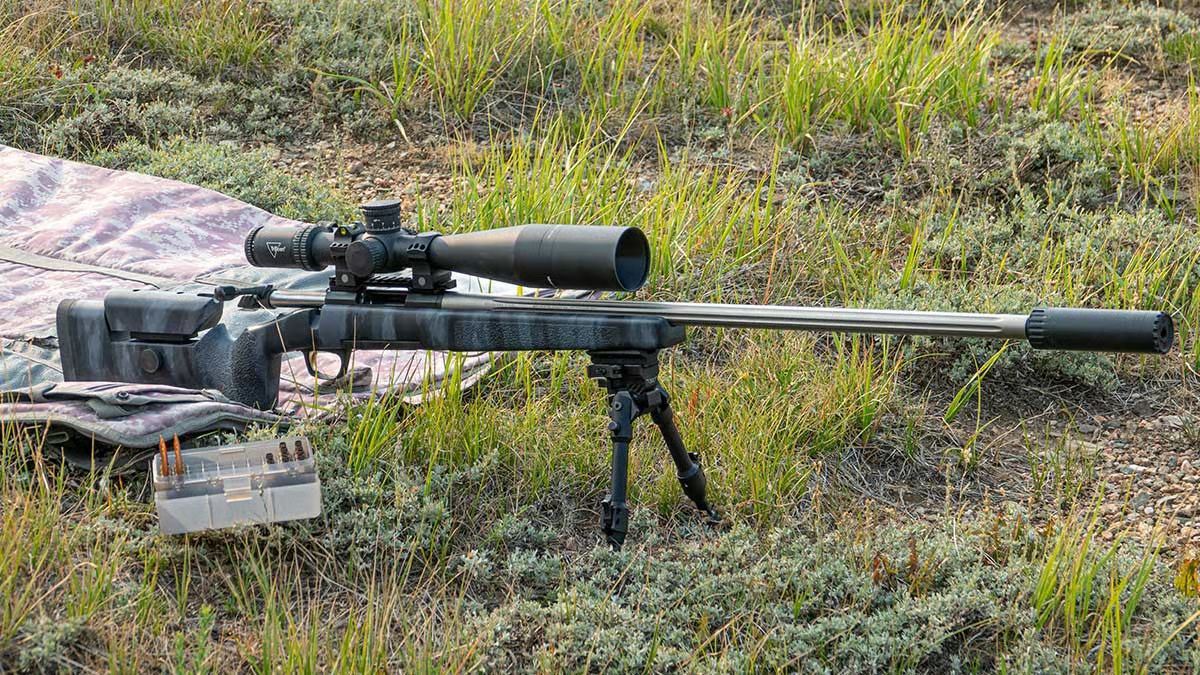
this Browning X-Bolt chambered in 6mm Creedmoor was a blast, you can read about it here

The 6CM offers the same performance as those older cartridges when shooting comparable bullets. And its optimal for use in the same types of hunting situations, arguably better due to efficiency. Getting similar velocities from the Creedmoor with less powder and bore erosion than the other cartridges mentioned. It would be an excellent choice for a light big game hunting cartridge, or as a competition cartridge as it has been used extensively over the years.

6 Creedmoor fits into rifles and other common accessories like this Cole-TAC ammo novel

Whether you wish to shoot 58-grain bullets at coyotes or 115 grain match bullets in a PRS match the 6mm Creedmoor has a diverse hand of talents. It has been pushed aside somewhat by smaller 6mm cartridges in the competition circuit, due to its lower barrel life and recoil. But still has quite a following of dedicated loaders and shooters, thanks to the support from the companies I mentioned above.

25 Creedmoor

Barrel Life Estimate: 2000-3000 rounds

Bullet Weights: 86-135 grains

Max Effective Supersonic Range Estimate: Approximately 1900yds

Component Suppliers: Hornady, Alpha Munitions, Petersen

Coming out of nowhere, the 25 Creedmoor is one of my favorites, likely because I was part of it’s renaissance. The 25CM came about because of new bullet designs that made the 25 caliber a better option than the original 6.5CM. Bullets with higher BC and lower weight meant that the 25CM could shoot faster than the 6.5, and enjoy flatter-still trajectories and more energy on target.

All of the Creedmoor family have excellent components available

This made the 25CM an outstanding choice for many shooters. Hunters and competition shooters alike have adopted the 25CM, and once again the aftermarket has stepped in to support it as well. Hornady only recently legitimized the 25CM, but Alpha Munitions and Petersen Cartridge Company have been making brass for it for some time. This is one Creedmoor that has actually gotten more love from companies besides Hornady, at least till now. With excellent components available from Sierra and Berger.

the 25 Creedmoor has been a fantastic hunting cartridge, you can read about this hunt here

Using the 25CM in competition like the NRL Hunter matches has become very popular due to its power and low recoil. It might be one of my favorite hunting cartridges as well, the incredible consistency has allowed me to make many one-shot kills on deer and elk. Some of which were so far out that it’s better to leave unsaid.

6.5 Creedmoor

Barrel Life Estimate: 3000-4000 rounds

Bullet Weights: 90-150 grains

Max Effective Supersonic Range Estimate: Approximately 1800yds

Component Suppliers: Hornady, Alpha Munitions, Petersen, Lapua, Nosler, Everyone at this point

The OG Creedmoor, a cartridge that stormed the precision rifle shooting circuit when it came out. At the time (2006-ish maybe) there were three 6.5 cartridges fighting for dominance. Besides the Creedmoor, the 6.5×47 Lapua and .260 Remington were all extremely popular. But likely due to support from Big Red and others, the 6.5 Creedmoor quickly became the dominant 6.5.

Still an excellent choice for many competitors, the 6.5CM might be the only cartridge today that has a shot at taking the place of the 308 Winchester in popularity. The 6.5CM does everything the 308 does, and it often does it better. The narrow 6.5 bullets have a higher ballistic performance and speed than the old Winchester, making it an excellent successor. The 6.5CM is the easy-button of sharpshooting, and because of that it enjoys support from nearly every corner of the shooting world. Whether you are looking for semi-auto rifles or bolt-action there is a great option in 6.5CM. And ammunition options are as deep and diverse as any other cartridge.

Continue Reading here

.243win, 6mm Creedmoor, 6mm GT, 6mm ARC, six millimeter, cartridge

Six Ways to Sunday: Supreme Six-millimeter Cartridges

Preface

Six-millimeter cartridges are very popular for various shooting activities. Their low recoil and high velocity mingled with great ballistic performance make them optimal for many purposes. Today I intend to take a walk through a selection of popular six-millimeter cartridges and why you might want one over the others. Whether you find yourself considering a six-millimeter for your next purchase, or trying to diversify your 6mm collection I hope we might be of help.

.243win, 6mm Creedmoor, 6mm GT, 6mm ARC, six millimeter, cartridge
Hornady is a big supporter of the six millimeter family

Old School

If you grew up in the 60’s and 70’s you were likely to run into a .243 Winchester on a typical deer hunt. A derivative of the always popular 308 Winchester; the .243 has always been a popular low recoiling hunting cartridge. Launched about the same time from a competitor, the 6mm Remington was a less popular but comparable option. Both of these cartridges have stood the test of time, pushing their typical 70-100 grain bullet quite fast. Making them great for varmint hunting and smaller big game animals.

There quite a few old Winchester Rifles out there in .243

The characteristics of these cartridges often led to them being relegated to either a “ladies caliber” or something for new shooters. There is surely nothing wrong with that, but they certainly shouldn’t be looked at as a lesser cartridge. I would happily take a .243 on a deer hunt or something comparable, the lightning speed and flat trajectory would come in very handy.

Way back then, you could have purchased a Model 70 chambered in .243. These days there are rifles from nearly every manufacturer chambered in the cartridge. Whether you want a bolt-action rifle from Savage or Sako, or even a lever-action .243 from manufacturers like Henry.

Modern Performers

If the .243 Winchester was such a good thing, and is still a popular chambering in todays modern firearms, you might ask why fix what isn’t broken? Hornady released the 6mm Creedmoor nearly ten years ago, much to the horror of the Creedmoor haters it took off. With a supply of high quality components it made sense. But what did the 6 Creedmoor have that the .243 didn’t already cover you might ask? Modern performance is the answer, Creedmoor’s came with aggressive twist rates like 1:8 and 1:7.5. The .243 has a slower twist rate which limits its ability to stabilize many modern bullets larger than 100 grains. The faster twist allowed the 6 Creedmoor to push bigger bullets like 108’s and 115’s at fantastic speeds, giving it a huge ballistic advantage.

Competition rifles like this 6mm Creedmoor Browning X-Bolt have all the modern features

One of my favorite 6mm cartridges is the 6mm GT. After the success of cartridges like the 6mm Creedmoor and competition cartridges like the 6 Dasher and 6 XC, the 6mm GT was released by GA precision and produced by Hornady. Finding a happy medium of performance and longevity, the 6GT fits easily into AICS magazines like the others I just mentioned. It does this while giving excellent ballistic performance and better barrel life than larger cartridges.

.243win, 6mm Creedmoor, 6mm GT, 6mm ARC, six millimeter, cartridge

All of these modern performers are shorter cartridges than the older .243 Winchester, which allows them to load longer higher ballistic coefficient bullets and feed from magazines. And the smaller powder charges allow longer durability before the chamber throat is eroded causing degraded accuracy.

Modern Sporting Rifles

Any of the cartridges mentioned today could be and frequently are chambered for semi-automatic rifles like the popular AR pattern. I would be remiss if I didn’t mention the very popular 6mm ARC, as it is the most likely to fit into this category. For a variety of reasons, but mainly because it fits in a 5.56 sized action and magazine. The 6 ARC offers 6mm attributes like ballistic performance and heavier bullets while still fitting into the average AR15 rifle.

6mm ARC, bullpup, mdrx, WLVRN, us optics, TXR, primary arms, GLx, suppressor, anechoic, yhm,
(bottom) My Desert Tech WLVRN custom chambered in a 6 ARC and outfitted with a US Optics TXH and Anechoic suppressor. (Top) my Desert Tech MDRX with its own custom 6 ARC barrel, and a Primary Arms GLx scope and YHM Turbo suppressor

Additionally due to its smaller size, it burns far less powder extending the accuracy life of the barrel. This makes even more sense in a semi-auto as they tend to shoot much higher round counts than typical bolt-action rifles. There are a great variety of 6 ARC autoloading rifles available like the CMMG Resolute series of rifles.

the Howa Mini has been a fantastic little hunting rifle for the whole family

The 6 ARC can obviously be used in bolt-action rifles as well, where it does an excellent job. Additionally the 6 ARC is also typically given a 1:7.5 twist which helps it handle modern bullet selections. I am a bit partial to the Howa Mini, a rifle we have used with great success. But there are also great bolt-action options from Ruger and Savage Arms. With the cartridge gaining in popularity every day, you are likely to find six of one, and half a dozen of another.

Continue Reading Here

Browning X-Bolt 6 Creedmoor

Introduction

Even though I’m a bit of a rifle junkie, the Browning X-Bolt is a bit of a stranger to me. I’ve shot a few of them over the years, and even had good luck loading ammo for them for friends. That said, I’ve never owned one myself. Browning is a common name down our way, the man himself was born just a few miles north of where I sit as I write this.

The X-Bolt rifle has plenty of clout in the rifle world, so I knew not to underestimate it as I prepared myself for this project. I was giddy with excitement to get my hands on this one.

The Browning X-bolt Target

The Target model of the Browning X-bolt comes in a McMillan A3-5 stock with an adjustable comb, as well a a match grade heavy profile fluted barrel. The muzzle is threaded 5/8-24 to attach any muzzle devices. In addition to those add-ons, the X-bolt receiver has an extended bolt handle, and a 20 MOA pic rail mounted on top.

There are a few other little extras as well, such as QD sling swivel studs, and a bipod pic rail mount. I pulled the rifle from the black Browning box, and was instantly in love. The fit and finish of this rifle were superb, and as soon as I put the Pachmayr Decelerator recoil pad to my shoulder I knew it was going to be a good match. I adjusted the cheek piece to fit my hold, and ran the bolt and trigger a few times.

I love the 60-degree bolt throw, it is shorter and faster than the alternative. And the smooth bolt stroke on the X-bolt feels much like a nice custom. The Trigger in this rifle is as good as any factory trigger I’ve felt, The Feather Trigger as Browning calls it, is adjustable from three to five pounds, and has a tang mounted safety. The detachable box magazine is Browning’s own design, it is an all polymer rotary magazine that holds four rounds. It fits flush with the bottom of the McMillan stock.

The Warne Skyline bipod made an excellent addition to the rifle

SETUP

After familiarizing myself with the rifle, it was time to get it ready for the range. I mounted a Trijicon Tenmile 5-50×56 scope on top of the receiver in a set of 34mm rings, perhaps a little more scope than normally needed but a great option for testing the performance of this rifle. I added a muzzle brake to the end of the barrel, with intentions of also shooting the rifle suppressed later. I then installed a bipod to the front of the gun. The only thing left to do on the rifle was boresight it and gather some ammunition.

Browning X-Bolt rifle on a bipod with scope
I adjusted the cheek rest to my liking and added a Trijicon scope and bipod before going to zero the rifle. 

Under normal circumstances, finding 6mm Creedmoor ammunition would not be a difficult task. But times being what they are, I had to make do with what was available. I fashioned several boxes of handloads featuring Berger 105 Hybrids, which is pretty common on the firing lines this rifle would normally sit on. Once I had enough ammo to get a good shooting session in, I loaded up the truck and went into the hills.

ON THE FIRING LINE

With my rifle freshly bore-sighted and a clean target hung at 100 yards, I set to zeroing the X-Bolt. In just a couple shots, I had established a consistent zero and began shooting some groups. The smooth stroke of the bolt even when stripping loaded rounds from the magazine was very pleasing.

The all-polymer magazine has a slippery feel to it, surely this aids in the smooth feeding of cartridges. One complaint about the magazine is that it only holds four rounds, for a rifle that plays in the competition realm with the big boys, this is almost a deal breaker. A 10-round or even 12-round magazine would be much better suited for this rifle. But it shot so smooth I could hardly put it down.

The easily operated bolt made loading and reloading the rifle very fast, and I noticed another one of Browning’s very intuitive designs while running it. When the safety is engaged, the bolt is automatically locked. But there is a small button on top of the base of the bolt handle. This button pops up when the safety is engaged. You can depress the button to open or close the bolt while on safe, and the button drops out of the way and the bolt runs with zero inhibition when the safety is in the firing position. This may not be the most fascinating feature of the rifle, but I found it to be very ingenious.

Another engineering bonus I found on the X-Bolt was the mounting of the optics rail. Instead of using four screws (two in the front, and two in the back) like on typical optics rails, the X-Bolt uses eight screws. There are four in the front, and four in the back, giving the X-Bolt a very solid mounting point for your riflescope. Again, this may not be a revolutionary thing, but I can certainly appreciate the engineer’s thinking.

Sum-MOA group at 100 yards
The rifle is easily capable of sub-MOA groups. 

The X-Bolt shoots just as good as it looks, and sub-MOA groups were easy with zero load workup. Half MOA accuracy was easily achieved with proper shooting techniques. I have no doubt that with additional load development this rifle would shoot better than half MOA.

The 6mm Creedmoor cartridge is an excellent round for target and long-range shooting. It has little recoil and is very efficient at escaping the winds effects downrange. This allows the shooter to see the bullet in flight and even spot his or her own hits and misses.

CONCLUSION

Browning X-Bolt with suppressor at the range

The Browning X-Bolt Target rifle is an immaculate gun. It’s well thought out and near perfectly executed. My only gripe is the previously mentioned magazine capacity, though it could probably be switched out for a different magazine system. But despite that, I think this rifle would make an excellent addition to almost any rifle collection. There are so many amazing competition rifles available today from manufacturers, and it’s nice to see Browning show up with their own.

-CBM

Continue Reading Here…