Even decades ago, it seemed that varmint hunters had an insatiable taste for accuracy. Very precise and accurate shots are needed when you are after small targets like squirrels and prairie dogs. My old gunsmith used to tell me that when they’d shoot the little sod poodles inside five-hundred yards it had to be a headshot or they wouldn’t count it.
I’ve smoked quite a few prairie dogs with my MDRX, seen here with the US Optics FDN17X
But can the competitive sport of shooting varmints make you a better shooter? In my experience, I think varmint hunting makes better shooters out of all of us. And that alone is good enough reason to engage in the practice.
Shooting Varmints
Varmints are typically small animals mostly of the rodent species or similar. Things like squirrels, ground hogs, and such. These varmints are often pests, and many folks enjoy eradicating them as a pass time. If you have a problem with that, perhaps knitting is a better fit for you.
Varmint rifles and precision rifles share many traits, making them excellent marksman rifles. This is my Fathers Ruger M77
Personally I enjoy hunting marmots and prairie dogs. Marmots often provide a cunning opposition, requiring some level of stealth and strategy. The country where I hunt them is the exact same territory we hunt deer and elk in, so it doubles as exercise and reconnaissance in addition to a fun hunt. And the size of marmots (typically between 5-10 pounds) requires some degree of accurate shooting. Even deer cartridges have not acutely incapacitated a few of our marmots, so making a good shot is important.
Prairie dogs on the other hand, are much smaller animals. The pound or so they weigh is filled with small bones and lots of flesh. Their smaller size makes them a tougher target, but it also makes it a little more obvious when one is hit. The terrain they thrive in is usually flat, which draws its own challenges when ranging targets, and understanding the lay of the land. Additionally the smaller centerfire cartridges used to shoot them are more affordable to shoot.
You may have imagined by this point how these hunting practices might make you a better shot. While an escaping prairie dog might not be the end of the world, it adds a competitive angle. As well as an opponent in the cat and mouse game. Simply having an opponent with a mind of its own automatically adds a level of challenge compared to simply shooting targets.
The sportier side of this cat and mouse game is further sharpened by the small target. Your need to make an accurate shot is paramount to your prey not escaping. The level of accuracy required to engage something like a marmot or prairie dog at ranges as far as five or six-hundred yards is demanding. And when you add the complexity of moving targets, measuring the distance to the target, and switchy winds either on the prairie or alpine forest, it gets pretty challenging.
Varmint hunting with my deer rifle gets me more practice, this Bergara HMR took a few marmots
While these micro-hunts might not compare to the big Mule Deer hunt you’ve got planned, it is every bit as educational. A typical scenario from one of my marmot hunts might entail spotting a target from as far as half a mile or so away. It takes good spotting practice to pick out a perched chuck laying among a rock-pile. Once you find one, the effort of sneaking into a comfortable shooting distance may require a level of stalking comparable to big game. The sharp eyes of these little critters don’t miss much. And if they see you within their safe-zone, they disappear before you can even get on your scope. Once you’ve closed the distance, and used the land to keep out of sight, its time to dope for the shot and conditions. Long shots often require offsetting for wind, and considering other ambient changes.
My Desert Tech SRS M2 has excellent accuracy, making one great shot after another on these PD’s
All this leads up to you taking one shot, a shot you likely wont get to followup on. So it’s with great anticipation and forethought each shot is taken. The beauty of varmint hunting is that typically you’ll get lot of chances to screw up and learn. With a kill zone about the size of a softball, practice is your ally.
Lessons and takeaways
The very things that will make you a better shot and a seasoned hunter are all in the scenario above. Mainly the following:
Honing your spotting skills
Rapidly coming up with a firing solution
Adapting to ambient conditions like wind, altitude and angles
Making every shot count (accuracy)
Keeping out of sight, or at least a minimal profile
Anticipating the moves of your prey
And perhaps the most important thing is the ability to repeat this process over and over, until you excel at it. And once you do, you will find yourself improving. And with any luck, it will make you a much better shooter and hunter all around. If you are proficient at quickly finding, ranging and engaging targets that are no bigger than a squirrel or ground hog, then doing the same on something like a deer or hog will be even easier.
If you haven’t tried varmint hunting, let this be your invitation. Its a fun way to get better at shooting, and a great introduction to hunting in general if you are new to it. Its also a fun way to nerd out over gear and equipment, which is also becoming popular in the gun community. Let us know your favorite way to hunt varmints in the comments below.
We’ve all heard the adage Aim small, miss small, it’s become more and more common as precision shooting has grown. It’s a simple idea, the smaller the target you shoot at, the smaller your margin of error. Getting the most out of your target practice can be done by using smaller and more precise aiming points.
For example, shooting paper plates to check your rifle before a hunt has long been the practice of American hunters. But if you ask me, it’s a bit sloppy and I’ll explain why. If you aim for a paper plate, you either hit it or you don’t. But if you aim for a small dot in the center of the plate, you might miss the dot but you won’t likely miss the whole plate.
Practice Makes Perfect
Most of the shooting we do could be summed up as practice, the amount of shots that “count for points” are far fewer. If you are a competition shooter, you probably fire thousands of rounds a year so that in any given competition the two hundred or so rounds all go where you want them to.
Practice helped clear this stage of the Hornady Precision Rifle challenge with my Desert Tech SRSrefining your aim, will make more precise shots in the field, a good scope like the Vortex Razor surely helps
One of the reasons I love steel targets so much is that it’s so easy to tell if you hit or miss.
Picking out small rocks for targets through my Kahles 318i
Good scopes like this Riton 3 Primal with accompanying reticles are helpful for precise aimingSmall points of aim allow better evaluation of your shots
Is theAK-47 type rifle any good for hunting purposes? This is perhaps a divisive question for many people. The Kalashnikov rifle was designed to be a fighting rifle for infantrymen, but its flourishing among American gun owners has brought it into civilian service. This has been a common practice since our countries inception, and countless military rifles have become hunting rifles. But today we will look into the subject; can we recommend hunting with an AK?
Most Americans hunt for recreation and sport, chasing after deer, hogs and other animals. From a purely hypothetical perspective, the AK could accomplish many of those tasks easily. If you have adequate accuracy and energy from a given firearm, it can do the job well. That’s the rub though, does your AK have those appropriate characteristics to hunt the animals that you are after? We need to address the cartridges involved for a start.
AK-47 CARTRIDGES
A huge majority of AK-type rifles are chambered in the 7.62×39 cartridge. The short Soviet cartridge shoots .30-caliber bullets of around 120 grains in weight, at a muzzle velocity of around 2,300 FPS. While those numbers are certainly enough to handle many hunting purposes, they can also be somewhat anemic for others.
Is bigger always better? There is a lot to unpack from that question, it’s not as simple as it sounds. When selecting a hunting caliber many hunters often go for the biggest and best thing they can find. Today we are going to discuss in detail all the little topics related to the subject; Does size really matter? Particularly when it comes to hunting calibers.
I’ve spent a few seasons chasing big game animals, and built quite a few guns I’ve used extensively to hunt them. Surely my way isn’t the only way, but it is a way that works. Hopefully by the time we’re done here today, we will have an understanding of what is needed to get the job done.
Overkill?
Overkill is a bit of a myth, you can’t really over-kill something. What you can do is kill something and destroy unnecessary amounts of meat in the process. We all have our own line to draw when it comes to that, some people don’t care that much, and for others it is critical.
my son with his very first elk, taken with a.260 Remingtonshooting 120 gr bulletsthe new 6.5 PRC is a new cartridge that has gained incredible popularitysmaller cartridges typically means more meat to eat, this came from my 6mm GTa perfect shot through the oil pump works every time, even with a caliber some might consider too littlemy Desert Tech SRS chambered in 6 GT has put up a lot of meat in the freezer
Nearly every day I drive past the home where my Grandparents raised my Father and his Brothers. I was born and raised very close to my father’s childhood home and currently reside just a few miles away.
One of the rivers you often see in my pictures runs through the property where my Great Grandfather lived, and where my Grandpa was born early in the last century.
It too is just a few short miles from where I sit as I write in the comfort of my home. The hills and mountains in who’s shadow I was raised, are the very same ones that my forefathers roamed.
For thirty-plus years I too have wandered through this dry and weathered country, but it has taken most of that term for me to understand what it is that draws me to this land and the roots that hold me here.
A Sense of Home
Surely I am not the first man to feel riveted to the land where I was raised. History is brimming with stories of people and past civilizations past that fought and died for their land, their homes, and their way of life.
But what makes a place home? Is it memories, is it familiarity? I think there is more to it than just that, I believe our hunting rituals can play a very large part in creating that feeling of home. Part of me sentimentalizes the idea of seeing my young Father standing in that same creek, catching the same little Rainbows voraciously feeding on rock-rollers as I often do. And to think that even two more generations beyond my own Father taught their Sons to fish in these same waters where my Son and Daughter learn with me.
I love hearing old stories told from Dad, Granddad, and my Uncles, that took place right here, stories about monster bucks that got away. Or listening to how good of a shot Grandpa was, as told from the perspective of my Father as a child.
There is indeed more to it than that, there is a familiarity with every step I take in these mountains. The rocks and shrubs, the trees and birds, the sounds of life that go on so beautifully around us. The handsome animals who also call this mountain home, who also push themselves every day to survive and thrive for the generation that follows them. I watch them, year after year as they carry on, probably following the same patterns for generations.
Like most hunters, I have incredible respect for the animals I hunt, and only my human insight of their value in our journey together gives me reconciliation when killing them.
my son trodding through snowy mountain valleys, his great great grandfather might have crossed a hundred years prior
You simply cannot pursue, observe and study these animals without becoming grossly aware of their beauty, resilience, and tenacity. I often wonder if the deer see me coming every fall and think; “this stubborn son of a bitch again…”.
I can only hope they esteem me as worthy an adversary as I do towards them.
Joining the Circle
I feel compelled to dispel what I see as a misrepresentation when it comes to the natural world. Man has long felt these connections to the life and wilderness around us, we are neither the first nor the last.
I am bone-weary of the assertion that modern man is no longer a natural man, detached from his ecosystem. As if modern men only care for industry and gain, with little to no care for the land and life around him.
That’s not to say there aren’t those people among us, but I and many others do not share that view. At an individual level we can be and are part of the landscape and part of the life cycle.
It is insulting to the human spirit to think that only native or indigenous people can feel this connection to the land and wildlife, it can be felt and experienced by anyone. Just because my ancestors have inhabited this land for a few generations and not thousands, does not make them more or less qualified to appreciating every aspect of it.
Anyone who has heard the wind whisper through the trees, or felt the cold mountain night close in around you. Can feel the allure of the natural world. Or perhaps watched as an animal’s life is drawn away from their body, either by a predator, or taken for a particular circumstance. These are some of the many ways for a person to be grafted into the great cycle of life, and I pity those who are sheltered from it.
Looking into the wild as a foreign visitor has a stark dissonance than one who is enveloped in it. It is the detachment that creates the void between us and the land we inhabit.
The spirit of hunting as I see it is almost a devotional experience. It gives purpose, teaches humility, hard work, honor, and respect. While it may mean something a little different to everyone, I’d like to think that most hunters feel a similar reverence for our practice.
I’ve always involved my children in my outdoor adventures
Obviously, not everyone feels that way, and there can be bad apples in any group. But anyone who has grown to love and respect wildlife can also cultivate a similar relationship with our fellow forest inhabitants.
The practices and life-changing lessons learned while hunting makes us who we are, and the experience connects us to our surroundings. These are also part of the hunting roots that connect us to a place and make it feel like home. Pursuing game animals tends to teach you about both the significance, and insignificance of individual creatures both two and four-legged. But we as humans seem to have special stewardship with our quarry.
It’s possible that the wolf and cougar consider the lives they take when hunting, but I don’t think they dwell upon it as we do. Reverently searching the blank gaze of our downed prey, giving thanks for both the opportunity and the bounty gained.
One needn’t be theological to understand and appreciate the sacred etiquette when a life is taken. A primitive man may or may not have done the same thing and he is no better or worse than we are today.
I guess what I’m saying is, a hundred years ago, these same mountains of which I feel part of and uniquely bound belonged to someone else. And a hundred years before that, they belonged to yet someone else.
Carving a life out of these mountains has made it our home. Learning how to do it from my ancestors has made it hallowed, and teaching it to our children has given me purpose. The hunting roots we put down may only last a few seasons sometimes, and others that can last generations. Do what is right for you, and for the sprouts that will come in the spring after you’re gone.
For years I have been fascinated by the performance of bullets both in the air as well as once they hit their target. As a hunter at heart, a bullets terminal performance inside flesh and bone are particularly interesting. Today’s subject is about Bullet Penetration and Tumbling.
Recent events have lead me to investigate the subject in a little more detail, and today I am jotting down a few theories based on experience and the albeit anecdotal evidence I’ve been exposed to.
Expansion is no guarantee of a kill, this bullet would have probably worked great had it gone through vitals (.270 Nosler ABLR)
The main theory behind that article is that shot placement is more important than the cartridge or bullet you choose. That’s not to say that cartridges and bullet selection are not important, just emphasizing that making a good shot is MORE important.
Today’s subject seems to be a little bit of an offshoot from that discussion, and more relevant to bullet selection.
Different bullet designs utilize different methods to transfer their energy to the target. Some use raw energy to simply peel open into a larger frontal face creating a larger diameter to plow through tissue. Others are designed similar to a mechanical broadhead that open to a consistent pattern that also generates a larger path of damage through the tissue.
There are other designs as well, our forefathers hunted with simple lead balls with little to no increase in size upon impact.
The bullet that got me thinking
For the last few seasons I have been using bullets quite different than I had used during the many seasons prior. Some of you may have already guessed that I am talking about the Cayuga Solid bullets manufactured by Patriot Valley Arms.
I was approached by the manufacturer to test the bullets performance on various big game animals at varying distances and conditions. For all the information about that subject you can read the whole thing in: A Solid Season.
Dont consider this a sales pitch for any specific product, I share information on products I use and I include information where they can be found. As always, I encourage you to use what you shoot best.
After shooting nearly a baker’s dozen of Utah big game animals (and one unfortunate Wyoming coyote), I had become quite pleased with the bullets performance. We used the bullets in almost every popular caliber, but mainly in 6mm, 6.5mm, and 7mm.
A Mule Deer heart that took a 122 grain 6.5mm Cayuga
The animals hunted with the bullets were Pronghorn Antelope, Mule Deer, and Rocky Mountain Elk. All the animals shown in A Solid Season were taken as close as 200 yards and as far away as 1000 yards.
How do bullets work?
As the seasons passed, and the meat stacked in my freezer, I was curious what exactly these bullets were doing. We had yet to recover a single one, even the 6mm bullet had zipped through a Mule deer at 1000 yards. This piqued my curiosity as most other styles of bullets had at one point or another come to rest in our game animals for inspection.
There are other solid copper bullets from other manufacturers that likely perform in a similar fashion
The Cayuga is turned on a lathe from a solid copper bar, with a hollow point cut into the tip of it. There is no other structural facets or features to it, which had me imagining that they simply mushroomed open somewhat at the front.
Discussing the topic with the manufacturer of the bullets, we discussed the probable eventuality that the bullets were tumbling within the tissue. Something I hadn’t considered beforehand.
Wound Channel Analysis
Inspecting the various animals that we had shot over several seasons, the damage was what I would consider a textbook wound channel. That is to say, everything looked exactly as I would have wanted and expected to see.
Broken shoulders when applicable, pulverized vital organs with large holes preventing their further use, as well as the almost exclusive anchoring of the animal upon being hit. This was the norm when shooting these bullets.
As I mentioned at the beginning, I’ve seen a lot of bullet holes. And for all applicable purposes the solid bullets I had used seemed to perform in a near identical way. Compared to all the cup and core bullets I have used over the twenty years prior.
This set of elk lungs took a solid bullet (and some bone fragments)
But do bullets tumble?
The gyroscopic energy of a bullet induced by the barrel’s twist surely keeps the bullet stable and moving in the right direction while in flight. But how far into the target tissue does this stability remain? Can a bullet start tumbling immediately? Or does it happen further into the medium?
Watching ultra-slow-motion of bullets impacting a ballistic torso you can clearly see that many bullets tumble. Particularly towards the end of their travel through the dummy torso filled with fake bones and organs.
the almost perfectly preserved tip of a Hornady 135 A-tip does it look like it bent to one side?
I expect this is due to the reduced stability caused by the loss of rotation induced by friction and bullet deformation within the target. Despite its tumbling, it continues to pass through the target. We know the bullet is expending its energy as it passes through the target. So it would make sense that running into bones and other “stuff” within a body could cause it to turn or tumble.
Expansion
The increased diameter of bullets as they expand, as well as the reduced weight as some of them shed their mass is also likely to slow their rotation. Much like a spinning ballerina extending their arms slows their rotation, so does an expanding bullet slow in its rotation.
I also think its a reasonable assumption that many bullets do the same as they mushroom out. The overall shape of the bullet becomes more of a round shape than a long cylindrical one. This too could make the bullet change its orientation as it passes through the target.
Is it possible that the solid copper construction of the Cayuga bullets has something to do with tumbling? The lack of any lead within the bullet means that they are particularly large for their weight. And the larger/longer bullets need a faster twist to keep them stable. Perhaps the bullets are close to the edge of unstable due to their size, and therefore easier to tumble than a traditionally constructed bullet.
Jacketed bullets
Many of the theories above can affect bullets regardless of their composition. Jacketed bullets also mushroom or expand and can change their orientation during pass throughs. The mushroomed tip of a jacketed bullet frequently has sharp copper edges. Together with the wider surface is likely why bullets come to rest backwards.
Once the centrifugal force of spinning is overcome by friction, the slowing bullet probably hangs up on the sharp edges and the drag of the wider mushroomed face pulls it to the rear. Much like the fletching of an arrow keep your arrows traveling the same direction.
The flattened meplat of a bullet causes a snow-plow effect as it pushes through tissue. Obviously the bigger surface of the meplat, the greater the effect. A bullet that travels sideways through a target also has greatly increased the forward moving surface area. Either of these scenarios seems to cause significant damage and wound channels.
A First Recovery
During a recent Pronghorn Antelope hunt, I was actually able to recover the very first Cayuga solid bullet. The shot was with my 6mm GT shooting the 100 grain Cayuga. The impact was from approximately 480 yards and crossed through the buck who stood at a quartering angle.
After shattering the left shoulder, the bullet passed through the ribcage tearing through one lung and the top of the buck’s heart. It continued towards the opposite corner of the animal passing through the liver, and a bit of the stomach (lucky for me it wasn’t messy).
The bullet came to rest in the soft belly skin. Just in front of the buck’s right hip and was poking out of the skin.
Inspecting the buck. Note broken left shoulder and exit wound low left (censored for my guy)
Perhaps striking a bone is all the bullet needs to start a spin. Or perhaps maybe hitting anything at all? Make sure you comment below to let us know your theory.
It is apparent from both the recovered bullet, and the damage that some of the bullet fragmented
After butchering the buck, I found that the bullet had broken the shoulder bone just below his shoulder blade. It was also apparent that either fragments of the bullet or pieces of the shoulder bone were sent thrashing into the chest cavity causing additional damage.
The broken shoulder, the shoulder blade is on the right
The Bullet
Perhaps the most interesting bit of all was the recovered bullet itself. Much of its weight had been lost at the front. But it also had not mushroomed at all, in fact it really wasn’t much bigger at the increased meplat than the 6mm bullet diameter.
Discovering the bullet pointing against the direction of travel, didn’t surprise me. I’ve found many jacketed bullets in the same awkward stance. Weighing the fired bullet turned out to render almost a 10% weight loss, the remaining bullet weighed 90.2 grains.
the recovered bullet (left) compared to an unfired bullet (right)
There has already been some serious panties ruffled discussing this topic, and the usual suspects doing their armchair spotting and backseat analysis. I myself remain quite curious as to what happens when these and other bullets hit their targets.
While I can only offer my opinion on what might be going on in the milliseconds after impact. My experience killing animals with bullets that appear to be tumbling has been nothing but good.
I don’t know for sure what happens, only that the result is a dead deer, elk or antelope. And many of them have been the cleanest of kills. With only a couple of them taking more than a step.
Questions?
Does a tumbling bullet do more or less damage? Do jacketed bullets tumble as well? Can bullets that come apart on impact effectively take down our prey?
Obviously I can only speak from my own experiences and those I have witnessed. But I suspect that all bullets will tumble at some point. Either when they slow down enough, or when they hit something significant enough to knock them out of their rotation.
this is another wound channel from a Cayuga solid bullet
We could all agree that a bullet that reliably opens to a larger size is probably a very safe bet for inflicting damage. However there is something that hasn’t added up for me here; We have been sold “reliable bullet expansion” as the most desirable trait a bullet can have for as long as I can remember.
Deductions
After witnessing what this little 100 grain chunk of copper did to this antelope buck I am curious. If the bullet isn’t tumbling, and its spinning stability sticks with it through most of the animal, then how did minimal or perhaps no expansion cause such impressive damage? If a 6mm flat-point bullet can cause that much damage, is the expansion sales pitch oversold?
I don’t think it is, as I’ve seen FMJ performance through big animals as well, which proved to be significantly less damage. Granted, fmj’s aren’t flat-points but you get the idea.
this set of lungs was hit by a very fast FMJ bullet, though they seem barely damaged the animal expired in seconds
My theory is that these solids must be tumbling, or at minimum a combination. Otherwise their wound channels would look more like an FMJ wound channel than that of an expanding bullet. Furthermore they seem to produce just as deadly wounds as expanding bullets.
2024 Update: Using the Cayuga 129gr 6.5 bullets, we took two deer at 500yds using the PVA Modus 6.5PRC rifle, as we butchered the two deer, we found a piece of copper in each deer that appeared to have opened.
Summary
This is all of course just my opinion based on my experiences. Don’t get too excited or bent out of shape if it conflicts with yours. These questions are simply looking to create a discussion and see how my experience contrasts with yours.
While I don’t consider myself a forensics specialist, or a ballistician. I am very interested in both of these subjects as its related to hunting and the equipment we use for it.
Please feel free to add your comments below, and share your own experiences. Perhaps we might all be somewhat enlightened through discourse. I will likely update this post as additional information is added.
The title of “Gold Standard” is no easy achievement to attain in any real competition. Having said such, if you put the proverbial gun to my head demanding I crown the greatest of all time American hunting rifle. I would have to pick between the Winchester Model 70, and the Remington Model 700. And lucky for you, today we will focus on the latter of the two, and what makes its reign so supreme.
this custom Remington 700 has taken quite a few mule deer and elk
The Model 700
The 700 was first produced in the early 60’s. A design meant to be mass produced with all the best that Remington had learned since its inception. It has since been revised, refined, improved, copied, cloned, and adopted. One would hope that the diverse offerings in the 700 line were not a contributing factor to Remington’s financial problems (but Im sure it did). There has been quite a few variants over the years, some stood the test of time. While others quickly faded away in dust covered gun cabinets. I’ve had a few myself during my firearm infatuation, and I can say none of them ever let me down.
The 700 has always had some great features that make it an excellent choice for hunters. Whether you like wood or synthetic, there is a stock selection that should fit your taste. Stainless all-weather models for those of us who love to hunt in the clouds, as well as traditional bluing and satin coated spray finishes. Left-hand models for those who were mis-wired, assorted barrel lengths, twists and contours, as well as some with threaded muzzles. And whether you are hunting varmints with a .223or moose with a 338WM there are incredible choices in calibers across the many variants.
great aftermarket support parts are available from companies like Hawkins Precision
Its All About the Options
Few rifles in the market enjoy as much aftermarket support as the Remington 700, you can find almost any conceivable accessory made for rifles. This gives shooters the ability to customize their rifle in subtle or extreme ways. And we know how much everybody loves to make their rifle their own. All of the best trigger manufacturers have a model for the 700, which is great considering the recent issues Remington faced with the X-mark. Rifle chassis for the 700 are everywhere, making it easy for beginners to upgrade their rifle as their skills improve. Scope mounting systems, bolt-releases, improved extractors, floor-plates and magazines of all kinds can be used to fit a rifle to your specified purpose.
So prevalent is the Model 700 that it’s footprint has become the standard for the growing mass of custom action makers. This is not so much an endorsement of superiority in design, but more of a recognition of market direction.
A rifle that grows with you
A new hunter could start out with a bone-stock 700 SPS from a pawn shop, and as skills and needs grow, a better barrel might be installed. A new stock or chassis could be added to increase rigidity, followed by perhaps a muzzle brake to help visualize impacts and recoil management. Better scope options with canted bases for increasing range as hit ratio increases at typical distances. You get the idea…
this bone-stock model 700 has killed more venison than it’s worth
And years later the same hunter may be using the same carbon fiber stock but has since upgraded to a Defiance Action and carbon-wrapped barrel. Many of us have traveled this road that started with a humble little Remington 700 picked up from a swap meet. My first 700 came from way back in the 60’s when the guns were still quite new. It’s since moved along to a new owner, but sometimes I miss that old smooth action. At least one elk and a few deer succumbed to its shots.
History
The venerable model 700 has seen action across the planet. Whether it be hunting, or as a law enforcement/military tool. Being in the business of shooting things for over fifty years can sure build a case for setting the standard, and the Remington 700 has surely shown to be that. Perhaps you’re one of the lucky ones who got handed down a rifle from Father or Grandfather, a rifle that came with both history and prestige.
Much of the same could be said about the 700’s former biggest competitor, the Model 70. But not to same degree. But that ship sailed, and all that are left besides the limited 700’s are countless 700 clones from companies like Bergaraand others. As well as seemingly cheaper models that while serviceable, don’t carry the same reputation or performance.
another successful hunt with a Remington 700
Final Thoughts
The Remington 700 definitively has everything a budding hunter could ask for. And you could probably find a dozen of them between here and the next sporting goods shop. Its a rifle that can grow with you, or spend generations giving families their annual venison. All this without much more than the occasional oiling.
I’ve lived my whole life in the great western state of Utah. When people think of our state they often think of red rocks and scenic desert vistas. For those of us with hunting in our blood other things come to mind. Like the roar of a rutting bull elk are a more common thing to imagine. That or a mythically large monster mule deer slinking through the brush like a grey ghost. But today we are hunting pronghorn antelope.
As a resident I have been lucky to experience plenty of both of Utah’s better known species, but today I bring you a tale of something a little less famous. And a hunt that is not so commonly associated with my home state.
Pronghorn antelope are an extremely unique animal that are far more commonly hunted in Wyoming and Montana than here. But I was finally able to draw a tag for one this year. And today I bring you the adventure I was lucky enough to experience.
The Great Basin
The Great Basin is a massive expanse of land that covers almost all of Nevada. As well as several other surrounding states. The water that falls from western skies into the Great Basin is captured there. Destined to either evaporate or sink into the dry ground.
The Great Salt Lake of Utah is the result of countless centuries of this process. Turning it into a briney inland sea. Surrounded by hundreds of miles of incredibly flat sedimentary valleys and salt flats. That is where today’s story takes place.
The topography is scattered with particularly rugged mountain ranges. Which typically run north and south. Cedar trees and sagebrush are variably scattered across the dry landscape.
a typical sight in Utah’s west desert
The Great Basin is home to the pronghorn antelope, the fastest land animal in the western hemisphere. Despite the dry and hot climate. They thrive in this open desertscape where their eyes and speed are the only defense they need.
Speed goats as they are often called aren’t as plentiful as Utah’s other famous big game species. Permits for them are therefor harder to obtain. This year the state saw fit to issue me one of the buck pronghorn permits, and I was excited to fill it.
I’ve done several of these hunts with others but this time it was my turn. I wanted to make sure it was a good one, so I selected myDesert Tech SRS M2. I installed the 6mm GT barrel for this particular hunt. The lightweight pronghorn couldn’t top 150 pounds, so a 6mm rifle is plenty of power.
Opening Morning
It was very early on a Saturday morning. I stood on top of one of the many rocky ridges that divide the landscape. The cool air of fall felt amazing in my lungs. It was accompanied by the stinging bite of voracious mosquitos eager to feed before the desert heat of day turns them into dust.
a lone doe antelope bedded approx. 400 yds, as seen through my Nikon Field Scope
Through my Kilo binoculars I surveyed the sea of dry grass and green tumbleweeds that expanded for twenty or so miles. The terrain is scared with natural drainage formations and the occasional sand dune. Any of which could easily hide the small bands of pronghorn that scrape out a living here.
This year was exceptionally wet compared to our normal precipitation. A lingering winter followed by a rainy summer actually kept some of these valleys green. Instead of the completely parched yellow I am used to.
As I panned across the seemingly endless plain, the occasional raven would glide through the spotting scope. I even laid eyes on several coyotes who were uncommonly comfortable and unaware of me perched in the distance. They sat and watched as the sunlight moved across the valley for twenty minutes or more.
A mother coyote watching her pups play
The much wetter than normal year had resulted in widespread greenery. Puddles of standing rainwater in low spots everywhere. This predicament, though a welcome one, had resulted in something I hadn’t anticipated. The antelope were scattered for countless miles due to abundant water and food. They had no reason to congregate as they often do.
Time for Action
As my brother and I sat and watched the sun creep across the valley. I fumbled cartridges into my rifle magazine. Not just any cartridge, these were Alpha Munitions 6GT cases loaded deep with RL-16and 100 grain Cayuga Solid bullets from Patriot Valley Arms. I’d used them on many occasions with incredible accuracy and devastating impacts.
The cold air kept my fingers from working right. But once loaded the magazine went into the rifle as we continued searching for a buck.
There were antelope scattered and bedded for miles. Despite their bright white color they are easily hidden by terrain and brush when bedded.
we watched this lesser buck follow my buck and his does for miles
We’d seen a couple bucks the night before. Only one of them looked good enough to burn my tag on, and we sifted through miles of desert to find him.
After a couple hours of watching, we found a particularly large group of twenty or so antelope together near a low spot that surely held a puddle. They were so far away that mirage prevented any realistic judging of horns. But we figured that with that many animals together there was surely a buck with them and possibly our guy.
Sneaking Into Place
From our elevated observation perspective, we picked out a drainage that would provide some concealment to get me closer to them. In a stroke of luck they seemed to be working parallel to the drainage which could provide me an opportunity. With all my gear in tow, I hustled down into the ditch. Hunkered over I started working my way towards them. I had to keep low, because if any of the dozens of eyes on that plain spotted me they would likely all run for several miles before stopping.
I’d managed to cut the distance from a mile, down to twelve hundred yards, and then down to only five-hundred yards. And almost exactly as I had planned, I lay there in my position as several animals popped into view through the tall tumbleweeds. As the previously identified buck followed a doe I zoomed in my US Optics FDN25X to have a better look at him. Even at five hundred yards the mirage made it hard to make out his horns, but pretty quickly I decided that he was not the buck I was after. I lay there and shot him in my mind a few times, just in case that was the closest to a trophy I would get.
Another buck we didn’t pursue
I called my brother to tell him the deal was off, and he told me to hurry back as he’d spotted another buck a mile or two north of me and moving further away. We hustled to the truck and drove a few miles to the north to see if we could sneak ahead of his path. And with almost no time to spare, we were setting up in front of him as he worked his way up and over a small rise in the valley.
The Shot
Seconds before the shot
The moment I saw him in the rifle scope, I knew he was the buck we’d come for. He was for sure the best buck we’d seen during both the hunt and scouting trips, and now it was time to take him.
When I fired the shot, he was standing quartered to me showing his left side. I watched through the light recoil of the rifle as the bullet flew the 480 yards to him. The bullet struck him centered in his left shoulder, shattering the bone.
It carried through the ribs puncturing one lung and cutting through the top of his heart. The angle of the shot continued through the liver and all the way to the back of his belly coming out just in front of his right hip. He took several backwards steps as his rump dropped to the ground and he toppled over. We gathered our things and moved in to find him.
Hands on
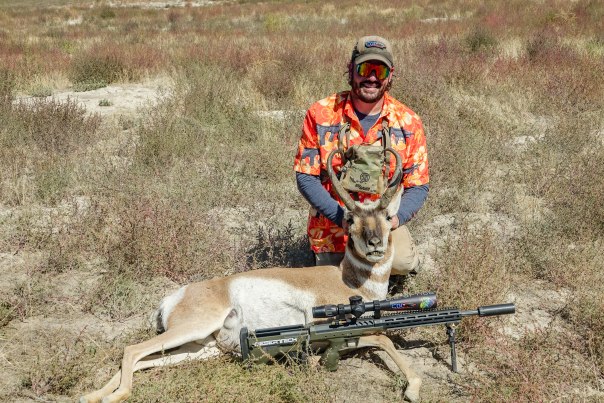
As I neared the downed buck, I was quite impressed with how handsome he was. He looked even better up close than he had in the scope, and he was for sure significantly better than any other buck we’d seen.
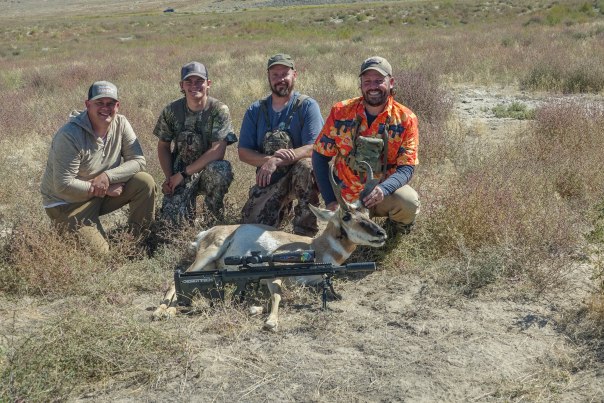
He had decent cutters and deeply hooked horns, he was just a fantastic specimen of his kind. And one I could certainly appreciate for years to come. A good friend of mine and his son had also joined us by this point, and the four of us stood there appreciating this magnificent little buck. The bullet had hung up in the skin just before exiting, which rewarded me with an additional souvenir.
the 100 Grain Cayuga bullet after traveling 24 inches through bone and flesh. For more information on this bullet, and what it looked like read Bullet Penetration and Tumbling
After taking a bunch of good pictures, we cleaned him up and filled him with ice to get the meat cooled as soon as possible. Then it was time to head back to camp for food and drinks while we recounted each others perspectives over and over.
Note damage to heart, lungs, and liver
Conclusion
I don’t blame people who don’t get excited about antelope hunting, I can understand that the call of a big bull elk or moose might be much higher on their list of dream hunts. But in my opinion hunting pronghorn antelope is an absolute riot of a time.
Make sure you wear your hunter’s orange, but keep it fresh
They are incredibly cunning animals with eyes that will pick you out of the brush, and when they want to get away from you there is almost nothing you can do but stand amazed at their speed.
the four of us with our prize
I typically do all my antelope hunting in the great state of Wyoming, but this hunt here in my home state has been a fantastic adventure. The desolate lands of the Great Basin are some of the most remote in the lower 48, and it feels incredibly romantic if only to find yourself here when the sun dips from view. Watching stars shoot across the silent night sky as coyotes bark in the distance brings a feeling you won’t find other places.
I am incredibly lucky to live like I do, and it is by no mistake that I am surrounded by such good company. I promised my brother I’d give his guide service (unofficial and sure as hell not licensed) a five star google rating, but the five stars go to the great family and friends that love these adventures as much as I do and make it worthwhile.