Tag Archives: varmint hunting

Vector optics, continental 2-12x44, riflescope, desert tech, quattro 15, aero precision, quadmag 53, yankee hill machine, fat cat, suppressor

Optimizing AR-15 Accuracy for Long-Range Varmint Hunting

Written by Guest


Intro

Stretching an AR-15 past 300 yards on prairie dogs this spring sounds ambitious. True — but not crazy. The platform has come so far that varmint hunting at real long range is practical now, not just some YouTube fantasy.
Still, you can’t bolt a Vortex onto a stock Ruger AR-556 and expect half-MOA groups at 400 yards. Doesn’t work like that. Every component matters — barrel, trigger, optic, ammo. Let’s see what actually moves the needle when you’re building an AR for precision small game work at distance.

US Optics, SXR, 1-6, lpvo, USO, low power variable optic, ar15, ar

What You Need to Know About the AR-15 Rifle


The AR-15 is not a single rifle. It’s a system — and that distinction matters way more for precision shooting than people realize. So, you need to know how the AR-15 rifle works to make the most of it for varmint shooting.
Here’s where most guys go wrong first. Factory AR-15s ship with mil-spec triggers breaking at 6-8 pounds. Heavy. Gritty. Completely wrong for careful shot placement at range. Drop in a Geissele SSA-E or a LaRue MBT-2S, and you’ll wonder why you waited. Cheapest meaningful upgrade you can make.


Next up — the handguard. Free-floated rail, non-negotiable. When your barrel touches the handguard anywhere, harmonics go sideways, and groups open up. Aero Precision and Midwest Industries both sell solid free-float setups. Now, something people overlook: the AR-15’s direct impingement gas system actually helps accuracy. Sure, gas pistons — like on an HK MR556 — cut fouling. Yet DI vents gas straight through the bolt carrier, meaning less mechanical movement while the round fires. For varmint hunting specifically, where you shoot from stable positions at tiny targets, that consistency edge compounds over an afternoon. Finally, modularity. No other platform lets you swap uppers in thirty seconds — .223 coyote rig to a 6.5 Grendel setup. That flexibility is why the AR owns this space.


Caliber Selection for Long-Range Varmint Work


Caliber choice will make or break you out past 300. Period. Under 300 yards, .223 Remington handles prairie dogs and groundhogs just fine. Cheap, low-recoil, available at every Walmart in America. Beyond that, though… The round bleeds velocity fast, and wind drift gets ugly with lightweight 55-grain pills.

223, 223 remington, hornady, bullets, handloading, reloading,


So what do you actually run? The .224 Valkyrie deserves a serious look. Federal built it for long-range AR work, and the 90-grain Sierra MatchKing load stays supersonic past 1,000 yards.
Overkill for ground squirrels at 500? Maybe. But that flat trajectory makes first-round connections on small targets way easier. Meanwhile, 6.5 Grendel gives you heavier bullets with strong ballistic coefficients — plus enough thump to drop coyotes cleanly.
Also worth knowing — barrel life varies across these calibers. The .224 Valkyrie eats barrels faster than Grendel, noticeably quicker than .223. Naturally, if you’re doing high-volume prairie dog shoots — 200 rounds in one sitting — factor that in before committing to a caliber.


Barrel Upgrades That Actually Matter


Not every barrel upgrade is worth your money. Some are. Knowing the difference saves you hundreds of dollars and a lot of frustration. Start with barrel length. For most varmint calibers, 18 to 20 inches hits the sweet spot between velocity and portability. Go shorter, and you leave real fps on the table. Conversely, past 20 inches with .223, diminishing returns kick in, and you’re hauling dead weight.

cmmg Banshee, banshee, cmmg, 300blk, eotech, vudu, anechoic suppressor,

Twist rate matters too — more than most shooters realize. A 1:8 twist covers the widest range of bullet weights in .223. However, heavy-for-caliber stuff in .224 Valkyrie needs 1:6.5 or 1:7 to keep those long 90-grain bullets stable. Criterion and Bartlein both make outstanding aftermarket options.
On material — stainless steel beats chrome-moly for pure accuracy. The tradeoff is durability; chrome-moly holds up longer under sustained fire. For varmint hunting, where precision matters more than barrel life in tens of thousands of rounds, go stainless.


Optics and Scope Setup


Glass matters more than the rifle itself. Yeah — hot take. Still true. For work past 300 yards, grab a variable-power scope in the 4-16x or 6-24x range. The Vortex Viper PST Gen II and Athlon Ares BTR both deliver without requiring a second mortgage. At those distances, though, magnification alone does not cut it — you need turrets that track and repeat.

ar15, ar 15, 6.5 Grendel, us optics, FDN17X,
this 6.5 Grendel rifle was unstoppable with the US Optics FDN17X on it


First focal plane holds the edge because your reticle scales with magnification, keeping holdover marks accurate at every power setting. The second focal plane works too — but only if you dial a set magnification before using subtensions. Otherwise? Your holds are off. MOA or MRAD — pick one, learn it properly. In practice, MRAD pairs better with metric-based ballistic calculators, and most competitive long-range guys have gone that direction already. Yet
plenty of accurate shooters run MOA without a single issue.


Besides parallax adjustment — don’t sleep on it. Past 400 yards, even a slight parallax error shifts your impact enough to miss a prairie dog entirely. Accordingly, check that your scope’s parallax knob dials low enough. Some budget glass bottoms out at 50 yards, which is useless for this kind of work.


Fine-Tuning Ammunition and Loads


Everything upstream — barrel, trigger, optic — only hits its potential when the right ammo feeds through it. Before you touch a reloading press, try factory match loads. Hornady V-MAX and Federal Premium’s Nosler Ballistic Tip offerings are proven. Test at least three loads in your specific rifle. Seriously — two guns off the same line can prefer completely different ammo. That’s barrels being barrels. Essentially, no two are identical. Handloading takes things further, though. Consistent charges weighed on a digital scale (not thrown volumetrically), proper brass prep, and careful seating depth work can shrink a 1-MOA rifle to half-MOA. Specifically, the Redding Type-S bushing die set earns every penny if you’re chasing sub-MOA consistency.
Brass lot consistency gets overlooked constantly. Mixing cases from different production runs introduces volume variations that change pressure and velocity shot to shot. Consequently, even a 15 fps spread shows on paper at 400 yards. Therefore, keep your brass sorted by lot number — no exceptions, no shortcuts.

ar15, quattro 15, desert tech, eotech, vudu, LPVO, desert shooting,


The Bottom Line


Building a precision AR isn’t about buying the most expensive parts. Your job here is to make the right parts work together. Get the right trigger, barrel, optic, and ammo, and 400-yard prairie dogs become routine. And you won’t need a $4,000 custom build, either. Smart upgrades for varmint hunting in the right order are what you should focus on — not throwing money at cool stuff from r/longrange.

Ruger M77 Overhaul: Turning 50 aint so bad

Introduction

Everybody loves a good comeback story, and today I’ve got a good one for you. Many great things came from the American 1970’s. No I’m not talking about the Carter administration but as a product of the 70’s myself I can assure you there was some good stuff back in the day.       Shortly before I met my father, a committed hunter and shooting enthusiast. He purchased one of the many guns he managed to collect during early life. It was a Ruger M77 Mark 1 chambered in the popular at the time 220 Swift.

I remember as a youth fawning over Dad’s guns, thinking they must be the coolest thing ever. Nothing got me more excited than when Dad would take me shooting.

My Father, he also grew up hunting these same mountains with Grandpa

The Ruger M77

Sturm Ruger introduced the model 77 in the late 1960’s, so by the time today’s subject was manufactured years later they surely had it dialed in. The original MKI used a tang mounted safety. Like many other rifle actions it borrowed a great deal from the Mauser model 98 . The M77 uses a claw extractor and a two-lug bolt, fed by an internal box magazine. To this day even modern M77’s utilizes the original angled action screw that pulls the action down and back into the stock. This curious design has been arguably beneficial as well as irritating for owners and gunsmiths alike.

Modern M77’s, which come with the MKII designation use a bolt shroud mounted safety vs. the original tang mounted one. A plethora of different models of M77 have been made over the years, in too many calibers to list here.

Rest assured if you want an M77 in a specific caliber, they probably made it at one time. The rifle we are talking about today came with a twenty-six inch heavy barrel featuring a one in fourteen-inch twist, it was blued with a glossy finish and a traditional walnut stock.

History

My father is a man of few shots, sort of a quality over quantity kind of marksman. During the many outings where I accompanied my Dad, I don’t remember him ever firing many shots, sometimes only a single shot was ever fired. But that was enough to bring home the venison at our house.

My siblings and I enjoying one of Dad’s deer, thats me in the middle

The 220 Swift is nearly a hundred years old already, it was a very popular cartridge a generation ago. It gained fame as one of the fastest cartridges around, and it is still a very fast cartridge today. This rifle shoots the same .224 caliber bullets you will find in a .223 Remington, but it shoots them MUCH faster.

Shooting Hornady 55 grain hollow-points yielded velocities near 3900 FPS, and the Hornady 75 Grain ELDM leaves the muzzle at 3400 fps. Both of these loads seemed quite mild, with room for additional speed.

the claw extractor of the M77

An Impressive Memory

I remember a specific occurrence, when as a young man I learned exactly why Dad shot sparingly. And at the same time I learned a LOT about why he chose the Swift.
It was a rabbit hunt in the dry deserts of Utah. We would push the brushy draws hoping to drive a rabbit or two up the other side in hopes of claiming one.

As a youth, it was my responsibility to push through the worst of the terrain to give others a shot. One of the many jackrabbits ran up the hillside in front of me, I followed him through the brush with my sights. As he cleared the top of the hill before me, I was beginning to press the trigger when the rabbit suddenly disappeared. In its place there was a cloud of hair drifting on the dry breeze.

In the distance I heard the report of a rifle that surely wasn’t a rimfire. I turned and saw Dad standing way back on the other end of the draw still looking through the Leupold 3.5-10 scope mounted on the Swift. As I neared the spot where the rabbit disappeared, I was immediately educated on several things. First was the impressive performance of the Swift and its exemplary demonstration of the destructive power of rifle rounds. Second was the entire anatomy of the jackrabbit scattered across the weeds.

That was at least thirty something years ago, and that old Swift became legendary in our family. But with that speed it also has an appetite for barrels, and more recently its blistering speed has consumed its accuracy with bore erosion.

Few things have ever escaped the Swift, before or after the overhaul

A New Life

There was no way that I was going to let this gun that I had idolized my whole life disappear into inaccurate mediocrity. I made a plan to overhaul the old Ruger and build it into a “Super Swift”.

Dad doesn’t get out as often, and varmint hunting seems as appealing as ever. So turning his Swift into an even better version of itself would be ideal for varmint hunting.


I started with the barrel, a replacement match grade blank from K&P was ordered. To be finished at the same 26-inches but this time with a 1-8 twist, a significantly aggressive twist rate for a cartridge like this. For this I sent it to my good friend Eric at ES-Tactical. My plan was to still shoot the 50-55 grain bullets at Mach 3+. But also have the ability to shoot the Hornady 75 grain ELDM bullets for things that are out there a ways.

refinished bottom-metal and floorplate

The new barrel would be threaded for suppressors because this isn’t 1974 anymore. And the old walnut stock would also be swapped out for something that better fit in with the rest of our guns.

ruger m77 220 swift
Suppressed is the only way to shoot

For that I looked to Boyds Gunstocks, and selected a model had Dad would like. The At One model with adjustable butt and cheek-riser, and a vertical style grip. Installing the new heavy barrel of the rifle would require opening the barrel channel somewhat to make enough room to float it.us optics

But despite being a 50-year-old design, the stock’s fit was perfect. To ensure consistency I glass-bedded the recoil lug area of the action into the stock, after which it fit so well you almost didn’t need screws.

Refinished

While I had it apart, I completely disassembled the action and bead blasted the old finish off, in preparation for fresh Cerakote. Since the trigger was apart, I stone polished the mating surfaces to improve the trigger which was already good, but now feels incredible. The stock featured dual front sling studs for bipod mounting, as well as a QD cup at the rear to add a QD sling swivel.

One thing some might call a drawback to the M77 is the scope mounting options. I don’t mind the Ruger scope ring design and mount, but you are limited to using what is offered. Lucky for me I found a set of Leupold high rings in 34mm to mount the US Optics FDN17X scope to the old MKI. Which would make an excellent match to the rifle.

The beautiful tungsten Cerakote match made the whole thing look sharp. Now it was time to get the legendary Swift back out where it belonged, scattering varmints across the countryside.

If you like this rebuild, you’ll also like Rebuilding a Hunter

Swift Vengeance

With the completely rebuilt rifle in hand, as well as some fresh 75 grain handloads, my father, brother and I headed into the high Rockies to put it to the test. Not only did the rifle shoot the 75-grain bullet very well, but it still craved the twenty-year-old hand-loaded 52 grain Match Kings I loaded once upon a time.

220 Swift shown next to a 223 Remington

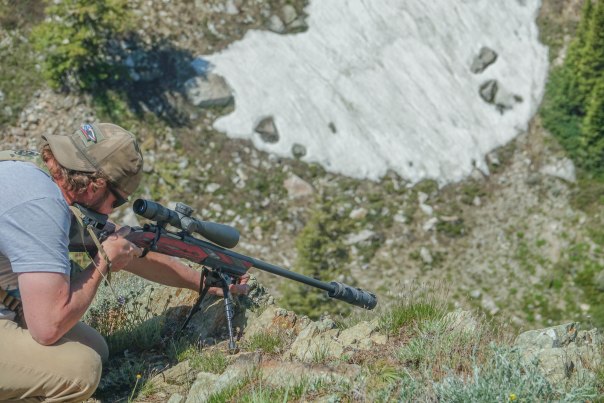
With the rifle zeroed, and after installing a Yankee Hill Machine Nitro N20 suppressor, it was time to exact the Swift vengeance it is so famous for.

We hunt Marmots all spring and summer long, and today would be an exceptional day of chuckin’. The blistering speed of the Swift had returned with incredible accuracy, allowing surgical pinpoint accuracy. We were all stunned at how fast the bullets arrived at their furry little targets. I can’t help but think that the aggressive 1-8 twist also greatly increases the rotational energy of the bullets making them even more explosive than before.

Continue reading here

Find your own Ruger rifle here

Conclusion

After renovating this old rifle, I am quite confident in the upgrades. This rifle will surely continue terrorizing varmints for the next generation. The match-grade barrel produces incredible accuracy, the new twist allows for a much broader selection of bullets to be used. And threaded for a suppressor will make doubling and tripling up on coyotes a possibility.father, son, ruger m77, 220 swift, us optics fdn17x

The new stock, besides being incredibly handsome, offers a great deal of modularity. Its polymer parts are in all the right places to avoid scratching the wood on the landscape.

The new scope vastly increases the rifles potential for shooting long-range. We’ve already shot it beyond 1100 yards, something near impossible with standard 220 Swift rifles. The further distance capability is also enhanced by the improved trigger.

The M77 with its new look and Cole -TAC suppressor cover

If you have an old Ruger M77 laying around, don’t be afraid to dive deep into a custom like this. Despite the fifty-year-old design, they still make a great rifle. I’m glad this project turned out to be such a fantastic result, that even eclipses the legendary performance it had before.

The unbelievable power of the 220 Swift shooting 75 gr ELDM’s

If your old M77 has passed its prime, do yourself a favor and breathe some new life into it. They could be a great performer for you as they are. Or serve as the base of your next project that may become its own legendary family heirloom.

-CBM

Me, Dad, Brad, and Spence. You can see the action in Major League Chuckers 9

Major League Chuckers 9: Chuckageddon

In this latest installment of the Major League Chuckers film franchise, we again take you into the high Rocky Mountains. Both my brothers, my father and myself running the guns.
This incredibly fun hunt is part of my spring hunting regimen, and it helps keep me active as well as sharpening all the shooting senses. Spotting these cunning little creatures takes talent at times, as does hitting them in their low-lying hideouts. Sometimes you go for the direct hit on their tiny pudding pot, and other times you literally bounce the bullet (or splatter it) into the target if it needs so.

Give this one a watch, and share it with your like-minded friends:

Major League Chucker’s 7

The latest installment of your favorite series of varmint hunting adventures:

Todays chucks were mostly hunted with My SRS M2 in 6 GT, lots of springtime weather including snow and wind made this one a little more challenging than others. Hunting Marmots (woodchucks, rockchucks, groundhogs, etc.) is an incredibly fun hunting activity, if you haven’t tried it, you need to try Springtime Chuckin’.