Category Archives: Product review

Products and equipment

Eberlestock Cherry Bomb: a perfect EDC backpack

Inrtoduction

There comes a time in a guys life, where he has to choose between a couple different ways of living. Whether its gym membership or a hiking regiment we make choices that effect our future activities. While many of these choices are about the mundane and everyday tasks we engage in, some of them can be life-changing, like whether we carry a gun, or a pocketknife.

You clicked on a backpack article right? Well the Eberlestock Cherry Bomb is in fact the subject of this article, but we are going to talk about how a backpack choice can effect your life.

Eberlestock is well known for making top-quality backpacks and other outdoor gear. While their products are probably most popular among outdoor types like hunters and backcountry hikers, they are also quite popular with just plain gun folk. I first heard of them years ago when my brother bought one of their Gunslinger backpacks, so when the time came for this project, my eyes turned toward Eberlestock.

Carrying a gun is a big deal that hopefully everybody takes with extreme responsibility, but there are many who take it to the next level. Your reasons might be professional such as public service or private security, or you might just work in the firearms industry or play with a lot of guns. On a day to day basis, a person not unlike myself might usually have a pistol and a rifle or two. One of those weapons should be ready to party at any given minute, and as a superior option to a handgun I would prefer the rifle. I wanted to see if the Cherry Bomb pack from Eberlestock would be suitable for an every-day carry backpack.
Having a rifle close and ready can certainly provide you with the upper hand should you need it, so after doing some measuring and research I decided to get a Cherry Bomb for my Desert Tech MDRX Micron.


The Cherry Bomb

The Cherry Bomb is a multiple compartment backpack that could easily be mistaken for a nice laptop carrier. It has an internal space of twenty-four inches by eleven inches wide, and has several dividers for storing assorted organized “things” inside. The pack comes with a removable waist-belt should you choose to use it, and it is available in a few different color schemes which don’t scream “Gun Inside”. The shoulder-straps are well padded and adjustable to fit most anyone, I chose to remove the waist-belt mainly because I don’t need it for carrying it on a daily routine.

Like all Eberlestock packs it is extremely well built, strong stitching and tough seams and zippers make it very robust and reliable to open and keep closed. There are two small zippered compartments at the bottom on each side, as well as a cunningly placed rainfly stowed in the very bottom. The interior of the pack has several dividers for keeping things like laptops from getting rubbed against your rifle. It also has some internal pockets for keeping small things like those you’d keep in your pants-pocket, but you have a backpack now. Next to the rigid weapon compartment there are also two pockets that are just right for holding extra magazines, complete with bungee retention.

The Grey man

I wont bore you with the grey man theory but to mention that the Cherry Bomb is a good start to your grey man kit. As I mentioned above it could easily be mistaken for a computer carrier or biking backpack. Carrying a concealed rifle around is easy with this pack, and you can do it with comfort and without attracting attention.

Stowing my rifle

Opening up the Cherry Bomb for the first time, I was excited to see if my measurements had been correct. I had my short-barreled MDRX ready to load up, and I was excited to see that not only would the rifle fit, but even with a shorty suppressor installed I could just squeeze it in. With a low profile red dot installed on the rifle, and a loaded 20 round magazine, the MDRX Micron SBR dropped right in. I stuck two additional thirty-round magazines into the pockets, as well as some other things that go well with a little rifle and zipped it up. The pack features zipper pull-tabs, and they are built well just like everything else. I zipped them both up to the middle-top of the pack, and decided to go for a walk. With a couple water bottles added to the outer pocket, I figure it probably weighed around fifteen pounds with all my gear comfortably stowed. The Cherry Bomb could easily carry much more weight comfortably, especially if you use the waist belt. Using only the shoulder straps for support I found it to be quite tolerable, and without the waist-belt it was still easy to maneuver and quickly remove the pack.

Shop Eberlestock products at Brownells

Just as important, I wanted to see how quickly I could pull my rifle from the bag, and be ready to shoot should such a need arise.
With both zipper-pulls at the top, I found it easy to “peel” the pack open like a banana, and the rifle was easily extracted by either pulling at the butt-hook of the stock, or just grabbing the sling and pulling it out. I also tried slinging the pack off of the shoulders and around the front using the waist-belt to keep my entire kit attached, which also worked out as a suitable option. After a little practice, either way I did it made for a fairly quick deployment. This is where the benefits of the bullpup MDRX were most apparent, most AR15 and similar SBR’s need either a folding stock, or be of the collapsible type. This requires an additional step upon removing the rifle from the bag, but my little Micron is ready to go with a slap of the charging handles as soon as its free.

The Cherry Bomb (center bottom) is a perfect fit for stashing your SBR

The Cherry bomb quickly became a briefcase for me, traveling to and from the office with me every day. Easily stored documents and other everyday items were also stashed inside. To be completely honest, it almost seemed like a little bit of light duty for the Cherry Bomb. But the opportunity to put it into another role would soon arrive.

The Hunt

With the local deer and elk hunts inbound, I saw the opportunity to test a couple things using the Cherry Bomb. I have backpacks all over, but my wife would be coming along on this hunting trip as well. I figured the comfy straps of the little Eberlestock might make her day a little more pleasant. So as opening day arrived, I cinched the shoulder straps way down to fit her petite shoulders and replaced the waist belt. We were only planning on being out for the day, with hopes of getting our hands on an elk. But because anything can happen, she loaded up the Cherry Bomb with all kinds of gear.
She wanted her thermos of hot tea, water bottles, plenty of snacks, extra jacket, knives, ammo for her rifle, and of course an emergency shit-kit and so on. All the things she thought we may need fit snugly into the little pack, and she slung her rifle over the shoulder strap.
Its a good thing she went prepared that morning, as she was seconds away from plugging her first elk. But instead we ended up packing out a deer, and by the time we made it back to the vehicles we had exhausted the snacks, water, and even the tea. They were replaced by a rifle and some backstraps. All the while I kept asking her how she liked the pack, and if she was comfortable. It was quite apparent from her attitude that the pack was indeed comfortable, and I had to wrestle it from her the following weekend to take it hunting myself.

Results

Part of the reason I went with the Eberlestock from the beginning was because I was confident I would like it. With their well known reputation for quality, my assumption that they would think it through was correct. The Cherry Bomb is an excellent backpack, whether you are using it to stow your daily rifle, as something to carry your daily effects to work, or to haul pieces of game from the bottom of a steep canyon draw. It’s adaptability to a variety of uses is perhaps it’s strongest point. I love carrying it wherever I go, knowing that readiness waits inside the Cherry Bomb.

-CBM

Dead Air Mask 22Lr Suppressor

Suppressed life

dead air, mask, dead air mask suppressor, suppressor, 22lr, .22lr, rimfire, bergara, bmr, vortex optics,
the Dead Air Mask suppressor on my Bergara BMR 22lr

Life is so much better with a suppressor, and the more suppressors you have the better in my opinion. Suppressed shooting brings a new level of enjoyment to the shooting sports, whether it be hearing your bullets impact on the target or just not having to wear ear protection and being able to speak with each other without yelling. Rimfire’s are already quiet compared to their centerfire counterparts, and when you put a suppressor on them they are even more quiet. The Dead Air Mask 22 rimfire suppressor has been in my inventory for over a year now, and I can certainly say it has made the year more pleasant. And if you are looking for one yourself, I’m here to give you my opinion on it.

The Mask

dead air, mask, dead air mask suppressor, suppressor, 22lr, .22lr, rimfire, bergara, bmr, vortex optics, shooting supported from a tree trunk,
unbelievable amounts of fun can be had with a suppressed 22

The Dead Air Mask is titanium and stainless steel rimfire suppressor, it is rated for everything from 22LR up to 5.7×28 cartridges. It is just over five inches long, and has a diameter of 1.070 inches and weighs in at 6.6 ounces. The Mask is disassembled using the provided tool for the muzzle cap, and the threaded breach of the can also threads out making cleaning the suppressor very easy.

Specifications

Caliber Rating .22lr, .22Mag, .17HMR, .17WSM, 5.7×28
Bore Diameter .22-inches
Length  5.1-Inches
Diameter 1.070-Inches
Materials 17-4 Stainless Steel Baffles, Titanium 3Al-2.5V Grade 9 Tube
Weight 6.6 Ounces
Finish Black or FDE Cerakote
Barrel Restrictions None
Full Auto Rated Yes
MSRP $489.00

All Season

The Mask has been with me for some time now, through the summer heat and the cold of winter. I think I’ve gotten a good handle on how it performs.
The Mask was easily installed on an assortment of host rimfire weapons, and in every instance it made everything better. I use my firearms mostly for hunting and practice prior to hunting. A good portion of the summer time was spent using the mask on several 22 pistols to hunt small game such as squirrels and marmots.

Using suppressed rimfire hosts can get you up close, the Taurus TX22 was another excellent host

The Mask made a perfect companion for that purpose, allowing me to take multiple animals without spooking them with muzzle reports. And it was easily threaded on and off of my firearms, and had what I consider minimal shift. The stainless mounting threads and square cut breach cap provide an excellent interface with the host.
Through the winter time the mask stayed with me and my rimfires, providing the children with all kinds of fun. All while not adding a bunch of length or weight to the host rifle.

The Mask was perfectly suited for this Tikka 17 HMR

Why the Mask?

With so many admittedly good options out there, what would make you choose the Mask over something else? Its a subject I’ve often thought about, not just with the Mask but all kinds of products. I have other rimfire suppressors, and to be perfectly honest there is not a huge disparity between them all. Which again begs the question, why pick one over the other? Obviously there is a commercial aspect to the answer that has some validity, if there is only one suppressor in stock when you go to purchase one then it pretty much answers your question. Dead Air has done a great job at keeping up with demand, even during the darkest days of the last supply crisis I could still find an assortment of Dead Air suppressors in stock.

Pretty much all of the US suppressor market is domestically manufactured mostly if not wholly. So buying American is easy as far as that goes, but its nice to know that parts for my Dead Air cans were made just down the road a piece by some of my friends.
I don’t consider myself married to one particular manufacturer, as I have cans from several of the larger manufacturers. But if you are one of those people who likes to stick to one brand, you certainly wouldn’t go wrong picking Dead Air as that brand.

A pair of Marmots, one of which was not threatened by the report from the Mask
ruger rpr 22lr
the Ruger RPR .22lr was an excellent host for the Mask

Price seems to be the most common decision factor on many things, the Mask has a street price as I write this around 420-480 dollars. That’s not exactly cheap for a rimfire suppressor, but you can surely spend a lot more money. And I wouldn’t bet the average shooter would see a huge difference between the Mask and suppressors that cost much more. So many times it can come down to who and where gives you the best price.
There are lighter suppressors, but we are talking in ounces so unless you are so high speed that two ounces is going to change your mind its probably not an issue.silencer central,

Final words

The Dead Air Mask offers the same thing the rest of the Dead Air family does; excellent suppression and robust durability that won’t require a loan application (unless you want a really big collection). So if you are a Dead Air fan, or if you have been considering the Mask as an addition to your firearms collection I am here to tell you, you will love it.
-CBM

Ruger 22LR Precision Rifle

Intro to the Ruger RPR 22

Steal his look with a jacket from KUIU

Sometimes we get the cart before the horse, and I’ll admit that I’ve done a few things out of order over the years. One instance where I think I started at the wrong end was a few years back, when I first put my hands on a Ruger Precision Rifle (RPR). Normally I like to start with a light recoiling rifle, get comfortable and proficient with its function, and then step up to the next bigger platform.
The first RPR I ever shot was the big one, in 338 Lapua Magnum. I later was able to shoot one chambered in 308 Winchester, which was obviously a little softer. And finally today, I have reached the small end of the RPR family, chambered in .22 Long Rifle.

A Natural Evolution

I remember when the first RPR hit the market, it started gaining fans immediately due to its many features and benefits. Ruger’s design quickly caught on to several large groups of rifle shooters, and in the process helped open new shooting activities to those shooters. The RPR at a glance could be mistaken for a Modern Sporting Rifle (MSR) or an AR type rifle, it’s simple yet handsome aesthetics appeal to the Black Rifle crowd just as much as it does to the precision rifle shooting crowd. Ruger was clever in the way the gun was made and marketed, the price-point of the RPR brought affordability to a shooting class that before then had been reserved to expensive custom rifles, or actual sniper rifles.
As the popularity and success of the RPR soared, additional models and calibers were introduced using the same basic idea, and it was only proper to have a rimfire version.

The Ruger Precision Rifle .22LR

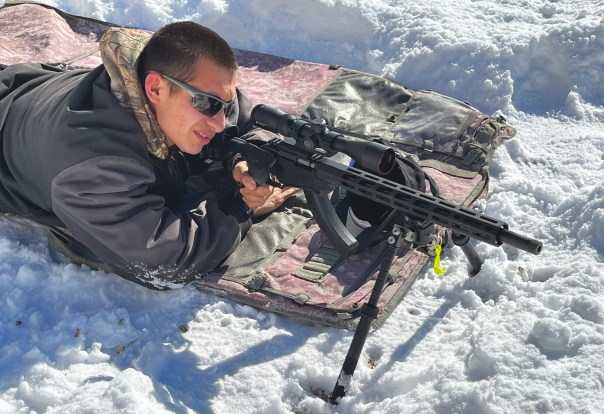
The RPR .22LR is a bolt action magazine fed rifle, built in a chassis with fully adjustable comb and recoil pad. The rifle uses an eighteen-inch hammer forged steel barrel which is threaded 1/2-28 at the muzzle to install your favorite muzzle furnishings. The chassis utilizes a free-floating handguard with M-Lok slots for adding accessories, and also uses standard AR type pistol grips so you can install whatever model you desire. The rifle has a built in optics mounting rail atop the receiver and in a brilliant stroke of genius, it was designed to use the incredibly popular Ruger 10/22 magazines, with fifteen and twenty-five round magazines shown in this article. All these intuitive features come with an MSRP of $579.00.

Getting Started

I’m currently on a rimfire kick, so this rifle couldn’t have fallen into a better lap. Upon receiving the rifle, I promptly started the process of fiddling and figuring it out. The rifle came to me with a Vortex scope already mounted in a one-piece scope mount, and a few extra magazines. All I needed was a bipod and my Yankee Hill Machine Phantom 22 suppressor  and an Atlas Bipod to make this rifle complete.

Luckily for me, I had several great options for ammunition testing. Plenty of the cheap bulk-packed ammo from manufacturers like Federal and Winchester, as well as match grade ammo from companies like Aguila and CCI. I was excited to see how it all came together in the little RPR. Once I had rifle, ammo, and everything else I needed, I headed to my shooting line to get it warmed up.

Shop .22LR Ammo at Wideners.com

Once there, I bore-sighted the scope and started loading magazines. I started with some of the Winchester bulk packed ammo, just to get a close zero. At one-hundred yards it was not particularly impressive, with shots dodging between two and four inches across a five-shot spread.
Running the bolt on the RPR was just a tiny bit glitchy, which I believe is simply getting used to it, and breaking in the action. One thing that I’ve noticed on most bolt action rimfires is that the shorter bolt is more susceptible to binding in the short action, I believe this is due to distribution of force being focused on just a few small surfaces. I have run the bolt on other RPR’s and found the bolts to be perfectly smooth, so it could simply be that this gun is new and needs some working.
I usually don’t use safeties much, I prefer to simply keep it empty until ready to fire. But when talking about 22’s, there will almost invariably be children around. In fact I used the RPR 22 for one of my kids hunter safety course, as it was a perfect fit for him. The safety on the RPR was a little stiffer than I would have liked, the kids actually thought there was something wrong with it. But this again could just be needed to be broken in, not a deal breaker for me.

Continue Reading Here…

Still, the adjustments of the buttstock of the rifle made it easy to match it to other shooters like my kids, making their shooting experience even more enjoyable. Though, one other small concern I had was mag feeding. Particularly when loaded to a full 25 rounds, the first few rounds were a little finicky when feeding. This also varied with different ammunition, so it could have had something to do with that as well.

ACCURACY

After trying four different types of ammo, there was clearly a winner. The cheap bulk-packed ammo worked fine but didn’t produce the best results as you might imagine. Both the Winchester and Federal produced groups around 3 to 4 inches at 100 yards, and the CCI was a little better but not much.

Get you some high quality Lapua 22lr Match ammo here

As you might imagine, the Aguila Match ammo was superior, producing 10-shot patterns around 1.5 inches. Five-shot groups were even better, some of them even shooting 1/2-inch groups. I was happy with the results, but I would have preferred better accuracy with the cheap stuff. At least I know what to use should I need to head-shoot squirrels from across the creek.

.22 Aguila Ammo and a target
With the right ammo, you can achieve some very nice groupings. 

SUPPRESSED

Bolt-action .22 LR Ruger Precision Rifle

Nowadays, suppressors are becoming more and more popular, so I had to shoot the rifle with a couple of different suppressors just to satisfy my curiosity. First was the Dead Air Mask, followed by my favorite Yankee Hill Machine Phantom 22. Both of them worked perfectly, making the report of the little rifle comparable to the BB gun I got when I turned 10.

In the open Rocky Mountains, it is hard to discern the difference between two rimfire suppressors, but the YHM wins because of it weighs a third less. Shooting suppressed rimfires is addicting, and the Ruger RPR makes it even better with great accuracy and the ability to adapt to each member of the family.

CONCLUSION

It should come as no surprise that the RPR 22 is an excellent choice for a good shooting rimfire rifle. Ruger has near-legendary experience in the rimfire market and adding a .22 LR rifle to the Precision Rifle family was exactly the right move. Despite the few hiccups I had with the rifle, I can hardly see a reason to own a different .22. Unless you have an extremely small budget, or desperately need a semi-automatic .22, you will love the Ruger Precision rifle in .22 Long Rifle.

-CBM

Crimson Trace Hardline 3-12X42 Riflescope

It wasn’t too long ago that imported and economically priced scopes were looked down upon by the American shooting public, I remember seeing quite a few of these less expensive brands being raked over the coals as junk. Some of it was warranted, while some of it was simply a perception of inferiority. Don’t take this the wrong way, there is nothing better in my eyes than a quality built riflescope made by the best companies here in the US, or our good friends from central europe. But there are great optical options to be had nowadays that are built elsewhere, and they are being made by American companies that we are quite familiar with.
Today we are going to discuss the Crimson Trace Hardline 3-12X42 Riflescope, and to be completely transparent here, I didn’t even know they made riflescopes. That was until I picked this one out of a line-up.

The Crimson Trace Hardline Series are marketed towards the tactical and sport shooters, they are priced lower than Crimson Trace’s Hardline Pro scopes which enjoy a few more high end features. The scope in hand today is the Hardline 3-12X42, it features a 30mm tube, MRAD turrets, the MR1 MIL reticle, and as you might imagine they come with other standard features like multi-coated lenses, nitrogen purged, and waterproof. They also feature a warranty that is fast becoming the standard, and that is a no-nonsense lifetime warranty that won’t ask for receipts, registrations, or money. Yes that is a great kind of warranty to have, but nonetheless it remains one we don’t want to use.

When the Hardline arrived I was eager to open the box and see what waited for my eyes. I must say that I wasn’t sure what to expect as I was previously unaware of Crimson Trace’s scope line. But as I immediately raised the scope to my eye, I knew this was something I would like. The optical clarity of this little scope was striking, as confirmed by a few fortunate passersby. Very clean, and very bright was the image from this scope, I took it outside to look down the street to confirm. This scope has a look that I very much like, that is that the scope body seems to disappear when you look through it, almost as though you are looking through a magnification bubble floating in the air over your rifle. I rushed home to get the scope mounted up on a rifle with plans to confirm a matching quality performance.

The rifle I chose to first mount it to, was a custom I had built a couple years prior. It is a 25 Creedmoor built on a Tikka T3, with a twenty-two inch Xcaliber barrel, mounted in a KRG Bravo chassis. It has been an extremely accurate and long-range performer. The rifle had previously been mounted with a Riton Optics 6-24 scope, which had worked well since day one, but it was time to change things up. I mounted the Hardline in a one-piece scope ring set, and put it atop the Tikka, in just a few minutes I was ready to bore-sight the scope.

The process of sighting in the scope got me quite familiar with it’s turrets, which at first I really liked. They do have a feature that I don’t like much, but is quite common. To zero the turret you pull up and rotate it back to zero, this raises the knob away from its seat, and the detents. It’s not a big deal really, I just prefer turrets that are mechanically seated and locked down with a screw. I cant help but think that just the right tree branch or bump could lift and turn the turret and mess up either your elevation or windage setting.
Other than that, I really like the turrets. The clicks are firm and audible, strong enough I believe that they will stay put hiking through brush. The MRAD turrets on my scope have 8 MILs per rotation, better than 5 which used to be more common among less-expensive scopes. I prefer 10-15 MRAD per rotation, which I’ll admit is a fairly meticulous gripe since most of my rifles don’t need that much elevation to shoot to the extreme end of their typical range. But for scopes like this one that do not have a zero-stop, I like it. Mainly because with 15 MRAD turrets you will likely stay on the same turret rotation for 99% of your shooting, thus avoiding the dreaded over/under miss because I dialed a whole rotation off.


Turret values appeared to be accurate, this rifle has very consistent drop values which means I could anticipate the hits at 600 and 1050 yards. Which came effortlessly after confirming a hard zero at one-hundred yards. I dialed up and down for many different ranges between 300 and 1100 yards, the Hardline kept up just fine, and the hits kept coming.

After running the Hardline on my 25 Creedmoor for a few days, I decided to swap it over to another rifle. I mounted the scope into a cantilever mount, and stuck it atop my Desert Tech MDRX, a multi-caliber semi-auto which happened to have the 223 barrel in it at the time. Back into the mountains I hiked, with my MDRX slung over my shoulder. When I pulled the rifle around to shoot the first time, I noticed that the scope was noticeably unclear which shocked me. I then noticed that the eye-focus ring Had been turned as I hiked by rubbing against either my pack, or my shoulder. Not good thing, but it also could have been the way I carried it. It was easily re-focused, and I was in the groove. In no time at all I found myself zeroed and smashing everything I aimed at. Despite my not caring for the pull-up to zero turrets, it sure made it nice and fast to re zero with no tools. Continue Reading Here…

The MR1 reticle is simple and effective. At 12x, it was easy to see bullet impacts at 1,000 yards and make any needed corrections. I am more of a first focal plane kind of guy. But for lower power scopes like this, I can make an exception. It does not hurt that it also lowers the price significantly, though I think this scope would be even more awesome if it was first focal plane.

FINAL THOUGHTS

The eye box on the scope is not difficult to center on, and the magnification ring is not too hard – or too easy – to turn. Handsome knurling on all adjustment surfaces made gripping in the cold easy. All in all, I think the Crimson Trace Hardline is a great buy at the MSRP of $459.99.

Comparing the scope to others in its price range, I think you’ll find it a strong performer with both an optical performance above its peers and a mechanical performance that breaks the norms set by offshore-made scopes of the past. Despite the few things I did not like about this scope, I still quite like it. I think I will keep it around as my switch-around scope due to its easily re-zeroed turrets and clean picture.

Excellent work Crimson Trace, bringing a great scope in at a very modest price point.

-CBM

The MR1 reticle features whole and half MIL marks on the vertical post, and .2 MIL marks on the horizontal. (Mule deer at approx. 400 yards)

The Tiny Terror of the Yankee Hill Machine Phantom 22 suppressor

Introduction

The first time I heard the name Phantom, I assumed like many of you probably did that the name implied a ghostly illusion of anonymity while shooting. Having shot quite a bit of suppressed rifle-fire over the years, and having heard other’s shots from various angles and distances gives the name more credence in my mind.
The latest suppressor to join my NFAmily is the Yankee Hill Machine Phantom 22, and another Phantom it surely is.

The Yankee Hill Machine Phantom 22

The aggressive suppressor market is doing an outstanding job of giving end users the great gift of choice, and the Phantom 22 is an excellent example of giving customers what they want.
The Phantom 22 is constructed of both aluminum and stainless steel, the outer tube being made of aluminum and the baffles themselves being machined from stainless steel. The attachment to the host utilizes a stainless steel threaded insert as well for robust mounting and durability.

The suppressor uses a threaded end-cap at the muzzle, and the main tube is comprised of two sections that thread together just ahead of the blast chamber. Inside the main-tube is the baffle stack, with indexing tabs to keep them all aligned in the same orientation. The blast chamber also has a stainless steel liner that slips into place at the back of the baffle stack. The short section of the main tube at the rear features all the serial numbers and identifying marks.

The Phantom 22 weighs in at a miniscule four ounces, which is a good two ounces lighter than most twenty-two suppressors on the market. The diameter of 1.1 inches and only five and a half inches long make it not only light but less intrusive into your shooting. The suppressor is rated at 114 decibels (which I assume was with a 22Lr), because the suppressor is also rated for 22 magnum, 17 HMR, and even 5.7×28.
All this at a street price not far from three-hundred dollars makes the Phantom 22 a great option for those looking to get quiet in the rimfire game.

Opening the box

suppressed Ruger RPR.22LR
The Ruger RPR .22LR was an excellent host

I managed to get my hands on one of the very first production model Phantoms, with a single digit serial number I knew it was at the head of the line. I couldn’t believe how light it was as I lifted it from the box, before I even got it opened I was worried I had been shipped an empty box. But there it was, the beautifully anodized little tube I had been anticipating for some time. After admiring the exterior of the suppressor for a moment I decided to get right into the guts of what makes it so light. The front and rear tube sections are undone by hand without tools, the compression and friction of the assembly keep it quite snug.

Upon removing the rear section of the tube I noticed that the breach of the suppressor has an embossed tool as part of it to be used in loosening the end cap which I also threaded carefully out. The smooth stack of baffles slid smoothly out the front, making one of those soothing metallic slipping sounds. I took a couple of them off the stack, to see exactly how it was that they went together. And at the back of the stack was the blast chamber sleeve.

Basically the liner and stack of baffles contain the entirety of the gasses and rimfire debris, the outer tube is simply there to align and hold it together. It was immediately apparent that the idea was to keep all carbon and lead buildup contained inside the blast chamber sleeve. This would keep buildup from locking the assembly together as carbon builds up, which it of course it will, at an impressive rate. So even if you shoot thousands of rounds through this can, and stack the crud deep into it, you will still be able to disassemble it for cleaning.
Another feature that quickly manifest to me was the location of the legal markings, they were all part of the short portion of the main tube at the breach end. This made a lot of sense to me, in the unfortunate event that the can should come loose under fire, and you suffered the dreaded baffle strike, it would be very unlikely to damage the serialized part of the can. This would make repair or part replacement very easy, with something like 85% of the suppressor being easily swapped out for a new part.

Head for the hills!

suppressed Taurus TX22
The Phantom 22 worked great with the Taurus TX22

I couldn’t wait to get the Phantom mounted on a rifle and outside, but it’s first host actually turned out being my Taurus TX 22 pistol. I had shot thousands of rounds through my two TX pistols with various suppressors so I figured it would be a great place to start my comparison. I installed the 1/2-28 thread collar on my pistol, an threaded up the Phantom onto it. Two ounces doesn’t seem like much, but it sure seemed like I could feel a difference between the Phantom and the Dear Air Mask that had been on it last. And it was definitely a noticeable difference from the SiCo can that also frequented the muzzle of my TX’s. There are lighter suppressors sure, but who wants a suppressor that looks like anal beads?

I wasted no time burning through a paycheck’s worth of ammo, a couple mags later I needed to swing by the house to pick up more. Shooting the TX with the Phantom installed was similar to what I was used to, the increased backpressure caused by suppressors was noticeable. Particularly when dumping large quantities of ammo through the gun I could see and feel plenty of gas and debris in my vicinity. (Note: always wear the appropriate safety equipment when shooting)
I will say that with this pistol, you better be wearing glasses when shooting suppressed because you WILL feel stuff hitting you in the face.
I don’t recall how many rounds I’ve put through that pistol/can combination since, but it is no insignificant number. And yes there tends to build up carbon and other crud around the breach and ejection port of the pistol, but not so much as to deter me from keeping them married.

I’m more of a rifle guy than a pistol guy though, so I really wanted to see how it would do on a rifle.

Yankee Hill Machine Phantom 22 on rifles

tikka T1x with Kahles 318i
The Tikka T1X and Kahles K318i

The first rifle I was able to use with the Phantom was a Tikka T1X in 17 HMR, a very smooth little rifle you can read about here shortly. The rifle was fairly heavy for a rimfire, making recoil non-existent. The noise was still there though, the higher velocity of the 17HMR obviously creates quite a bit more racket than a 22Lr. But it was plenty quiet for my ears, shooting with the Phantom in the open country of the Rocky Mountains needed no hearing protection. The cold winter snow seemed to help soak up some of the sound as well. The Tikka saw no decrease in accuracy with the Phantom installed, which I expected to be the case.

Next I threaded the Phantom onto a Ruger RPR 22Lr to give it an additional workout. The Ruger shot outstanding with the Phantom installed, watching all my impacts one-hundred and fifty yards away was beautiful, and the icing on the cake was the thud sound every-time I pulled the trigger. I tried both super-sonic and sub-sonic ammunition through it and the results were outstanding. The anonymity that comes with shooting that quiet can certainly inspire the sensation of a Phantom presence.
Shooting long strings of fire barely heated the Phantom 22 up at all, though that could have something to do with the below freezing temperatures around here.

Score-Card

I’ve shot a few cans, but the other two rimfire cans I have are in the same competitive league as this one, so I think they are a great comparison.
I have to give the Phantom all high marks, it is just as if not quieter than my other cans. And the significant weight reduction cannot be ignored when compared to the others. And the price on the Phantom is hard to beat, if you can find one they are priced around $325 up to near the $400 mark.
The sound is outstanding, and the ease with which you can disassemble and clean this can makes it a perfect suppressor for just about any rimfire need.

The Phantom 22 next to the author’s SilencerCO Spectre II and Dead Air Mask, both excellent company for comparison.

Conclusion

As usual with YHM cans, this one is an obvious winner in my opinion, at least when compared to those that I’m familiar with. There may be better cans, there may be lighter cans or some other feature that outperforms this one. But I’ll have a hard time justifying to myself looking for a better one with this spectacular little suppressor in my stable, it is an absolute joy to shoot.

-CBM

If you like this review, check out the YHM R9 suppressor
desert tech trek 22
The Phantom 22 on the Desert Tech Trek 22

Cayuga solid copper bullets: 6mm 100 grain

Preface

Some of you may have already read about my experience with the 6.5 Cayuga from a year or two ago. That may or may not have led you to this subject, but if you are seriously looking into the Cayuga solid copper bullets as a hunting option then I’d recommend reading both articles.

The Cayuga

All Patriot Valley Arms Cayugas are solid copper monolithic bullets, lathe turned to perfection from the same alloy as traditional copper cup bullets. This allows them to be extremely consistent from bullet to bullet, and the CNC turning process also allows their profile to be controlled meticulously. The Cayuga solids boast much higher ballistic coefficients than comparably weighted bullets, but due to their lighter weight from lacking a lead core they can be shot at higher velocities. So to sum it up; higher bc’s and lighter weight make them better for distance shooting and the lot consistency and gentile ogive make them accurate and easy loading.

target, group, cayuga solid,
A typical group from the Cayuga, with zero load workup

Earlier this year, I started my second six millimeter project, a 6mm GT for my Desert Tech SRS M2. It took only a few minutes to fall completely in love with the Tiger, so when given the opportunity to test these new Cayuga bullets in it, I wasted no time. The 6mm GT easily pushes hundred grain bullets to the 3,000 fps mark, and the high BC of the Cayuga meant that it would hold onto that velocity and energy for quite a ways.


The Numbers

The 100 grain Cayuga didn’t exactly come with an owners manual, PVA gave me some suggested data to work with which seemed to be spot on. I used a G7 BC of .270 which is very similar to the extremely popular Berger 105gr. I tested the Cayuga to beyond 1400 yards and as far as I shot with it, that .270 lined up perfectly.

Easily Loaded

desert tech, srs, srs a1, srs m2,
My Desert Tech SRS M2 (among its siblings) during the hunt

Once I had the Cayugas in hand, I sat down at the loading bench to get busy. The go to powder for the GT is Hodgdon Varget, and for good reason. But if your reading this in the same era it was written, then you know how hard its been to get certain loading components. Varget was hard to come by, but I had eight pounds of Reloader 17 that I could make work. And boy did it!
The very first load I tried with the Cayugas was a modest charge of RL-17 that produced around 2960 fps from my twenty-four inch barrel. The first five bullets I tested went through nearly the same hole, I shit thee nay. Groups in the .2’s and .3’s were immediately achieved with ZERO load workup or seating depth fiddling. While I do consider myself to be both lucky and handsome, I think the generous curve of the bullets ogive likely bears more credit for the accurate shooting than any luck of my own.
I added a touch more powder to break the big three-o, and left the rest alone. From there I spent the rest of my test shooting validating drop and such to confirm the bc. The end goal here was the same for nearly every project of mine; what can I kill with it?

Hunting Season

mule deer
the exit hole of the 100gr Cayuga from 680 yards

The GT had accompanied me on a bear hunt to Montana, no kills were made there so the next opportunity would be the Mule deer hunt in my state of Utah. The Rocky Mountains that I call home are quite spacious, and the steep and deep canyons where we hunt our deer can often stretch for miles. Shots can be anywhere from one hundred yards, out to two or three ridges away. To put it simply, a five, six or seven hundred yard shot on a mule deer buck is about as common as anything. The Gay Tiger loaded with Cayugas had become such a predictably accurate shooter that anything in that realm felt like a chip shot as far as hitting my point of aim. So when opening day arrived, the GT road right next to me, and never left my side. We ended up using it for two separate shots on deer, both of which hang quietly in the shed in my backyard.
The first deer was shot at six-hundred and eighty yards, it was a perfect broadside shot that passed through leaving an inch and a half hole on its way out. The deer staggered about twenty yards before he tipped over.

The second deer was taken a few days later, at a distance just over a thousand yards. He too took a single shot and dropped straight to the ground where he expired. While the second shot may have had less energy than recommended by many, it certainly did the trick just fine.
Broken rib bones, shredded lungs, and bright blood stains against the dry yellow grass are exactly the kind of indicators that good hunters like to judge a bullet’s performance.

Antelope

Since the initial posting of this article, I have also use the 100gr Cayuga on other animals. I was lucky enough to draw a buck Pronghorn Antelope tag in Utah, and the GT loaded with Cayuga’s would be just the ticket.

antelope, pronghorn, buck, desert tech, srs m2, srs,
my SRS M2 was outfitted with the US Optics FND25X and the YHM R9 suppressor

The shot would end up being taken at 480 yards, and would penetrate almost fully from a quartering shot. Entering the front left shoulder, and exiting just in front of the right hip. The buck went straight down, as a result of the impressive damage from the Cayuga. You can read more about the hunt here. I also went into some deeper detail and analysis about this an other shots in this article about tumbling bullets.

Conclusion

Just as I had expected, the 6mm Cayugas are everything I had hoped for. Accurate and flat shooting bullets that make an impressive wound cavity through animals. We often joke that Im going to have to shoot an elk with a 6mm Cayuga if ever I want to find a fired one. But after seeing what I have, it’d have to be really far away, or else I’d have to shoot him length-wise. We killed seven deer last week, just in my group. And the 6mm GT shooting Cayugas killed every bit as well as the larger cartridges used (6.5CM, 260, 308). If you are in need of a solid copper hunting bullet, or if your stuck in California for example, the Cayugas are just the ticket for six-millimeter big game hunting.

-CBM

Browning X-Bolt Hells Canyon 6.5 Creedmoor

Introduction

When I first saw the Browning X-Bolt Hells Canyon 6.5 Creedmoor at SHOT Show, I remember thinking to myself that many folks were going to eat it up. And as years have passed it surely has become one of the most talked about hunting rifles out there. So when I finally got a chance to check it out myself, I was eager to see if all the hype was well founded. I had already been playing with a different X-bolt model, so I was pretty familiar with it before I even opened the box. What I didn’t realize was just how deep into Hell’s Canyon I would descend.

First Impressions

My very first impression of the rifle was not unlike my feeling when I saw it at SHOT Show, it was just a plain handsome rifle. A bronze colored Cerakote job and similar A-TACS camo pattern clearly sets this rifle apart on the rifle rack. The fluted barrel and it’s inconspicuous muzzle brake flow seamlessly into the receiver, all of which is set nicely into the camouflaged composite stock. A nice soft recoil pad at the back was a welcome feature, as was the detachable box magazine. And like other X-bolts I’ve shot, it was just smooth. The sixty-degree bolt design makes shorter and faster operation, and the gold-plated trigger breaks as clean as most any hunting rifle I’ve ever pulled from a shelf. The X Bolt action features a bolt release button to unlock the bolt when the safety is on, a very cunning and intuitive design. If this rifle shot as good as it looked, I was going be hard pressed to let go of it.

Setup

I wanted to get straight to the range with this rifle, but first I had to get a scope mounted. Selecting a one-piece scope base that uses eight screws to hold it down to the top of the receiver. I found this to be a superior mounting system than the traditional four screws that most manufacturers use to mount scope bases.

I tried a couple different mounting systems and riflescopes. First a Nikon 4-16 scope which worked great, but was too high. I ended up with the system that seemed to work the best, a Crimson Trace 3-12 mounted in Warne rings and bases.
I had a small amount of Hornady American Gunner 6.5CM ammo that I could test in the rifle, but I wanted to try more than one thing just in case the rifle didn’t care for it. So I sat at my loading bench to crank out another couple options.  Hoping at least one of them would provide me with the exceptional accuracy I was hoping for. After that, I installed a Harris bipod so I could get this rifle into the field and shooting.

Continue Reading Here…

RANGE TIME

A hunter shoots the Hell's Canyon X-Bolt
The Hell’s Canyon X-Bolt is a good-looking gun, and it did well in our range testing after some honing. 

I bore sighted the rifle before I left the house, so it was straight to the paper at 100 yards when I got to my range. It only took a few adjustments to get the rifle zeroed, and I was ready to start some serious shooting in earnest. My hopes for the Hornady American Gunner were not quite met. The groups averaged around an inch, which isn’t terrible, but not good enough for me.

Some of my reloads averaged around the same. I expected that the 1:7 twist of the Browning would stabilize them well, but perhaps it just didn’t like those loads either. Adding a suppressor to the rifle improved the shot pattern. Closing most of the groups down to sub-MOA and even half-MOA accuracy with certain loads.

The four-round magazine of the Hells Canyon rifle is fantastic. Its magazine is rotary, allowing for four 6.5 Creedmoor cartridges to be preloaded in the rifle. This is more than enough for your average big game hunt. If it’s not, I’m sure Browning will sell you additional magazines. The polymer magazine feeds flawlessly, probably in part due to its slippery surface. It fits snugly into the bottom of the rifle and is easily removed by pulling on a hinged catch at the front of the magazine.

Shop Browning rifles, that’s why you are here right?

Long-range Shooting

Shooting the Hell’s Canyon rifle out in the mountains where it would be used was my next task. With the rifle zeroed and predictable accuracy, I decided to take it out a little further. We first started with a target at 440 yards. Which is a very realistic shot in these steep canyons of the Rocky Mountains. With a spotter on the target and ballistic data estimated, I dialed the scope for my shot and put my finger on the golden trigger. Wind was coming from my left at about 4 mph. So I gave a slight favor to the wind and gave the trigger a gentle squeeze.

Browning Hell's Canyon X-Bolt and a dog in a field
The X-Bolt handled long-range shooting well, especially with a suppressor
A shooter with the Hell's Canyon X-Bolt on a hill
Even shooting from elevated positions, the gun was more than capable of claiming prey beyond 400 yards

Watching the bullet impact is a big part of shooting at these kinds of distances. The muzzle brake on the front of this rifle helps reduce the movement of the gun. This so the shooter can spot those impacts. Recoil felt behind this rifle was quite modest, and spotting shots as close as 400 yards was doable. We fired several shots at that target before we moved to another. And we managed to hit it over and over with very predictable results. Hitting a deer or elk properly at that range would be very likely with this rifle. But I wanted to see how much further we could shoot and get the same results.

Further Still

We took it further downrange just to see how it would do. Another target that would make a nice addition to the rifle’s envelope lay at 660 yards. I dialed the 3.6 MRAD indicated by my ballistic computer and again estimated the wind for the shot. Next up I picked a target that was about 10-inches wide. Which is about right for a kill zone on a deer and exactly what this rifle was built for. The 800 milliseconds it took for the bullet to get there were easily viewed through the scope as the trajectory arched into the target. As the bullet crashed hard in the middle, it created a puff of gray.

Over and over, we sent shots downrange. I imagined each one as a potential buck sneaking away, but the little Browning was just the right tool for preventing such a scenario.

DISLIKES

Browning Hell's Canyon X-Bolt on a hill
My only complaint is the non-common threading, though I was able to find a custom adaptor for my suppressor

I was very excited to find the muzzle was threaded on this rifle. Surely I was going to mount a different brake or a suppressor for part of my testing. To my shock and horror, Browning had gone to all the work of threading the barrel. But it wasn’t threaded in one of the common thread patterns used for muzzles. This meant that I wouldn’t be able to use any of my muzzle trinkets unless I wanted to recut the threads. Luckily, I found a thread adaptor made by X Caliber Firearms designed specifically for the X-Bolt. This allowed me to install suppressors on the rifle, which made it even more fun and accurate to shoot.

CONCLUSION

After having spent some time with this rifle, I can see why so many have chosen it. Besides its good looks and construction, the X-Bolt has all the quality features that your American hunter would like. It has a great trigger, intuitive controls, an excellent magazine feeding system, a recoil-reducing muzzle brake, and more.

It doesn’t surprise me that I like this rifle. Browning has a long, distinguished history of producing great rifles. What did surprise me was how hard it was to let it go.

-CBM

If you like this X-Bolt, here is another one you might like

Surgeon Scalpel 300 Win Mag

Introduction

The Surgeon Scalpel with a B&T Industries Atlas 5H bipod

There are many names that stand out in the extremely competitive precision rifle market, one of those big names is Surgeon Rifles. Once a fairly small custom shop, it has grown to become a very well known manufacturer and supplier of civilian precision rifles and sniper rifles. I had seen and handled many different Surgeon actions and custom rifles over the years, but I’d never had my own until today.

Unboxing

I eagerly opened up the Pelican case when it arrived, knowing what was inside. It was the Surgeon Rifles Scalpel 300 Winchester Magnum in the Cadex Dual Strike chassis. The OD Green and black rifle immediately commanded my attention, as I lifted it from the foam-lined case. My very first thought as I looked it over was the incredible amount of structural detail on the Cadex chassis, many fasteners and interlocking pieces make up this rigid structure. The impressive weight of the rifle was also immediately perceivable, the twenty-six-inch heavy-profile barrel is responsible for much of that. But the chassis itself is also no insignificant thing. I shouldered the rifle, to run the bolt and feel what kind of rifle this would be. My support-hand was opened wide to accommodate the large forearm of the rifle, and I pulled the bolt to the rear to inspect the chamber. I ran the bolt a few times, impressed with the feel so much I had to confirm it several more times.

The Cadex chassis featured a rubberized pistol-grip, also of a large size to fill the palm of your hand. The soft exterior of the grip is necessary to firmly grasp and control a rifle this long and heavy. The rifle is available with a Trigger Tech or Jewel trigger, this one came with the Jewell trigger. Something I wanted to get a feel for right after running the smooth bolt. The trigger broke as clean as one could ask for, with no perceivable movement at all. Also included with the rifle were five Accurate Magazines. The Dual Strike Cadex chassis is a folding model, with a small lever on the right side that allows the buttstock to be folded over the bolt side of the rifle. This folding motion protects the bolt and significantly shortens the length of the rifle for more compact transportation. It also locks in the folded position, preventing unwanted opening of the rifle when manipulating.
After familiarizing myself with the adjustments of the Cadex chassis, I put the rifle back into its case as I impatiently waited for a chance to shoot it.

Continue Reading Here…


PREPPING FOR THE RANGE

As soon as I got the rifle to my bench, I started preparations to get it on the firing line. I mounted up a Kahles 318i rifle scope on top of the 20-MOA scope rail. The Scalpel incorporates the Cadex scope mounting rail to its own scope rail, increasing rigidity.

With my scope firmly mounted and torqued into position, I turned my attention to the trigger. The Jewell trigger is adjustable, so I wanted to tweak it to a pull weight more along my taste. Some of the Jewell triggers can be adjusted to as little as 1.5 ounces, but I was going nowhere near that light. Once I was happy with the weight of the trigger pull, which was extremely simple to set and required no disassembly, I decided to add a few accessories to the rifle that I thought I would use.

A shooter uses the Surgeon Scalpel .300 Winchester Magnum rifle
The rifle is a precision shooter, and it’s easy to customize it to your shooting needs

I first added an Area 419 Arcalock rail to the forearm of the chassis. The rifle came with a Harris bipod, and it worked fine, but I wanted to be able to use something a bit more robust with this heavy-hitting rifle. Installing the Arcalock rail would allow me to use a variety of bipod and tripod mounting solutions that are quickly interchanged.

Five magazines came with the rifle and an assortment of Cadex Pic rail sections of various lengths. This is almost a requirement, as the Cadex chassis does not use M-lok slots. While many may find this to be an issue, it was a small one to me, especially since the chassis came with a good selection of accessories that are easily installed and moved on the chassis forearm.

QD sling attachments were also included with the chassis and can be moved around to fit the shooters needs. All that was left was ammunition procurement and a quick and dirty bore-sight job. Then I would be ready to hit the range and see what this beast of a rifle could do.

ON THE FIRING LINE

A target shot with a Surgeon Scalpel .300 Winchester Magnum rifle

My first chance to shoot the Scalpel was a brief one. With paper targets set up at 100 yards, I loaded a few of the magazines to get the rifle zeroed. My initial impressions were very positive. The muzzle brake that came with the rifle is very effective at reducing recoil. Though the shooters to my sides would like a word with the engineers of it. The solid feel of the rifle made it very pleasant to shoot, watching bullets impact at 400 and 800 yards was easy.

For my second outing, I decided to install a suppressor to the rifle to see how it shot. With Barnes Bullets 190-grain long-range ammunition, the rifle was shooting predictable 1-inch five-shot groups. The easy cycling of rounds from the magazines into the chamber was very effective. I noticed that the rifle had come with both bolt-stopping magazines as well as traditional ones. With the bolt-stop magazines, your bolt locks to the rear when the mag goes empty, which could come in handy in a high-volume shooting scenario. Mag changes were easily accomplished by pushing the release with my trigger finger and swapping mags with my left hand.

Additional testing of other ammunition provided superior accuracy performance. Hornady 195-grain Match loads rendered half-MOA groups and could easily print groups with sub-half MOA after a little tuning. Shooting the rifle with a Desert Tech suppressor made it even more pleasant.

PROS VS. CONS

A shooter fires the Surgeon Scalpel .300 Winchester Magnum rifle
The rifle is neither light nor short, but that can be used to your advantage

Obviously, one must look at this rifle from the perspective of the professional shooter. It was not made for the deer hunter or the average weekend plinking enthusiast. So let’s keep this in mind as we go over the pros and cons.

First of all, this rifle is a tank. Depending on the professional application, this could be good or bad. If you are a sniper that must pack this thing to the top of an office tower stairwell, that might be a little bit of a hindrance. But once you are in position, I consider the mass of this rifle to be a strong asset. The powerful .300 Winchester cartridge has both impressive range and recoil, and the Scalpel/Cadex platform is an outstandingly stable platform to launch it from.

My tastes in rifles lean towards the shorter lengths, so it should come as no surprise that I found the Scalpel to be a bit longer than I would have liked. With a suppressor installed, it felt like carrying around a boat oar made from steel. This, again, may not be an issue if your job is overwatching a valley from a static position and vehicle transport. The folding feature of the chassis does help in combating this issue. The .300 cartridge does see better performance from long barrels like this 26-incher, so the above-mentioned scenario makes it a perfect choice.

The Cadex chassis did increase the height of the optic over the bore, which is not a deal-breaker by any means, but it is something that needs to be accounted for. That’s all I can think of as far as negative marks for this rifle, so let’s get to what I like about it.

The heart of this rifle is the Surgeon action. It is incredibly smooth and functions like a Swiss watch. Running the straight bolt handle feels therapeutic to me. In conjunction with the Cadex chassis, it feeds rounds from the magazines with ease and finesse. The supplied Jewell trigger has its own well-known reputation that gives the shooter perfect control of the shot and placement. The adjustments of the Cadex chassis make it easy to fit to a particular shooter, regardless of the clothing or protective gear being worn. The various adjustments are quickly and easily done without tools.

The folding mechanism on the chassis is very robust and introduces effectively zero play in the rifle’s function while allowing the shooter to reduce the carry size of the rifle. The chassis attachment points would benefit from adding M-Lok, but they are still very customizable.

A Surgeon Scalpel .300 Winchester Magnum rifle on rocks
The Scalpel runs like a Swiss watch, regardless of the handful of small complaints I can find to level against it

CONCLUSION

Overall, I would give the Surgeon Scalpel all high marks. It is exactly what it has been marketed as, a high-quality professional-grade precision rifle. I think anyone who would purchase such a rifle would be very happy with its performance. It brings sledgehammer-like power and the precision of a custom-built rifle.

-CBM