Can I start out by just saying how I love American ingenuity? I am constantly presented with impressive new products from an untold well of small business’ that push the envelope. Today that product is from Area 419, some of you will be quite familiar with their products and for those that aren’t, prepare yourselves for fresh lust. see video below
Area 419 is a precision rifle shooters wet dream, they produce custom rifles, precision loading equipment, muzzle brakes, suppressors and more. Its all done with top tier industry standards, and has kept 419 at the top of their game for some time.
As much as I’d like to evangelize the entirety of their products, today I must focus on one product in particular. The ARCALOCK rail system is Area 419’s proprietary version of the impressive and popular ARCA rail. The ARCA has become the go to accessory rail for precision rifle shooters in PRS and NRL style shooting. The 1.5 inch wide rail allows shooters an impressive host of rifle supporting equipment, it allows quick attachment and adjustment of bipods, clamps, bags, tripods and more.
The ARCALOCK system made by Area 419 features a serration like edge, with tiny radii down both sides. The ARCALOCK clamps that go with it have three hard steel pins that engage the serrations when tightened down. It does this while still retaining the reciprocal use of standard ARCA products from other manufacturers as well. The augmented engagement of the ARCALOCK system allows shooters to quickly and securely install and adjust their rifle support hardware.
It may look like a measuring device for small fish, but the index marks are simply reference points for the shooter.
How it works
The ARCALOCK rail attaches via machine screws to the bottom of your rifle chassis, it is available in various lengths to fit most rifles. It has a long slot down the center line to take advantage of most any attachment point. The dove tail of all ARCA rails give a broad clamping surface, with lots of surface contact. The added benefit of the ARCALOCK system is that with the clamp lugs engaging the rail, there is a mechanical engagement in addition to the clamping, which will reduce wear. Also in my experience, the ARCALOCK’s additional engagement translates into lower torque required to firmly secure your clamped on accessories.
I decided to install the ARCALOCK rail on my 25 Creedmoor, which uses the KRG Bravo chassis. The rifle is a perfect candidate for the rail, and I’ve wanted to add something like this to it since I first got it.
Once installed, I was immediately intrigued with its use. I played with both a Harris and an Atlas bipod that had been fitted with 419’s ARCALOCK clamp. The clamp is easily attached to the Atlas with two screws, the Harris does require an adaptor that Area 419 produces that only improves the mounting and use of it in my opinion.
It mounted up neatly in my tripod, which gave my rifle a firm foundation that locks up so tight it feels like you could stand on it.
My Cole-TAC Support bag attaches to the ARCALOCK perfectly for shooting from barricades or rocks. There are many other accessories made by Area 419 like barricade stops, weights, and bag riders. These all clamp right onto the rail, giving the shooter an impressive amount of support.
Conclusion
As I stated at the opening of this article, I am constantly impressed by so many great ideas that good people like those at Area 419. Simple yet brilliant solutions to advance our shooting sports.
After shooting just a short time with the ARCALOCK system, I find myself wanting to add it to all of my rifles. I don’t shoot as many matches as I used to, but I can see how this system would add trigger-time to the clock. Together with all the available accessories, it will absolutely help you stabilize your rifle, through transitions of all sorts.
I wouldn’t be surprised if this system continues to see proliferation, and offered as OE from precision rifle companies.
In the meantime, I think I may have to get a few more of these for my other rifles, because good rifles should be spoiled. -CBM
The fresh smell of smoke was hanging in the cool but dry air, but the early morning chill wasn’t enough to keep the sweat from running down my brow. I struggled to focus through the eyepiece of my spotting scope, breathing heavily and feeling the hard pumping of my heart. And there he was, walking slowly along a line of the last green vegetation in the valley. He seldom held still, he hadn’t stopped since sunrise, I whispered quietly out the distance as my voice pounded in unison with my heart. His dark black horns stood out from the bright white of his rump as the sun just now reached him. The safety was off, and my little Brother rested his finger on the trigger as the buck stopped for the last time to survey the dry desert landscape. This is Pronghorn Antelope Hunting…
Watch the video at the end of the story
We had been preparing for this hunt for the last couple weeks, prepping gear, scoping out the terrain. It was early September, and the August sun had beaten nearly every plant in Utah’s West Desert into dry submission. The raging wildfires across the west had yellowed the skies and stained the sunlight. It was the opening morning of the buck Pronghorn Antelope hunt that my Brother had beaten me to in the draw. We had spent the night listening to the distant howling of coyotes while poking at the fire.
We had spent the previous afternoon watching the inhabitants of this parched valley, several good bucks, as well as a bunch of lesser bucks roamed around. To us their wandering seems aimless, but surely there is a reason to their constant motion. One of the several good bucks we had seen made his way to an area with a few trees and sand dunes just before night fall. And as the morning broke, we watched the dunes for signs of life. Within minutes of observable light, we spotted one of his does standing. And as the next few minutes passed, several more appeared. As I had hoped, it was only a matter of time before he too appeared from his sandy bed. Despite my Brothers shooting prowess, we decided to close the distance, mainly because we could. With rifle, binos, and the spotting scope, we dashed in the most covered direction towards a high point between us and the group of antelope. But perhaps to challenge our stalk, just as we reached our predetermined position, they worked over the hill. We kicked into high gear and moved as quick as possible another six hundred yards to the top of the hill they previously occupied. Knowing they could easily make a half a mile without even having been spooked, we wanted to get them back in sight before they made it too far away. Time passes excruciatingly slow, when your prey is out of sight. This can cloud your judgement when cresting the next hill, so we took our time, slowly glassing to make sure that we saw them before they saw us. When we did spot them, they had made it nearly four-hundred and fifty yards further. As usual, the buck was at the back keeping the ladies moving. It was time to turn up the heat on this hunt, my Brother quickly found a good shooting position while I steadied the spotter and ranged the buck. He worked his way away from us moving to our left, as I whispered the range to my Brother. He had just chambered a round in his custom Remington, a 23” Bartlein barrel that had been chambered in 260 Remington. With Hornady 140 grain BTHP match bullets we had hand-loaded just a day prior. The rifle sat in a KRG Whiskey 3 chassis, and wore a Vortex Gen 1 Razorfor a scope. His finger rested on the Trigger Tech shoe, and we all held our stifled breathing as the buck stopped and checked his surroundings. It was a perfect broadside shot, I barely breathed as I focused hard through the spotter. Everything came together perfectly as the trigger broke, and the near silent desert was suddenly woken by the crack of the bullet. We watched as the bullet impacted the buck, passed through, and hit the dirt behind him making a puff of grey dust envelop him as he slowly reared back. He stumbled a step or two, then made a brave effort to run forward, his offside leg clearly broken. The terrain between us quickly blocked him from our view as he ran.
The impact of the bullet
We both felt the shot was good, and confident he was down just out of sight. The suppressed report of the rifle had startled the rest of the antelope, who now stood attentive to the actions of their patriarch. We watched for a few minutes to ensure he didn’t appear elsewhere, and the attitude of the does told us everything we needed to know, they stood motionless, fixated on the last known position of the buck. They watched curiously, as if waiting for him, even as we began to close the distance, they watched on. We quietly approached the spot we’d last seen him, and looked for blood and sign. To our delight, none of it was necessary. The buck had hardly made it 50 yards, and he left a crimson trail against the moon-like dirt. From the first sight, it was clear he had succumbed to the acute shot, hitting him low in the brisket and destroying his heart.
We quietly approached the beautiful animal, giving both space and time for the reverence due at such a moment. We accessed the results of the shot, and took pictures. There was an overwhelming sense of satisfaction, that we had done right by this beautiful buck. We played the deadly game of predator and prey, and we had won. And his demise had been judicious and quick, sparing him the suffering that is the fate of many natural casualties.
Above: what was left of the heart Below: impact and exit wounds
We cleaned him up, and took him back to camp. He was skinned and prepped to be butchered after some time in the fridge. The meat harvested will surely be turned into various meals, and tasty projects that we will remember for years to come.
The next hunt for us is just days away, we’ll do it all over again. Time to resharpen knives, oil a few bolts, and re-stock my pack, the next hunt will be savored every bit the same. -CBM
I go through a lot of scopes, not like you think though. I find myself constantly switching optics back and forth, from one rifle to another. One of the reasons I can getaway with it is because of quality scope mounts. And today I’d like to share a little bit about the latest one I have been fortunate to use. Today we are taking a look at the Strike Industries adjustable scope mount.
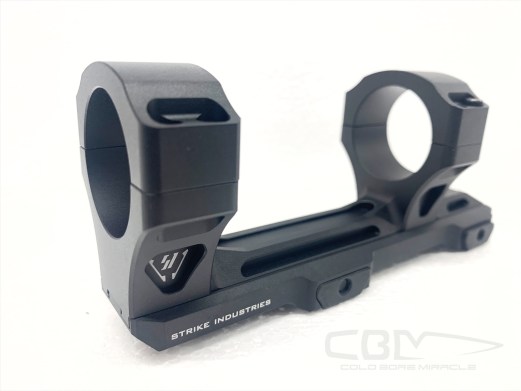
That scope mount is from Strike Industries, a company I am well familiar with. They make all kinds of firearms accessories, the ASM is the first scope mount from Strike that I have used. The ASM is a 30mm set of rings, joined together as one billet piece of aluminum. It does come with ring reducers should you choose to mount a 1” tube scope. The base and rings are held together by a few screws, that also allows one of the paramount features of this mount. The rings can be slid fore and aft to use the mount either as a standard scope mount, or as a cantilever mount. The base of the mount features a recoil lug and two claw clamps to attach to the pic-rail of the rifle.
These features make this mount extremely useful, particularly if your like me and switching back and forth between rifles.
The design and style that comes with most Strike Industries products wasn’t lost on this unit, its clean lines and slender features make it both attractive and unlikely to snag on clothing or other gear.
I like that they used appropriate sized fasteners, some scope rings use insufficient screws that are easily stripped or broken. And I like that there are nearly zero exposed clamps, or screws and such to hangup on. This minimalist design style likely reduces the weight of the mount.
This scope mount is a handsome and useful piece of equipment, no matter which of its four positions you need, I think you will be very pleased with it.
Many years ago, when I first stumbled down this rifled rabbit hole. I would daydream about the high-end and prestigious rifles I saw in magazines and movies. The internet had not yet become the superhighway it was destined to be. But as it developed I could also visit websites and court those beautiful works of art. Not only was it the rifles, but the impressive optical sights that accompanied them. My dreams of owning such a piece of artisanship seemed unattainable at the time, but I never could have foreseen just how far down this hole I would go. Today we are looking at the US Optics Foundation FDN 25X.
Years would pass, more than a decade. Before I found myself the proud owner of what I had always considered a dream scope. US Optics had always been one of the brands I was smitten with. Maybe it was the incredibly robust design that seemed overbuilt for what many would consider standard use. On top of their strength, US Optics scopes had a mechanical attractive flair. It was like looking at top-fuel race engine, you could see all the little things that made it work its magic, and that enticed me even further.
The US Optics Foundation 25X
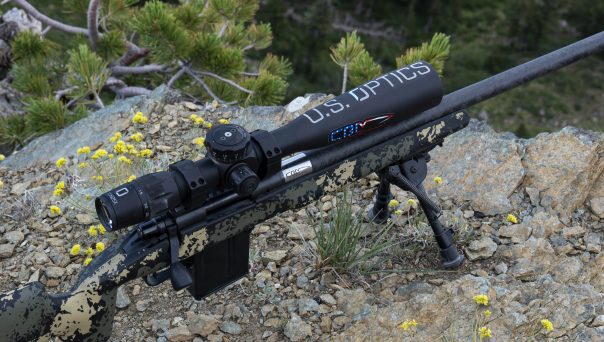
That first US Optics scope was an ER-25, it was the first but far from the last. I’ve since had four more. With the latest being the newest offering from US Optics, the Foundation Series 25X. The Foundation series is USO’s latest line of top tier telescopic sights, made here in the US. The FDN25X boasts some impressive features. Some you would expect, and others you might miss if you didn’t pay close attention.
The 25X uses a fairly standard 34mm tube and 52mm objective, manufactured from 6061 T6 aluminum, it shares a nearly identical body with its predecessor the B25. But there is more, the FDN25X has the new EREK3 elevation turret with 11 MRAD per revolution. As well as a 180-degree throw magnification ring, the new JVCR reticle (my favorite) with illumination available in red, blue, or green, smooth parallax adjustment, and an internal bubble level.
As I opened the box of the 25X and first picked it up, I was surprised at the weight. At thirty-four and a half ounces, it’s not exactly light but it seemed light for its size. Perhaps I was expecting it to weigh more. I surely wasn’t going to waste much time, I wanted to get this scope mounted and get shooting with it.
In no time I mounted it on the rifle it was ordered for, my custom built 257 Blackjack. It is a lightweight carbon fiber hunting rifle to haul all over these Rocky Mountains for Mule Deer, Elk, and likely a few Antelope as well. The 25X makes a great companion optic for the Blackjack. It stays supersonic beyond two thousand yards, and its energy, drop, and wind deflection makes it ideal for long-range shooting. The 25X has been designed and built for just such shooting. With high-quality lenses to give a clear picture of distant targets. The JVCR reticle gives fine wind holds and holdovers, with .1, .2, and .5 subtensions.
JVCR Reticle detail, and green illumination
Rangetime with the FDN25X
So with the 25X mounted in rings on a 20 MOA scope base, I wandered off into the hills to get it zeroed and to put it to the test. Zeroing the scope was simple, the new EREK3 elevation turret was easy to figure out with a brief revision of the manual. I removed the center screw on top of the turret and adjusted my reticle with the provided hex wrench. After a couple adjustments, it was zeroed perfectly and my elevation set to zero.
Normally I slowly work my way out from closer targets to more distant ones, but that day, I went straight for the long shots. The first shots after zero were 1230 yards, I dialed 6.5 MRAD on the EREK3, and fired a few shots. After getting the wind call right, they were hammering the steel. The EREK3 turret is a good combination of stiff, and crisp. Not too hard to turn, but firm enough to avoid accidental movement.
As it happens, my first trip out with the FDN25X was a shoot with Donald Trump Jr. He was impressed by performance of the 257 Blackjack, and the FDN25X
Turret clicks are both audible and tactile, adjustments are easily made from the shooting position by simply counting the clicks either felt or heard. The magnification ring is also a welcome improvement, with only 180 degrees of rotation, you can go from 5x all the way up to 25x with one movement. Instead of having to release and turn again like other scopes. It’ also easier to turn than previous models.
Refinement
After zeroing my scope, I swapped out the scope base for a 30MOA, to get the scope closer to an internal mechanical zero (to avoid the extremities of erector movement). And with it freshly zeroed, the turret had a full twenty-one MRAD of elevation available. It is highly unlikely I will ever use that much elevation, according to my ballistic computer, twenty-one MRAD will take the supersonic Blackjack to 2159 yards.
The EREK3 elevation, and US #1 windage turrets
US Optics’ JVCR reticle is one of my favorite reticles, I’ve got another one in another US Optics scope. The .2 MRAD marks are all over the reticle, giving a quick and easy reference for adjustments. An open center floating dot makes a perfect reference point when trying to shoot tiny groups on paper. And the open space around it will make it easy to hold center on any of the animals I plan on hunting this fall.
I ordered green illumination on the scope. Mainly because I’ve had red on every other scope I’ve ever had and wanted to see something different. I’m not overly worried about it, as illumination has rarely been used in most hunting scenarios I’ve been in. But for that occasional need, it is sure nice to have.
One little thing that I found that did bug me perhaps, is an abnormal crescent shaped shadow when the scope is dialed to either of its extremities. This is normal as US Optics has it listed under their FAQ’s on their website. To be fair, it is only visible at low power (less than 8x), and only when the EREK3 turret is almost all the way up or down. I think it is very unlikely that it will ever be an issue. Because if Im dialed all the way up, I’ll very likely be zoomed in at least to 12x or more. And if it is an issue bottoming out the scope, then you’ll need to use an additionally canted base. Like I said, a small issue, but one you may want to know about.
Beneficial features
The anti-cant bubble inside. When looking thru the scope and focusing on the target, the highlight of the bubble is seen at the bottom of the reticle
Another very cool feature of the Foundation 25X is the internal level or anti-cant device as it’s often called. I always loved the idea of having it inside the scope, but so many times its been done poorly. Not that I have anything against it being external, especially good ones you can see from the shooting position.
But it is so much nicer to see in real-time, through your aiming eye without taking it off the target. The way US Optics executed this level is very nice, I ordered the internal level. But it is so subtle that I didn’t even notice it the first time I looked through it. It is tucked neatly at the bottom of the field of view, and like I said, its so low profile that you actually have to make an effort to see it. I’m not sure if the engineers at USO want you to look at the actual bubble itself. Or if you are meant to see the highlight reflecting on the bubble as your reference point, either way, it is very handy when you’re in the shooting position.
Accuracy Testing
I also tested the scope for actual click value, which can vary greatly in rifle scopes. I tested the click value by measuring the turret movements against the values of the reticle, as well as against a ruler at a set distance. By doing this you can tell if the clicks actually represent the value claimed. I’ve never tested one that came out perfect, but this one is close enough for my purposes. Under 10 MRAD of adjustment, the actual value was no more than .02 MRAD off of claimed value. And at 20 MRAD, it was just over a tenth MRAD from claimed value. I am not a rocket surgeon, but I think it’s safe to assume that the difference between claimed and actual is spread progressively across the curve as elevation increases.
In addition to testing click value, while I had the scope clamped down solid I also checked the tracking and for reticle cant. Cranking the turrets up down and left and right shew no inconsistency. They always returned back to the exact same spot as I counted the clicks. No noticeable movement in the reticle either, as I zoomed from one magnification to another.
The only thing I haven’t been able to test so far with the Foundation 25X, is its durability over time. My First US Optics scope took such a beating I was sure it would break, banging into rocks, falling off the tailgate onto concrete attached to a twenty-pound rifle, stuff like that. But I was blown away when not only did it survive these events, but didn’t even lose zero. That is a pretty hefty standard to live up to, and I hope that the Foundation scopes are up to it. Time will tell, I certainly don’t plan on dropping it, or bashing it against rocks, but who knows what the future holds?
There is no way this rifle and scope aren’t coming with me for hunting season this year. The 257 Blackjack will light up anything I intend to hunt. And coupled with the impressive view from the Foundation 25X, it should be unstoppable. I am extremely anxious to get up into the high country, and get comfortable and effective with this rifle and scope. You will no doubt be hearing from and seeing more pictures of us in the fall. -CBM
Low Power Variable Optics (LVPO’s) have been flooding through the firearm market for years now, likely due to the proliferation of medium-range carbines. It didn’t take long for shooters to realize the value of variable low power optics, but what makes an LVPO shine over another?
I’ve had several different models from a wide range of manufacturers, and today we will discuss in depth theUS Optics TS8X.
The Tactical Sport 8 power LVPO is one of several great scopes I’ve been able to shoot in the offshore line of scopes from USO. So far they have proven to be a great option for shooters in my opinion. I have been shooting USO scopes for many years now, and to be completely honest I was a bit worried when I saw they were releasing a more affordable line of scopes. My concerns were quality and performance, for which USO’s are well known. My concerns were assuaged with the TS20x, which quickly became one of my favorites. The TS8X has so far been just as good an experience.
Why an LVPO?
I also have the TS6X, which is the little brother to the TS8x. I wanted the 8X because having used several 1-4’s and 1-6’s, I wanted just a little bit more power for seeing those downrange targets. Again in my opinion, a 1-8 or 1-10 is about perfect for a medium range rifle, for distances around six to eight hundred yards. The TS8X fit that spot perfectly in my estimation, and with the RBR Reticle, it would give me plenty of holdover points for shooting at those further distances. Features
The TS8X features a 30mm tube, with adjustable diopter eyepiece, covered turrets, and an illuminated front focal plane reticle.
Many manufacturers have moved to the 30 or 34mm scope tube now, it gives a larger tube to pass light through, as well as allow a larger erector to increase the internal mechanical movement of the scope. The parallax is fixed for 100 yards, which leaves the diopter eyepiece focus the only adjustment for the image seen. This is common in most LVPO’s, particularly in this price range. If I had one wish for the TS8 it would be adjustable parallax, I frequently shoot well beyond 500 yards with this scope and others like it. The ability to adjust parallax for those distance targets would be very welcome.
Another feature that thankfully is becoming more commonplace, is the reticle placed in the front focal plane (second focal plane models are also available at a lower cost). This means the reticle is magnified with the power setting of the optic, keeping the reticle values always the same regardless of power setting.
The RBR reticle is illuminated red, with an adjustable rheostat for brightness. It also features both MRAD hash marks (both whole and half) as well as range based holdover points, including wind holds at five and ten MPH.
With the stiff competition in the LVPO market, the TS8X fits in the middle ground of price range. There are many options that are far less in price, and many others that cost double, triple, or more.
My initial concerns about quality were more based on mechanical performance and robust construction. I knew that due to its price point, it would likely not have the same optical quality as scopes costing more, which I was okay with.
Speaking of optical quality, I found the image to be bright, and clean. Not much to complain about there, but don’t expect to see the same image as a $1600-$2400 scope.
I found the RBR reticle to be very useful at distances out to nearly 1000 yards, at 8X it could possibly be a little thick for tiny targets, but I don’t expect many people will be doing benchrest or squirrel hunting at that range. For real world shooting, such as echo targets inside 600 yds, it is perfect. The rifle its currently mounted on will be doing some coyote hunting, and I’m very confident that anything inside 800 yards will be easily identified, targeted, and engaged using the RBR.
As I mentioned above, the reticle features both MRAD marks, as well as estimated drop and wind marks. This is handy, because if you need an honest elevation or wind call, you have the actual MRAD values. Whereas if your shooting at the aforementioned coyote, you can use the drop values according to how far away he is.
I mounted the TS8X on my Desert Tech MDR, which at the time was a sixteen-inch 223. The scope was easily zeroed with no tools, and in no time I was shooting steel all over the range.
I love using the scope at 1X, with the reticle lit up, it is just like using a red dot scope. Up close shooting at steel, animals, or whatever else is easily done with both eyes open. Cover the target with red as you break the trigger will give you sure hits.
I then switched out the barrel for the new Hornady 6mm ARC barrel, to see how the TS8X would match up to its ballistic curve.
Without even rezeroing the scope, I was in business, perhaps more a testament to the rifle than the scope. I later made a few corrective adjustments, and the rifle was punching centers very consistently. The click values of the turrets seemed to be close enough to values marked, but to be honest, I hardly had to move them.
Stretching the rifle out would require using the drop points indicated on the RBR reticle, I figured they would be close since the 6 ARC is not too far off of the 223 trajectory it is based on.
It was close enough to be dangerous that is for sure, at 960 yds I shot over the target. The 6 ARC has less drop than a 223 at that distance, so I held a corrected hold (7MRAD) and a bit of left wind for a perfect center punch hit.
I followed it up with a few more shots to confirm, inside I was giggling like a child watching the trace of my bullets on the way to the target.
I’m not sure if its the TS8X or just better optics that we are spoiled with today. When I first started shooting these farther distances, it seemed like 10X was barely enough, and 15-25 was more like what you needed for shooting long range. But I found shooting almost everything inside a kilometer to be relatively easy with the 8X of this little USO.
I recently took a LE Carbine LVPO course and was extremely happy with the way this little scope ran on the range. We engaged targets all over from 50 to 600 yards in every position you can imagine, I was able to use the wind holds to get some great hits on windswept targets boiling in mirage.
I guess the technology is catching up, soon one thousand yards will no longer be a long range benchmark. It will be more like medium range for drills at a beginners carbine class. If you find yourself on that spectrum, the US Optics TS8X will fill the need for a medium range optic. And it will do it without needing a signature loan to checkout, and you’ll still have the quality and guarantee US Optics has always put on their scopes. -CBM
Good friends can often be the catalyst we need to try something new. Whether it be a new activity, or way of thinking, some of our best practices are simply learned from the good people we surround ourselves with. Today we are looking at how the Canik TP9 Elite Combat and how I ended up with one due to good friends.
Im a rifle junkie, always have been. However due to the good influence of friends, I have been exposed to all kinds of additional shooting enterprises. One of them being IDPA style pistol shooting, which if you haven’t tried, you should.
Having tried it a few times, mostly as an informal competition between friends, I was immediately hooked. Steel targets, and fast reloads just seem like the best kind of practice for having a good time. But I needed a good pistol for it, being a rifle junkie, my pistol inventory was very superficial and necessity based (CCW). So I began the search for something that fit the bill.
What do we have here?
It was SHOT Show 2018 that I first noticed Canik USA firearms, they are imported by Century Arms from Turkey. My initial impression was they looked great, and I wanted to run a few mags thru one, but much time would pass before I would. A friend let me handle one, and I immediately fell in love again. It was the TP9 Elite Combat model, which draws on several aftermarket parts from Salient Arms International (SAI). The TP9 EC uses a fluted threaded barrel, trigger, +3 floor-plate, and flared mag-well from SAI. The styling and custom look only enhance the graceful lines of the TP9. The Canik is a striker fired 9mm, with double stack magazines. I purchased the pistol as a kit from Century, which included a host of additional goodies. Two magazines, one of which had the SAI +3 floor-plate boosting its capacity to 17+1. Two different grip back-straps to choose from to better fit your hand. A polymer holster to fit the pistol to your gun-belt. It also comes with the slide pre-cut for sighting devices, the kit included aVortex Optics Viper red dot, and with several other baseplates, I believe you can mount others as well. The threaded SAI barrel is suppressor ready, mine came with 13X1 left-hand threads, but apparently the newer ones are 1/2-28 right-hand threads.
The EC also has a chamber indicator on the top of the slide, when a round is chambered, the red indicator is clearly visible. The chamber indicator is also tactile, you can feel it either in the dark, or while looking towards your next engagement. Also on top of the slide is the fiber optic sight (rear sights removed to install the Viper red dot). The fiber optics are interchangeable with others included in the kit.
Several other things are included in the hard-case, trigger lock, tools for assembly and cleaning, as well as different mag release height options you can customize.
I wasted no time, and literally within minutes of delivery, I was pumping magazines through the TP9.
The Vortex Viper was easy to mount, and zero. I was amazed at how accurate the gun was, I wasn’t shooting particularly far, but once zeroed, I could put a whole magazine thru a less than two inch hole at 10 yards. And if I can hold steady enough, whatever you put the red dot on within 30-40 yds, gets hit.
The trigger overall is pretty good, though I was a little bit let down, as mine wasn’t as good as the ones I had felt prior to purchase. The take-up has a bit of stickiness to it that I didn’t feel on other guns. The break and reset however is clean and very crisp. I have taken it apart several times to see if I can clean up the trigger pull, We’ll see if any of that helps.
The EC also comes with an oversized mag release, which I found to be very good for dropping the magazine. And despite its prominence, never caused an undesired mag drop.
Underneath the muzzle there is a pretty standard accessory rail, perfect for mounting lights, lasers, etc.
The magazines themselves are manufactured by Mec-gar, a well known manufacturer of great aftermarket magazines. There are several different models available including an 18 round and a 32 round stick mag.
The holster is about what you would expect from a manufacturer, nice enough to use, but leaving you wanting more. It’s serviceable, but I dont care for the release. Instead of pressure to the side releasing the pistol, you curl your trigger finger in the same action as you would to pull the trigger. This seems a little unsafe, in that once clear of the holster, if your finger continues the curling motion, it could find the trigger before your on target. This is probably just a training issue, but I didn’t care for it none the less.
Shooting the TP9
I mentioned the accuracy of the TP9,I’ll add that the functionality has also been almost perfect. I say almost perfect because I have had a couple malfunctions, nothing a tap, rack, bang wouldn’t fix. And more than likely due to the low budget ammunition I was shooting at the time.
Even so, with the cheap ammo I find it very easy to hit what I’m aiming at.
The flared mag-well made mag changes easy to feel into place, though I wish the flared part had at least two points of contact. As it sits, the mag-well flare is attached by a single screw at the rear, not a huge deal, but it has caused me to re-engineer it in my head.
I bought the gun with the plan of using the red dot on it, though I wasn’t sure I was going to like it. I figured if I didn’t, I could just run the iron sights on it and sell the Vortex. But as it turns out, I really enjoy shooting with the red dot. So much in fact that I’m considering doing the same to another pistol I love and shoot quite a bit, my Taurus TX22.
I have since run a couple other red dot optical sights on the pistol, and I settled on the US Optics DRS 2.0 Enhanced, I found it to be a superior option to the other two. One thing that I absolutely love, is the way this Canik feels in my hand. It’s a perfect fit with the larger grip back-strap, and it points so nicely and naturally. The way it draws from the holster and lines up perfectly for the shot gives me some undeserved confidence.
Suppressed
With a threaded barrel it was only a matter of time until I ran the Canik with one of my suppressors, and I was very happy with the results. I used two suppressors from Yankee Hill Machine, the first one and my favorite of the two is the Nitro N20 shown above. It is a modular can that has a short or long configuration and is built with extremely light materials. In the short configuration it is so light I barely noticed it when shooting the pistol, and the sound suppression was amazing. There was a slight uptick in the felt recoil, but I was expecting it. Not so much as to feel pressure against your hand, you could just feel the pistol cycling harder.
Conclusion
It may sound like I’m ragging a bit on the TP9 Elite Combat, but to be honest I really do like it. I’ve never been much of a gun snob, so when it comes to minor issues I tend to look right thru them. I love shooting the Canik TP9, and intend on becoming much better with it, might even take a few classes or training courses to save myself the embarrassment in public.
I think despite the little issues I’ve brought up, the gun is a great option. I may get another holster for it, and I will definitely be getting a bunch more magazines, and ammo. -CBM
Like many of you, I grew up swooning over guns I saw in the movies. And one of the iconic weapons from all those great eighties movies, was the Heckler & Koch MP5of one variant or another. The short and rapid stroke of these old roller guns, together with their sexy physique made them the envy of anybody with an eye for firearms. Who would have thought that years later, when the time came to shoot one, I’d feel a little let down.
But this story is about a CZ Scorpion you might be thinking? Indeed it is. Your average gun owner cant afford the real MP5’s, and have to settle for clones, or something else entirely. I find myself in the latter group, and this is my “something else” story.
The Scorpion EVO
A co-worker showed up to the office one day, and like we do at my work, when you bring a gun to work, you damn sure go around and show it to everybody else. The gun he brought was the aforementioned CZ Scorpion Evo S1, configured as a pistol, with the short barrel and everything. In short order he had changed out the feature-less rear end, and installed an arm brace. For those that are unaware, the arm-brace is essentially a legal loop-hole around the SBR Tax. For those unfamiliar with the SBR Tax, its part of the National Firearms Act (NFA) that requires certain firearm configurations to be registered and taxed by the Bureau of Alcohol Tobacco and Firearms/Explosives (BATFE). And those of us who are familiar with the ATF have been robbed, infringed upon, and inconvenienced enough for all the rest of the gun community that aren’t familiar with them. Gratuitous, stupid, and superfluous are words that come to mind when reading through ATF regulations. The SBR/arm brace debacle is a perfect example of that.
The CZ Scorpion is a 9mm blowback operated pistol. But when a stock, and other accessories like suppressors and larger magazines are added, the Scorpion comes very close to feeling like a valid replacement for the MP5 I always dreamed about as a kid.
I immediately swore an oath to myself that the Scorpion would one day be mine. With disposable income well beyond my reach, I set to finding deals, and discounts. And it wasn’t too long before I found just what I was looking for, and for a decent price. They even had the SB Tactical arm-brace in stock that I wanted, the collapsable PDW Style. I was off to a great start, but there was much more I wanted to do. The pistol grip of the Scorpion is widely believed to be too steep and angle, and is a bit uncomfortable. So I replaced it with one from Magpul, the pistol grip is mounted on a dovetail, which gives the user the opportunity to adjust it closer or further from the trigger. A nice feature for sure.
Another frequent complaint for the Scorpion is the right side safety selector digs into the trigger finger when firing.
The good folks at Gear Head Works made a fantastic reverse safety option, that shifts the selector above the finger instead of into it.
I wasn’t quite done with Magpul yet, I also bought a few 35 round P-mags for the Scorpion, as well as their magazine release which extends a bit further, and adds a paddle release to the end.
I was getting very close, all that was left I thought was a Midwest Industries 11.5” handguard, it should cover most of my SilencerCo Octane suppressor. It was close, so after running it like that for a couple months, I took an axe to my little Scorpion (actually a lathe) and cut the barrel back another 1.75 inches and re-threaded the muzzle 1/2-28. This allowed the suppressor to poke out just enough to get my fingers on it and tighten it.
One of the great benefits in my eyes to the Cz Scorpion, and pistol caliber carbines in general, is getting my kids on the firing line. The small size of the Scorpion, and its collapsible arm brace/stock make a perfect companion for even my 11 year old to shoot with comfort and confidence.
With all my alterations and additions finally in place, the Scorpion felt like what I wanted it to be. Which leads me back the beginning of our story. I told you I felt a little let down by the MP5, and I’ll tell you why. After shooting my Scorpion for several months now, getting used to the function and features, I was again given the chance to shoot an MP5SD, Which of course I jumped at. But to be perfectly honest, there were a few things I wished the MP5 had. For example a bolt lock-back on empty, and a pic rail.
Final Thoughts
I guess I should clarify, I LOVE the MP5, its beauty and performance are nearly untouchable. The beauty runs deep with its impressive and reliable mechanics inside as well.
But for all that, I think if my Scorpion was setup as a full auto like the HK was, I might like it just a bit more. This of course after the alterations, and making the gun fit me just the way I wanted it. I know there is a lot of you out there cringing, and shouting heresy over the crowd, but it’s true. Rest assured however, if ever I get the chance to own the OG HK, I will jump at the chance.
I love everything about this handy little “pistol”. It is compact, but packs quite a load of ammo, and despite being a pistol, it is still quite useful at distances out to nearly 100 yards. TheTrijicon MROis a perfect option to keep sight picture simple and quick to bring on target. While not a true long gun, the CZ Scorpion is an excellent weapon to have handy in my vehicle, bedside, or anywhere your CCW might not be quite enough. The controllability, and high capacity, make it a a good defense weapon. While the compactness and profile make it easy to take almost everywhere.
It may be sometime until I can run around wielding dual sub machine guns, but until then, the CZ Scorpion will be following me everywhere. -CBM
I swore off shooting unsuppressed long ago, and I only do it occasionally by choice. The suppressor bug bit me hard many years ago, and I have never vanquished its effects. With that in mind, I am always thinking about better ways to hush the noise of my favorite pastime. Who would have thought that an idea I had depreciated would turn my jaded eye.
One of my most favorite rifles of all time, is my old Desert Tech SRS A1. I have run countless barrels through it, I currently have somewhere between ten and fifteen barrels of assorted different calibers. Factory, custom, and even a few specialty barrels. Even with all those options, I still love my old 16” 308 Winchester Covert barrel. The calm and consistent performance of the 308 is like an old friend, so when I got the opportunity to try yet another great 308 Winchester option for my favorite rifle, I jumped at it.
Suppressed Weapon Systems
Suppressed Weapon Systems has been in the suppression business for some time. They specialize in the integration of suppression technology directly into the firearm, instead of making the suppressor just a muzzle device. Their MISB (Monolithic Integrally Suppressed Barrel) is available for many different firearms, including my dearest SRS. The modularity of the SRS family of rifles makes it ideal to pair with technology like the MISB, and with a durable cartridge like the 308, it would last for some time.
I’ve often tinkered with the idea of an integrally suppressed barrel for my SRS, but I was always worried about spending the money on an NFA item that would get burnt out and need to be replaced. A valid concern I had always thought, but the MISB is constructed in such a way that the tube can easily be removed and installed on a new barrel/baffle stack. So with my main concern assuaged, I dove in with both feet. The Suppressed Weapon Systems MISB for the SRS is manufactured from a Bartlein Barrel blank, well known for great quality and precise shooting. The muzzle is cut at a determined length, in my barrel’s case, around sixteen inches. But the remainder of the barrel blank is then cut into the suppressor baffles. The length of the barrel to the breach of the muzzle is fluted, and drilled, I assume to decrease weight but also to add an expansion chamber for venting high pressure gas. The outer tube of the Suppressed Weapon Systems MISB is a good fit, but not entirely tight, this was a bit of a concern for me at first but I later learned it was necessary to free-float the barrel. Having the outer tube captured and tightened with the barrel would add stress and torque to the overall structure. The tube is sealed at both ends with what appears to be Viton high temp fluoroelastomer O-rings. The muzzle end of the MISB has a threaded cap also sealed with the O-ring, it is knurled and has cuts for torquing it into place with a tool. Its an impressive example of machining design and ingenuity.
Shooting with the SWS barrel
I couldn’t wait to get the barrel mounted in my rifle chassis, and test its performance. As soon as I got home with it, I hurried to my basement man-cave and installed it into my SRS. I found the fit to be a bit snug, perhaps more-so than any other barrel I’ve tried. Its easy to get a burr on the shank of SRS barrels, one must be careful. But that was not the case with the MISB, it was simply just a bit tight. Perhaps a slightly smaller diameter would help, but I found it to be consistent, so it was a minor inconvenience. It was the same when I mounted it in my SRS A2.
Once mounted, I headed for the hills to get the rifle zeroed with this new barrel. As usual, it was an easy process. Most SRS chassis will change POI with a different barrel, but it is rarely off by more than a few inches. So a quick re-zero on my scope was easy, and in no time I was using the rifle to shoot steel at 710 yards.
SWS guarantees sub MOA accuracy for three shots with their MISB system, but suggests that 1/2 to 3/4 MOA is expected more often than not. I found my barrel to be consistent with that.
The suppression quality of the barrel was on par with what I expected. The first round pop was significant, but quickly forgotten with successive shots. The slender barrel looks very handsome in my A1 with the longer handguard. A few inches longer than a standard twenty-two inch barrel which pokes just out of the handguard. When mounted in my SRS Covert A2, it was a few inches longer than the standard Covert sixteen-inch barrel when fitted with the DTSS Suppressor.
Conclusion
I think the Suppressed Weapon Systems MISB barrel offers a great option for those looking for a slender and inconspicuous barrel to keep things quiet. At $2200 for a barrel, it is no small investment. But it’s also not much different than a good barrel fitted with a suppressor would cost you, and SRS owners are gluttons for dropping coin on good barrels. And the fact that you can reuse the tube on a new barrel blank having no interaction with the Federal agency everyone loves to hate makes it even more appealing. I look forward to using it even more in the future. -CBM






 The Canik is a striker fired 9mm, with double stack magazines. I purchased the pistol as a kit from Century, which included a host of additional goodies. Two magazines, one of which had the SAI +3 floor-plate boosting its capacity to 17+1. Two different grip back-straps to choose from to better fit your hand. A polymer holster to fit the pistol to your gun-belt. It also comes with the slide pre-cut for sighting devices, the kit included a


 They even had the


