Tag Archives: 25 creedmoor

6.5 creedmoor, federal, sierra, hornady, desert tech munitions, ammo, bergara,

Creedmoor Family Tree

Cartridge Families

Cartridge families have been a thing since shortly after the first cartridges were made. A family refers to a group of cartridges based on the same parent cartridge, and it’s how some of our best cartridges came into being. A well-known family would be the 30-06 Springfield clan, with the .270 Winchester and the 25-06 Remington being some of its popular kin. Today we are taking a look at the Creedmoor Family Tree, on their ascent to being one of the great dynasties in the cartridge world.

Creedmoor cartridges enjoy flawless function from various magazine systems

6.5 Creedmoor History

Back in the early 2000’s, the Creedmoor was developed by a group of folks looking to design a perfect cartridge. Their goal was a flat-shooting, low-recoil cartridge with high ballistic coefficient (BC) bullets that would feed well from a magazine. They based the cartridge from the 30 Thompson Center, another cartridge looking for fame. The case was shouldered at thirty-degrees and necked down to .264 and the Creedmoor was born.

Since then, the cartridge has been adopted widely by nearly every corner of the shooting market. Much to the chagrin of Creedmoor haters, whose sophomoric insults are blind to the obvious performance of the cartridge.

6.5 creedmoor, prs, prs rifles, competition rifles, savage, mdt, christensen arms, mpr, mpa,
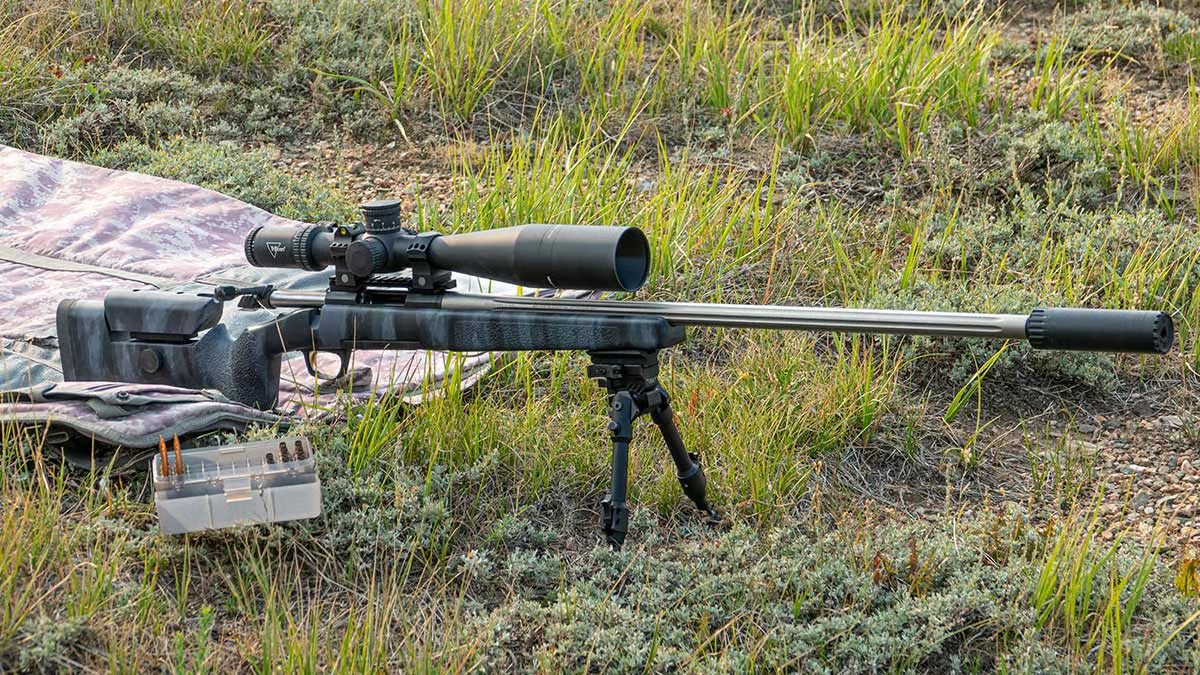
PRS rifles like these are very often chambered in 6.5CM, though these days they are switching to 6mm cartridges.

The 6.5 Creedmoor has also spawned a whole family of descendants that have become well-known titans in their own bore-size. There is no free lunch however, so the advantages of each come with their liabilities as well. Today we’ll look at some of them and evaluate their attributes and how they might best fit into your next rifle purchase.

22 Creedmoor

Barrel Life Estimate: 800-1100 rounds

Bullet Weights: 50-80 grains

Max Effective Supersonic Range Estimate: Approximately 1500yds

Component Suppliers: Hornady, Alpha Munitions, Petersen, Nosler

Let’s start at the bottom of the pile, with the 22 Creedmoor. Necking is the process of narrowing the case mouth of a cartridge to hold a different caliber bullet. The 22 Creedmoor is the result of necking the 6.5 down to .224 caliber, I understand there is some thinning of the neck during this process as well to make it work.

22 Creedmoor, alpha munitions, hornady,
22 Creedmoor components like Alpha Munitions cases and Hornady Dies provide great performance

The result is a hot-rod overbore 22 centerfire cartridge, similar to the extremely popular 22-250. The 22 Creedmoor has done very well in the hunting and target shooting arenas. Mainly because it has large displacement and the horsepower to push even the large .224 caliber bullets fast. Typically made with a 1:8 twist, the 22CM can push big 75 and 80 grain bullets well over 3200 FPS. This leaves cartridges like the 22-250 and 220 Swift in the dust. And makes the 22CM an obvious choice for varmint hunting and long-range target shooting.

22 Creedmoor, patriot valley arms, barrel,
Using even faster twists like this 1:7 allow use of the heaviest 22 caliber bullets

Feeding the 22CM is easily done from popular magazine systems, and it cycles well from all the popular actions. Handloading is fairly easily done with support from companies like Hornady and Redding. You can buy ammunition and components from Hornady, Alpha Munitions and others. The scorching performance of the 22CM come at a cost, as it has an appetite for barrel throats. Making this cartridge a choice for the bold shooters out there.

6mm Creedmoor

Barrel Life Estimate: 1500-2200 rounds

Bullet Weights: 58-115 grains

Max Effective Supersonic Range Estimate: Approximately 1700yds

Component Suppliers: Hornady, Alpha Munitions, Petersen, Lapua, Nosler, Starline

The next step up in the necking process is the 6 Creedmoor. Very comparable to the venerable .243 Winchester, the 6CM offers high speed 6mm/.243 bullets for either sport or hunting. The 6CM uses a faster twist than the older .243 design, typically 1:7 to 1:8 twist. This gives the 6CM the ability to shoot more modern bullets, many of which were basically designed for this cartridge. The longer high BC bullets of today won’t fly from the 1:10 or 1:9 twist rates of decades passed. This gives the 6CM a leg up over cartridges like the .243 and 6mm Remington.

this Browning X-Bolt chambered in 6mm Creedmoor was a blast, you can read about it here

The 6CM offers the same performance as those older cartridges when shooting comparable bullets. And its optimal for use in the same types of hunting situations, arguably better due to efficiency. Getting similar velocities from the Creedmoor with less powder and bore erosion than the other cartridges mentioned. It would be an excellent choice for a light big game hunting cartridge, or as a competition cartridge as it has been used extensively over the years.

6 Creedmoor fits into rifles and other common accessories like this Cole-TAC ammo novel

Whether you wish to shoot 58-grain bullets at coyotes or 115 grain match bullets in a PRS match the 6mm Creedmoor has a diverse hand of talents. It has been pushed aside somewhat by smaller 6mm cartridges in the competition circuit, due to its lower barrel life and recoil. But still has quite a following of dedicated loaders and shooters, thanks to the support from the companies I mentioned above.

25 Creedmoor

Barrel Life Estimate: 2000-3000 rounds

Bullet Weights: 86-135 grains

Max Effective Supersonic Range Estimate: Approximately 1900yds

Component Suppliers: Hornady, Alpha Munitions, Petersen

Coming out of nowhere, the 25 Creedmoor is one of my favorites, likely because I was part of it’s renaissance. The 25CM came about because of new bullet designs that made the 25 caliber a better option than the original 6.5CM. Bullets with higher BC and lower weight meant that the 25CM could shoot faster than the 6.5, and enjoy flatter-still trajectories and more energy on target.

All of the Creedmoor family have excellent components available

This made the 25CM an outstanding choice for many shooters. Hunters and competition shooters alike have adopted the 25CM, and once again the aftermarket has stepped in to support it as well. Hornady only recently legitimized the 25CM, but Alpha Munitions and Petersen Cartridge Company have been making brass for it for some time. This is one Creedmoor that has actually gotten more love from companies besides Hornady, at least till now. With excellent components available from Sierra and Berger.

the 25 Creedmoor has been a fantastic hunting cartridge, you can read about this hunt here

Using the 25CM in competition like the NRL Hunter matches has become very popular due to its power and low recoil. It might be one of my favorite hunting cartridges as well, the incredible consistency has allowed me to make many one-shot kills on deer and elk. Some of which were so far out that it’s better to leave unsaid.

6.5 Creedmoor

Barrel Life Estimate: 3000-4000 rounds

Bullet Weights: 90-150 grains

Max Effective Supersonic Range Estimate: Approximately 1800yds

Component Suppliers: Hornady, Alpha Munitions, Petersen, Lapua, Nosler, Everyone at this point

The OG Creedmoor, a cartridge that stormed the precision rifle shooting circuit when it came out. At the time (2006-ish maybe) there were three 6.5 cartridges fighting for dominance. Besides the Creedmoor, the 6.5×47 Lapua and .260 Remington were all extremely popular. But likely due to support from Big Red and others, the 6.5 Creedmoor quickly became the dominant 6.5.

Still an excellent choice for many competitors, the 6.5CM might be the only cartridge today that has a shot at taking the place of the 308 Winchester in popularity. The 6.5CM does everything the 308 does, and it often does it better. The narrow 6.5 bullets have a higher ballistic performance and speed than the old Winchester, making it an excellent successor. The 6.5CM is the easy-button of sharpshooting, and because of that it enjoys support from nearly every corner of the shooting world. Whether you are looking for semi-auto rifles or bolt-action there is a great option in 6.5CM. And ammunition options are as deep and diverse as any other cartridge.

Continue Reading here

Top Five Cartridges For Long-Range Shooting

Top five you say? What kind of maniac could narrow it down to just five of the best cartridges? I mean the world is littered with spent casings from countless different cartridges that offered something that another didn’t. So to avoid being labeled as that guy, I am instead going to go over the process by which anyone can select their top performers as it applies to their shooting. And how I did it for myself. Today we will discuss my top five cartridges for long-range shooting.

The first step in this process would be to know and set your limits. Unless you’re Elon Musk you probably can’t afford or build a rail gun for your weekend shooting exchanges, so obviously there is a budget to keep. And if you live in flat country where the furthest you can see on a clear day is five-hundred yards. You will have very different needs than someone who lives in mountains ranges where one-thousand yards is just to the next turn in the trail. Another important consideration is the target. Hitting paper or steel is much different than meat and bone. So it’s very important to define your needs properly, both ballistically and financially.

Extremist Need Apply

If your goal is extreme distance competitions like King of 2 Miles, then you are going to want something big. My experience here is minimal. However there are many marksman shooting these distances with a cartridge I am quite fond of and my choice for extreme distance. The 375 Chey-tac, or something similar to it. The cartridge is perhaps the most common in big-bore ELR shooting, as the ammunition and components are plentiful. Not only that, it is an outstanding performer.
With high performance bullets like the Cutting Edge MTAC or the Warner Tool Flat-line, you can shoot distances that most people have never considered possible. Of course all this comes with significant cost. And perhaps an above average level of dedication, but how else could you call yourself an extreme shooter?

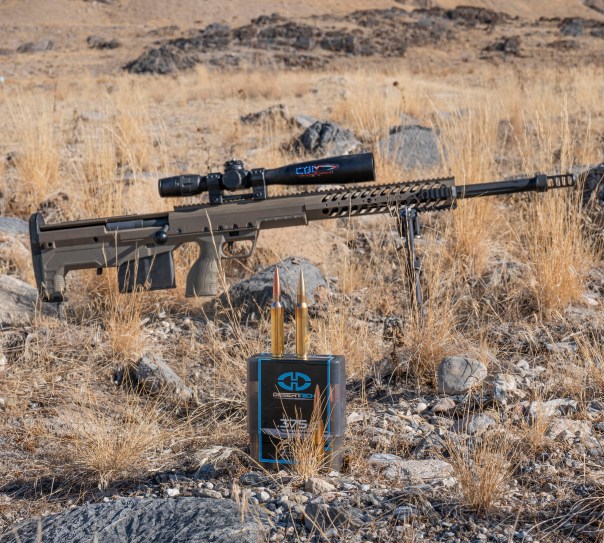
The Desert Tech HTI in 375 Cheytac is an excellent ELR rifle, matched here with a US Optics 25X scope

Okay, Maybe not that extreme

If your goals are perhaps a little more mainstream, and you don’t feel like spending $10-$20 every time you pull the trigger. Let’s talk about a better fit for you. Shooting a mile or less is much more common than it was even ten years ago. One of the reasons it has become so commonplace is the proliferation of the venerable 338 Lapua to so many affordable rifle platforms. But that’s not the cartridge I was about to recommend, I was about to say the 300 Norma Magnum. Why the 300 over the 338 you might ask? I’ll explain.

Click here to see the 300 Norma in elk hunting action

300 Norma ballistics when using high ballistic coefficient like those available today, will rival those of the 338 Lapua. There are pros and cons either way between the two, as far as barrel life, recoil, and even suppressors if that’s your thing. High quality bullets loaded in the 300 Norma make it a devastating long-range performer. Whether you are shooting targets, big-game hunting, or anything else. I prefer the more slender and faster fired bullets in the thirty-caliber as compared to the heavier and a bit slower thirty-three caliber bullets of the 338LM.

The 300 Norma will easily shoot to a mile and beyond, handily take down any North American animal. Additionally it has a huge selection of bullets and ammunition selections of the highest quality.

A Poor-Man’s 338 Lapua

Many years ago, before I had experienced both the 338 LM and 300 NM, I found myself in quite a quagmire. I wanted a new barrel for my Desert Tech SRS that would allow me to shoot comparable ranges to those cartridges (1700-2000 yards) , but I was but a common man.

I had nowhere near the money to feed a Lapua or a Norma, which is no small cost. Buying a barrel is one thing. But coming up with all the ammunition components needed to become proficient and shoot as frequently as I do is another entirely.  So I began a study to find a suitable replacement, a champaign cartridge on a beer cartridge budget so to speak. 

What precipitated from my numbers evaluation, was this; a very high BC bullet in the 7mm (.284) caliber is comparable to the BC of the bullets commonly loaded in the 338LM. So if I could get them up to comparable or better speeds, I would find myself shooting Lapua distances on  Remington resources. 

The 7mm SAUM

After some careful market evaluation, I was quoted a build for a 24″ 1-8 twist barrel chambered in the mighty 7mm Short Action Ultra Magnum (7SAUM). And before I knew it, my poor-man’s Lapua was in my hands.  I had done all my prep work before-hand, and I had loading components ready to go.

I ended up shooting the Sierra Bullets 183 Match King, which has a very high BC. My new barrel would launch them at a magnificent 3050 feet per second (FPS).  After spending a few seasons hunting with the 7SAUM, I was completely convinced I had made a good choice for the times. My SAUM shooting the 183’s actually shot flatter than the mighty 338 out to around a mile. The energy on impact wasn’t as high obviously but I wasn’t planning on hitting anything besides steel at those ranges. Even so, the SAUM retained more than enough energy to take down an animal as far away as 1000 yards, so I was certainly in good company.

The popularity of the 7 SAUM has waned some with the passage of time, another more popular choice with many of the same qualities is the 7 PRC

Two elk taken down by a single shot from the 7SAUM, at 900 and 500 yards respectively

Lets Get Common

Nothing I’ve mentioned above is particularly common, or very cost effective for your average shooter. Sharp marksmen have been shooting significant distances for a very long time with everyday cartridges like the .308 and 30 06. And with proper bullet selection and load development, you could certainly continue on that fine tradition. Or you could embrace something more contemporary.

Go ahead and light your torches, sharpen the pitchforks, and prepare your best effeminate insults because we’re about to use the “C” word. Just prior to the current ammo crisis, the 6.5 Creedmoor has infiltrated nearly every little ammo shelf across the country. And for good reason.

The 6.5 Creedmoor

The 6.5 CM offers 300WM ballistics with recoil and cost subordinate to even the 308 Winchester. There is an extremely high-quality components and ammunition selection for the 6.5, and its easy to load and shoot. There is so much to like about the cartridge, it begs the question why it is the subject of every sophomoric and unsophisticated insult the internet has to offer.

excellent Creedmoor performance can be had from a simple setup like this Ruger American Gen2 and Maven Scope

Personally I believe it to be its own worst enemy, unfledged shooters are easily tired of hearing how great the Creedmoor is. Especially since what they choose to shoot is obviously better because they chose it, at least that’s how they feel.
Do not discount the Creedmoor, it is what it was built to be; a great shooting cartridge for those first thousand yards. A great deer hunting cartridge, and anything similar to those two disciplines. It can be found nearly anywhere ammunition is sold, making it a strong contender on this list.

These 129 grain Cayuga bullets perform exceptionally in the Creedmoor, read more about them here

Out of Left Field

My tastes have changed, and my budgets matured, so I’d be remiss to omit my latest favorite. I wasn’t sure whether to put it in my list or not, due to the obscurity, but this is my list so I’ll do it my way.

Wildcats are a little different, like fingerless gloves at the range, or guys who wear fedoras. Wildcats if you didn’t know, are illegitimate children of the cartridge world, derived from other cartridges. They are either “necked up” or “necked down” and usually “blown out” to create a whole new cartridge. Many of our best cartridges were born this way, and to that list I add this one of my personal favorites.

The 257 Blackjack

The 257 Blackjack is a cartridge formed by shortening the SAUM case. Changing the shoulder geometry, and necking it down to twenty-five caliber. Simple enough, but the crown jewel of the cartridge is another very high BC bullet built by Blackjack Bullets (designer of the cartridge). The 131 grain bullet has a .340 BC, which is nearly untouchable by anything comparable in size and price. Nearly none of the 6.5 and 6mm bullets that would give the Blackjack a run for the money can. Especially when shot from the 257 Blackjack cartridge.

Blackjack has since closed, but the 131gr bullet is still made by Sierra.

From my 24” barrel the muzzle velocity is 3270 FPS, and with that impressive .340 BC you can imagine the extremely flat trajectory. There are also other high BC bullets available from Berger andHornady that have a predictably outstanding performance

This little short action cartridge will reach a thousand yards with less than 5 MRAD of elevation. And when it gets there it will still be packing well over a thousand pounds of energy and more than 2200 fps. It doesn’t go subsonic till well beyond two-thousand yards. Making it very competitive in the same ranges as the 338LM and 300 NM mentioned above.

My wife took this pronghorn doe with the 257 Blackjack, seen here with the US Optics FDN25X

Would I recommend the 257 Blackjack for long-range shooting? Not at the moment. The tediousness and dedication it takes to run a wildcat cartridge like this is probably more than most would care for. But should factory made brass become available, this would be a shoo-in for anyone interested. It is truly an amazing little cartridge.

Conclusion

So there you have it, my list of my top five long range shooting cartridges. You may take them or leave them, and you wont get any argument from me. Every shooter can decide what works best for his/her needs, and create their own top five.
The good news is that there are so many great choices. Despite my little list of cartridges, I could probably make due for the rest of my life with just a plain jane 308.

-CBM

Let us know in the comment section what your top five cartridges are

Mule Deer Hunting: Triumph Favors the Prepared

Introduction

I consider myself quite lucky when it comes to mule deer hunting, not only am I blessed to hunt frequently, but I’ve managed to become mildly proficient at it. This past season was a tough one when compared to the preceding decade, but perseverance and healthy bit of luck kept a special surprise for me waiting at the end.
I say it was a tough season, but to be more accurate, it was a season void of mule deer bucks. This came as surprise to most of us as it had been a wet year, with plenty of feed. And there seemed to be as many deer around as there always had been.

I spent several weeks scouting my traditional spots, trying to get a pattern established with them. But I was astonished with how few deer I saw, and nearly none of them were bucks, much less a good buck. So as October arrived, and friends, family and I began hunting, the outlook wasn’t too good.

The Hunt Begins

Days passed before we even aimed a rifle at a buck, and even then it was nothing big enough to write home about. Everybody I spoke to both on and off the mountains described a very quiet and inactive hunt. Dad and I were lucky enough to get on to a small buck that found his way into the bed of the truck, but even after five days hunting, I could count every buck we’d seen on one hand. And not one of them was more than a fork.

mule deer hunting
Dad and I with our rifles suppressed by SilencerCo

On the last day of the mule deer hunting season, we had another patch of good luck. A very cold wind had brought in a snow flurried storm, dusting the entire mountain with a white coating. I know from experience that when the weather turns off bad, the Mule deer hunting gets better. The tops of the mountains were enveloped in clouds, making it almost impossible to see more than a hundred yards or so. I determined that the foothills would be a better place to try, at least there we could see for half a mile or so, depending on the snowfall.

As the early-morning darkness slowly turned to light, I found myself glassing everywhere I could make out through the falling snow. And before it was even quite shooting light, I spotted three deer feeding their way up through a grassy open area on the edge of a deep river ravine. Their dark bodies contrasted greatly with the all-white surrounding, I could tell immediately that one of them was a good buck.

tikka t3 rifle 25 creedmoor
my rifle sits in a KRG Bravo chassis, fed by MDT magazines

The deer were eight hundred and fifty yards or so away, they were feeding quietly, so I decided to close the distance to somewhere that at least had a better place to shoot from than my current position. Anybody who has hunted Mule Deer knows how tricky they can be, and this guy was no exception. He must have either sensed our closing presence or perhaps caught sight of us as we snuck through the brush. When we reached the spot I had hoped to ambush him, they had gone into the deep river draw with its thickly wooded sides. I knew that the buck was likely to have either gone down the river towards the safety of civilization, a place I surely could not shoot at him. Or he went up the river, towards the safety of the brush-covered canyons that expand for hundreds of miles. I took a gamble, expecting that if he’s gone down, he’s likely already gone and we missed our chance. So we went up, towards the top of the ravine, slowly and quietly glassing the whole way. The snow continued to fall, and the wind picked up carrying wisps of snow from the trees where it had accumulated. I prepped for the shot I hoped was coming, though I had no idea where it would be.
The flying snow made my rangefinder almost useless, still I estimated the distances to various locations where the buck might come out. I laid flat on the snowy ground, hoping to avoid further detection by either the deer, or a large group of wild turkeys that foraged about sixty-yards uphill from us. I brushed the snow off the lens of my scope, knowing that any second I would need to see through it clearly.

Time to Shoot

As I laid glassing above the opposite side of the draw my eyes caught through the fog the unmistakable image of a white deer butt, with a broad face beside it looking back directly at me. I knew it was him, and I immediately dropped my binoculars, and shouldered my rifle, I could see him through the falling snow. He was only a step or two away from disappearing into the brush permanently, he made his last mistake by looking back to see if I was there.
I knew that there was only seconds to shoot or lose him forever, I had estimated that treeline to be about 400 yds, and with no time to dial, I held four MOA just inside his right shoulder, hoping to cross his vitals diagonally. I pressed the trigger, and the shot broke.
Everything felt right, despite my rushed shot. Steady hold on him, good clean trigger pull, and I held a good hand, full of Blackjacks. My 25 Creedmoor is quite possibly the most predictable and flat shooting rifle I own, and I had a warm feeling that the buck had succumbed like many others, to the 131 Grain Ace.
After a grueling hike across that miserable little creek canyon, I closed in on the spot where I’d last seen him. The snow continued to fall as I quietly poked into the trees, prepared for another shot, I carried my rifle at the low ready. But the tension evaporated into excitement as my eyes picked out antlers just a few yards away, already built up with a white snowy coating.

The buck was the biggest deer I or anyone I know even saw during the whole hunt

The buck had only made it a leap or two before he collapsed, the shot had hit him perfectly. It entered at the back of his rib cage on his right side, it traversed him diagonally and exited left of the side of his neck. The Ace had cut his lung in half, and detached most of its pulmonary plumbing.

note exit wound, and my Tikka rifle and Riton scope

I was amazed at how quickly this mule deer hunting season had turned from bust into bounty. The sun was just coming up, though you’d never see it through all the snowy storm clouds. We could get this buck back down to town, and be home for breakfast.
It was mostly luck, but triumph favors the prepared. Turning off during the hunt just isn’t an option for me, eyes, ears, and nose are always going. Familiarity and training with my gear all year long have paid off over and over, so that one chance you might get doesn’t go to waste. Be prepared, and embrace the high speed tunnel vision that is the mind of a predator within you, it’s there for a reason…

-CBM