The CMMG Banshee 9MM Mk4 AR Pistol

Introduction

Nine millimeter carbines have become extremely popular over the last few years, and with ammo prices maintaining their ridiculous highs it should come as no surprise that people are looking for less expensive range guns. Today we are talking about the CMMG Banshee 9mm Mk4 AR pistol, it is a nine-millimeter carbine that is a bit different than everything I’ve ever tried before.

The CMMG Banshee is a nine-millimeter AR style pistol, it features a five-inch Chromoly barrel with a 1-10 twist. A pistol brace is mounted at the back on the buffer tube, and using both 6061 and 7075 alloys for the upper and lower receiver help keep the weight of this little pistol down to four-point-seven pounds.

Overall length of the pistol is just under twenty-one inches, making the Banshee Mk4 a very mobile and handy weapon. Other features such as custom furniture and six different Cerakote colors to choose from put the Banshee on many shooters want list.

Many of the nine-millimeter carbines on the market today are of the blowback type. This simple design operates much like a semi-auto pistol.  Utilizing the recoil and pressure generated at the breech of the barrel to open and cycle the action.

It is less expensive and requires fewer parts in most cases which makes it a good option for entry-level priced pistol caliber carbines (PCC’s).
More advanced designs like the MPX utilize a gas system like those seen in many AR pattern rifles for more reliable function. And still others like the old roller guns from HK utilize a different locking bolt and a gas-operated system for their legendary reliability.

What makes the Banshee scream?

The Banshee utilizes CMMG’s Radial Delayed Blowback system to improve several aspects of the carbine. One of the many complaints with blowback systems is the heavyweight that is typically required to hold back the bolt long enough for the bullet to get down the barrel. Heavy bolts made from blocks of steel are usually the culprit.

Another of the complaints heard about blowback-operated guns is the recoil impulse felt by the shooter. With nothing holding the bolt closed but its weight and spring pressure, a blowback gun begins moving and opening the action as soon as the shot is fired. This added to the heavy cyclic weight of the bolt increases the feeling of recoil and motion.

More advanced designs of the gas-operated systems don’t start operating the action until the bullet has left or nearly left the muzzle. And with their lighter bolt carriers they feel much smoother in operation.

The radial delayed system of the Banshee allows greater reliability than traditional blow-back designs. It also makes the weapon more stable and controllable by reducing the recoil impulse with its lighter bolt carrier group.

The Banshee

The CMMG Banshee has several features that will make it extremely popular for AR-style rifle enthusiasts.

-Radial delayed blow-back system. The flagship feature of the Banshee series of rifles is the CMMG’s patented radially delayed system. The beveled lugs on both the bolt and barrel extension cause the bolt to be pushed open as it pivots inside the carrier, the time it takes to rotate the bolt out of battery allows chamber pressures to drop to much lower pressures before opening. This feature also allows the Banshee to use much lighter carriers than traditional blow-back designs.

-Ripbrace “not-a-stock”. The pistol brace that comes with the Banshee has several locking points that are locked into position using the common rocker lever under the “stock”. The difference between this one and others is that the Ripbrace has beveled pin bosses in the rear-pulling direction. This allows the stock to be pulled as far to the rear as the user would like without the need to push any release rocker. It makes for fast and simple deployment of the weapon.

-Threaded barrel and compensator. The Banshee comes with a linear compensator to reduce muzzle rise, and underneath the muzzle was threaded 1/2-28. This is a must nowadays, as suppressor have become extremely popular.

-Standard AR mags with adaptor. The Banshee Mk4 utilizes standard AR 5.56 sized magazines. The 9mm cartridges are made to fit using a magazine insert that uses its own internal feed ramp and follower.

Controls

-Sixty vs. ninety degree safety. Most AR’s can take a an ambidextrous safety, but the ambidextrous safety provided by CMMG has a reversible center barrel that allows you to choose either sixty or ninety degrees of motion to safe or fire the weapon.

-Ambi mag catch. Magazine catch controls are located on both sides of the receiver, allowing ambidextrous control of the magwell and it’s contents.

-Extended mag release. The Banshee comes standard with extended magazine release buttons, I found them more than adequate and added ease when dropping the magazine.

CMMG has offered a wide selection of configurations for the Banshee. Including six different Cerakote colors; black, green, tan, bronze, grey, and titanium. The Mk9 series of Banshee utilizes pistol magazines, but that’s for another story.

On the range with the CMMG Banshee

After mounting up a Sig Sauer Romeo on top of the Banshee, and grabbing a few accessories for it, I headed out the door with great expectations. I don’t much care for proper ranges, and I avoid them as best I can. So into the mountains I fled with a Banshee under my arm.
I began loading the curious magazine, which was much easier than I had anticipated. The inner mag adaptor has feed lips that mate to the existing P-mag feed lips, the front of the magazine adaptor is a long feed ramp. Stuffing thirty rounds into the magazine went quick, and it was time to empty it.
Shouldering this tiny little pistol felt so easy. The lightweight and size of it make you almost ball up into a a solid mass of pistol, elbows and arms bones. I started popping off several rounds, and the bumping of this little banging Banshee felt like just like I hoped it would feel.

Light weight was matched by the CMMG Banshee’s light recoil, and before I knew it I was back to fumbling fresh cartridges into the magazines. I made a few adjustments to my Romeo, and went right back to shooting. The linear compensator wasn’t particularly noticeable. It’s hard to say how much of a difference it made with such light recoil anyway.

My nine year old had come along with me, and as kids often do he started hinting at interest in shooting the Banshee. He’s shot plenty of other guns so this wasn’t a big ask, but I was supremely pleased as I watched how simple it was for him to handle and manipulate the gun. I collapsed the brace to better fit his little stature and off he went.

Shop all the Banshee model here

Shooting the CMMG Banshee Suppressed

Since I am not one for making a racket, so it was time to see how this pistol would do suppressed. I had brought along my Yankee Hill Machine R9 suppressor.  I knew it was up to the task and easily swapped out the muzzle threads to fit the Banshee.

Shooting 124 grain supersonic ammunition I wasn’t expecting it to be extremely quiet, but it did seem to be quieter than I expected. Most of the PCC’s I have shot in the past were blow-back designs.  Delayed guns like this Banshee seem to be quieter still due to their breech staying closed longer.

The Banshee with the Romeo red dot and the YHM R9 suppressor

With the Romeo and the YHM R9 suppressor installed, we spent a good portion of the day making little piles of brass all over. I’m not sure what kind of accuracy you might expect from a 9mm carbine such as this. But hitting things like soda cans and six inch steel plates at fifty-yards seemed pretty easy. I would have liked to try some different ammunition in the gun to see if it had a preference for one over another. But the way things are at the gun counter right now I was lucky to get what I could.

Pros and Cons

There are quite a few pros when it comes to the CMMG Banshee, many of which I’ve already mentioned above. For me, the best pros of the Banshee are the weight and controllability. It almost felt like a toy compared to a CZ Scorpion or an MP5.  It was easy to control with almost zero muzzle rise when suppressed.

The quality of the Banshee felt at or above its price point, with smooth fit and sexy finish. And all the little things like the extended mag buttons and such made this rifle feel perfect in my hands.

I suppose there are a couple things that I could call cons, but I’m not sure they can be blamed on the Banshee’s design alone. Short guns like this can be more than a little handy.  But if you aren’t careful with your hand, you may find it has some new holes in it.

CMMG put a good little hook at the front of the handguard to keep you from getting your fingers to close to the muzzle.  It is still close enough that a careless move could cost a finger though. This is of little concern to me as I will probably always use a suppressor on the gun. I’m still unsure if I would prefer the Mk9 Banshee over the need to put adaptors in several P-mags, but that is another thing to evaluate. Continue Reading Here…

Ammo Used with the Banshee

We shot quite a bit of 124 grain Hughes Precision ammunition through the Banshee, and it seemed to love every bit of it. I also shot some Magtech 115 grain ammo through it that also performed flawlessly.

If I had my choice I would stick with the heavier loads. I would even prefer some heavy sub-sonic ammunition to shoot the Banshee suppressed. The delayed operating system would be ideal for super quiet subs when used with a suppressor.

BANSHEE MK4 ACCESSORIES

I feel like the Banshee is a perfect place to use the Sig Romeo.  I also used the US Optics TSR-1X which also was a good match for the Banshee. The suppressor was an absolute must-have for me. The R9 from Yankee hill was a great match for compact and quiet shooting.

Another great option to add to the Banshee is a good sling like the padded Magpul MS1 model.  Since the Banshee is not a heavy load to carry,  having a good sling to drop the gun in favor of a secondary weapon is a good option. I suppose the only other thing I would add to the Banshee is a good set of backup sights. I like the Magpul MBUS Pro’s for this purpose.

The Banshee functions like a standard AR-15

Conclusion

CMMG’s Banshee is an outstanding little AR pistol. It runs flawlessly and bring comfortable easy shooting to an extremely compact firearm. Simple and convenient operation as well as the magazine situation make the Banshee and excellent traing tool as well.

While it may be a touch expensive for a little 9mm pistol. I think it is well worth the price. Tell us what you think of the Banshee below!

-CBM

Canik SFX Rival 9MM

Introduction

Canik keeps throwing out one banger after another, I have followed them somewhat closely watching eagerly to see what comes next. I bought a Canik TP9 Elite Combat (EC) a year or two ago, and I was very pleased with how it functions. The latest thing from Canik to cross my path is the new Canik SFX Rival 9mm which is the subject today.


The SFX Rival

The Rival is being marketed as an IDPA competition gun, with both its size and weight restrictions meeting the standard for most competitive circles. The Rival does this while bring all the many features from all its Canik siblings, with things like ambi-slide release, reversible and extendable magazine release, flat trigger-shoe, undercut trigger guard, magwell-flare and a picatinny accessory rail up front. In addition to these features, the Rival has deeply cut slide serrations, as well as a fluted barrel. Like many of the TP9 family it also comes optics ready, with an assortment of baseplates and sight options. All this with two custom Cerakote color schemes, mine has the Rival grey with gold accents.
As usual with Canik, the pistol came in a hard plastic case with an assortment of tools for cleaning and maintenance. It also came with a Kydex holster and spare magazine pouch, as well as a couple magazines.

First Impressions

My very first initial thoughts of the Rival were pretty flashy, it seems quite busy to the eyes. But I wanted to find out quickly though if the busy looks matched up to a busy time shooting targets.
As I expected, the Rival felt nearly identical to my TP9 in the hand. A good thing in my estimation as both of the pistols feel great filling the hand and giving a good textured grip to control with. I actually rubbed the Cerakote off of my other Canik doing draw drills, shooting and reload drills constantly. And after all that, the Rival felt like an old friend. My fingers instinctively landed on every control with perfection, and it didn’t take long to notice just a couple things.
The first thing was the ambidextrous slide release, I think perhaps the Rival uses a stronger spring because there is more felt resistance on the slide than my other guns. This translated into just enough extra effort to annoy me, but that’s all.
I also noted that the extended magwell-flare seems to be a better fit than the one on my other Canik, this made reloading even easier than I anticipated. Magazines were easilly slid into place with little to no effort.
The trigger felt fantastic, which has been my typical experience with these higher grade Canik pistols.

Continue reading here…

Once I was on the firing line with the Rival, I decided it would be a good idea to compare it to its well-known relative, the TP9 EC with a Vortex red dot. With a stack of ammo on the tailgate, we went to town. The first order of business was to adjust the Holosun red dot for proper impacts, which didn’t take very long. In less time than it took to empty the magazine, I was hitting my pop-can targets.

Going back and forth between the Rival and the Elite Combat, it didn’t take long to feel and see the differences between the two pistols. The triggers felt very comparable, as they should. It seems they are the same in everything but their colors. The grip area on the Rival was a bit more generous, allowing for more engagement with the grip.

The mag release on all of the TP9 family seem to be reliable and easy to manipulate. The Rival shared that trait, but it did feel ever so slightly stiffer than the others. This could have simply been that it was newer and not worn in. The dual slide-release levers on either side of the frame felt significantly stiffer than other TP9s I’ve shot.

Pick out your own Canik, because you deserve one

Then again, after shooting several magazines through the gun, that seemed to loosen up. One thing that I felt was a significant improvement on the Rival was its flared magwell. Blindly stabbing the magazine into the gun took nearly zero focus to get it right. I quickly became proficient at fast and smooth reloads. This was a definite improvement over the EC, and not an insignificant one.

The Rival plowed through an expensive pile of  Magtech 124-grain ammunition and Winchester 115 grain, showing no failures or malfunctions during the shooting other than an ammunition malfunction confirmed in several other pistols. The bluish-grey Canik Rival finish was losing its shine in the afternoon sun, exchanging it for a powder-burned darker shade.

Pros & Cons

The overall experience shooting the Rival was an outstanding one. It offered flawless function and very predictable, accurate hits. The quality and just plain performance of this pistol is quite evident, as good as almost any striker-fired poly-framed pistol I’ve played with over the years. The aggressive serrations of the slide as well as the engraving details bring a bit of “noise” to the gun’s image, but for me, it just works. The ease of reloading the pistol, the filled palm with a great grip, the smooth trigger, and the short reset all just make this pistol feel like it truly is an excellent Rival for others.

Buying yourself a Rival is not, however, a sure shot to becoming the next John Wick. Still, at the price, it isn’t going to kill you either. The adjustable grip backstraps, extra magazines, and extra sight mounting options are also a fantastic value. The modularity of the mag-release buttons also help the shooter perfect their fit.

The Holosun 507 was a perfect companion for this pistol. I’ve used many slide-mounted optics now, and this one seems to be a great option for not just the Rival but any pistol. The various mounting plates that come with the Rival will allow you to mount whatever optic you choose.

There are a couple of things I would change about the Rival if given the chance. First of all, it seems like a chance was missed to port the barrel to match the fancy slide cuts. Not only would that have added to the mall-ninja factor, but it would also have helped a bit with the recoil. For a full-size pistol, the Rival did seem to climb a bit more than I expected from a ported slide. Even a built-in compensator up front would help with that. The fluted barrel itself seemed fine, and I expect that friction is reduced as well in that weight loss.

Conclusion

For a pistol directed at the competitive shooter, I feel like the many features of the Rival are an absolute win. It is affordable but feels like you are getting so much more for your money. The many extras just keep coming as you get into it, and those included extras allow many gun owners to do what they love most – customize their gun.

The beauty of this pistol is that it is flashy and handsome right out of the box, and it is indeed ready to lay out one target after another with speed and comfort. I have to say, Canik continues to bring us consumers new options, and the Canik Rival is a great option to consider.

-CBM

Why Classic Sig Sauer pistols are still great

Introduction

Sig Sauer perhaps leads the market with a plethora of new firearm products every year, and of course among those many items are their always popular pistols like the Legion series and the countless models of the Sig P320. With all these hot releases and choices, it can be easy to forget some of the old standby pistols that Sig has made in the past. At the risk of sounding like the old guy trying to convince you to trade your Glock for a 1911, today I’m here to tell you about a few classic Sig pistols and why they deserve your time.

The P220

The P220 is an aluminum framed single stack pistol, chambered in the Automatic Colt Pistol caliber .45. It uses a double action (DA) trigger and an magazine with room for eight rounds. As with many of the older Sig pistols, this P220 is safety-less. The controls are extremely simple using only a trigger, slide-lock, and a de-cocking lever to safely lower the hammer. The mag release is in the traditional spot, all these controls are comprehensive and easily manipulated. It also has a low-slung accessory rail up front for installing weapon lights.

sig sauer p220 suppressed
the P220 fitted with the SilencerCo Octane 45

This P220 happens to be one of the fancy German made ones, and it also features a threaded barrel for installing a suppressor. I intended on running my Silencerco Octane 45 to see how they played together. With a few boxes of 230 grain ball ammo, the 220 and the Octane in hand I hit one of my shooting spots.
I don’t shoot much .45ACP very often, but it sure felt powerful coming out of this Sig. The full-size pistol felt perfect in my hands, its grip and angle match my natural point of aim. Hitting targets with the heavy and slow bullets was very enjoyable, even more so once I installed the suppressor. The naturally subsonic bullets of the 45 made shooting the suppressed P220 pure joy, I could have perhaps benefitted from taller sights but had no problem hitting what I aimed at.

The P220 has everything from classic firepower to the iconic looks of a service grade pistol. The trigger still feels fantastic all these years later, and the pistol’s function was flawless. The gun is obviously a little heavier than more modern pistols, and everyone but the old 1911 guy would probably like more magazine capacity. But despite those few things, I absolutely love this pistol. The heavy weight tames the movement of the gun significantly, making it smooth and deliberate in every motion.

The P239

One of the reasons that the P220 was so easy and familiar to me, was that it has the identical controls and design as my P239. I bought this pistol shortly after Y2K for those old people out there who remember phones with cords, though none of that had anything to do with my purchase. I bought the P239 because I was a freshly minted CCW carrier, and my taste then was just as good as it is now. Years later I found while reading that the P239 was frequently used as a concealable or backup pistol by agents and SEALs.

Much like the P220, the P239 is a single-stack aluminum framed DA pistol. The aforementioned identical controls are easily manipulated, and the only changes made over the last two decades has been a Hogue grip. The soft edges of the pistol and its low profile sights make it an easy option to conceal and draw.

I’ve carried the P239 for nearly half of my life, so nothing could feel more comfortable to me when shooting. And like it always does, the 239 functioned flawlessly during my latest trip afield. Shooting both 115 and 124 grain ammo, the P239 was right at home hammering targets. The eight-round magazines are solid and easily changed, and having several of them made reloads and multiple engagements quite fun. My wife who is significantly more petite than I also found the P239 to be easily handled and fun to shoot.


I typically carry this gun with the hammer down, which is easily done using these pistols. One need only pull the trigger whilst whistling Dixie. Both the 239 and 220 proved to be quite accurate, but the P239 and I have pulled off some near unbelievable shots over the years. Including the decapitation of a rodent on the first shot from sixty-nine yards, whether you believe that or not, you can certainly count on this gun shooting accurately.

The Mosquito

Before the Sig P322, there was a Mosquito. The Mosquito is a .22LR chambered pistol that basically mimics the P series of pistols. It does use a polymer frame however, with an alloy slide and this one does have a safety. Not sure why, perhaps due to the idea that it may be used by young shooters. Other than the safety, the Mosquito is again identical in its controls and function to the other two pistols mentioned here. It does feature a pic rail for adding your favorite accessories under the front. The single-stack ten-round magazine is familiar and simple, much like every other 22 pistol from that era. Continue Reading Here…

The Mosquito has been known for being finicky about ammo. I have found this to be true as well. In order to keep the little pistol popping, I always run high-velocity ammo through it. Ammo like Velocitors or other rounds that run at 1200+ fps offer reliable loading. Other than that, and the limited 10-round magazine capacity, the Mosquito is a great little pistol.

CLASSICS STICK AROUND

These are just three of the older Sig pistols that can be found all over the world. So, while you may be fawning over the latest Spectre Comp or P320X, keep in mind that there are some truly classic pistols out there that can really make you appreciate what a pistol can be.

It’s true that they sure don’t make them like they used to, so it may not be a bad idea to grab one of these older pistols while they are still relatively easy to find. Regardless, I can guarantee you that these three aren’t going anywhere soon.

-CBM

Check out more pistol content HERE
bergara HMR 6.5 creedmoor

Bergara B-14 HMR 6.5CM

Introduction to the Bergara HMR 6.5CM

If you missed my last article on the Bergara BMP, do yourself a favor and go check it out after this one. I was pleasingly surprised by that rifle, the very first Bergara I’ve had the pleasure to shoot. So it should come as no surprise that when this HMR showed up, I was quite excited to see if it too would exceed my expectations. What I couldn’t have anticipated was how deep down the Bergara hole I would fall.

The HMR

The Bergara B-14 action is the heart of many of their centerfire rifles, the HMR model is one of those. Bergara’s B-14 action shares some the best features with the Remington 700 action, which allows it to utilize the large aftermarket support that it inherited from Big Green. A two lug ninety-degree bolt throw locks up the one piece bolt into the action. It is retained by a left-hand side bolt stop machined into the back of the action.

The B-14 uses a trigger of Bergara’s making, but can be easily replaced by one of the many suitable aftermarket options. I found it to be completely unnecessary as the factory trigger feels fantastic. The safety is located just right of the bolt shroud, in a standard pull for safe, push for fire configuration. Underneath the action is the detachable box magazine, a standard AICS pattern. The rifle came with a five round, but I also ran some of my ten-round Magpul units as well.

Buy Bergara rifles here

More Features

The mags are released in typical fashion by pushing forward a catch at the front of the trigger guard. Bergara’s famous match grade barrel is of a heavy contour, and threaded 5/8-24 at the end. It came with a nice radially ported muzzle brake, or it can be removed to install a suppressor which is a better idea. I tested the 6.5 Creedmoor model  which featured a twenty-four inch barrel with a 1-8 twist, which is ideal for stabilizing most factory loads. The B-14 is perfectly rounded out with a quality twenty moa scope base, and a handsome sniper grey Cerakote finish.

A fiberglass molded stock is built around Bergara’s mini-chassis, and hosts a few of its own features. It has a fully adjustable length of pull and adjustable comb, the former is adjusted by removing or adding spacers. The comb is adjusted with a wing-nut on one side of the buttstock. Both are easy enough to adjust and I believe that Bergara got it right by making the comb adjustable while taking the simple spacer path for the LOP adjustment. There are sling attachment cups at both the front and rear of the stock. As well as double front sling studs if you choose to go that way. The whole thing is finished with a cunning paint scheme that is only flashy to the human eye.

Bergara B-14 HMR Rifle
The Bergara bolt ran smooth, neatly piling brass beside me, and I had ample accuracy with my U.S. Optics scope.


A good rifle needs a good scope

I was very excited to get this rifle warmed up, but first I needed a good little scope to mount on it, I chose the US Optics TS25X.
The TS series of US Optics scopes are lightweight and have all the features a rifleman needs. I mounted the scope in a pair of Warne rings, and bore-sighted the rifle before heading out to shoot it. I picture this rifle as a perfect companion for a hunter who means real business, someone who aims to get what they’re after. The five to twenty-five power range of the TS25X gives serious marksmen all the power they need.  And the JVCR reticle is handy for measuring corrections at whatever range a hunter may need them. The hunter I have in mind must be a serious one, because at just under twelve-pounds he is going to need to be serious to pack this around.
Once the scope was mounted and leveled, I threw on one of my Harris bipods and stuffed the rifle in a case.

Going Hot

The sun had been shining all morning long, and the wavy rays of mirage were quite visible on the flat desert plain where I lay. My shooting mat was already warm to the touch as I prepared to fire my first shots. I lay there stuffing a few cartridges into the magazines for the HMR. The cartridges were Winchester Deer Season Copper Impact, quite a mouthful if you have to repeat it more than once so remember that. This ammunition featured a one-hundred twenty-five grain Copper Extreme Point bullet. A lead free projectile that utilizes a red polymer tip but is NOT made by Hornady.

After loading my magazines, I laid behind the rifle and peered through the scope at my distant target. Moisture began to accumulate on my cheek as I rested on the stock of the HMR, slowly adjusting my hold to get the very best and solid position. The curved shoe of the trigger felt perfectly mated to my finger as I pressed, and I watched the impact of my very first shot impact through the target. My bore-sight job had been on-point, as almost no adjustments were needed.

I sent a couple magazines of ammunition through the rifle, quite pleased with the results. Running the bolt on the rifle was smooth and easy, extracting spent cases with ease. The brass piled up so neatly next to me as to think someone had placed them there with care. I pushed the rifle out another couple hundred yards, with hits coming easily as I went. The feeding and ejection of this rifle are very reliable, as is the clean break of the trigger. After a couple boxes of ammo spent, I was very happy with the HMR.

Let’s Hunt

A few days later I took the rifle to another one of my spacious hides, the high alpine forests of the rocky Mountains. There I wanted to see how the HMR would fair as a rugged mountain rifle. As I knew that walking back and forth from a truck to a blind wasn’t much of a challenge. The thin air at nine-thousand feet taxes your lungs and circulatory system for sure, but it also helps bullets fly better and farther. So I figured this was a place the HMR would shine, perhaps reducing my effort by exchanging the distance of walking for distance covered by bullets.

I hiked into a large bowl carved from rock and filled with both snow and pine trees. It may have felt like summer was almost here, but it snowed more than half a foot just a few days prior. I found a comfortable spot to set up my gear and began searching for prospective targets, preferably hares, marmots, and squirrels.

In the meantime, I figured I would test my aim on the other opportunities before me. I picked a distant slope that had exposed soil and found one of many small patches of snow that was quickly melting under the morning sun. The snow was perhaps the size of a clay pigeon, and I decided to play a little game with myself.

Changing it Up

Each of the snow patches I found represented the kill zone on a potential monster buck. I wanted to see how I would do engaging random “bucks” at varying distances and angles while fighting the switching wind. The first one was at 375 yards, a very likely distance to find a deer in these mountains. I had changed up the rifle just a bit since my last trip out, and it now featured a Yankee Hill Machine R9 suppressor on its muzzle.

Bergara B-14 HMR Rifle
I chose to run the HMR with a Yankee Hill Machine R9 suppressor over the ported compensator. Shooting suppressed is my preferred method, though the compensator that came with the rifle was nice. 

I had since run out of the Winchester ammo and was now shooting some Desert Tech Munitions 140-grain Match ammunition. Resting the rifle on the bipod legs I settled in on my first snow patch. I had adjusted the TS-25X scope for the anticipated drop over the distance. All that was left to do was estimate a few other corrections if needed. There was a stiff breeze blowing from right to left, but my shot would take the bullet under the wind and parallel to a rock rim, so I gave just a slight favor to the right.

Bergara B-14 HMR Rifle
Between the TS-25 and the 6.5 Creedmoor round, reaching out with the Bergara HMR was accurate and easy. 
Bergara B-14 HMR Rifle
Of course, setting yourself up with a solid shooting position and a Harris bipod certainly helps.

I also knew that my drop chart was for a lower elevation, so I chose to favor low expecting the shot to hit a little high. With everything in place, I began my trigger press. Leaning into the bipod, I anticipated the gentle recoil, hoping to see everything. The trigger broke clean, and I focused on steadying my view to see the impact. To my great pleasure, I watched the small pile of snow explode and scatter in the dry dirt around it. I ran the bolt on the HMR and smiled.

I repeated this process over and over as the day went on, picking out new targets and testing my ability to make first-round hits.

CONCLUSION

Bergara B-14 HMR Rifle

I’ll not bore you with the rest of my day in the mountains. I missed a few for sure. But the evidence in favor of the HMR was overwhelmingly positive. This rifle and scope combination just shoot. The only things I could find to complain about were very small. There was the slightest gritty feeling when closing the last few degrees of the bolt throw. It’s certainly possible I got some dirt in there somehow, or maybe it just needs to be greased. Either way, it wasn’t a big deal. Twelve pounds is also not most people’s ideal weight for a hunting rifle, but it would make an excellent weight for a match gun.

If anything, it’s a bit light for such a chore, but that’s it. I just plain like this rifle and most things about it. I would feel extremely confident taking this rifle hunting or to a match knowing that any failures would be my own. If you haven’t yet, get on the Bergara train. The price is very affordable, and the results are worth every penny.

-CBM

Continue Reading Here…

Beretta A300 12 gauge shotgun

Introduction

It’s hard to imagine a good lineup of autoloading shotguns that doesn’t include something from Beretta, the European manufacturer is one of the oldest pillars in the firearms business. The firm is well known for many notable firearms, but they are known in these parts for their shotguns, and the Beretta A300 Outlander is the one we are playing with today.


Autoloading Beretta’s

My Father is a bit of a shotgun junkie. Being things as they were when I was younger, I was exposed to some very nice shotguns. I also got to shoot many of them, Dad wouldn’t let me bring my two-hundred dollar Remington 870 when he had a couple fancy Italian’s on standby. And whether it was a fancy double barreled gun or a handsome auto-loader, I was happy to give it a go.
Beretta makes a broad assortment of semi-automatic shotguns, whether it is an M9 for tactical scenarios, or today’s A300 field gun, there is a Beretta to fit your needs.

The Beretta A300 Outlander

The A300 Outlander like many of Beretta’s semi-auto guns is a gas operated system. The action is operated by gas pressure vented from the barrel to a piston, which pushes an operating rod disengaging the bolt and cycling the action. It sounds pretty simple, because it is. Perhaps the reason why it is such an effective system used by so many. The gun is fed from a tubular magazine that can hold up to three two and three-quarter inch shells with the plug removed.
This model came with dark wooden furniture, but the gun is also available with synthetic options and camouflaged coatings. The twenty-eight inch barrel features a three-inch chamber which allows you to shoot any two and three-quarters or three-inch loads. And the muzzle utilizes an assortment of replaceable chokes to adjust your shot pattern to the ammunition and expected shots.

The controls of the Outlander mirror most semi-auto shotgun patterns, so whether you are learning on the A300 or coming from a different model you will find the controls familiar and easy to operate.
I grabbed a few boxes of Winchester and Fiocchi ammunition, both of them with one-ounce loads of 7.5 and 8 shot. And with a couple cases of clay targets my Dad and I headed out for an afternoon of bustin’ clays.

In the field

Of course Dad was going to bring a couple of his own guns, something we could compare the A300 to. A Benelli SBE and A Winchester SX3 would make great company to the Outlander, as well as something we were both familiar with to compare it to.
We started throwing targets to get a little warm up going, and before long we switched over to throwing doubles and report pairs.

The Beretta felt great in my hands, I felt a little bit of a squish on the cheek to get a good view down the rib. As I continually swung the gun after targets I found that old familiar feel of pacing the flying target with the bead. To my surprise I did quite well shooting the A300, better than I had done with the other guns present anyhow. A good bit of time passed before I managed to miss a target, and as it invariably happens the gun wasn’t at fault.
Following the faster targets that came from the side I was able to maintain a good sight picture down the rib, and it felt great to watch those clays turn to dust. The modest recoil from the one-ounce loads was easily manageable, and follow-up shots were quick to get on target.

Proper shooting with any shotgun requires a proper setup, we did change out the full-choke for something a little more open. Hand thrown clays can often be more challenging to hit than mechanically thrown targets, and many of the shots we made were fairly close. So before we started, I swapped the choke out for a modified for a little broader pattern.
I managed to talk my Dad into putting his gun down for a minute, to see how what he thought of the Beretta. He too was able to make good hits with the Outlander, and his old guy hmm haw of approval was well deserved. Continue Reading Here…
beretta a300

Aftermath

After cleaning up a pile of shells and heading back to the house, it was time to clean up this beauty. Disassembly of the A300 was quite easy, resulting in an easy cleanup. Removing the barrel is done by removing the magazine cap and sliding it out. The piston assembly and spring are easily serviced if needed, and the bolt and operating rod can also be removed to get all the gunk out. I’m a bit of a clean freak with shotguns, but I do come by it honestly. 

Growing up, I spent countless hours in the marshy wetlands around the Great Salt Lake. Bad weather always made for the best hunting days back then. So, it was common to bring home my old shotgun with both water and other marsh crud attached. It usually required a near full disassembly to get everything clean. If I were to do it all again with the A300 Outlander, I think it would have been easy for a 16-year-old me to get it torn down, lubed, and put back into shooting order.

beretta a300 outlander

Beretta A300 Pros & Cons


The Beretta A300 seems to be an entry-level autoloading shotgun. There are surely less expensive semi-auto 12 gauges. But while it’s not a cheap gun, the reputation that comes with a Beretta makes it fairly priced. The controls of the Outlander also made it very easy to shoot. The safety is a bit larger than many, which I found to be a pleasant departure from the norm.

The gun is also a bit no-frills, which is okay if you’re just trying to bust clays. I would have liked a brighter bead on the rib, perhaps a fiber-optic type. But I also would have probably gotten one of the various camouflage-coated models as well to better fit the kind of hunting I would likely do. Of course, these aren’t marks against the Outlander, but it is nice to know you have the option.


Conclusion

There are so many great options for shotgunners in today’s market. You can spend as little or as much as you’d like. That said, I think the Beretta A300 Outlander is an easy bet to win. No doubt it will serve your needs in the marsh or the wooded hills in search of feathered game.

-CBM

Looking for more? Check out the Beretta A400 Xtreme
mauser, 6.5x55, sig sauer optics,

Turning a Military Surplus rifle into a Hunting Rifle

Preface

The years following the great wars of the past had a significant impact on much more than the borders of Europe. One of the many facets of life on our planet effected by those wars was the supply of firearms. We’ve probably all heard a story about someone bringing home a rifle from distant lands, or some other fantastic story featuring one of the many military surplus rifles that was either destined for, or retired from the fields of battle. Today I hope to share a few of those stories, and how those once prolifically produced firearms have become treasured family relics and makers of forever hunting memories. The following are just a few examples.

Springfield 1903

In the summer of 1943, many manufacturing companies had switched from making sewing machines and typewriters to making rifles for the military. One of the Springfield 1903 rifles made that summer ended up in my father’s young hands many years later, whether it ever went to war or spent it’s life crated in a warehouse somewhere is unknown. But in 1964 my Dad was a young man looking to get his very own first deer rifle. As I understand it, it was all the rage back then to sporterize these rifles, and my grandfather and his brothers had all gone through the same process to get an affordable rifle.
Dad purchased the rifle for what we would consider a pittance today and sent it to a local gun shop to have some machine work done to it. Removing iron sights and much of the unnecessary parts of the rifle, as well as drilling and tapping the receiver to accept the mounts for the four-power Weaver that was the best thing going in these parts. Dad purchased a stock kit for the rifle and began whittling away at it to fit his rifle.

My Father hunted with that rifle almost exclusively from that year until 1992 when as a young boy myself, I watched him shoot the last deer that rifle ever killed. Dad said it was always an accurate shooting rifle, something I watched him confirm a few years back. He was shooting some of the same sixties vintage ammo, in paper boxes with single-digit price tags still intact. And sure enough, dad could handily print a five-shot group under an inch.

The sporterized rifle is five years older than Dad, and yet it seems it could kill deer for another lifetime to come. It comes in around eight pounds total, and holds four 30-06 cartridges. It seems to like small and fast 30-06 loads like the 150 grain Silvertip from an old Winchester catalog. The twenty-two-inch barrel has a one-in-twelve twist, optimized for the old military ammunition, but a good fit for Dad’s old hunting handloads.

The K98 Mauser

Next up on our list is another legendary rifle, this one came from a pre-war factory in Germany. The K98 Mauser was mass-produced and copied by near countless other manufacturers who made both copies, clones, and their own rifles that mimicked the Mauser’s design. There are many things that made the K98 great, it utilizes a controlled round feed system and claw extractor that make the rifle very reliable. A blind box magazine housed the cartridges, which for the most part were 8×57. Continue Reading Here…

Enfield 1917, 300wm
Another of my Father’s sporterized surplus rifles. This one is an Eddystone Enfield 1917 that has been rechambered to 300WM

If you like old hunting rifles check out this one

The 1917 Enfield below a comparable model 70

sks, typer 56,
This old Chinese Type 56 SKS can easily be used for hunting applications

<

Top Five Cartridges For Long-Range Shooting

Top five you say? What kind of maniac could narrow it down to just five of the best cartridges? I mean the world is littered with spent casings from countless different cartridges that offered something that another didn’t. So to avoid being labeled as that guy, I am instead going to go over the process by which anyone can select their top performers as it applies to their shooting. And how I did it for myself. Today we will discuss my top five cartridges for long-range shooting.

The first step in this process would be to know and set your limits. Unless you’re Elon Musk you probably can’t afford or build a rail gun for your weekend shooting exchanges, so obviously there is a budget to keep. And if you live in flat country where the furthest you can see on a clear day is five-hundred yards. You will have very different needs than someone who lives in mountains ranges where one-thousand yards is just to the next turn in the trail. Another important consideration is the target. Hitting paper or steel is much different than meat and bone. So it’s very important to define your needs properly, both ballistically and financially.

Extremist Need Apply

If your goal is extreme distance competitions like King of 2 Miles, then you are going to want something big. My experience here is minimal. However there are many marksman shooting these distances with a cartridge I am quite fond of and my choice for extreme distance. The 375 Chey-tac, or something similar to it. The cartridge is perhaps the most common in big-bore ELR shooting, as the ammunition and components are plentiful. Not only that, it is an outstanding performer.
With high performance bullets like the Cutting Edge MTAC or the Warner Tool Flat-line, you can shoot distances that most people have never considered possible. Of course all this comes with significant cost. And perhaps an above average level of dedication, but how else could you call yourself an extreme shooter?

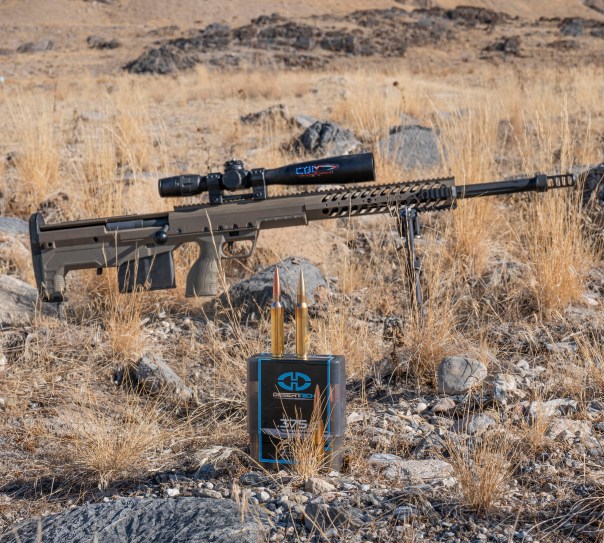
The Desert Tech HTI in 375 Cheytac is an excellent ELR rifle, matched here with a US Optics 25X scope

Okay, Maybe not that extreme

If your goals are perhaps a little more mainstream, and you don’t feel like spending $10-$20 every time you pull the trigger. Let’s talk about a better fit for you. Shooting a mile or less is much more common than it was even ten years ago. One of the reasons it has become so commonplace is the proliferation of the venerable 338 Lapua to so many affordable rifle platforms. But that’s not the cartridge I was about to recommend, I was about to say the 300 Norma Magnum. Why the 300 over the 338 you might ask? I’ll explain.

Click here to see the 300 Norma in elk hunting action

300 Norma ballistics when using high ballistic coefficient like those available today, will rival those of the 338 Lapua. There are pros and cons either way between the two, as far as barrel life, recoil, and even suppressors if that’s your thing. High quality bullets loaded in the 300 Norma make it a devastating long-range performer. Whether you are shooting targets, big-game hunting, or anything else. I prefer the more slender and faster fired bullets in the thirty-caliber as compared to the heavier and a bit slower thirty-three caliber bullets of the 338LM.

The 300 Norma will easily shoot to a mile and beyond, handily take down any North American animal. Additionally it has a huge selection of bullets and ammunition selections of the highest quality.

A Poor-Man’s 338 Lapua

Many years ago, before I had experienced both the 338 LM and 300 NM, I found myself in quite a quagmire. I wanted a new barrel for my Desert Tech SRS that would allow me to shoot comparable ranges to those cartridges (1700-2000 yards) , but I was but a common man.

I had nowhere near the money to feed a Lapua or a Norma, which is no small cost. Buying a barrel is one thing. But coming up with all the ammunition components needed to become proficient and shoot as frequently as I do is another entirely.  So I began a study to find a suitable replacement, a champaign cartridge on a beer cartridge budget so to speak. 

What precipitated from my numbers evaluation, was this; a very high BC bullet in the 7mm (.284) caliber is comparable to the BC of the bullets commonly loaded in the 338LM. So if I could get them up to comparable or better speeds, I would find myself shooting Lapua distances on  Remington resources. 

The 7mm SAUM

After some careful market evaluation, I was quoted a build for a 24″ 1-8 twist barrel chambered in the mighty 7mm Short Action Ultra Magnum (7SAUM). And before I knew it, my poor-man’s Lapua was in my hands.  I had done all my prep work before-hand, and I had loading components ready to go.

I ended up shooting the Sierra Bullets 183 Match King, which has a very high BC. My new barrel would launch them at a magnificent 3050 feet per second (FPS).  After spending a few seasons hunting with the 7SAUM, I was completely convinced I had made a good choice for the times. My SAUM shooting the 183’s actually shot flatter than the mighty 338 out to around a mile. The energy on impact wasn’t as high obviously but I wasn’t planning on hitting anything besides steel at those ranges. Even so, the SAUM retained more than enough energy to take down an animal as far away as 1000 yards, so I was certainly in good company.

The popularity of the 7 SAUM has waned some with the passage of time, another more popular choice with many of the same qualities is the 7 PRC

Two elk taken down by a single shot from the 7SAUM, at 900 and 500 yards respectively

Lets Get Common

Nothing I’ve mentioned above is particularly common, or very cost effective for your average shooter. Sharp marksmen have been shooting significant distances for a very long time with everyday cartridges like the .308 and 30 06. And with proper bullet selection and load development, you could certainly continue on that fine tradition. Or you could embrace something more contemporary.

Go ahead and light your torches, sharpen the pitchforks, and prepare your best effeminate insults because we’re about to use the “C” word. Just prior to the current ammo crisis, the 6.5 Creedmoor has infiltrated nearly every little ammo shelf across the country. And for good reason.

The 6.5 Creedmoor

The 6.5 CM offers 300WM ballistics with recoil and cost subordinate to even the 308 Winchester. There is an extremely high-quality components and ammunition selection for the 6.5, and its easy to load and shoot. There is so much to like about the cartridge, it begs the question why it is the subject of every sophomoric and unsophisticated insult the internet has to offer.

excellent Creedmoor performance can be had from a simple setup like this Ruger American Gen2 and Maven Scope

Personally I believe it to be its own worst enemy, unfledged shooters are easily tired of hearing how great the Creedmoor is. Especially since what they choose to shoot is obviously better because they chose it, at least that’s how they feel.
Do not discount the Creedmoor, it is what it was built to be; a great shooting cartridge for those first thousand yards. A great deer hunting cartridge, and anything similar to those two disciplines. It can be found nearly anywhere ammunition is sold, making it a strong contender on this list.

These 129 grain Cayuga bullets perform exceptionally in the Creedmoor, read more about them here

Out of Left Field

My tastes have changed, and my budgets matured, so I’d be remiss to omit my latest favorite. I wasn’t sure whether to put it in my list or not, due to the obscurity, but this is my list so I’ll do it my way.

Wildcats are a little different, like fingerless gloves at the range, or guys who wear fedoras. Wildcats if you didn’t know, are illegitimate children of the cartridge world, derived from other cartridges. They are either “necked up” or “necked down” and usually “blown out” to create a whole new cartridge. Many of our best cartridges were born this way, and to that list I add this one of my personal favorites.

The 257 Blackjack

The 257 Blackjack is a cartridge formed by shortening the SAUM case. Changing the shoulder geometry, and necking it down to twenty-five caliber. Simple enough, but the crown jewel of the cartridge is another very high BC bullet built by Blackjack Bullets (designer of the cartridge). The 131 grain bullet has a .340 BC, which is nearly untouchable by anything comparable in size and price. Nearly none of the 6.5 and 6mm bullets that would give the Blackjack a run for the money can. Especially when shot from the 257 Blackjack cartridge.

Blackjack has since closed, but the 131gr bullet is still made by Sierra.

From my 24” barrel the muzzle velocity is 3270 FPS, and with that impressive .340 BC you can imagine the extremely flat trajectory. There are also other high BC bullets available from Berger andHornady that have a predictably outstanding performance

tide we, ad, turkey,

This little short action cartridge will reach a thousand yards with less than 5 MRAD of elevation. And when it gets there it will still be packing well over a thousand pounds of energy and more than 2200 fps. It doesn’t go subsonic till well beyond two-thousand yards. Making it very competitive in the same ranges as the 338LM and 300 NM mentioned above.

My wife took this pronghorn doe with the 257 Blackjack, seen here with the US Optics FDN25X

Would I recommend the 257 Blackjack for long-range shooting? Not at the moment. The tediousness and dedication it takes to run a wildcat cartridge like this is probably more than most would care for. But should factory made brass become available, this would be a shoo-in for anyone interested. It is truly an amazing little cartridge.

Conclusion

So there you have it, my list of my top five long range shooting cartridges. You may take them or leave them, and you wont get any argument from me. Every shooter can decide what works best for his/her needs, and create their own top five.
The good news is that there are so many great choices. Despite my little list of cartridges, I could probably make due for the rest of my life with just a plain jane 308.

-CBM

Let us know in the comment section what your top five cartridges are