Tag Archives: scope

desert tech, WLVRN, us optics, fdn17x, blklbl bipod, rifle resting on bipod in front of cold winter mountains,

The US Optics Foundation 17X precision rifle scope

Preface

I love a good riflescope, one of the great things about having so many guns is getting riflescopes to go with them. The challenging optics market continues to push for the perfect scope, the one that has everything. Despite their best efforts, there are just too many eyes to please which leaves consumers to pick and choose the features that they find most useful. I say most useful, but there is also an associated cost with all these features. It is not uncommon to spend two to three times the cost of a rifle on the scope that goes with it. So there is a great deal of settling for when it comes to general consumers, for example choosing scopes in the 1000-1500 dollar range with similar features to a scope that costs twice that much.
I find myself lucky to live and work in a world that can help justify some of the best equipment available. And being a bit of a scope junkie, one place I enjoy some of the finest products is on the glass that sits on my rifles. I have used many of the best brands, but today as you might have guessed from the title we are looking at my latest purchase from US Optics.

Perfectly at home on an MPA competition rifle

The US Optics Foundation 17X

The Foundation series of riflescopes is US Optics premier line of US made sights. I’ve had several US Optics scopes over the years, last year was my first dip into the Foundation series with my Foundation 25X. And after running that scope hard for over a year now, swapping it between multiple rifles, and packing it all over the Rocky Mountains from here to nearly Canada. It has hit the top of my list, always keeping zero, and precise adjustments have kept me always on target. I’ve used it hunting everything from antelope on the plains of Wyoming, to the dark bears of Montana’s Kootenai Forest, and the elusive elk of the Uinta Mountains.
I’ve also been running 5-25’s for some years now, and I wanted to try something different. Particularly because I rarely use them on maximum power for anything other than inspecting potential targets, so the next obvious choice for me was the US Optics Foundation 17X.

us optics fdn17x
The FDN17X mounted to a Ruger RPR 6.5CM

The FDN17x uses the same 34mm tube as the other Foundation scopes, and at its heart is the ER3K turret above the erector. The third generation of the EREK system allows the erector to be adjusted with a center screw to the rifles zero, without moving the turret itself from its zero. This allows full turret rotation, and it also keeps all turret movement in the up direction from its stop. Unless of course I’m lost and barmy, in which case someone will be along to correct me in a few seconds.

The FDN17X has since ended up on this handsome Ruger M77, read more about that here

The objective lens on the FDN17x is a modest 50mm, slightly smaller than its bigger sibling. The windage is controlled with a capped US #1 windage knob, and it stays capped for the most part as I rarely dial any wind once I have a zero. Another standard feature of the Foundation series is the illumination, using a simple and single button to power up and select brightness settings. I can count on my fingers the times I’ve really needed illumination, but I can also tell you I never would have made those shots without it. Everybody has red illumination, so last time I ordered my FDN25X I selected green illumination. And this time around just to be different, I chose the blue illumination. I’ve yet to decide which of the three colors I like the best, but its nice to be given the choice. Other improvements of the Foundation line is a shorter throw on the magnification ring, where one-hundred-eighty degrees of rotation takes you from minimum to maximum magnification.

us optics
Another great option I added on to both of my Foundation scopes was the internal bubble level. It is cunningly placed in the eyepiece just out of the way enough that you need to look for it to see it. From the shooting position you can simply adjust the focus of your eye and see the bubble and its markings to ensure your rifle is level without ever breaking your eye from the target in the scope.

Perhaps one of my favorite options with the Foundation series is the reticle choices, and I usually choose the JVCR. It is a Christmas tree style reticle, with just enough going on to not distract my brain from doing its thing. Subtensions as small as .1 MRAD are part of the reticle, but much more prevalent are the .2 and .5 subtensions.
The JVCR like most modern reticles gives the user a superior ability to spot misses and correct for them. The FDN17X and its siblings are first focal plane scopes, which I prefer over the alternative. The reticle always reads true regardless of the magnification setting, which allows you to easily measure and correct for a miss. Whether you dial or hold for that miss depends entirely on your preference, depending on the size of the correction I will often do either. Good reticles like the JVCR allow you to do exactly that without getting so much information in front of your eye that you can’t focus, or worse yet you lose your impact in the noise around the reticle.
Before mounting the scope to an actual rifle, I ran it through a few scope tracking tests to double check turret values and repeatability.

Mounted up!

I mounted the FDN17X into one of my 34mm scope-mounts, and leveled everything up. Bubble levels aren’t perfect, but they certainly can give you a very close to level mark. I carefully torqued down the scope rings checking the internal bubble level on the scope to see that it matched the bubble on the scope-mount, and triple checked them both against another level.

adjusting the zero of the ER3K turret

Then it was time to get it mounted up on a rifle, or a series of rifles better said. This scope was likely going to be one of my switch-around scopes, jumping from one rifle to another (I go through a lot of rifles). The first rifle I mounted the scope to was a Ruger RPR 6.5 Creedmoor, a great little rifle to wring out this scope and ensure it functions properly. Using the provided tools, I adjusted the ER3K knob to zero using my bore-sighting method. And after firing a few shots to confirm, I reset the zero according to impacts. Aside from this very convenient method, there are other things to like about the ER3K turret. I love the firm stop at zero, unlike the mushy stops from cheaper scopes achieved by shims, this thing stops on a dime. The large size of the knob gives you a very precise grip, and as you turn the turret to zero it stops hard. The turret has twelve MRAD per rotation, which for most of my rifles will take them out to their usable limits.
Today I was only able to take this little Ruger out to nine-hundred and fifty-yards, plenty far for sure, but not even into the second rotation of the FDN17X. As I am accustomed, I made corrections using the JVCR reticle, and using it to measure target sizes.
The clarity and brightness of this scope is superb, watching leaves flutter on the distant ridge made wind estimating more simple. Even at nine-hundred and fifty-yards picking out the soil rolling downhill from my misses was visible, as was the occasional snow flurry floating between my target and I.

us optics fdn17x desert Tech MDRX
The FDN17X mounted to my Desert Tech MDRX

Another day brought another rifle, the FDN17X was destined to end up on one of my MDRX rifles. This one has just received the 6.5 Creedmoor conversion kit in it, with a twenty-inch barrel and the new Blk Lbl Bipod twenty-inch handguard installed. The beautiful Tungsten Cerakote of this scope didn’t exactly match the black of the rifle, but I’m okay with that.
I quickly reset the zero on the ER3K turret using the Allen wrenches, and in no time I was ready to go. The 6.5CM MDRX is not quite as accurate as the RPR was, but still plenty accurate for many purposes. In the snowy and cold desert of the Great basin, I picked out a small white rock across a long draw. It was five-hundred and fifty yards according to my rangefinder, so after consulting my drop chart for this rifle I dialed 3.7 MRAD elevation and began evaluating the cold wind. My estimates put my wind-hold right at .6 MRAD, which is real convenient to hold with the JVCR. To me there are few things more satisfying than first round hits, and watching that first round pulverize the rock into a bright dust-cloud was exactly that. I spent an entire afternoon picking out little targets at varying distances out to seven-hundred forty-five and nine-hundred yards. I find the offset two-tenths sub tensions of the JVCR very handy and quick to make sense, this is particularly handy when you shoot in wide open spaces and mountains where the wind switches direction faster than a politician.

note bubble level at bottom of scope

Am I wrong?

As I said in the beginning, it’s hard to make a perfect scope that fits everyone’s needs. But I’ve found that for my purposes, these Foundation scopes seem to fit me perfectly. I don’t know if that means US Optics just nailed it, or if I’m past my prime and simply content with what I’m used to. The ease of use with the ER3K elevation turret, the clear and bright clean images through the glass, and no need for an external anti-cant level make this scope very user friendly. And though I haven’t abused this one just yet other than smacking it into a few rocks, I have no doubt it will be as robust as the other USO scopes that I have abused thoroughly.

another custom Remington used with the FDN17X

This scope is already lined up to go on several other rifles, I look forward to a bright future shooting with it. The moderate magnification and size will fit perfectly into a well used portion of my gun collection, and more than likely it will see some killing come this fall.

-CBM

IPSC steel target at distance

When a 10th isn’t a 10th

Almost everything we do with a precision rifle involves a rifle-scope, whether it is target identification or adjusting for come ups and such. We have become so dependent on them that the idea of using iron sights on a precision rifle seems almost foreign or backwards.  Not that there’s anything wrong with that, but I spend a good portion of my time peering through scopes. But how many of us have stopped to think about that expensive miniature telescope we so carefully mounted to the top of our rifle?

Most of you are probably quite aware of the proper way to mount a scope, we take extreme care to ensure the scope is perfectly level, and properly torqued and such. But I’ll bet just as many of you have never done thorough testing of your scope to see if it does what it says it does. I hope you’re not scratching your head wondering what it is I’m talking about, but just in case you are, I’ll explain. Continue Reading here…

Sig Sauer Tango 6T

Introduction

Low Power Variable Optics (LVPO’s) have been flooding through the firearm market for years now. This is likely due to the proliferation of medium-range carbines. It didn’t take long for shooters to realize the value of variable low power optics, but what makes an LVPO shine over another?

Sig Sauer has long been a big name in the firearms industry.  I’ve been a big fan as long as I’ve been a gun owner. So it came as no surprise several years ago when Sig brought their own line of optics to market. What was a surprise, at least to me, was how invested I would get.

Sig Sauer Tango Riflescopes

My first Sig Sauer optic was a Tango 6 5-30. A high powered riflescope with all of Sig Sauer’s bells and whistles. It has been a great scope for several years, and still enjoys its place on one of my favorite rifles.

The 6T features Sig’s high quality, clear lenses for which they are well known. The 1-6 power 6T features a 30mm tube and a front focal plane 5.56/7.62mm/300 Blackout Horseshoe Dot ballistic reticle with illumination. There are a couple of different configurations for the 6T, the one I ordered came in Flat Dark Earth only. It also features a line lengthwise down the side of the tube. Which eases the scope’s mounting by giving a reference point. This allows users to evenly seat the scope in the rings. A “cattail,” or clamp-on handle, gives the user better purchase when adjusting the magnification setting.

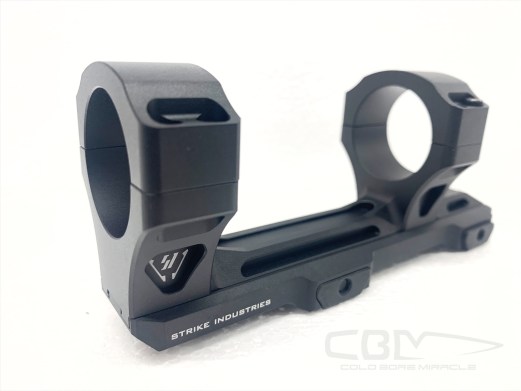
I mounted the Tango 6T in the Strike Industries ASM mount, an adjustable scope mount that can cantilever the optic out to several different positions. After mounting the scope, it was time to zero it — an easy task using the finger adjustable turrets. When not in use, the turrets are capped. I installed the CR2032 battery into the illumination turret and lit up the Horseshoe reticle. The 8-position rheostat has an off setting between each number and a push-pull lock to avoid accidental adjustment.

On the Range


My first impression on the range was the image. My eyes were swept from their sockets by the crystal clear and bright image. I am more of a 1-8 fan than a 1-6, but this 1-6 is so beautiful I would have a hard time turning it down for more magnification. The Tango 6T has parallax set to 150-meters, so shooting targets further out isn’t a problem.

This was very convenient because I ran the Tango 6T on two different rifles, both capable downrange performers. I first mounted the scope on the Armalite M-15 Comp Rifle, a match-grade competition rifle built specifically for 3-Gun. I found the M-15 to be very accurate, and with the Tango 6T mounted, it was a nearly unstoppable setup. The low power setting of the Sig made closer targets easy to engage accurately with both eyes open. Zooming in to 6X gave me enough magnification to pick out distant targets, while the Horseshoe reticle offered handy hold points for those distances.

I never expect ballistic reticles to match perfectly. It’s nearly impossible unless you are shooting the same ammunition in the same conditions as those who designed the reticle — the same goes for custom scope turrets. The good news is that it’s pretty close. Modern flat-shooting cartridges have a fairly similar trajectory so drop points on the reticle are close enough to be useful.

Read the full article on Guns.com

Round Two

After testing the Tango 6T on the Armalite, I moved it over to the Desert Tech MDRX. The MDRX is a multi-caliber rifle, and I shot it with both .223 Remington and 6mm ARC barrels. The Tango 6T felt right at home on top of my MDRX, a much more compact rifle than the Armalite. Maneuvering around obstacles for shooting positions was much easier, and regardless of how close or far away the targets were, the Sig provided a beautiful sight picture with bright images.

I keep bringing that up, but the optical clarity may be the part I like the most about this scope. There is more to the Tango 6T than just optical clarity, though. The engineers at Sig paid attention to so many little details like the texturing of control surfaces, high visibility green fiber optics markers around the magnification ring, and other little features that make you feel good about purchasing this scope. 

Shop Sig Sauer optics at Palmetto State Armory
Euro Optics Has the full line of Sig Sauer Optics as well

Turrets and Reticle

The turrets of the Tango 6T are 0.2 MRAD per click, which matches the MRAD reticle inside. The clicks are very clean and audible, and the grip surfaces inside the turrets are rubberized for easier grip, whether using gloves or your bare fingers. 

As far as the reticle itself, this might be one place where I wish they had put just a tiny bit more effort into it. Some people like a simple and clean reticle, while others like a reticle with many hold points to use. Being that I am a bit of a distance junkie, I find myself in the second camp. I like a reticle with plenty of hold-over positions, and accompanying wind holds as well. 

While the reticle in the Tango 6T is plenty useful, it wouldn’t have hurt my feelings to see a bit more detail to the reticle. That said, Sig also offers the 7.62 Extended Range reticle in this scope, which is better for that kind of shooting. I completely understand that most people might not need or care about this, and if you like just a few simple hold-over points, you will more than likely love this reticle.
 

Concluding Thoughts

In a market flush with many great options across nearly every price range, the Sig Sauer Tango 6T stands out as a spectacular LVPO. You would have to spend significantly more money to get a noticeably better scope with the same features. Not to mention, the Tango 6T is significantly better looking than scopes that are only 10 to 20 percent less on the market. At least, in my opinion, it would be worth spending a little bit more to step up to the Sig Sauer Tango 6T.

-CBM

Strike Industries Adjustable Scope Mount (ASM)

I go through a lot of scopes, not like you think though. I find myself constantly switching optics back and forth, from one rifle to another. One of the reasons I can getaway with it is because of quality scope mounts. And today I’d like to share a little bit about the latest one I have been fortunate to use. Today we are taking a look at the Strike Industries adjustable scope mount.

I mounted a Sig Sauer Tango 6 riflescope in the mount

That scope mount is from Strike Industries, a company I am well familiar with. They make all kinds of firearms accessories, the ASM is the first scope mount from Strike that I have used. The ASM is a 30mm set of rings, joined together as one billet piece of aluminum. It does come with ring reducers should you choose to mount a 1” tube scope. The base and rings are held together by a few screws, that also allows one of the paramount features of this mount. The rings can be slid fore and aft to use the mount either as a standard scope mount, or as a cantilever mount. The base of the mount features a recoil lug and two claw clamps to attach to the pic-rail of the rifle.

These features make this mount extremely useful, particularly if your like me and switching back and forth between rifles.
The design and style that comes with most Strike Industries products wasn’t lost on this unit, its clean lines and slender features make it both attractive and unlikely to snag on clothing or other gear.

I like that they used appropriate sized fasteners, some scope rings use insufficient screws that are easily stripped or broken. And I like that there are nearly zero exposed clamps, or screws and such to hangup on. This minimalist design style likely reduces the weight of the mount.

This scope mount is a handsome and useful piece of equipment, no matter which of its four positions you need, I think you will be very pleased with it.

-CBM

Shop additional scope mounts at Palmetto State Armory

US Optics TS8X

Low Power Variable Optics (LVPO’s) have been flooding through the firearm market for years now, likely due to the proliferation of medium-range carbines. It didn’t take long for shooters to realize the value of variable low power optics, but what makes an LVPO shine over another?

I’ve had several different models from a wide range of manufacturers, and today we will discuss in depth the US Optics TS8X.

The Tactical Sport 8 power LVPO is one of several great scopes I’ve been able to shoot in the offshore line of scopes from USO. So far they have proven to be a great option for shooters in my opinion. I have been shooting USO scopes for many years now, and to be completely honest I was a bit worried when I saw they were releasing a more affordable line of scopes. My concerns were quality and performance, for which USO’s are well known. My concerns were assuaged with the TS20x, which quickly became one of my favorites. The TS8X has so far been just as good an experience.

Why an LVPO?

I also have the TS6X, which is the little brother to the TS8x. I wanted the 8X because having used several 1-4’s and 1-6’s, I wanted just a little bit more power for seeing those downrange targets. Again in my opinion, a 1-8 or 1-10 is about perfect for a medium range rifle, for distances around six to eight hundred yards. The TS8X fit that spot perfectly in my estimation, and with the RBR Reticle, it would give me plenty of holdover points for shooting at those further distances.

Features

The TS8X features a 30mm tube, with adjustable diopter eyepiece, covered turrets, and an illuminated front focal plane reticle.
Many manufacturers have moved to the 30 or 34mm scope tube now, it gives a larger tube to pass light through, as well as allow a larger erector to increase the internal mechanical movement of the scope. The parallax is fixed for 100 yards, which leaves the diopter eyepiece focus the only adjustment for the image seen. This is common in most LVPO’s, particularly in this price range. If I had one wish for the TS8 it would be adjustable parallax, I frequently shoot well beyond 500 yards with this scope and others like it. The ability to adjust parallax for those distance targets would be very welcome.
Another feature that thankfully is becoming more commonplace, is the reticle placed in the front focal plane (second focal plane models are also available at a lower cost). This means the reticle is magnified with the power setting of the optic, keeping the reticle values always the same regardless of power setting.

The RBR reticle is illuminated red, with an adjustable rheostat for brightness. It also features both MRAD hash marks (both whole and half) as well as range based holdover points, including wind holds at five and ten MPH.

With the stiff competition in the LVPO market, the TS8X fits in the middle ground of price range. There are many options that are far less in price, and many others that cost double, triple, or more.
My initial concerns about quality were more based on mechanical performance and robust construction. I knew that due to its price point, it would likely not have the same optical quality as scopes costing more, which I was okay with.
Speaking of optical quality, I found the image to be bright, and clean. Not much to complain about there, but don’t expect to see the same image as a $1600-$2400 scope.
I found the RBR reticle to be very useful at distances out to nearly 1000 yards, at 8X it could possibly be a little thick for tiny targets, but I don’t expect many people will be doing benchrest or squirrel hunting at that range. For real world shooting, such as echo targets inside 600 yds, it is perfect. The rifle its currently mounted on will be doing some coyote hunting, and I’m very confident that anything inside 800 yards will be easily identified, targeted, and engaged using the RBR.
As I mentioned above, the reticle features both MRAD marks, as well as estimated drop and wind marks. This is handy, because if you need an honest elevation or wind call, you have the actual MRAD values. Whereas if your shooting at the aforementioned coyote, you can use the drop values according to how far away he is.

I mounted the TS8X on my Desert Tech MDR, which at the time was a sixteen-inch 223. The scope was easily zeroed with no tools, and in no time I was shooting steel all over the range.

The MDRX with the TS8X and YHM Turbo suppressor

I love using the scope at 1X, with the reticle lit up, it is just like using a red dot scope. Up close shooting at steel, animals, or whatever else is easily done with both eyes open. Cover the target with red as you break the trigger will give you sure hits.
I then switched out the barrel for the new Hornady 6mm ARC barrel, to see how the TS8X would match up to its ballistic curve.
Without even rezeroing the scope, I was in business, perhaps more a testament to the rifle than the scope. I later made a few corrective adjustments, and the rifle was punching centers very consistently. The click values of the turrets seemed to be close enough to values marked, but to be honest, I hardly had to move them.

us optics
Stretching the rifle out would require using the drop points indicated on the RBR reticle, I figured they would be close since the 6 ARC is not too far off of the 223 trajectory it is based on.
It was close enough to be dangerous that is for sure, at 960 yds I shot over the target. The 6 ARC has less drop than a 223 at that distance, so I held a corrected hold (7MRAD) and a bit of left wind for a perfect center punch hit.
I followed it up with a few more shots to confirm, inside I was giggling like a child watching the trace of my bullets on the way to the target.

I’m not sure if its the TS8X or just better optics that we are spoiled with today. When I first started shooting these farther distances, it seemed like 10X was barely enough, and 15-25 was more like what you needed for shooting long range. But I found shooting almost everything inside a kilometer to be relatively easy with the 8X of this little USO.
I recently took a LE Carbine LVPO course and was extremely happy with the way this little scope ran on the range. We engaged targets all over from 50 to 600 yards in every position you can imagine, I was able to use the wind holds to get some great hits on windswept targets boiling in mirage.
I guess the technology is catching up, soon one thousand yards will no longer be a long range benchmark. It will be more like medium range for drills at a beginners carbine class. If you find yourself on that spectrum, the US Optics TS8X will fill the need for a medium range optic. And it will do it without needing a signature loan to checkout, and you’ll still have the quality and guarantee US Optics has always put on their scopes.
-CBM

Riton Optics RT-S Mod 7 4-32X56

Riton Optics is a relatively new manufacturer of optics, since their start in 2013 they have been working in the Arizona heat to make affordable sighting optics without sacrificing quality.
My first encounter with Riton Optics came a year or so ago, when I put their RT-S MOD 5 6-24X50 scope on one of my rifles. I wasn’t sure what to expect as Riton was relatively new to me, but in a short time the scope’s performance had earned my praise. That same scope has been hauled all over these Rocky Mountains on my Tikka , dropped, snowed on, rained on, used as a crutch, and still maintains a perfect zero. Its no stranger to distance work, these past two seasons it has been used to take five mule deer and two cow elk from two hundred to eleven hundred yards. So I can say with pretty good certainty that these scopes are robust enough for western hunters. Today we will take a look at another Riton scope, the Riton Optics RT-S Mod 7 4-32X56.

The Riton Optics RT-S Mod 5 6-24X50 mounted on my Tikka T3 25 Creedmoor

I recently talked myself into one of Riton’s newer and bigger scopes, the RT-S Mod 7 4-32X56. The Mod 7 is definitely a step up in both price and performance from my Mod 5, at more than twice the price, the Mod 7 delivers quite a few more features to the optics aficionado. Both scopes are front focal plane (FFP), which means the reticle is magnified with the power adjustment. This feature allows shooters to use the reticle for accurate holdovers and corrections regardless of the magnification setting. The 8X zoom of the Mod 7 gives a substantial power range from 4X up to 32X, like many scopes, however, I found the very top end of the magnification (29-32x) to be too dark and aberrated to be very useful in the field. It was fine for shooting paper targets up close though.

The PSR reticle in the Riton Mod 7

The PSR reticle featured in my Mod 7 was also a significant step up from the Mod 5. I say step up, some might call it stepping out, the PSR reticle is a bit busier than some. It is a “Christmas Tree” style reticle, with a broadening grid of wind and drop values. I am growing more and more fond of these kinds of reticles, and this one is done very well. Subtensions are clearly marked (on the evens) so you can keep track of your holds, and the marks are thin enough to not bother your view of potential targets. A hollow center and .2 Mrad hash marks come in handy when doing long-range work. The illumination rheostat allows shooters to adjust reticle illumination to fit their surroundings.
Speaking of Mrad, the Mod 7 is available in Mrad which made me very happy. It was one of few complaints I had with my Mod 5, that it wasn’t available in anything other than MOA. Seems like most Riton optics are MOA, could be related to their military background, but I am glad to see newer products available with an Mrad option.
The Mod 7 has a 34mm tube, this again is a step up from the Mod 5’s 30mm tube. The bigger tube allows for more internal travel, giving the Mod 7 a total of 30 Mrad of elevation adjustment. That’s more than enough elevation for your average long-range shooter.

Turret details and throw lever on the Mod 7

Another feature I appreciated on the Mod 7 was the integrated throw lever on the magnification ring. Some call it a “Cat Tail”. You can run the scope with or without it, the throw lever gives you more purchase when trying to adjust the power ring, not a big deal, but a nice touch.
The Mod 7 also features a zero stop in the elevation turret, something the Mod 5 did not. This feature is handy, as you can return your elevation turret to zero without even needing to look at it. This will save you from a miss by being a rotation or more off.
One of the features both scopes have that I don’t like is there isn’t graduation marks on the turret housing to show which rotation you are on, to be fair it is much less of a problem on the Mod 7 because there are only two turns. The Mod 5 has several more, making it hard to be sure which rev you are on unless you keep track in your head.

I mounted the Mod 7 on my Desert Tech SRS A2 rifle, which seemed like a good fit for the scope. With the new hunting weight 6.5 Creedmoor barrel mounted in the rifle, I figured it would make a good companion for this years elk hunts.
But first I took the rifle to the range to get a good solid zero and check a few other things. My first impression with the Mod 7, was that the eye relief seemed to be just a bit touchy. Not so much as to be a problem, just more so than I was used to. I quickly zeroed the rifle and adjusted the zero stop per the instructions, easy enough and very functional. I then took the rifle up into the mountains to do some more testing at further ranges. I was very happy with the optical clarity of the Mod 7, even when looking at animals and trees at a mile or more away, it was a very clean and bright image.
As I mentioned earlier, the quality does degrade some at the very upper end of the scopes magnification, this is something I have noticed with most scopes including the Riton Mod 5. This is a phenomenon I have noticed on almost all riflescopes, but it is significantly less an issue as the price tag goes up.
It doesn’t bother me much as I rarely use a scope at its maximum power setting, for that matter I rarely use them above 60-70 of their maximum. The glass clarity of the Mod 7 is a great improvement over the Mod 5, as it should be at this price point.

The turrets on the Mod 5 have a push pull locking system, whereas the Mod 7 does not. I am torn a bit as to which I prefer, sometimes I like having my turrets locked, to avoid involuntary elevation changes. And other times I like just being able to turn the turret without having to unlock it. For hunting, I think I prefer the locking system, but for range or competition use I would prefer it without.
The turrets are plenty stiff so as not to be inadvertently moved, the clicks are plenty audible, though I would like them a tiny bit more defined. The line between too stiff, and to mushy a click is a hard line to walk sometimes.

As it turns out, I really enjoyed the throw lever on the magnification ring. To be honest I couldn’t describe the tension on the magnification ring, because with the throw lever it doesn’t even register.

It didn’t take long for me to get quite proficient shooting with the Riton Mod 7, so when the time came to put this rifle into action I was quite comfortable. The late season elk hunt had arrived, and I took my Riton topped SRS up into the snow covered mountains. The first shot I was given was some 475 yards away from a young cow, I dialed the 2.0 MIL on the Mod7’s elevation turret, and pressed the trigger. The cold and clean mountain air was visibly disturbed by my shot, I watched the trace cut through the bright image before me as I followed the shot in. I watched the cow drop, kick, and slide down the snowy slope.

The Riton Mod 7 has turned out to be a strong, clear, accurate and repeatable rifle scope. I look forward to using it more in the future.

-CBM

One of the five deer killed over two seasons using the RT-S Mod 5 6-24X50

US Optics TS20X Rifle Scope

Introduction

Im a sucker for scopes, you might say I have a weak spot for them. I have used most of the very best scopes, and Ive also used many that weren’t worth straining my eye to focus through them. Part of my affliction is due to being spoiled for some time now, and I blame US Optics for it, at least partially. I have had several of them over the years, and they have earned their keep in my safe. Today I bring you another review of the US Optics TS20X rifle scope.

US Optics has a history for robust builds, with nail driving strength. They have seen many changes over the years, and we could argue surely over the pros and cons. But for me, only one thing matters, whats on-top of my rifle, and how does it perform.

The USO TS20 mounted on my Desert Tech SRS A2

The TS20X

As a riflescope addict, I was interested when US Optics launched their Tactical Sporting line of scopes, the TS Series. Like any true addict I rested not until I had the TS 20 in my hands. It was love at first sight.

My initial impression of the TS 20 was its weight, it seemed light for a USO. This new TS line was clearly a more economical series of scopes, so I expected a simpler construction. Lightweight, and a very clear and clean image were both very welcome features. The JVCR reticle was new to me, and well received. I prefer the newer “Christmas tree” style milling reticles, and I found the JVCR to be very handy to use. The offset two tenth windage holds made perfect sense when hurriedly making a wind call. And like most good reticles, even numbering to keep track of your holds. With as many as ten mils to hold over, and five wide for windage, it makes a perfect companion for todays ultra-flat shooting rifles.

Another feature that impressed me very quickly was the focus/parallax adjustment, which is adjustable down to ten yards. At first I didn’t think it was a big deal, but when I dialed the scope down to 2.5X, I realized that this scope could almost be used like a red-dot. If I ever had any up close shooting to do such as approaching a wounded animal, I could simply turn on the illumination, and mark the target with the red cross and pull the trigger. This to me seemed like a very handy feature for a scope I would surely use while hunting. And yet with the max power of 20X from the scope, there are few things I would not be able to shoot at inside my distance envelope.us optics

US Optics has always helped me put food on the table

The turrets of the TS20 are ten MIL per revolution, that for me is a minimum. Long gone are the days of five MIL per turn scopes, that was so 2010. The clicks are clean, and you can both feel and hear them as you turn the turret. The TS20 has an interesting zero-stop feature, but it requires you to limit the rotation to one turn only. Not a big deal for many things, but since I like to live on the edge, I decided to pull any stops and run it wide open. One complaint if you’ll allow it, the turret housing isn’t numbered to help you keep track of what revolution you are on. Bit of a pet peeve of mine, but not a deal breaker by any stretch. The tension of the turrets, power ring, and focus knob were all just right, not too hard to turn, but stiff enough to avoid accidental movement while packing it around.
I already mentioned the parallax/focus adjustment, but just next to it on the left side of the scope, is the rheostat to adjust the illumination on the JVCR reticle. It’s your standard 1-10 clicks with an off position in between each setting. 10 is bright enough to use as a red-dot in dim daylight, and 1 is dim enough to use with night-vision and thermals.

A downed animal, as seen at 500yds through the TS20 and thermal. Notice JVCR reticle detail

With 24 useable MILS of elevation from its 34mm tube, the TS20 is a very useful long range tool. The rifle it currently commands only needs 5MRAD of elevation to get to a thousand yards. But even if you are shooting a 308 you wont have a problem getting way out there. But with it’s super low power setting, and 28 ounce weight, it is a good option for a long-range hunting rifle as well.

The TS20 mounted on my all carbon 257 Blackjack

Shooting with the TS20X

In the field the TS20 performed exactly like every other USO I’ve ever fielded. Click values were consistent, and lined up with my known ballistic data. I keep coming back to it so forgive me, but I love the high and low range of this scope. I never thought I would want a 2X precision rifle optic, but I sure am glad I have one now. In the field was the best place to see the value.
I am not huge on high magnification, I rarely use my scopes above 20X. So the TS20 is right in the middle of where I want all my X’s. Even at max power the image is still clear, and the reticle is very useful. Even so, I usually find my power ring somewhere between 10 and 15. It is at those medium settings that I find the optical magnification and reticle proportions to be ideal, both for targeting, and making corrections.

The USO TS20 played well with everything, especially this clip-on thermal

Shop all US Optics rifle scopes

I mounted the TS20 on three different rifles, first on my Desert Tech SRS A2, and then on my MDR. Regardless of which caliber I was shooting I had every confidence that the TS would keep up. Whether it was hunting varmints on the foothills around my home, or chasing big game like mule deer or elk through these big Rocky Mountains. I’ve never had to worry about my US Optics scopes while traipsing through the brush, and no amount of bumps, drops, or bouncing around in the bed of a truck has ever knocked them out of zero. The heavy recoil from my 300 Remington Ultra Mag didn’t phase the scope, and neither did the repetitive cycling of my 450 Bushmaster chambered Desert Tech MDRX, it just kept on ticking.

This young buck couldn’t escape into the dusk, not from this combo. 450BM/MDR/TS20

Final Thoughts

The Tactical Sporting Series of scopes from US Optics looks like it has a bright future. The scopes are well made, and fit a price point that opens the door to a less expensive market than historically available to those wanting US Optics products. The premium Foundation Series remains the flagship of US Optics quality, I may need to get one of those too, but for now I will enjoy the view from this little TS20.

-CBM

Sig Sauer Tango Riflescopes

Introduction

When a company like Sig Sauer jumps into the optics market, paying attention is a must. I was more than happy to get my hands on a couple specimens early on, and I was very happy with my purchase.
The Sig Sauer Tango line of optics is marketed towards precision shooters, long-range shooters, and hunters, as well as tactical marksmen in the LE/MIL community. I’ve been exposed to quite a few good optics in that realm, so I wanted to see how Sig stacked up.

For the purpose of this article, I will be comparing two of the Tango series of riflescopes. One is the Tango 4 which is a 4-16X44, the other is a Tango 6 5-30X56. The comparison will simply be an evaluation as these scopes are peers of different levels and price points.

sig sauer tango 6
The Tango 6 seen on my Desert Tech MDRX 6.5 Creedmoor


Sig Sauer Tango Riflescope Features


For starters, let’s look at the features they share, then we will look at them individually.
All Tango series scopes feature Sig’s HDX coated lenses for optimal light transfer, waterproofing, Lock-Down turrets, and one free laser-etched turret that is matched to your custom load data and atmospheric conditions.
Both the T4 and T6 are Front Focal Plane (FFP) optics, which means the reticle is placed after the magnifier inside the scope. This means the reticle will grow and shrink with the magnification setting. I prefer this configuration as it makes reticle usage more uniform, regardless of the power ring setting.
Both scopes are available with the MRAD/Moa milling reticle, or the Mrad/Moa DEV-L reticle, for those that prefer one system over the other.
The T4 and T6 also have the available MOTAC™ (Motion Activated Illumination) that initiates when motion is detected and shuts off when motionless.

The differences between the two scope are probably where most people are going to make a choice. The T4 is a 4X scope, and the T6 is a 6X, the T6 allows a wider choice of magnification from 5X all the way up to 30X. The T6 also has a larger diameter tube, it’s 34MM tube allows the T6 a greater internal adjustment range. To this larger tube is owed the 12 MRAD (30 MOA) per revolution of the turret. The slightly smaller T4 has a 10 MRAD (25 MOA) of adjustment per revolution of the turret. The 4X magnification on the T4 also gives it a shorter magnification range of 4-14, depending on your application these two different ranges of adjustment could make your choice for you.

sig sauer tango 4
The Tango 4 mounted to my Tikka T3 25 Creedmoor

The T6 that I purchased, also features Sig’s Level-Plex anti-cant system. It is a digital system that uses internal sensors to tell you when the scope is level or not. When engaged (by pushing the outer end of the parallax turret) there are two small illuminated arrows visible through the reticle. You simply adjust the cant of your rifle following the indicators, and when the rifle is level the indicators go dark, showing that the rifle is level. It is a simple and very quick to use system.

On the Range

sig sauer tango 6
Turret and other control detail on the Tango 6

Shooting the Tango 4 and 6 made me like them even more. The overall clarity of both Sig Sauer Tango riflescopes was very good, and the bright images made target acquisition and spotting hits and misses a piece of cake. Whether in the bright midday sun or in the waning light of evening, I found the scopes presented more than a satisfactory image.
I did find that for shooting groups that I really appreciated the 30 power magnification of the T6, and the DEV-L reticle provided very precise measurements for both corrections and wind holds. The simpler MRAD Milling reticle in the T4 was also very useful for those who might want a reticle that isn’t so busy. And the lower magnification of the T4 made it a great option for my hunting rifle. Lighter, smaller, and easier to quickly bring onto target.
The process of zeroing the scopes, and setting the zero stop was simple, quick, and effective. In no time I had them zeroed, and was dialing them up and down for distant shots. The Level-Plex system on the T6 proved to be very handy in the field, a simple push of a button engages it, and I never had to take my eye off the target. And it turns itself off after a few minutes. I also like the locking turrets on the scopes, raising them unlocks the turret for smooth rotation, and once set, you can push them back down to lock them in place and avoid accidental adjustments.
If I had to say I didn’t like anything about the scopes, it would probably be regarding the sliding up and down of the turret. I have no basis to prove this theory other than feel, but it seems that when the turret is raised it is not as firmly supported. It feels as if you were to knock it against something hard in the up/unlocked position it could be easily broken. Again, I have no evidence to prove that, it is just a simple observation. To be fair it feels rock-solid when it is down in the locked position.
Perhaps the only other gripe I have is likely a simple defect that is easily repaired. The two fiber optic illuminators that indicate the setting on the power ring seemed to be poorly mounted on my T6. One of them came out and was lost, not a big deal, but something worth noting. I usually don’t focus too hard on the actual setting of the magnification ring anyways, I just adjust it till it looks right to my eye, and shoot.

Conclusion

I think that both of these Sig Sauer Tango riflescopes are fantastic scopes, they definitely come in at two different price points so you can pick one the one that best fits your budget. The T4 at its $719.99 MSRP is a great competitor for the sub $1000 FFP Milling reticle scope market, I think it would compete very well against any scope in that group. The larger and much more expensive T6 MSRP $3,119.99 (as tested) is in another group altogether. I would say pending a few more hard trips into the rugged mountains, and it surviving the beating therein, I would put it against any scope in the 2k to 3k dollar range. The quality is there for sure, the only concern I have yet is with durability over time, but so far I have no reason to think it won’t
clear that hurdle as well. It is quite clear that the engineers at Sig Sauer took great care in every little feature, whether it is the griping surfaces of adjustment knobs, or something as simple as aesthetic angles and accessories. And with an unlimited lifetime warranty, you can confidently put one of these scopes to work today.

-CBM

Check out more optic reviews here